Piston Pump
Water raised by valve and piston
Plate
- 1Handle
- 2Spout
- 3Pump rod
- 4Leather cup seal
- 5Piston valve
- 6Foot valve
- 7Suction pipe
Anatomy
Loading the figure…
A piston pump moves water with a plug that slides up and down in a cylinder, between two valves that let the water pass one way only. Ctesibius of Alexandria is credited with the force pump, in the third century BCE; the suction pump, which draws water up from below, came into wide use in late medieval Europe and ended up on village wells all over the world.
What it is
A piston pump moves water with a plug that slides up and down in a tube, between two valves that open one way only. Such pumps have drained mines, fed fountains, fought fires and drawn water from wells for over two thousand years.
A suction pump, or lift pump, stands above the water and draws it up a pipe. A force pump sits in the water, or below its outlet, and pushes the water out under pressure. The plate shows a nineteenth-century suction pump on a covered village well.
How it works
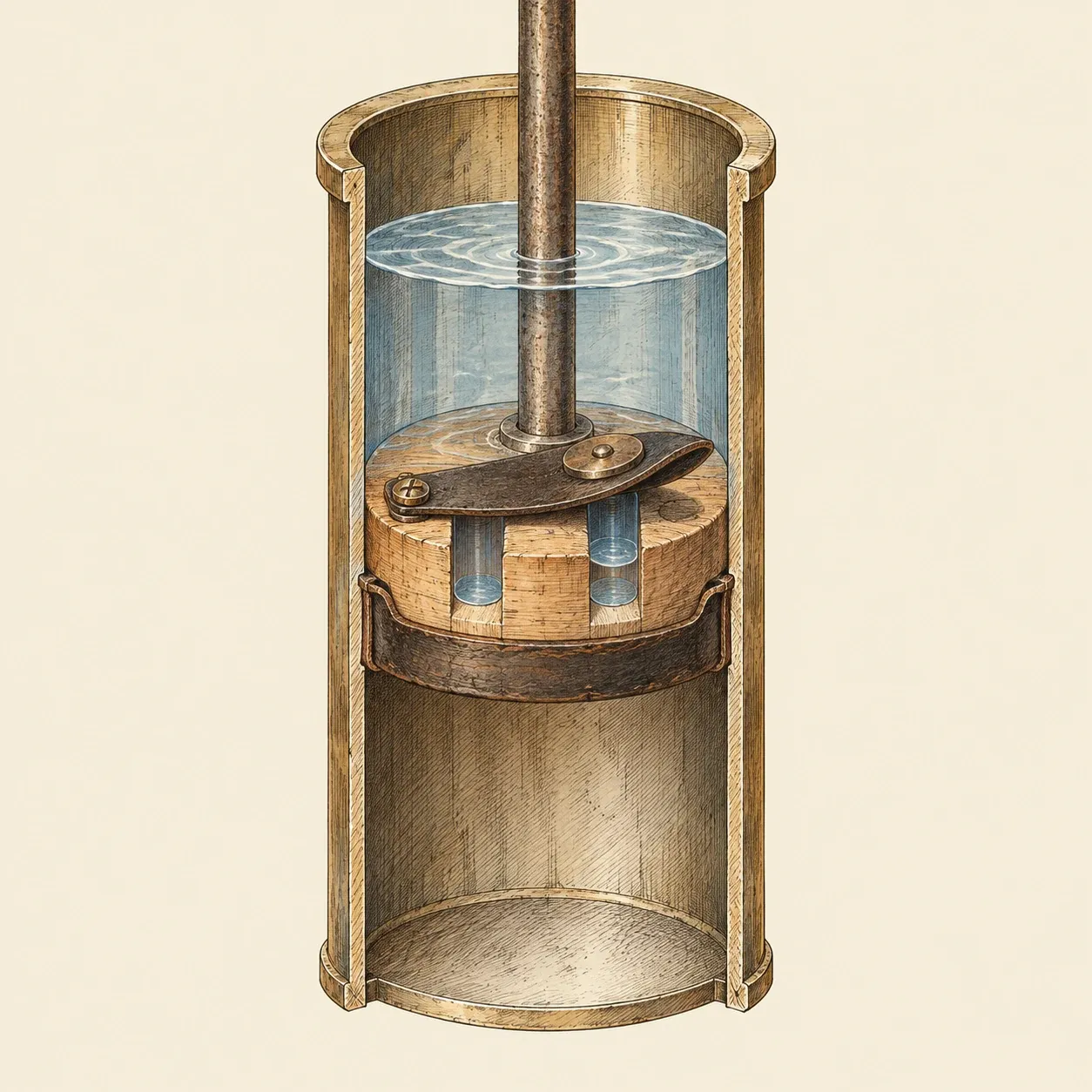 On the upstroke the water above holds the flap shut; on the downstroke it lifts and the water passes through.
At the bottom of the cylinder sits the foot valve, a flap of leather or rubber that lifts to let water in and drops back onto its seat. The piston carries a second flap over holes bored through it, and a leather cup round its edge. The cup opens upwards, so the water above presses it against the wall.
When the handle pulls the piston up, its valve stays shut and the water resting on it rises to the spout. Below the piston the pressure falls, and the air pressing on the well surface pushes water up the suction pipe and through the foot valve. On the downstroke the foot valve closes, the piston valve opens and the piston slips down through the water.
On the suction side the atmosphere does the work, and its push has a limit. At sea level the weight of the air balances a column of water about 10.3 metres high, or 76 centimetres of mercury. Leaks, friction and water boiling at low pressure keep a hand suction pump to about 7 metres, less in the mountains.
A force pump drives water out through a delivery valve, as high as the force applied and the pipes allow. Deep-well hand pumps put the cylinder below the water and work the piston with a long rod, so suction no longer sets the limit. Two cylinders worked in turn, or a double-acting piston that delivers on both strokes, even out the flow, and an air vessel on the outlet, where trapped air is squeezed and expands again, turns the pulses into a steady jet.
How to build
A small suction pump for a shallow well or rain tank can be made from plastic pipe, with the water less than about 6 metres below the cylinder, ideally 3 or 4.
Cylinder. Use 60 to 80 cm of smooth PVC pipe about 50 mm across, mounted upright, with a tee near the top as the spout. A narrower pipe runs from its base into the water. Every joint below the piston must be airtight.
Foot valve. Close the bottom of the cylinder with a plug drilled with a hole about 2 cm across. Lay a disc of leather or inner-tube rubber over it, screwed down along one edge as a hinge and weighted with a washer.
Piston. Cut a plug of hardwood or plastic slightly smaller than the bore, drill holes through it and cover them with a similar flap. Clamp a cup of thick leather or rubber below it, rim turned upwards and centre cut away so the holes stay open. Soak a leather cup before fitting it. A rod joins the piston to a lever about a metre long, pivoted on a post.
Prime and maintain. Pour a cup of clean water into the cylinder to wet the cup and seal the valves, then pump. If it loses its water overnight, check the foot valve.
Safety. Never leave a well open: cover it with a slab or a lid an adult can stand on, and keep children away. Never climb down a well, where the air may lack oxygen. Keep fingers clear of the pivot. Seal the pipe through the cover, slope the ground away and keep latrines and animals far off. Prime only with water safe to drink, since it runs into the well. Leather, inner tube and ordinary plastic are not made for drinking water: keep this pump for garden or washing water unless every wetted part is certified for drinking water. Do not drink from a well until a test has shown it safe; boiling kills germs but does not remove chemicals.
History and evolution
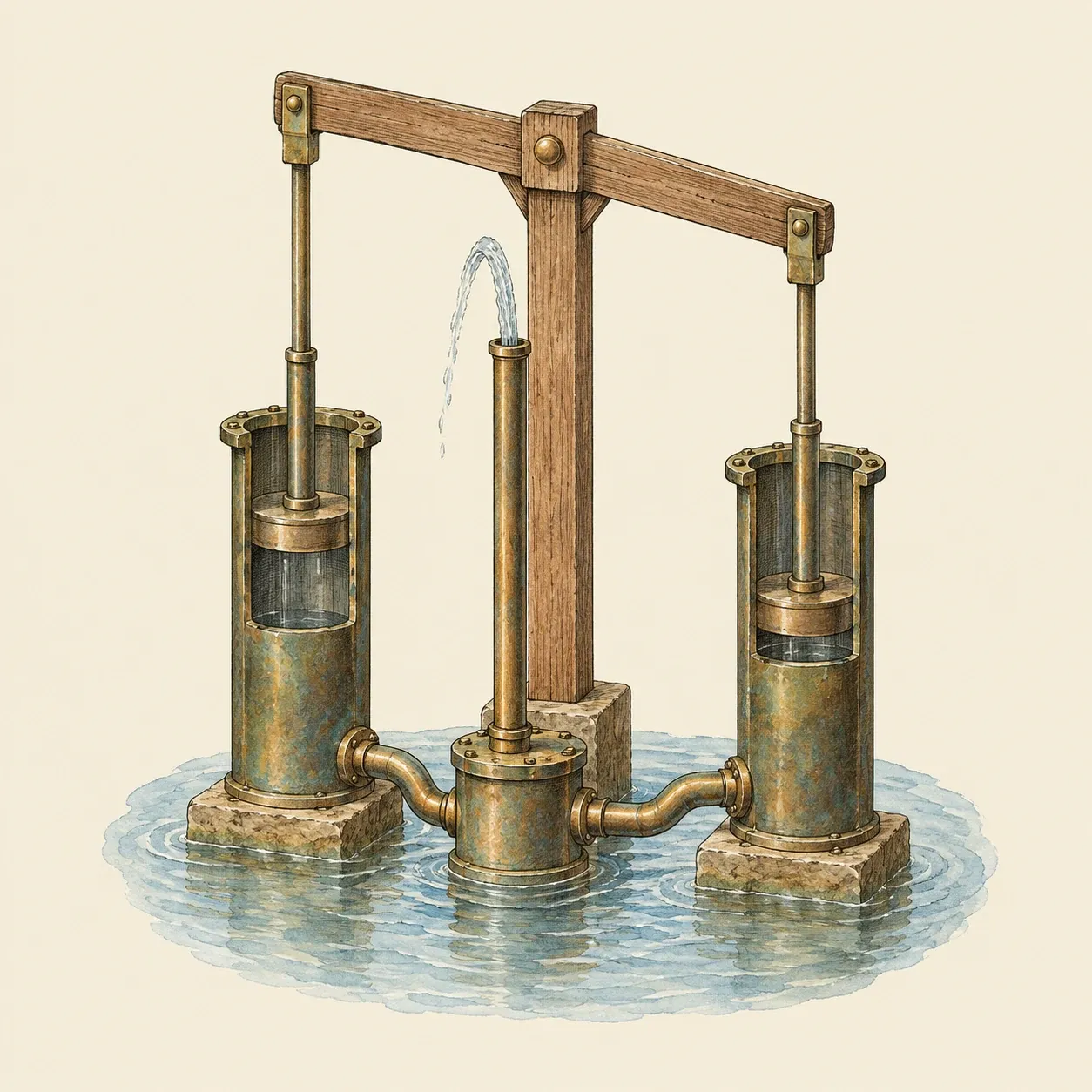 The pump of Ctesibius as Vitruvius describes it: two bronze cylinders working in turn and feeding one upright pipe.
Ctesibius, an engineer in Alexandria around 270 BCE, is credited with the force pump. Vitruvius described its bronze cylinders and valves about 25 BCE. A 2007 census by Richard Stein counted thirteen Roman metal pumps, mostly bronze, and eighteen wooden ones cut from oak blocks, most of them found in wells; one, from Silchester, is in Reading Museum.
Around 1206 al-Jazari described a pump driven by a water wheel, with two opposed pistons and true suction pipes. Suction pumps reached European mines in the late Middle Ages. In 1556 Georgius Agricola described sets of three pumps one above another, each with about seven metres of pipe, lifting into a tank for the next.
In 1638 Galileo reported that no suction pump could raise water more than eighteen braccia, about 10.5 metres, and thought the column broke under its own weight. His pupil Torricelli found the cause in 1644 (some accounts say 1643): mercury in a glass tube stands at about 76 cm, held up by the weight of the air. In 1648 Pascal had his brother-in-law carry the tube up the Puy de Dôme, where the mercury stood about 8.5 cm lower.
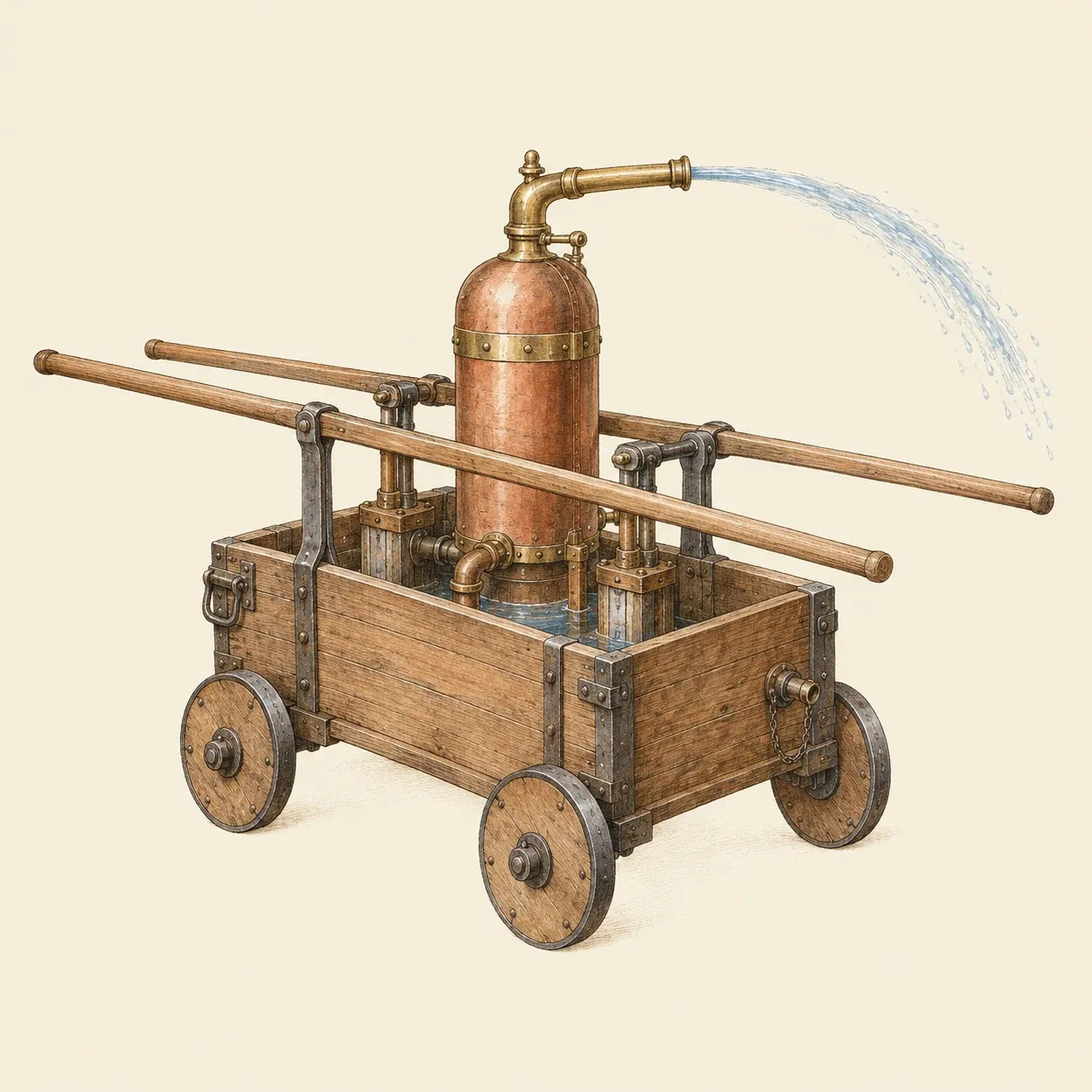 A fire engine of Newsham’s type: two pumps worked by long handles, and an air vessel that keeps the jet steady.
In London, Richard Newsham patented a fire engine in 1721 whose two pumps fed an air vessel for a continuous jet. For mines, Thomas Newcomen had built his first steam engine near Dudley in 1712 to work their pumps. In India, a UNICEF review in 1974 found that three quarters of the wells drilled over the previous seven years were not supplying water. UNICEF, the government and the firm Richardson and Cruddas then developed the India Mark II, with its cylinder down the borehole, able to lift water from 50 metres. Millions are in use, and it has been exported to more than 40 countries.