Water Turbine
Falling water turned into electricity
Plate
- 1Penstock
- 2Spiral case
- 3Guide vanes
- 4Runner
- 5Draft tube
- 6Governor
- 7Generator
Anatomy
Loading the figure…
A water turbine is a bladed runner that water under pressure drives at high speed, either inside a closed casing or from a jet. It takes energy from a fall of water, like the water wheel, but in a far smaller and faster machine, and since the 1880s it has driven the generators of hydroelectric plants.
What it is
A water turbine is a wheel of curved blades, the runner, driven round at high speed by water under pressure. Like the water wheel, it draws energy from water falling from a height. But an overshot wheel turns in open air under the weight of the water in its buckets, and an undershot wheel under the push of a current, at a few revolutions a minute. A turbine is fed through a pipe and turns tens or hundreds of times faster, so a much smaller machine handles the same power.
Its speed lets it drive an electric generator with little or no gearing. Almost every hydroelectric plant uses one of three designs: the Pelton wheel, the Francis turbine or the Kaplan turbine.
How it works
In an impulse turbine a nozzle turns the whole pressure into a fast jet and the runner spins in air. In a reaction turbine the runner is enclosed and full of water, and the pressure drops between its blades, which act like curved wings.
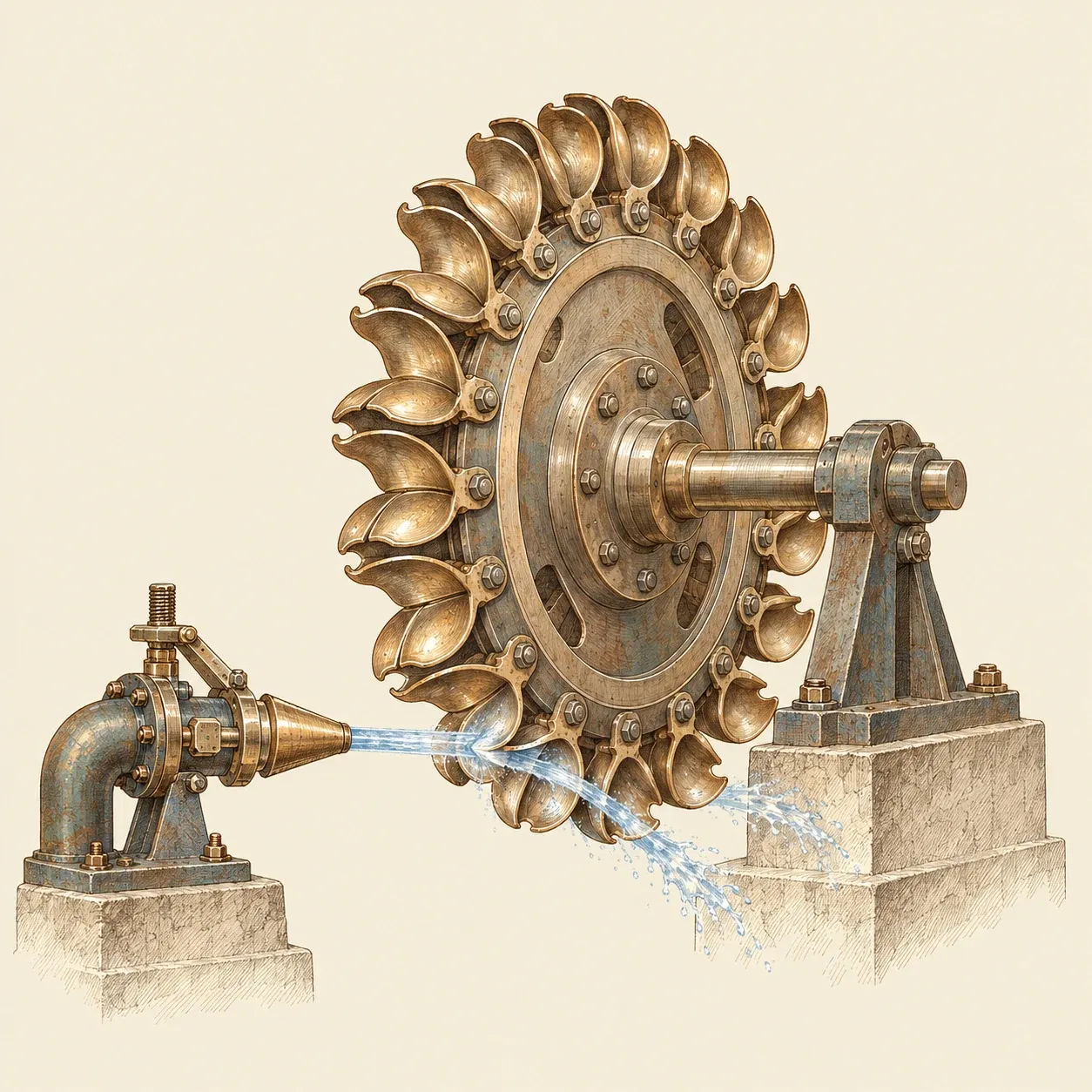 The ridge in each bucket cuts the jet in two and turns both halves back.
The Pelton wheel is an impulse turbine for high falls and small flows. A ridge splits each bucket, cuts the jet and turns each half almost straight back. The Francis turbine, a reaction machine and the most common type, covers the middle range, roughly 40 to 600 metres of fall. The Kaplan turbine, a propeller whose blades turn on the hub, serves low falls and large flows, below about 80 metres.
The plate shows a Francis unit. Water comes down the penstock (1) into the spiral case (2), which narrows as it wraps round the machine so that water enters evenly from every side. The guide vanes (3) set it swirling and control how much passes. It flows inwards through the runner (4) and leaves downwards through the draft tube (5), a flared pipe that slows it gradually and recovers part of its remaining energy.
The power available is P = ρ·g·Q·H·η: water density ρ (about 1,000 kg/m³), gravity g (9.81 m/s²), flow Q in m³/s, net head H in metres and efficiency η. With 100 metres of head, 0.2 m³/s and 85% for turbine and generator together, P = 1,000 × 9.81 × 0.2 × 100 × 0.85 ≈ 167 kW. Large Francis turbines exceed 90% on their own.
The generator (7) sits on the same shaft, and its frequency follows its speed. The governor (6) holds that speed steady by closing the guide vanes when the shaft speeds up and opening them when it slows. It must act gradually: closing a long penstock suddenly causes water hammer, a pressure surge that can burst the pipe. At 100 revolutions a minute, a generator needs 60 poles to give 50 hertz.
How to build
A wheel of spoons fed by a garden hose from a stream can light a bicycle lamp. Ask the landowner and the water authority first: in most countries taking water from a stream needs permission.
Measure the head. Lay a hose from the intake down to where the wheel will stand, hold its upper end under the water and let it run until no more air comes out. Then close the lower end with a pressure gauge: each bar of static pressure means about 10.2 metres of head. A builder’s level and a staff, moved downhill from one marked point to the next, give a check.
Measure the flow. For a trickle under about 5 litres per second, lead it through a pipe in a small earth dam and time how long it takes to fill a bucket. For a larger stream, time a float over 10 metres, multiply the speed by about 0.85, then by the width and the mean depth.
Work out the power. With 8 metres of head and 0.3 litres per second in the hose, the water carries P = 1,000 × 9.81 × 0.0003 × 8 ≈ 24 W. The hose and nozzle waste part of the head, and a home-made wheel and dynamo turn only a modest share of the rest into electricity. Expect a few watts, perhaps enough for a 3-watt bicycle dynamo, and measure what you really get. Leave most of the stream to the fish.
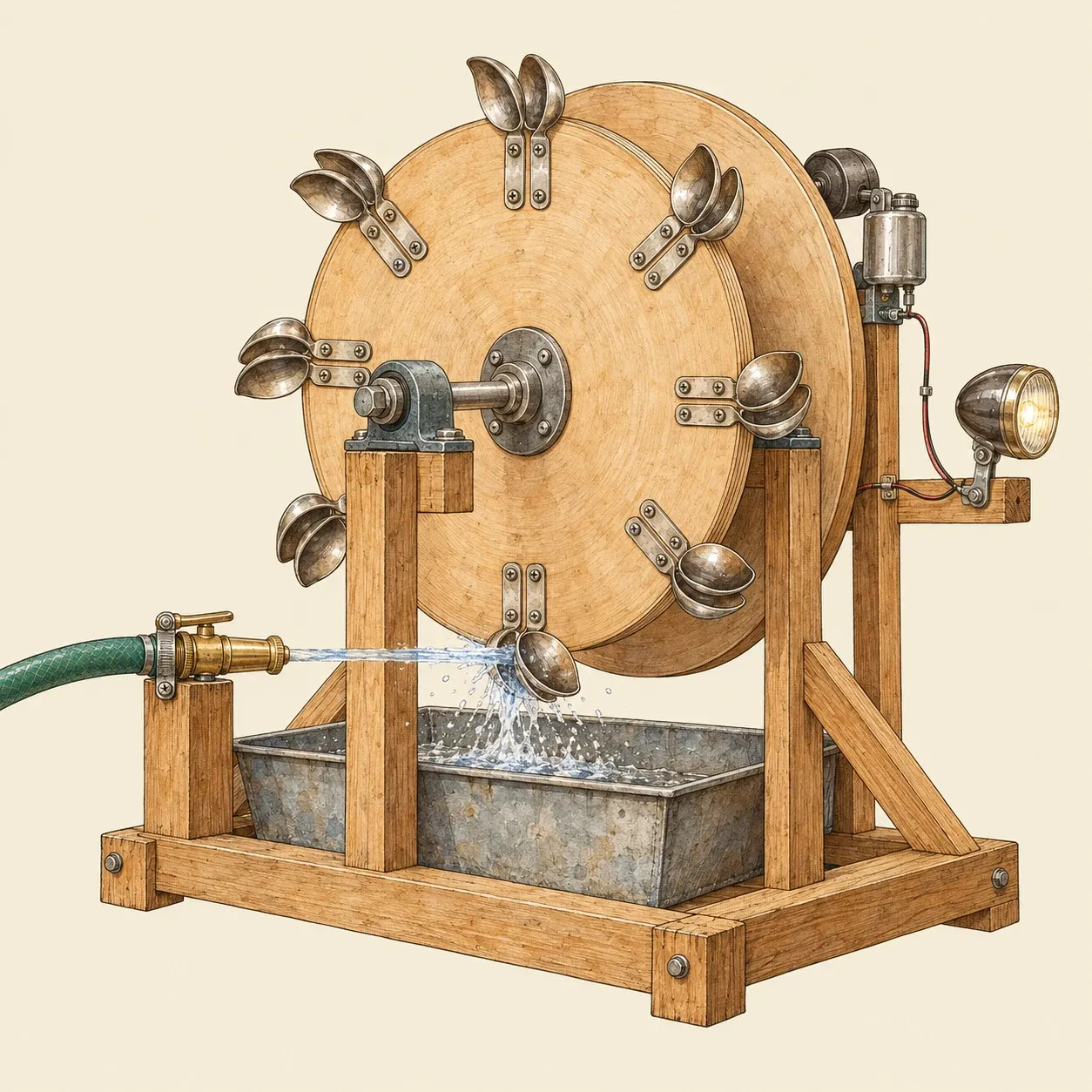 Paired spoons make a rough split bucket for the jet.
Make the runner. Fix a plywood disc about 30 cm across on a steel axle turning in two bearings. Screw eight to ten pairs of tablespoons round the edge, side by side, their bowls standing out beyond the rim, turned to face the jet and meeting in a ridge.
Aim the jet. Clamp a jet nozzle on the hose so the jet strikes the ridges tangentially. Without losses it would leave at 12.5 m/s; with hose friction, about 10 m/s is more likely. The spoons work best at half the jet’s speed, measured on the circle where the jet strikes them: about 270 revolutions a minute if that circle is 35 cm across.
Add the dynamo. Fix a second, smooth disc about 35 cm across on the axle and press the roller of a bottle dynamo against its edge. At 270 revolutions a minute that edge moves like a bicycle tyre at about 18 km/h. Run two insulated wires to a bicycle lamp: on a bicycle the frame carries the return current, here a wire must. Lead the water back to the stream below the wheel.
Safety. Never work alone by a stream, and stay out of it when it runs high: fast, cold water knocks people over and drowns them. A hose 8 metres down a slope holds almost one bar. Open and close long pipes slowly, because a sudden stop causes water hammer that splits fittings. Keep eyes and fingers out of the jet, guard the runner and stop the water before touching it. Insulate every connection and keep fingers away from the dynamo roller as well. Larger generators reach dangerous voltages: never connect one to a building’s wiring.
History and evolution
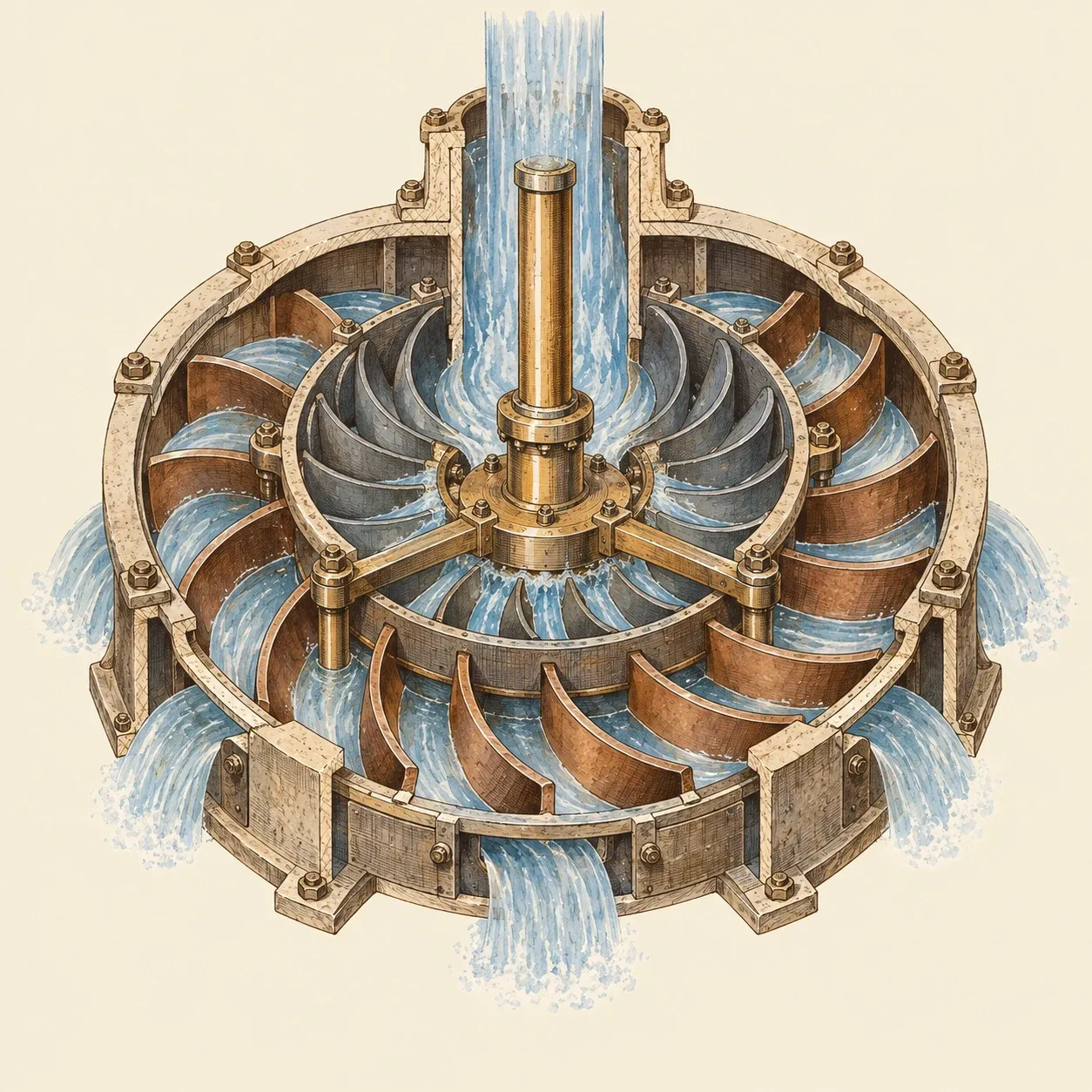 In Fourneyron’s turbine the water flows outwards, from fixed vanes into the moving ring.
In 1825 Claude Burdin, a professor at the Saint-Étienne mining school, built a turbine at Pontgibaud with an efficiency of 67%. His former student Benoît Fourneyron made it industrial: in April 1827, at the ironworks of Pont-sur-l’Ognon, he installed a six-horsepower turbine under a 1.40-metre fall.
At Lowell, Massachusetts, in 1849, James B. Francis built an improved inward-flow turbine and published his tests in 1855. In the California goldfields Lester Pelton built his first wheel in 1878 and patented the split bucket in 1880.
In 1878 Lord Armstrong lit his house at Cragside, in Northumberland, with arc lamps powered by water from the estate’s lakes. A plant at Appleton, Wisconsin, supplied direct current from 30 September 1882. In 1895 the Adams station at Niagara Falls started Westinghouse generators of 5,000 horsepower giving alternating current on Nikola Tesla’s system; from November 1896 its power reached Buffalo. Viktor Kaplan filed his patent for adjustable runner blades in 1913, and the first industrial Kaplan turbine ran at Velm, in Austria, in 1919.
The world had 1,412 GW of hydropower in 2023. China’s Three Gorges Dam alone has 22.5 GW, and about 1.3 million people were moved for its reservoir. Dams block migrating fish and trap sediment: a study published in 2019 found that only 37% of the world’s 246 longest rivers still flowed freely along their whole length.