Cipher disc
Two turning alphabets that change the key
Contents
- 1Fixed outer disc
- 2Ring of 24 plaintext cells
- 3Movable inner disc with its 24 cipher cells
- 4Central pin
- 5Index mark on the movable disc
A cipher disc is a pair of lettered rings, one fixed and one turning on a common pin. Each setting of the inner ring gives a different substitution alphabet, so the writer can change alphabets in the middle of a message. Leon Battista Alberti described the device in Rome in 1466–1467.
What it is
A cipher disc replaces each letter of a message with another letter. It is made of two discs of different sizes, laid one on the other and held by a pin through their centres. The rim of each disc is divided into the same number of cells, so that every cell of the large disc faces one cell of the small disc. The large disc carries the plain alphabet in its usual order. The small disc carries the cipher alphabet in a mixed order and turns on the pin.
In any one setting, each plain letter faces one cipher letter, and that setting is a complete substitution alphabet. Turning the small disc by one cell gives a new alphabet, so a disc of 24 cells holds 24 of them. Sender and recipient need identical discs and must agree on how they will set them. Alberti cut his discs from metal sheet; later ones were often of card or paper. A turning grille moves the letters of a message around, while a disc changes the letters themselves.
How it works
Alberti’s disc had 24 cells on each ring. The fixed ring held 20 capital letters in alphabetical order, without H, K, J, U, W or Y, followed by the numerals 1 to 4. The movable ring held 24 small letters set down at random, including h, k, y and the sign &. The two correspondents agreed on one letter of the movable ring as the index, for example k.
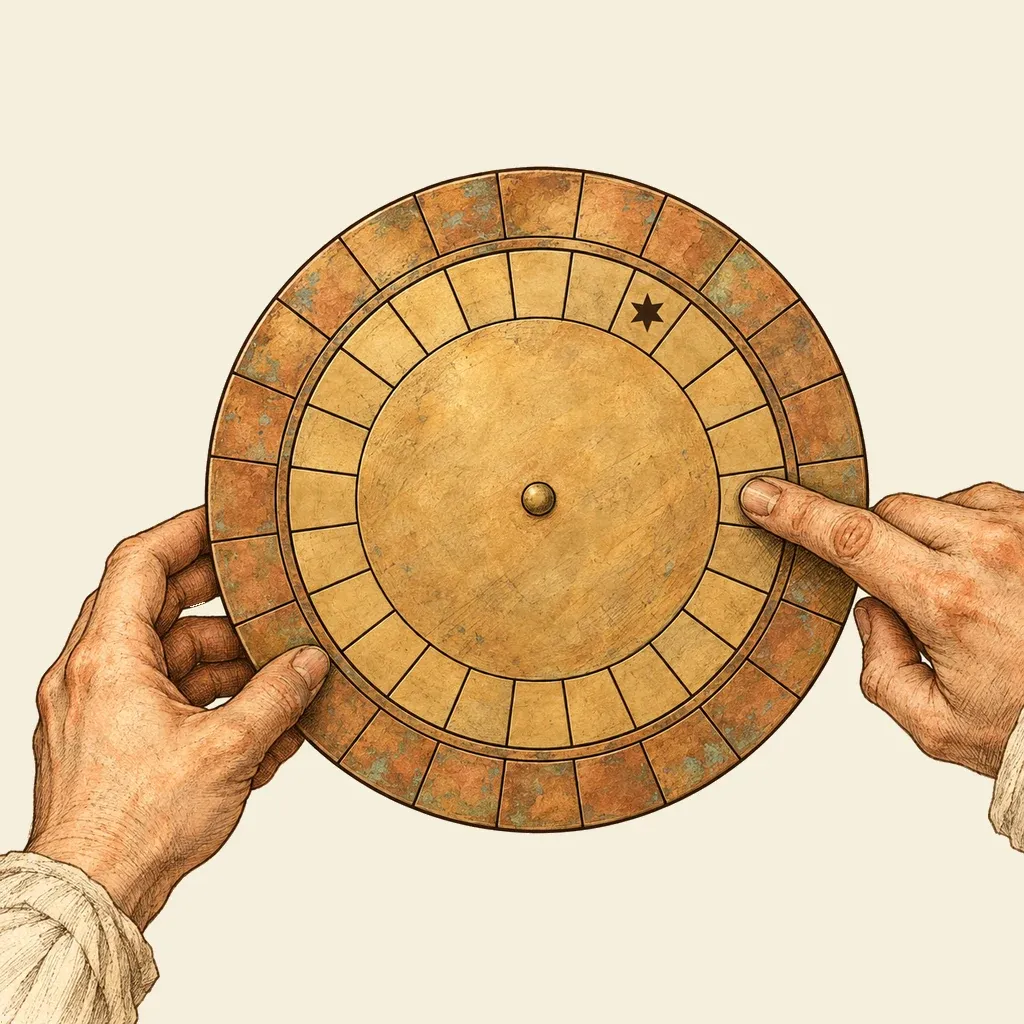 Turning the small disc on its pin brings the index under another capital.
To begin, the sender turned the disc so that k stood under a chosen capital, say B, and wrote that capital as the first sign of the message. Each plain letter was then found on the outer ring and replaced by the small letter beneath it. After a few words the sender turned the disc to bring k under another capital, say R, wrote R into the text and carried on with the new alphabet. The recipient set an identical disc the same way each time a capital appeared, and read each small letter back to the capital above it.
Changing alphabets disguises the frequency of letters. With a single alphabet, the commonest letter of the language always gives the same cipher letter, and a patient reader can count letters and guess. With several alphabets, one plain letter turns into several different cipher letters, and one cipher letter stands for several plain ones.
The numerals had two uses. In Alberti’s example the cipher letters found under them were nulls, dropped into the text to break up the words. The numerals also wrote a code: groups of two, three or four of the digits 1 to 4, which give 336 groups, each standing for a phrase agreed in advance. Every digit was enciphered by the small letter facing it. The movable ring carries no numerals, so the code groups looked like any other cipher letters.
How to do it
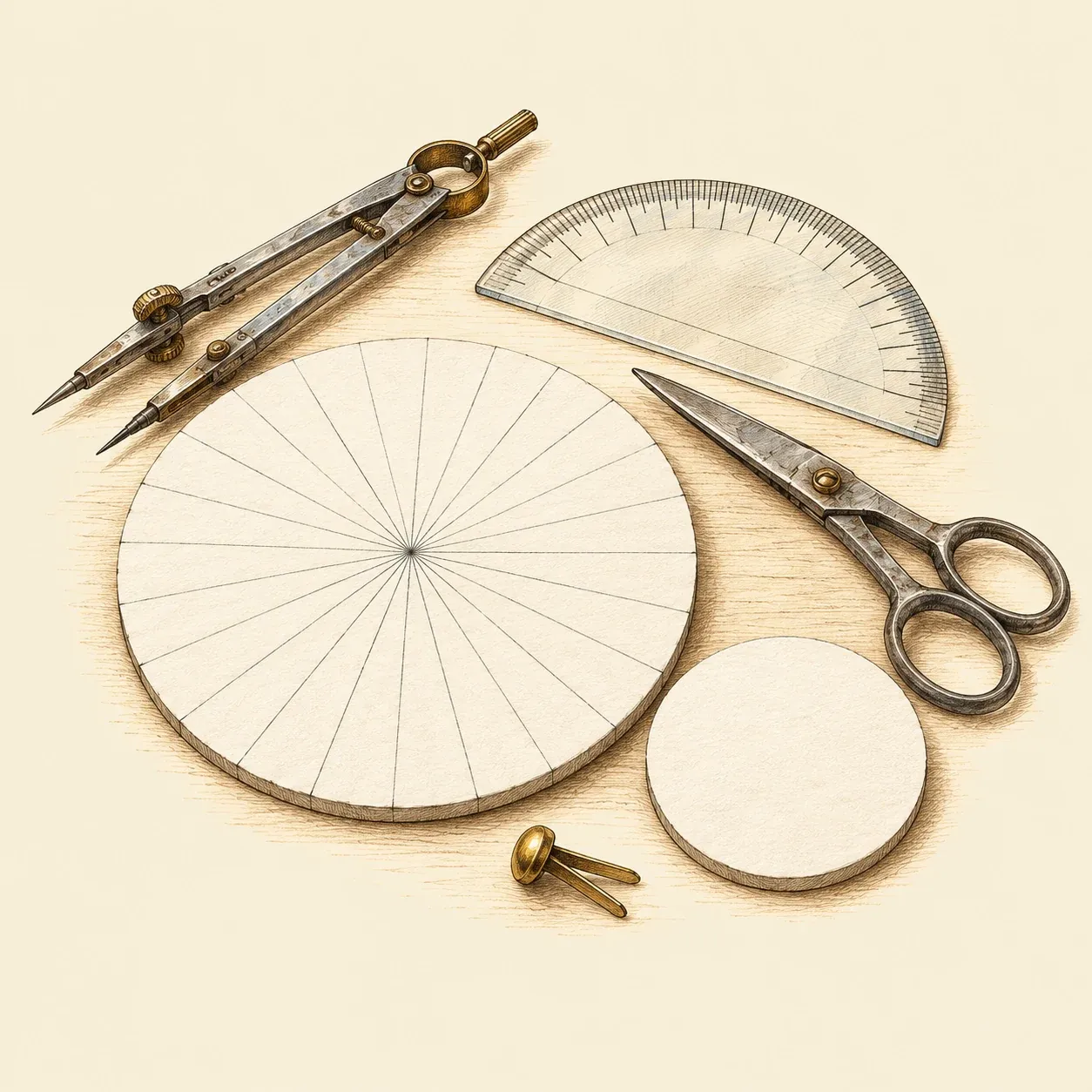 A pair of compasses, a protractor and a paper fastener are enough to make a working disc.
Draw two circles on stiff card with a pair of compasses, one 12 cm across and one 10 cm across. Inside each, draw a second circle about 2 cm from the edge to mark the ring of cells. With a protractor, divide both rings into 24 cells by drawing lines from the centre every 15 degrees. In Alberti’s time I and J, and U and V, were each written as one letter; treating them the same way leaves 24 letters, one per cell. Write them in alphabetical order round the large disc.
For the small disc, write the same 24 letters on slips of paper, shake them in a cup and draw them one at a time, writing each into the next cell. Make a second pair of discs for your correspondent and copy the mixed order exactly. Mark one cell of each small disc with a small star: this is the index.
Cut out the discs, lay the small one on the large one and push a brass paper fastener through both centres. Turn the small disc and check that the lines of the two rings meet all the way round. Agree with your correspondent on the starting capital and on how often the disc will be turned. Cut on a board with the blade moving away from your fingers, and mind the point of the compasses. A disc of this kind shows a historical method and gives no real protection to a confidential message today.
History and evolution
Leon Battista Alberti, a scholar and architect at the papal court in Rome, described the disc in a short Latin treatise known as De componendis cifris. He wrote it after a conversation on ciphers with Leonardo Dati, a papal secretary, between 1466 and August 1467. The treatise circulated in manuscript and was not printed in the fifteenth century. No older cipher disc is known. The historian David Kahn has suggested that Alberti took the idea of turning rings of letters from the combining discs of the thirteenth-century philosopher Ramon Llull, which joined concepts rather than hiding words.
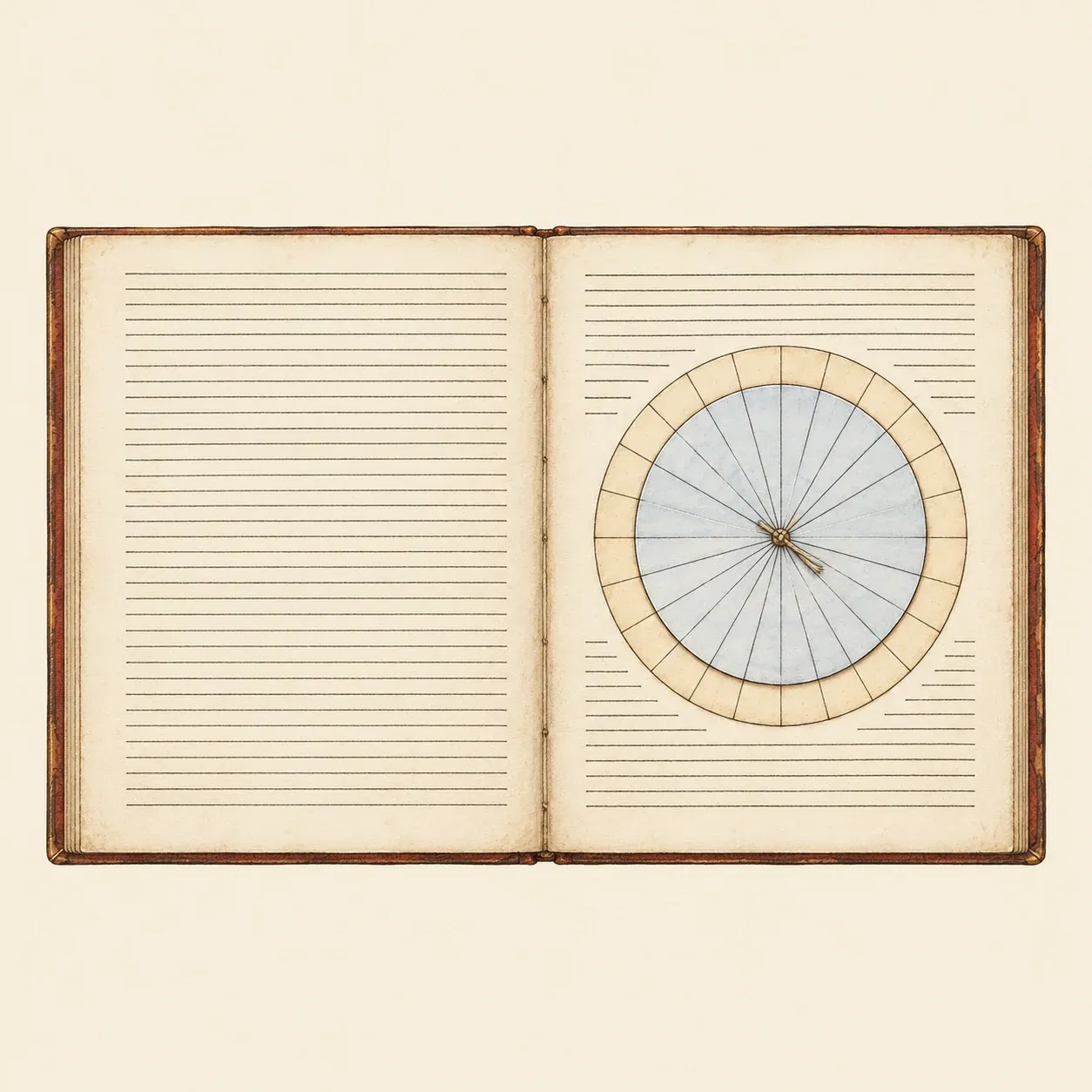 A paper volvelle sewn to the page of a sixteenth-century book on ciphers.
Printed books on secret writing later gave their readers paper discs, called volvelles. A disc was cut out and fastened to the page with a thread, so that it turned inside a ring printed on the page. Giambattista della Porta’s book on ciphers, in its London edition of 1591, has three of them. Each copy had to be finished by hand, and some owners never cut the discs out.
During the American Civil War, Union signal stations used discs of brass or card devised by the army surgeon Albert J. Myer. One disc carried letters and the other combinations of numerals, which the signallers sent by waving flags, so that a letter A could go out as 81. Turning the disc changed the code.
In the nineteenth century, cryptanalysts such as Friedrich Kasiski and Auguste Kerckhoffs published methods for solving ciphers whose alphabets come back in a fixed cycle, as they do when a disc is turned by a short repeating key. In the twentieth century, wired discs turned by machine after every letter took the principle much further in the rotor cipher machine.