Rolling Mill
Two rolls turning in opposite directions that squeeze metal thinner and longer
Contents
- 1The two rolls
- 2Iron housing
- 3Screw that sets the gap
- 4Pair of gears coupling the rolls
- 5Crank
- 6Strip, thicker going in than coming out
A rolling mill makes metal thinner by squeezing it between two rolls that turn in opposite directions. The metal loses thickness and gains length, and a set of screws fixes the gap between the rolls. Leonardo da Vinci drew a hand-cranked mill for rolling tin in a notebook of about 1497, and the Paris mint was rolling coin metal by 1551.
What it is
A rolling mill is a machine that makes metal thinner by passing it between two rolls. The rolls are smooth cylinders of hard metal set one above the other, with a gap between them a little narrower than the piece going in. They turn in opposite directions, grip the metal and draw it through, and it comes out thinner and longer. Repeated passes, with the gap closed a little each time, turn a thick bar into a plate, a sheet or a foil.
Two upright frames called housings carry the rolls. Each end of a roll, the neck, turns in a bearing block that can slide up and down in a window of the housing. Screws through the top of the housings press down on the blocks of the upper roll and set the gap. A pair of gears of the same size couples the two rolls so that they turn at the same speed and in opposite directions, and a crank, a waterwheel or later a motor turns one of them.
A rolling mill gives a sheet the same thickness over its whole length, which is hard to obtain with a hammer. Mints used it to prepare the strips from which coin blanks were cut, ironworks to turn bars into plate and rod, and jewellers still use small hand mills for silver and gold sheet. Its rolls and their gears carry large forces, so the frame has to be stiff and the bearings well greased.
How it works
The surfaces of the two rolls where they touch the metal both move in the direction of travel. Friction between roll and metal pulls the piece into the gap, which is narrower than the piece, so the rolls press it down as they carry it through. If the reduction asked for is too large, the friction cannot pull the metal in and the rolls slip on its end.
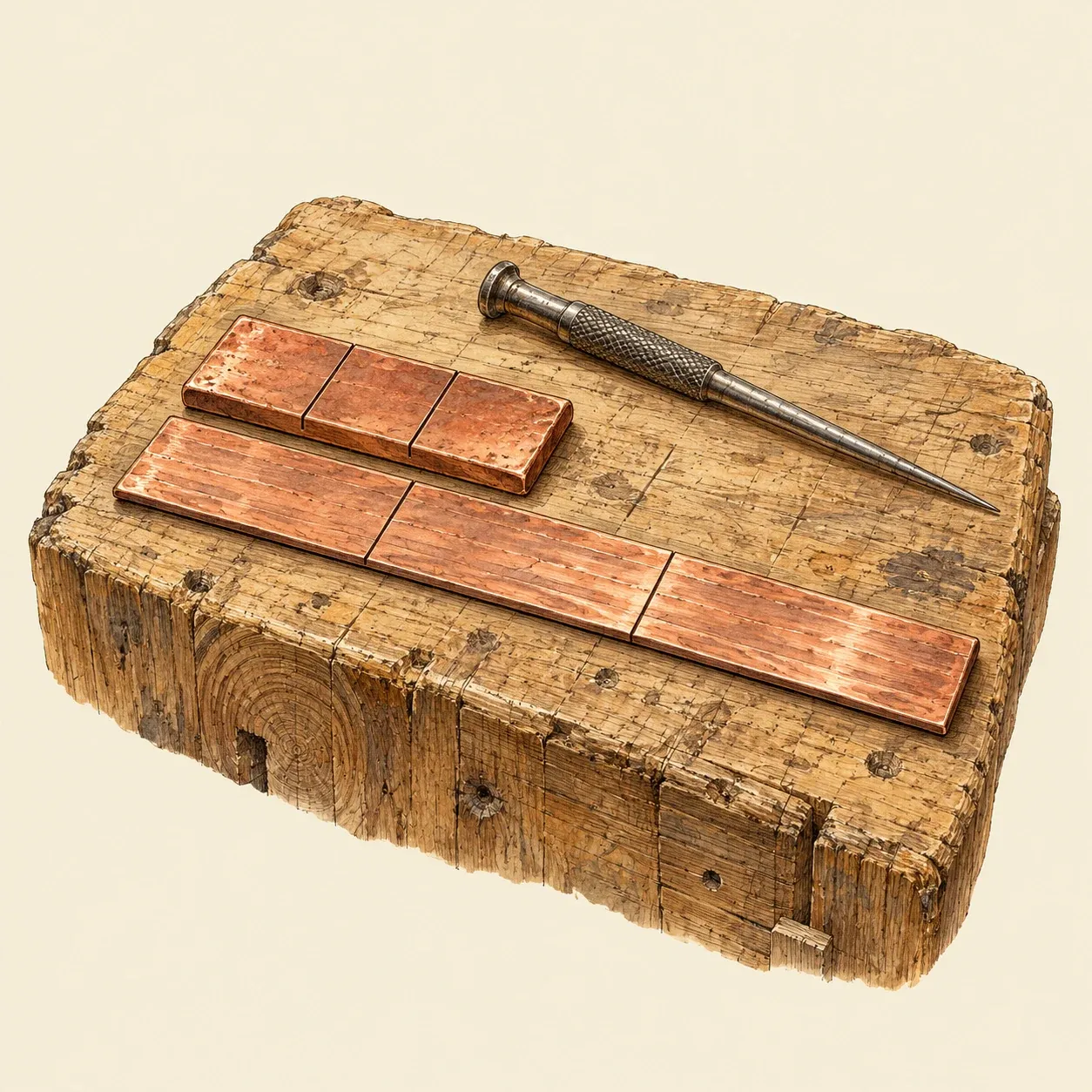 The same strip before and after rolling: thinner, as wide as before, and longer in proportion.
Metal is squeezed, not removed, so its volume stays the same. A strip that loses half its thickness and keeps its width comes out about twice as long. Because the same amount of metal has to leave the gap as enters it, the strip leaves the rolls faster than it went in. A strip spreads only a little sideways, since the friction of the rolls holds it across its width; a square bar spreads more. Marks scribed across a strip move apart as it is rolled, which is an easy way to watch the metal flow.
Rolled cold, metal gets harder and less ductile with every pass, a change called work hardening. After a few passes copper or silver becomes stiff, springs back and may crack at the edges. Heating it to a dull red glow, called annealing, makes it soft again, and the work can go on. Iron and steel are usually rolled hot, when they are soft and do not harden, and the bars come out of the furnace glowing.
Under the load the rolls bend a little and the housings stretch, so the sheet comes out slightly thicker than the gap set and a little thicker in the middle than at the edges. Large mills for thin sheet use small work rolls, which need less force, pressed from behind by larger backup rolls that keep them straight. Rolls cut with grooves give a bar a square, round or more complicated section, such as a rail, as it passes through a series of grooves of decreasing size.
How to do it
Roll a strip of copper in a small hand rolling mill of the kind jewellers use, bought rather than made, and anneal it when it grows hard.
Gather the materials. You need a small hand rolling mill firmly clamped or bolted to a heavy bench, a strip of soft copper, thin enough to pass between the open rolls and long enough to hold well clear of them, a vernier or digital caliper, a steel rule and a scriber, a fire brick, a small gas torch, a pair of tongs, a bowl of water, fine abrasive paper and a cloth. The copper must be clean and dry, with no grease, solder or grit on it, which would mark the rolls.
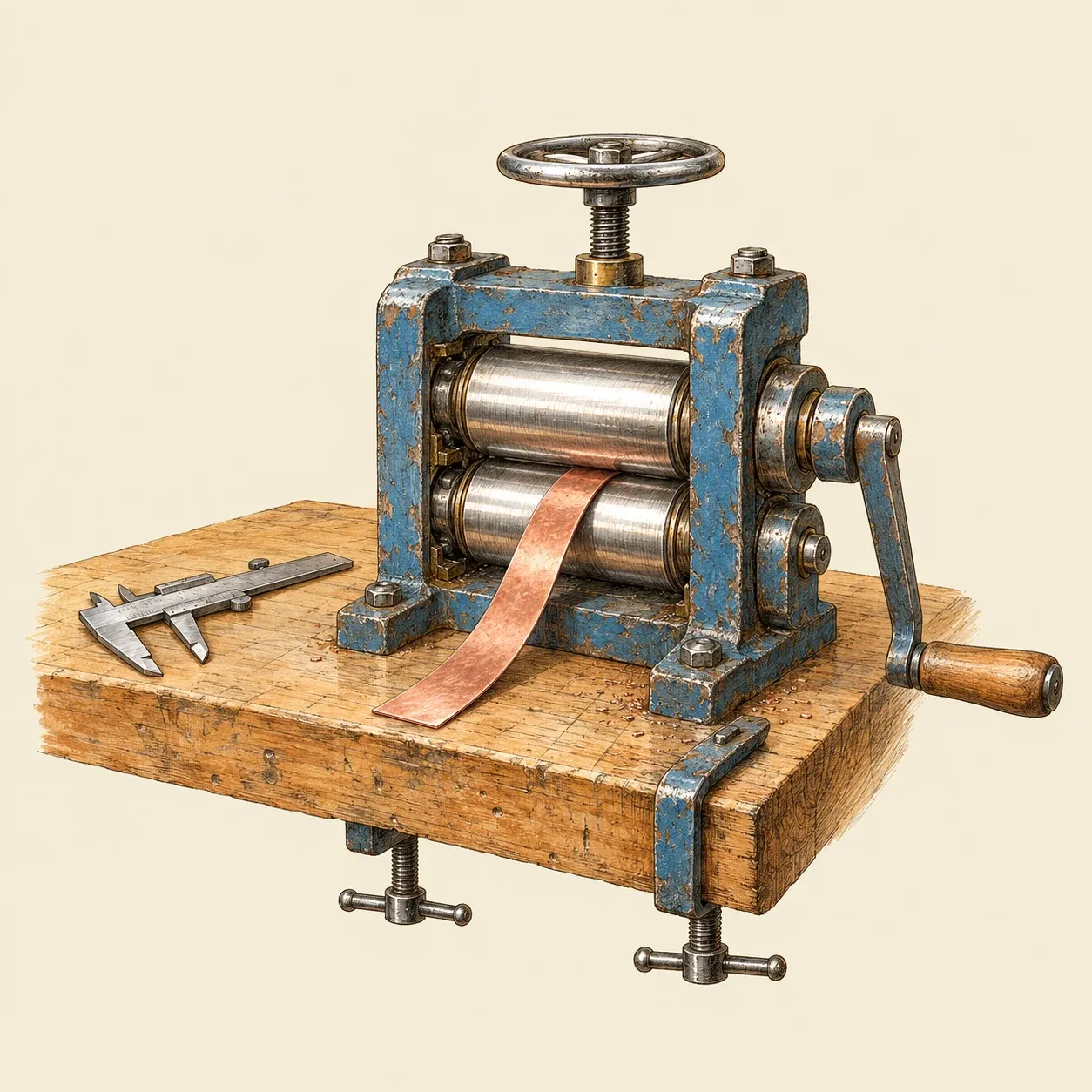 A jeweller’s hand mill: one screw on top sets the gap and the crank turns both rolls through gears.
Measure and mark. Measure the thickness, width and length of the strip and write them down. Scribe two fine lines across it, a few centimetres apart.
Set the gap. Open the rolls, slide the end of the strip between them and close the screw until the rolls just touch the metal. Take the strip out and close the screw by a small turn more.
Roll. Hold the strip by its far end, flat and square to the rolls, and turn the crank steadily so that the rolls draw it in. Let go before your fingers come near the rolls and take the strip from the other side. Feed it in the same direction each time. After each pass close the screw by the same small turn, and measure the thickness and the distance between the scribed lines. The strip grows longer as it grows thinner, while its width hardly changes.
Feel the hardening. After several passes, bend the end of the strip with your fingers. It is now stiffer and springs back. Lay it on the fire brick, dim the light, and play the torch flame over the whole strip until it glows a dull red. Let it lose its glow, pick it up with the tongs and drop it into the water. Dry it completely, clean off the dark oxide with abrasive paper, and bend it again: it is soft once more. Go on rolling and compare the length you have gained with the thickness you have lost.
Safety. The gap between the rolls is a pinch point: keep fingers, loose sleeves, hair and gloves away from it, and never feed a piece too short to hold well clear of the rolls. Anneal on a fire brick, away from anything that burns, with eye protection, and handle the hot strip with tongs only.
History and evolution
Leonardo da Vinci drew a rolling mill in a notebook dated to about 1497–1499, now in the Institut de France in Paris. It is a hand-cranked machine for rolling tin into thin plates: the crank turns gears that drive the upper roll, and the lower roll rests on two brackets that can be raised or lowered to set the thickness. Leonardo asked for the rolls to be made of bell metal, a bronze, so that they would not deform. Nothing shows that he built it.
In the sixteenth century, rolling mills went to work in mints. In 1551 the Paris mint opened a workshop at the western tip of the Île de la Cité with machines brought from Germany: a rolling mill turned by mill wheels, a cutter for the blanks and a screw press for striking them. Metal cast in strips was passed several times through the rolls to bring it to an even thickness. The moneyers who struck coins by hammer opposed the new machines, and in the 1580s the workshop was confined to medals, tokens and copper coins. France adopted mechanical striking of its coinage for good only from 1645.
By the seventeenth century, rolling and slitting mills worked by waterwheels were turning iron bars into flat bars and nail rod. At the ironworks of Saugus, in Massachusetts, two cast-iron rolls in a heavy wrought-iron frame flattened bars heated to a red heat, and a slitter then sliced the flat bars lengthwise into rods for nailmakers. The rolls turned in opposite directions and pulled the bar into the machine, while the waterwheels gave them the force to flatten it.
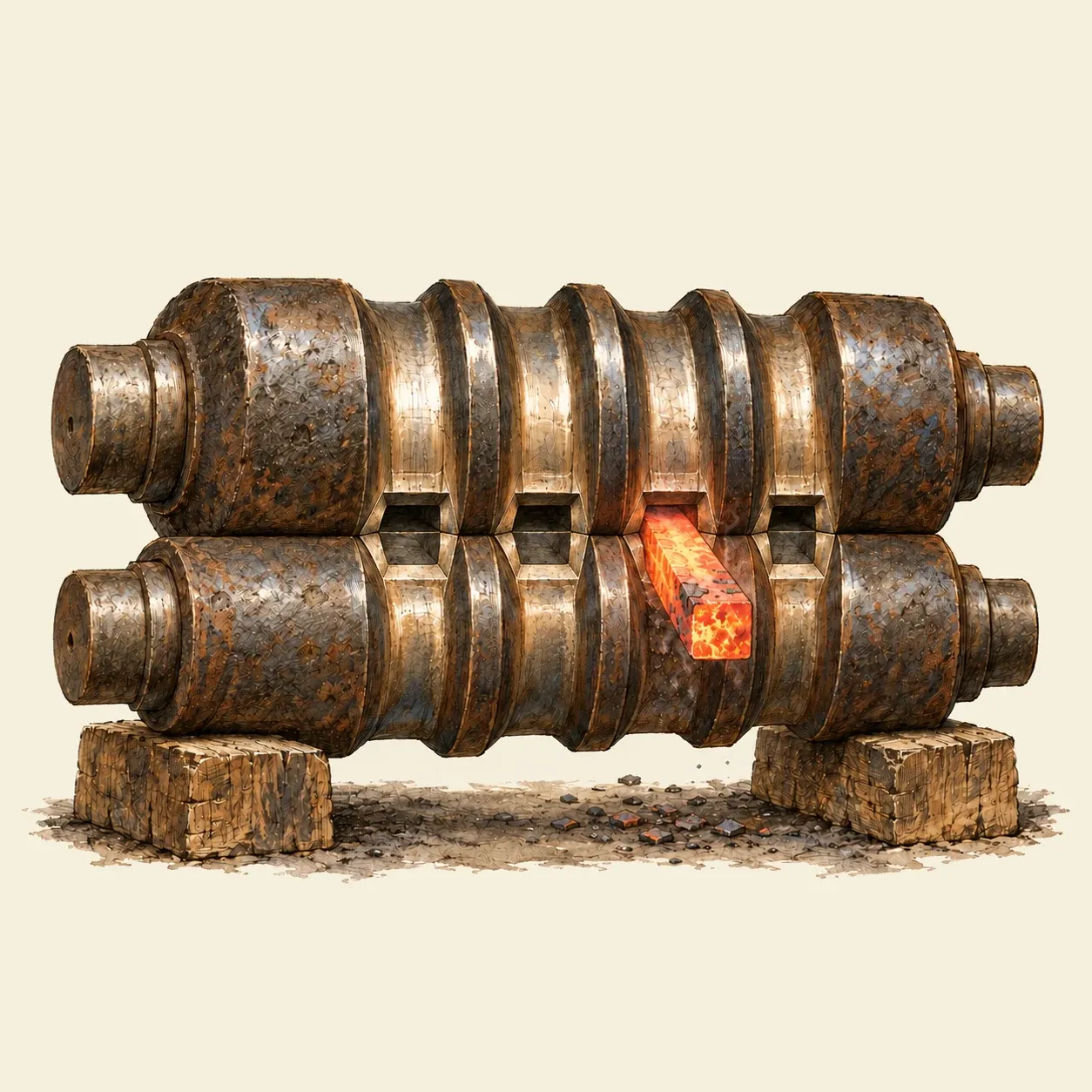 Grooved rolls: the bar takes the shape of the pass it goes through.
In 1783 Henry Cort, who ran a forge and slitting mill at Fontley in Hampshire, patented grooved rolls for making bar iron. Hot iron passed through a series of grooves of decreasing size and took their shape, far faster and more cheaply than a bar could be drawn out under the hammer. The next year he patented puddling, a way of refining pig iron with coal, and the grooved rolls shaped the iron that came out of the puddling furnace.
Rolling became the main way of shaping iron and then steel. Mills grew heavier, gained more stands and stronger rolls, and the small work rolls of mills for thin sheet came to be held straight by larger backup rolls. Rails, beams, plate and thin sheet all come from rolling mills, and the jeweller’s hand mill still works on the same principle as Leonardo’s sketch.