Iron Smelting
Wider adoption around 1200 BCE; ore, charcoal and a bloomery
Contents
- 1Bellows
- 2Tuyère (clay air nozzle)
- 3Charge of charcoal and ore
- 4Clay furnace wall
- 5Iron bloom
- 6Tapped slag
Loading the figure…
Iron smelting extracts metal from ore heated with charcoal in a small clay furnace supplied with air by bellows. This bloomery normally produces a solid, low-carbon lump called a bloom, which the smith consolidates and forges into wrought iron.
What it is
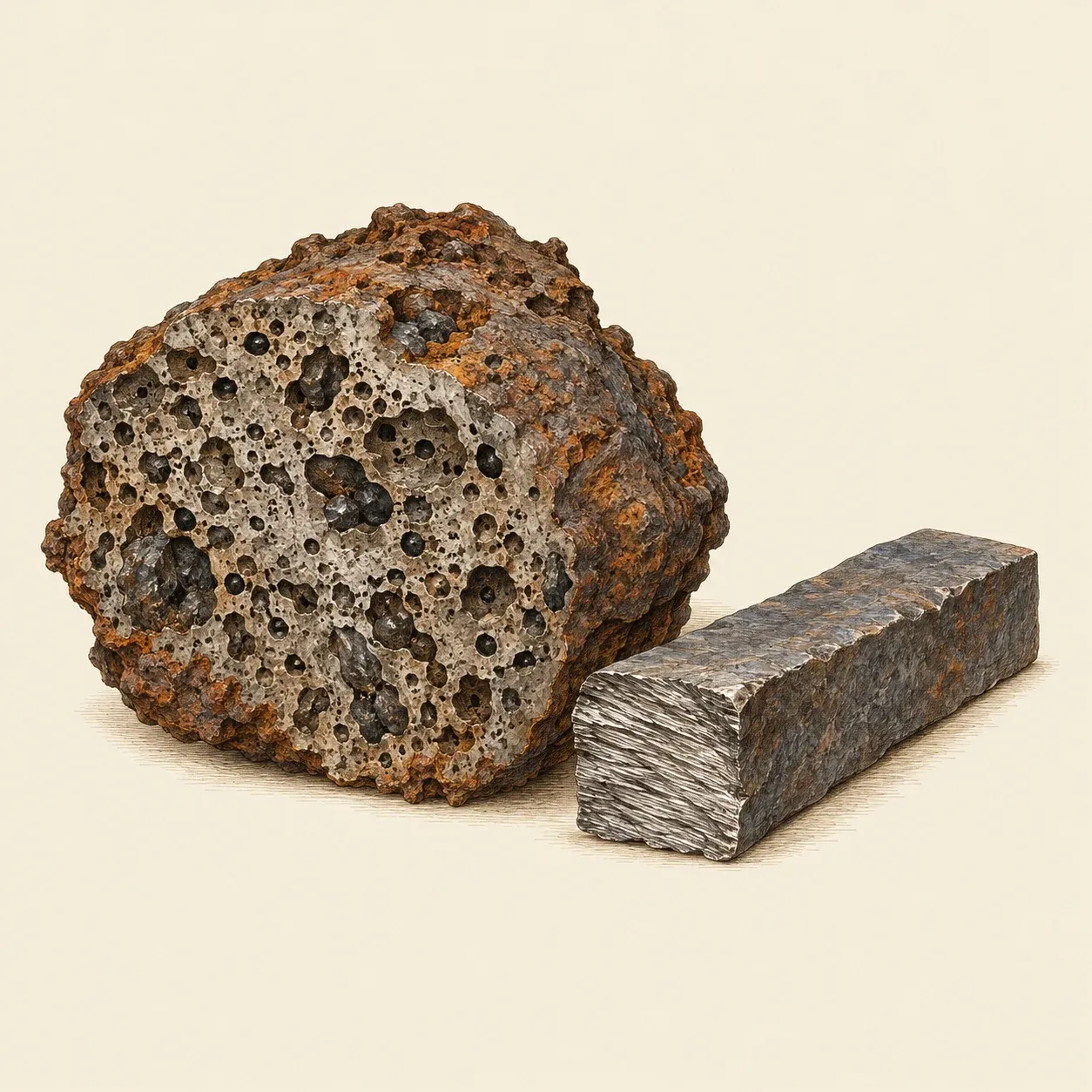 Inside, a raw bloom is a sponge of iron and slag. Hours of forging turn it into a bar.
Iron is one of the most common elements in the Earth’s crust, yet it is almost never found as metal. It sits in ores as oxides: red haematite, black magnetite, brown bog ore dug out of marshes. Smelting pulls the oxygen out of these ores and keeps the metal.
For close to three thousand years the tool for this was the bloomery, a clay furnace about a metre tall in which charcoal burns in a blast of air from bellows. It is named after its product, the bloom, a spongy lump of iron mixed with slag. Hammered while hot, the bloom becomes wrought iron, tough and easy to forge. Ploughshares, nails and swords were made of it until the blast furnace took over in Europe at the end of the Middle Ages.
How it works
Burning in front of the air nozzle, the charcoal heats the furnace. Higher up the shaft, where oxygen is scarce, it forms carbon monoxide, and this gas takes oxygen away from the iron oxide as it rises through the charge. The ore gives up its oxygen in stages, and the reaction becomes fast above about 900 °C.
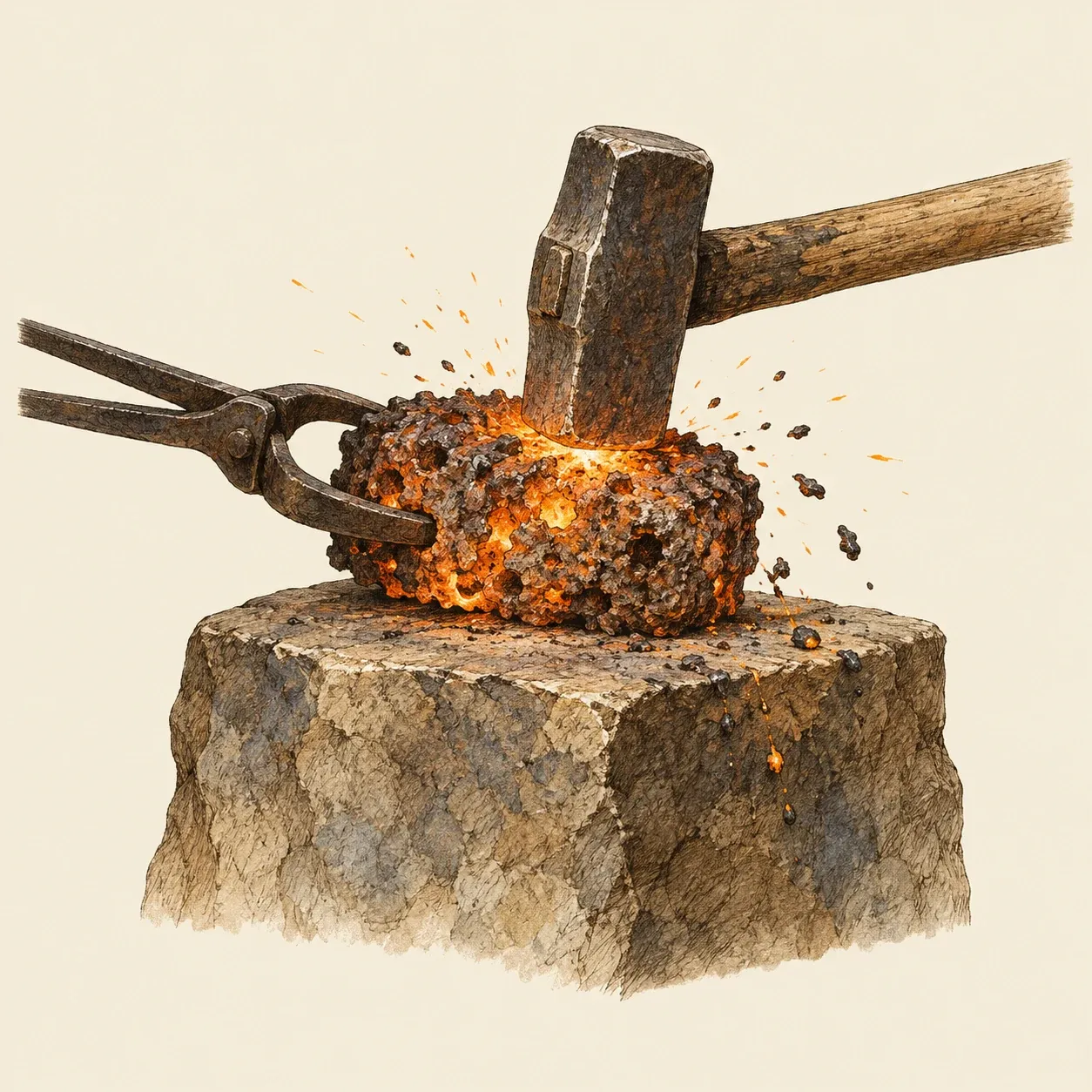 The bloom is first consolidated with light blows while hot; it can be reheated between rounds of hammering.
The furnace runs at around 1,100 to 1,200 °C and normally produces a solid, low-carbon bloom. Pure iron melts at 1,538 °C, but carbon-rich iron can melt at bloomery temperatures. Silica and other minerals in the ore combine with part of the iron oxide to form iron-rich slag, which can flow at about 1,180 °C depending on its composition. The slag trickles down past the tuyère, the clay air nozzle, while metal grains gather just below it into the bloom. The smelter drains the slag through an arch at the base, or the slag collects in a pit underneath.
The bloom leaves the furnace as a glowing, porous mass full of slag and charcoal. Repeated heating and forging compact the metal and squeeze out much of the slag, and the bloom loses weight as they do. Its carbon content is usually low and uneven, so soft iron and patches of steel may occur in the same bloom.
How to do it
What follows is the outline of a small smelt, not a measured drawing. You need clay mixed with sand and straw, ore, a lot of charcoal, bellows or a blower, and a team for a full day.
Prepare the ore. Roast it in an open fire to drive off water and make it brittle, then break it to pieces of about a centimetre. Break the charcoal to about two centimetres and sieve out the dust so the gas can flow through the charge.
Build the shaft. On dry ground, raise a clay cylinder about a metre high and 25 to 30 cm across inside, with walls several fingers thick. Leave a hole near the bottom for the tuyère and an arch that can be opened and sealed again with clay. Let it dry slowly for several days, then finish with a small fire inside.
Preheat and charge. Fill the shaft with charcoal and blow air until it glows from top to bottom. In the experiments of the Wealden Iron Research Group (WIRG), about 1 kg of ore and 1 kg of charcoal go in together every 10 to 15 minutes, 15 to 20 kg of each over a run. Charging and the final burn-down take about five hours, not counting the preheating. Keep extra charcoal for the preheating and for a last charge of charcoal alone.
Control the blast. Watch the temperature and how fast the charge sinks, and adjust the air to keep the reduction and the slag flowing. How much carbon the iron takes up depends on the ratio of charcoal to ore, the furnace atmosphere, the time the charge spends in the hot zone and the slag chemistry. A stronger blast does not by itself give cast iron: some experiments got lower-carbon iron with more air. Tap the slag when it builds up; WIRG made its first tapping after about three hours.
Extract and consolidate. When the last charge has burnt down, open the front and pull the bloom out with tongs. If it is fragile, start with light blows, with a wooden mallet for instance, and strike harder as it holds together; it can also be left to cool and reheated later. Reheat it in a forge between rounds until the metal forms a solid bar.
Safety. Never let water touch hot or molten slag or enter the hot furnace: sudden steam formation can cause an explosion. Wear leather boots, gloves, an apron and eye protection, and never stand in front of the tapping arch. Carbon monoxide leaves the top: keep your face away from the stack and never smelt indoors.
History and evolution
People worked iron before they could smelt it. Some of the oldest iron objects were hammered from meteorites, which contain nickel. Evidence points to early smelting in Anatolia, in present-day Turkey, though the place and date of its invention remain uncertain. Fragments from Kaman-Kalehöyük dated to about 1800 BCE include some carbon steel, and their uneven carbon suggests smiths who were still experimenting. Around 1250 BCE the Hittite king Hattusili III wrote a letter about making “good iron”.
Iron came into wider use in the Near East from around 1200 BCE, though smelting was older and each region took it up at its own pace. By about 1100 BCE it was common in Cyprus and the Levant, most of Europe used it from around 800 BCE, and by 500 BCE bloomeries were known from the Mediterranean to Scandinavia. Unlike the copper and tin for bronze, iron ore could be dug almost anywhere.
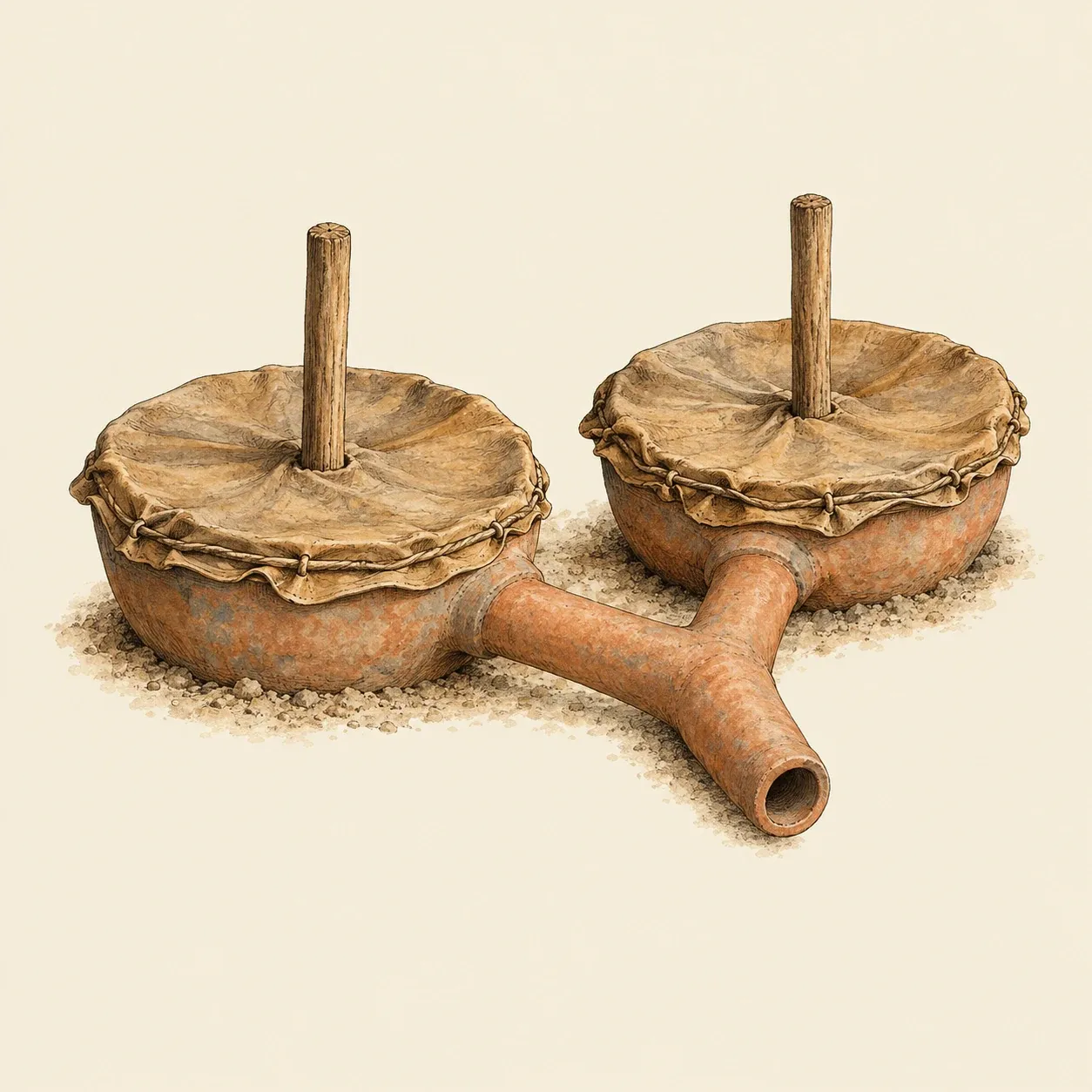 Pot bellows: pumping the leather covers in turn keeps the air flowing without a break.
Africa had its own traditions, with furnaces in Nubia by the seventh century BCE and in West Africa by the sixth at the latest. China probably learned bloomery smelting from the west around the eighth century BCE, then moved early to furnaces hot enough to make liquid cast iron.
European blooms weighed about two kilograms for centuries, small enough to forge by hand. Roman furnaces, up to two metres tall, gave blooms of 10 to 15 kg, and around 1500 water-driven hammers could work blooms of 100 kg or more. A blast furnace was already working at Lapphyttan in Sweden in the mid-twelfth century. Blast furnaces spread in the later Middle Ages and were making cast iron in quantity by around 1500, while the bloomery slowly gave way. Catalan forges in Spain and southern France were still working in the middle of the nineteenth century.