Coilgun
Pulling iron along a barrel of coils
Contents
- 1Barrel made of a row of coils
- 2Iron projectile
- 3Wooden frame carrying the barrel
- 4Electric cables
- 5Target of thick planks
A coilgun moves a projectile with magnetism instead of burning powder. A row of coils of wire around its barrel pulls an iron projectile along it, one coil after another. Charles Grafton Page described a 'magnetic gun' in 1845, and in 1903 Kristian Birkeland's attempt to sell an electromagnetic cannon ended in a short circuit.
What it is
A coilgun throws a projectile with magnetism alone. Its barrel is a straight tube with coils of insulated wire around it, one after another. When current flows through a coil, the coil pulls a piece of iron into its middle. Coils switched on in turn pull the projectile along the tube faster and faster, and it leaves the muzzle with the speed it has gathered. Nothing burns and no gas pushes it. The device is also called a Gauss rifle. It differs from the railgun, another electromagnetic launcher, which uses a pair of rails instead of coils.
The first coilgun was a scientific curiosity. Kristian Birkeland later tried to sell one as a cannon, without success, and in the 1970s engineers built coilgun models of launchers meant to throw rock mined on the Moon out into space.
How it works
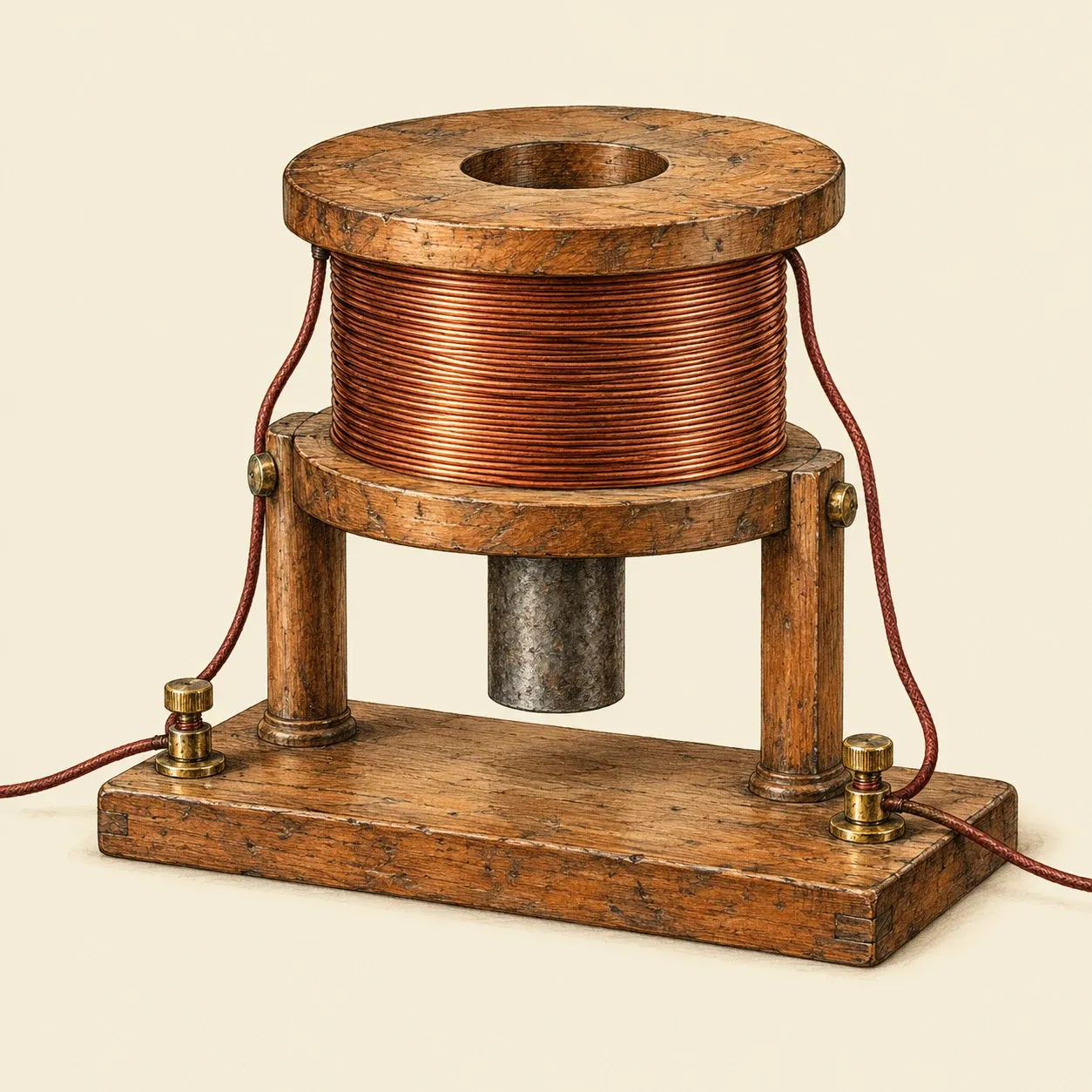 A coil carrying current draws a bar of iron up into itself and holds it there.
A current flowing through a coil of wire makes a magnetic field, strongest inside the coil and along its axis. A piece of iron in that field becomes a magnet itself, with its poles turned so that it is drawn towards the place where the field is strongest, the middle of the coil. In 1845 Charles Grafton Page described how a coil could draw a bar of iron up into its centre and hold it there, hanging free with no visible support.
The same pull makes the device hard to build. The coils speed the projectile up only if they act one after another, in the right order and at the right moment, and both Page and Birkeland had to find a way of making them do so.
The projectile need not be iron. It can carry a coil of its own, and the forces between the current in that moving coil and the currents in the coils of the barrel then drive it forward. Birkeland tried this arrangement in a later version of his cannon, and the mass driver models of the 1970s carried their payload in a “bucket” pushed along by a row of drive coils.
The coils need very large currents for very short moments, and supplying them is the hard part. A fault can release the stored energy all at once as an arc or a short circuit, as happened during Birkeland’s demonstration of 1903.
History and evolution
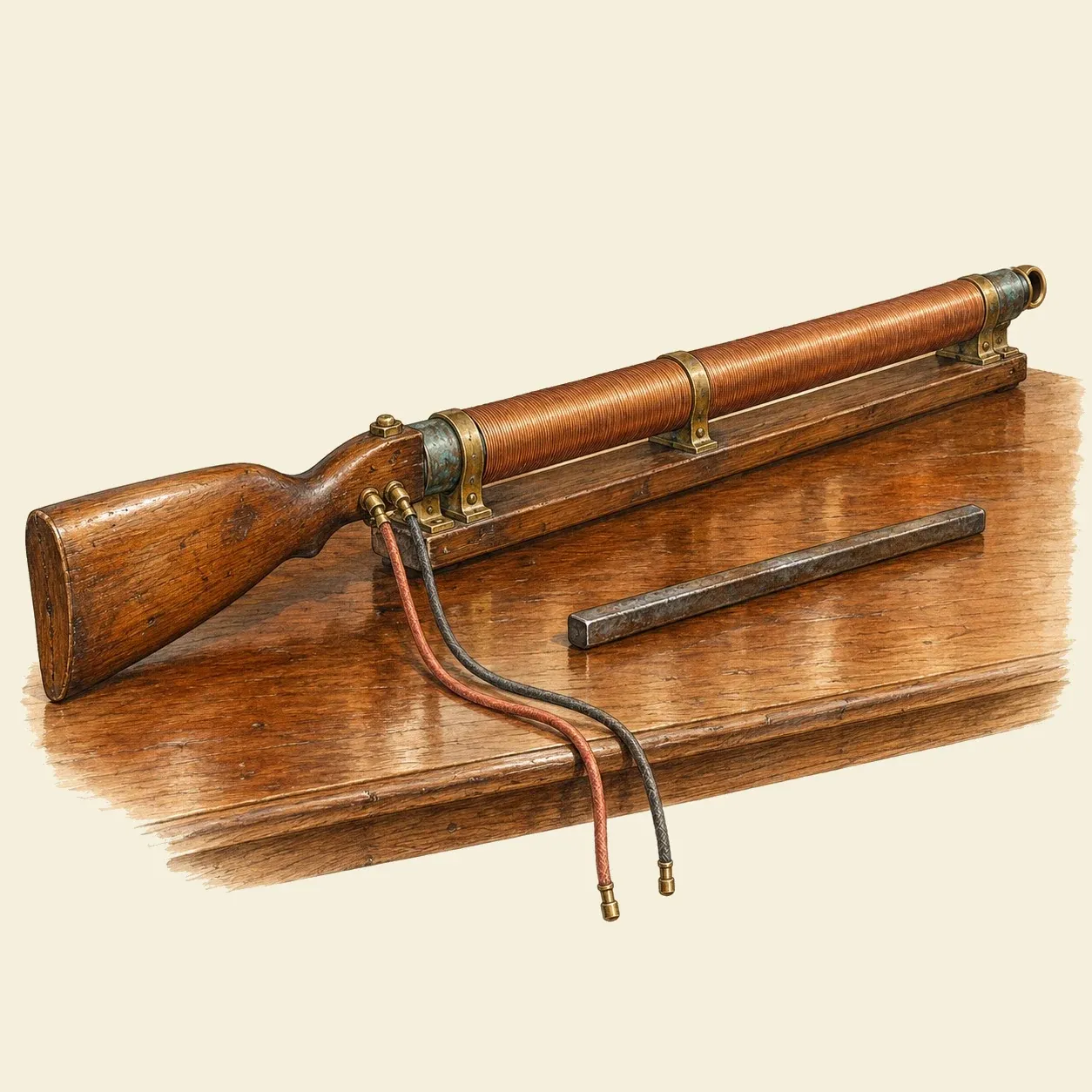 Page presented his magnetic gun of 1845 as an instrument for demonstrations.
Charles Grafton Page was a professor of chemistry and pharmacy and an examiner at the United States Patent Office who studied the pull of a coil on an iron bar. In an article on a new electromagnetic engine, published in the American Journal of Science in 1845, he described a “galvanic or magnetic gun”. Coils of wire placed one after another formed its barrel, which was mounted with a stock and a breech, and they threw an iron bar along it. Page presented it among instruments “of philosophical research and amusement”. As an officer of the Patent Office he could not take out patents, so he published his inventions instead. The same pull of a coil on a bar drove the engines he built, relatives of the electric motor.
Kristian Birkeland, professor of physics at the university in Kristiania, now Oslo, from 1898, studied the aurora and needed money for his research. While working with strong magnets he thought of a military use, and in 1901 he founded a company to develop a cannon whose magnetic projectile would be driven by the field of a row of coils along the barrel. He patented the design. On 6 March 1903 he gave a demonstration in the old ceremonial hall of the university, before an audience that included representatives of the arms makers Armstrong and Krupp; Eyde’s memoirs, and several accounts based on them, give 6 February. A short circuit inside the cannon produced a huge flash and a deafening noise. The projectile still hit its target of thick planks, but Birkeland sold neither his patent nor a single cannon.
The cannon experiments had another outcome. Birkeland had seen that an electric arc in a magnetic field spreads out into a disc. Early in 1903 he met the engineer Sam Eyde, who was looking for a very large electric arc to make nitrogen compounds from the air, and on 20 February 1903, under an agreement with Eyde, Birkeland applied for a patent on a method using such an arc. The Birkeland–Eyde process made fertiliser from air and led to the founding of Norsk Hydro.
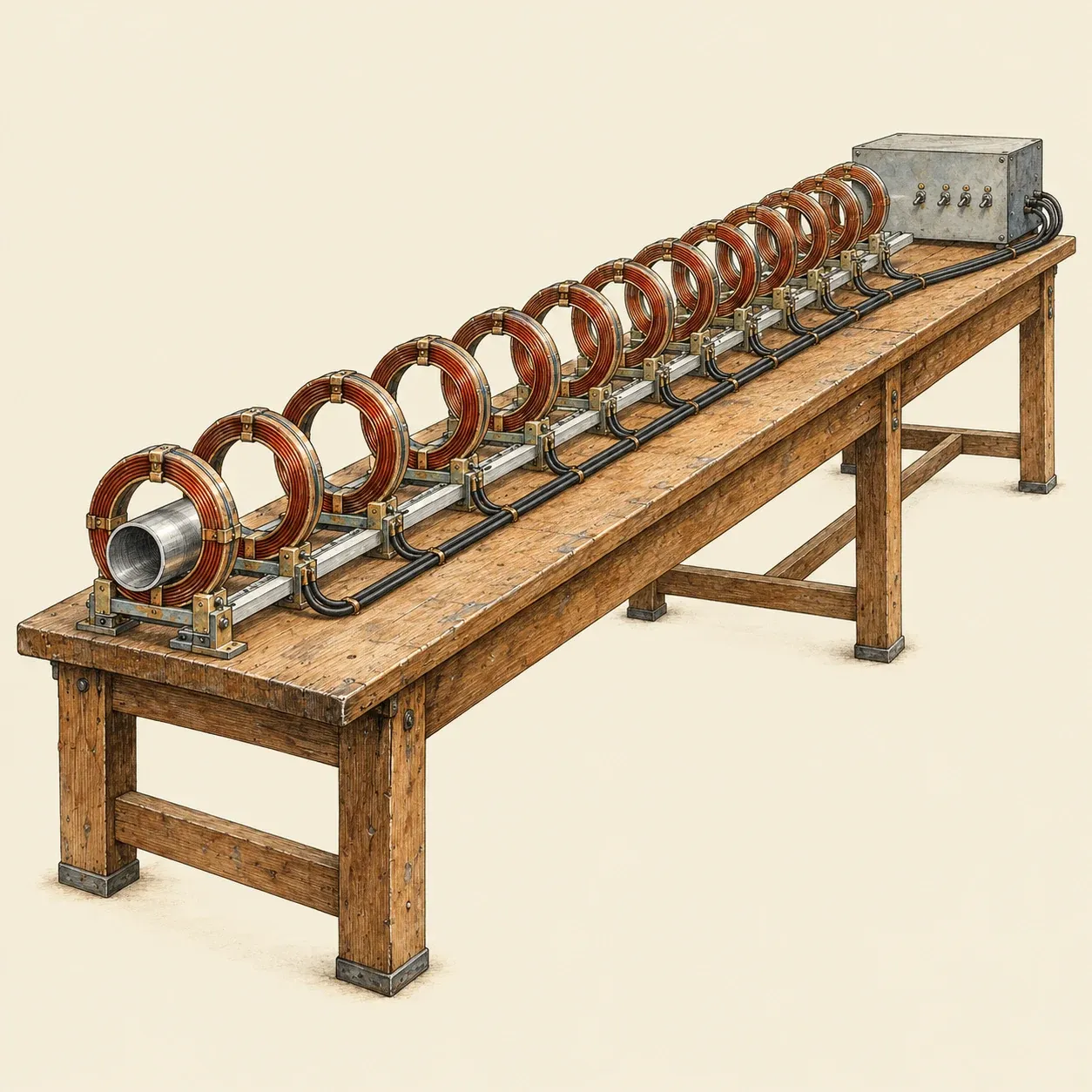 Mass Driver One, built at MIT in 1977, pushed a small bucket through a row of drive coils.
The principle returned in the 1970s for a peaceful purpose. The physicist Gerard O’Neill proposed to launch material mined on the Moon into space with a mass driver, a long line of coils accelerating buckets of lunar rock. Launching building materials from the surface of the Earth seemed far too costly, and the weaker gravity of the Moon made it the better source. In 1977 students at the Massachusetts Institute of Technology, working with Henry Kolm and O’Neill, built a working model, Mass Driver One, and demonstrated it at a conference on space manufacturing at Princeton. Larger versions followed at Princeton and MIT.