Drawing iron wire by hand
A steel drawplate and tongs turn soft iron rods into wire
Contents
- 1Short soft-iron rod with a tapered point
- 2Fixed steel drawplate with decreasing holes
- 3Braced bench, wooden wedges and nailed iron strap
- 4Drawing tongs aligned with the hole
- 5Emerging wire, progressively thinner and longer
A short rod of soft iron passes through successively smaller holes in a steel drawplate. Tongs pull it longer and thinner, while the smith checks for cracks, removes scale and prepares the iron for another pass.
What it is
Wire drawing turns a metal rod into wire by pulling it through a hole smaller than its cross-section. A short piece of soft iron, a drawplate fixed to a bench and a pair of tongs are enough to do it by hand. The stock must be ductile and the holes smooth: a roughly drilled plate scores the iron or snaps it.
The wire becomes rings, small fasteners and parts for assembly. Bloomery wrought iron carries slag inclusions, and neighbouring pieces of one billet can behave differently, so choosing the stock matters as much as pulling hard. Steel goes into the drawplate and the tools. A rod hardened all through would resist drawing.
How it works
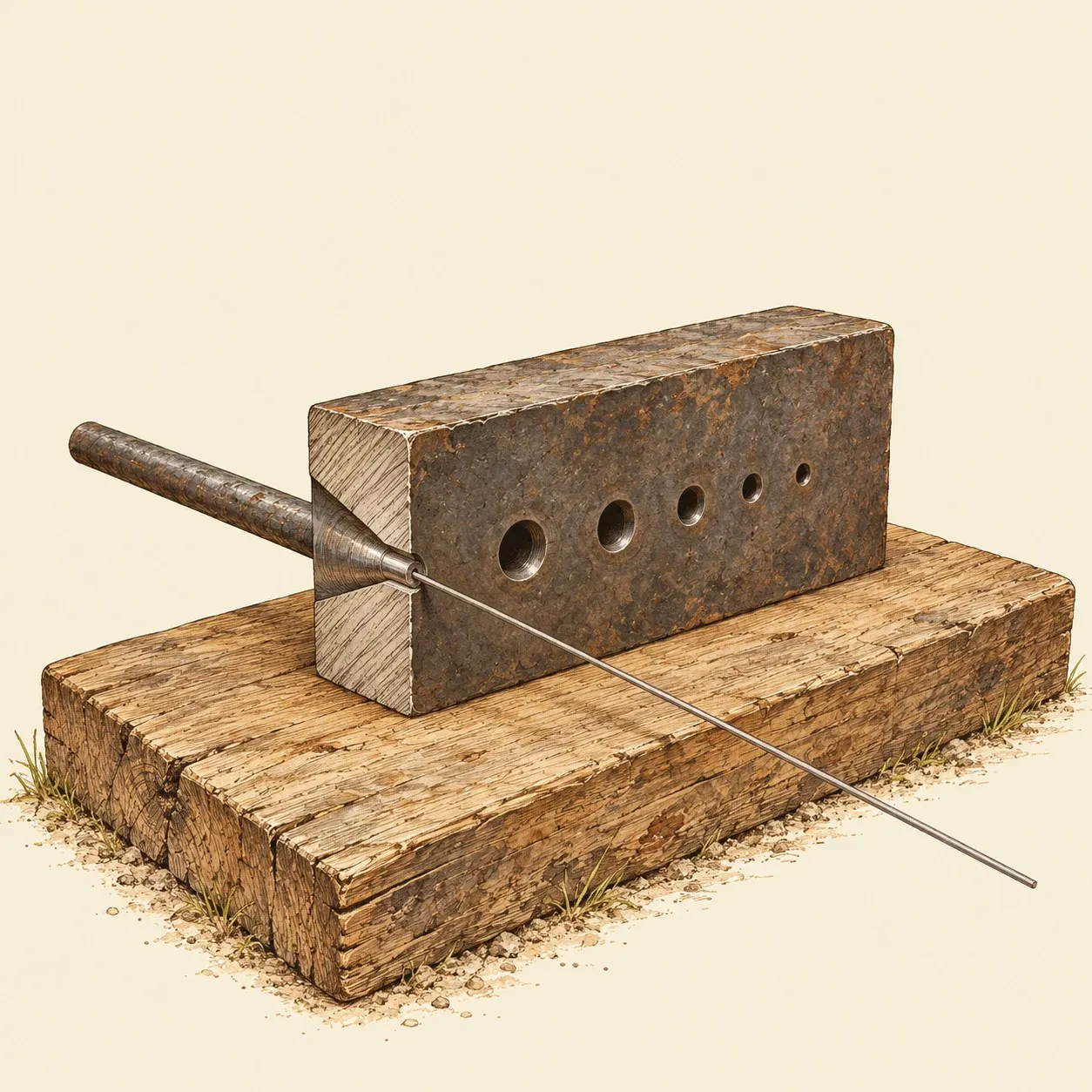 The hole guides the iron and reduces its cross-section as the tongs pull.
First, the tapered point slips through the hole, leaving enough metal beyond the plate for the tongs to grip. Pulling straight along the hole’s axis then forces the thicker body of the rod against the working surface. The metal deforms, becoming thinner and longer. A flared entrance helps it feed into the hole, while a smooth bearing reduces scoring. The plate’s mounting carries the pulling load, and the bench must stay still.
Too small a hole breaks the wire or asks for more force than the operator has, so the reduction goes in small steps sized to the iron in hand. Cold deformation work-hardens the stock. Annealing restores ductility, but it cannot remove a large inclusion or mend a crack. Heating also leaves oxide scale, which must come off before the next pass because it hinders sliding and damages the surface.
How to do it
With a smith, select a small batch of soft iron or low-carbon wrought iron. Forge a short, reasonably even rod with a tapered end, rejecting cracked portions and those heavy with slag. Consistent measures help order the holes and record the gauge of the wire produced.
Have a steel drawplate made. After drilling or punching the blank, finish the entrances, size the passages and polish their working surfaces with suitable tools and abrasives. The smith sets the tool’s hardness and tests the holes on sample stock. Stand the plate upright on a braced wooden bench, lock it between wooden wedges and nail an iron strap across its foot so that it can take the pull.
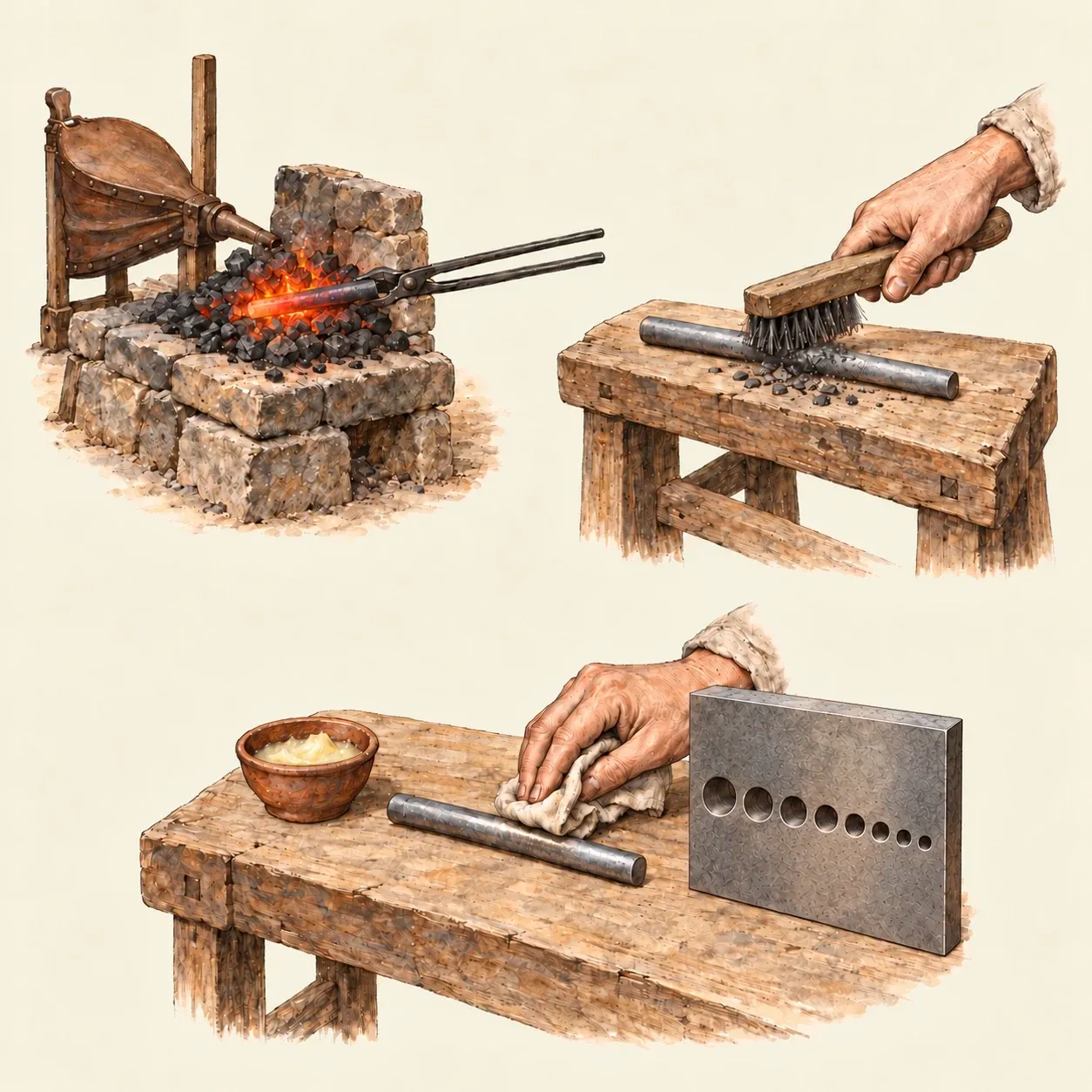 The iron is prepared and inspected between passes; annealing depends on the batch.
Feed the point through the flared entrance, grip the emerging end with serrated tongs and pull steadily in line with the hole. Coat the rod with grease, tallow or beeswax; the experiment reported by EXARC used beeswax, then sheep tallow. Between passes, the smith anneals the iron as the batch requires, knocks off the scale, inspects the stock and lubricates it again. Temperature, holding time and the number of passes between anneals change from one batch to the next.
Wear eye protection, keep hands away from the hole and leave clear space behind the operator. Broken wire can whip, and slipping tongs can cause a fall. Stop when cracks appear or the pull becomes excessive. Annealing belongs in a ventilated forge under competent supervision because of burns, fire and carbon monoxide. Do not improvise acid descaling at home.
History and evolution
Around 1100, the monk Theophilus described iron plates pierced with graded holes for drawing wire, in Book III, Chapter VIII of his treatise on the arts. The tool is older. An iron drawplate from a workshop of the sixth to eighth century at Old Uppsala, in Sweden, still carries traces of the silver drawn through it. The Topoi project studied ancient drawplates and tested drawing a strip first rolled into a tube, comparing the result with a mail ring from Zemplín. That method asks less of the tool than drawing a solid rod. Much ancient wire was also hammered out or cut from strips.
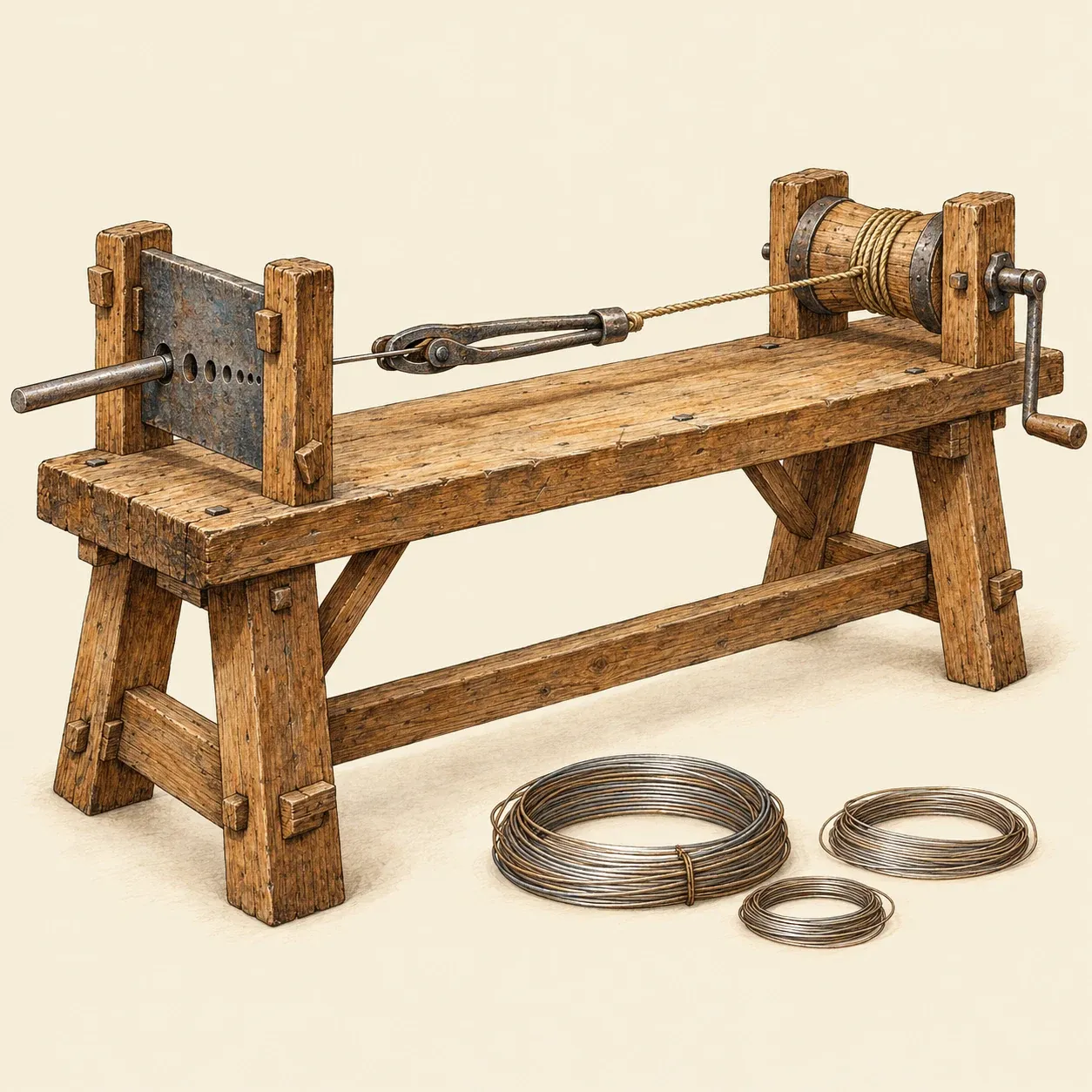 With a windlass, a rope pulls the tongs and the wire through the plate.
Water power later took over the heavy first passes. Nuremberg’s city archive dates drawing driven by water wheels to 1408–1415, and Albrecht Dürer painted a wire-drawing mill on the Pegnitz, west of the city, in a watercolour of about 1489–1494 now in the Kupferstichkabinett in Berlin. Biringuccio’s Pirotechnia, printed in 1540, described the craft, with woodcuts of wire drawn on capstans, windlasses and drums and of heavy wire pulled by a water wheel. In the nineteenth century, wire rope and the telegraph raised demand, which new ways of rolling rod and drawing machines supplied.