Canning & Pasteurisation
Seal, heat, keep the microbes out
Plate
- 1Wood fire
- 2Copper kettle of boiling water
- 3Glass bottle packed with vegetables
- 4Cork tied down with wire
- 5Headspace left under the cork
- 6Soldered lid of a tinplate can
Anatomy
Loading the figure…
Canning seals food in a jar or tin and heats it enough to kill the microbes that would spoil it; the closed lid stops new ones getting in. Nicolas Appert published the method in 1810, Louis Pasteur explained it half a century later, and his gentler heat treatment, pasteurisation, made milk, wine and beer safer to drink.
What it is
Salting and drying keep food by depriving microbes of water. Canning kills them: the food is closed in a jar or tin and heated long enough to destroy the microbes that could spoil it or make people ill. While the seal holds, no new germs get in, and the food keeps for months without cold.
The plate shows Nicolas Appert’s method of 1810, corked bottles stood in boiling water, beside the soldered tinplate can adopted soon after in England. Pasteurisation, a milder relative, heats milk, wine or beer below boiling. It kills most germs that cause disease, not every microbe, so pasteurised milk still needs a refrigerator.
How it works
At 100 °C the active cells of bacteria, yeasts and moulds die within minutes. While the jar is hot, air escapes under the lid. As it cools, the contents shrink and the steam in the headspace condenses, and the vacuum pulls the lid tight onto the rim.
The hardest to deal with is Clostridium botulinum. Its spore survives boiling, and spores are on most fresh vegetables. In open air they stay dormant; in a sealed jar of moist, low-acid food at room temperature they germinate and make botulinum toxin, one of the most poisonous substances known, often without any visible sign.
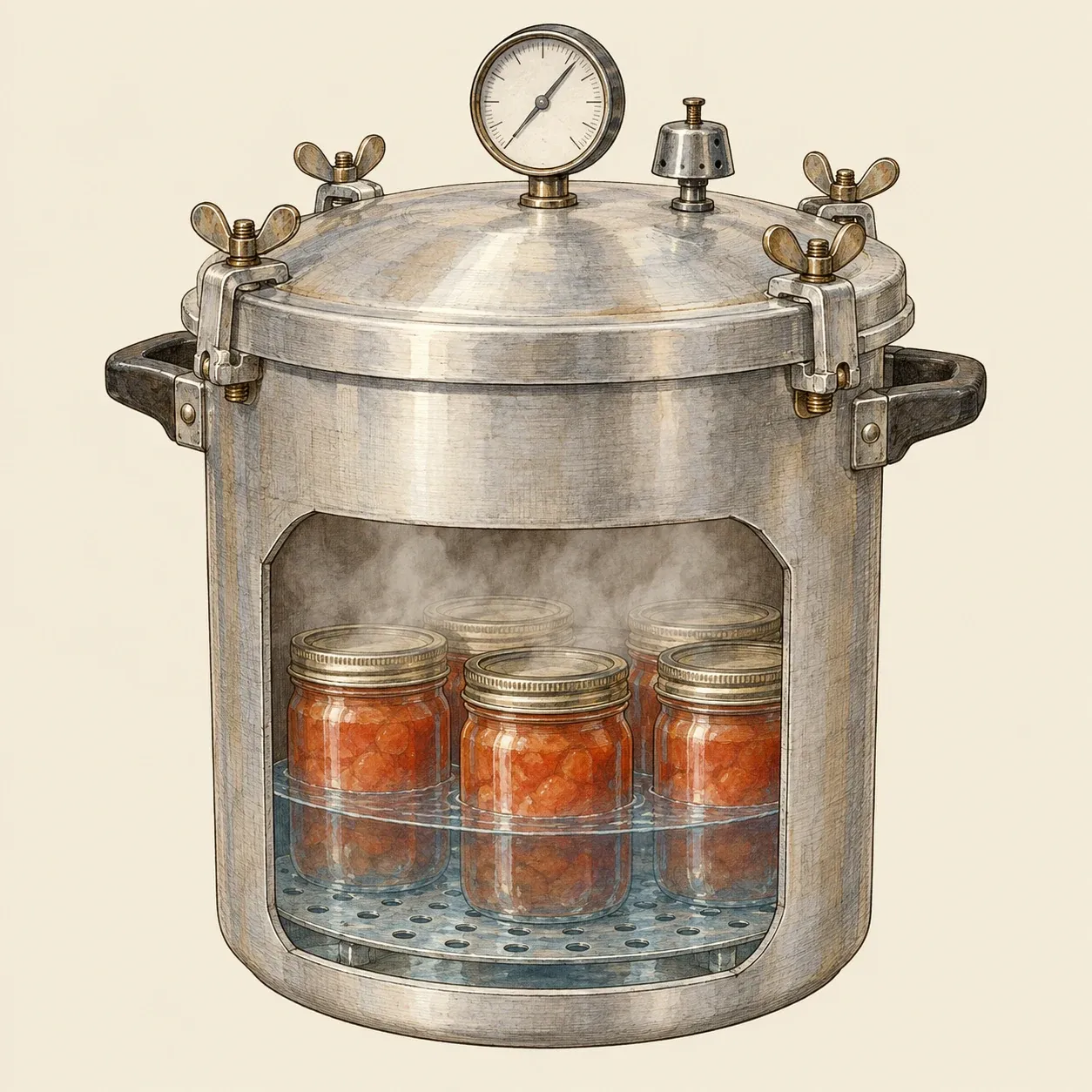 A pressure canner holds steam under pressure, so the jars reach 116–121 °C instead of 100 °C.
The spores cannot grow at pH 4.6 or below. Most fruits, jams, pickles, and tomatoes or figs with added acid are therefore safe after a boiling-water bath, which kills the yeasts and moulds that would spoil them. Vegetables, meat and fish are less acidic. Their spores must be killed at 116–121 °C (240–250 °F), and water only gets that hot under pressure, in a pressure canner at about 0.7–1 bar above atmospheric pressure, which works like a kitchen autoclave. Each food, pack and jar size has its own tested time there; at 100 °C the same result would take hours, and no tested recipe cans these foods in a water bath.
Processing times are measured with thermometers at the slowest-heating point of each jar and food. At altitude water boils below 100 °C, so the tables add time or pressure.
Pasteurisation uses lower temperatures. Dairies usually heat milk to 72 °C for 15 seconds, or 63 °C for 30 minutes, then chill it. That destroys the active bacteria behind tuberculosis, salmonellosis and other milk-borne diseases. Spores and some harmless microbes survive, so the milk sours within days unless kept cold.
How to build it
Follow tested official guidance only: the USDA Complete Guide to Home Canning and the National Center for Home Food Preservation in the United States, Health Canada, or your national food safety agency. These steps cover a boiling-water bath for high-acid foods.
Pick a tested recipe. Follow it exactly: jar size, headspace, added acid (bottled lemon juice or citric acid for tomatoes), time and altitude adjustment. Adding onion or pepper to tomatoes can make them unsafe.
Gather the equipment. A deep pot with a lid and a rack, canning jars with unchipped rims, new two-piece lids (a flat lid with sealing compound, held by a screw band) and a jar lifter. Wash everything in hot soapy water. If the processing time is under 10 minutes, first sterilise the empty jars by boiling them for 10 minutes, plus one minute for every 300 m of altitude above 300 m.
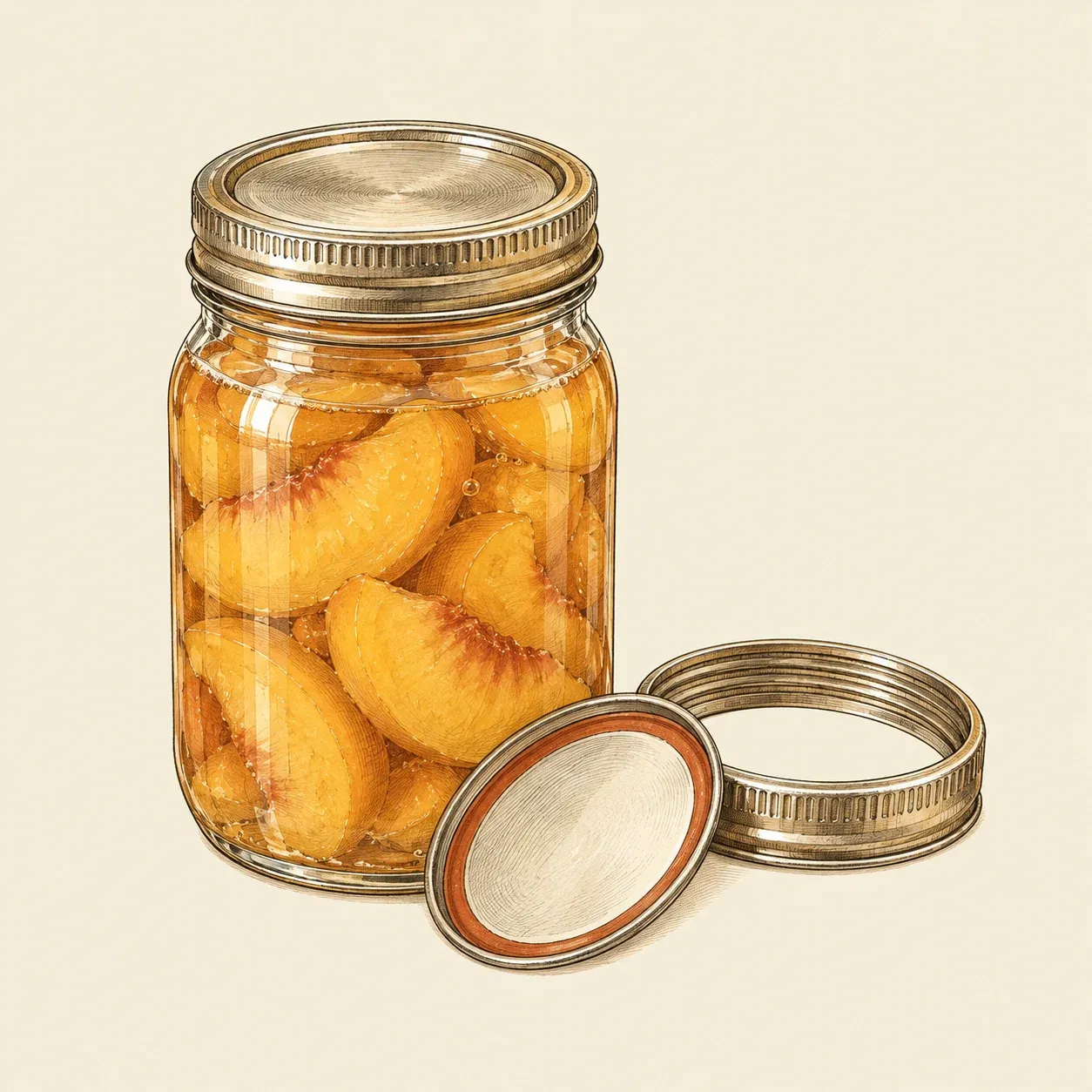 The flat lid with its sealing ring is used once; the screw band can be used again and again.
Fill and close. Leave the stated headspace, free trapped bubbles, wipe the rim and screw the band on just firmly enough for air to escape.
Process. Stand the jars on the rack in hot water, covered by at least 2.5 cm (5 cm for times over 30 minutes). Start timing at a full rolling boil; if the boil stops, restart the time from zero. At the end, turn off the heat, uncover and wait five minutes.
Cool and check. Lift the jars out upright and leave them 12 to 24 hours. Remove the bands and press each lid: a sealed lid is curved down and does not flex. Refrigerate an unsealed jar and eat it within days.
Store and inspect. Keep dated jars cool, dark and dry. Before opening, look for bulging or loose lids, leaks, foam, cloudiness, mould or an odd smell.
Safety. Botulism is rare but can kill. Never process vegetables, meat, fish, poultry or mixtures containing them in a water bath, an oven or an open pot, unless a tested pickling recipe has acidified them: otherwise they need a pressure canner and a tested pressure process. There is no tested home method for milk or other dairy products, so never can them. Never shorten a time or reduce the acid. Never taste a suspect jar: the toxin cannot be seen, smelled or tasted. When in doubt, throw it out. Blurred or double vision, drooping eyelids, slurred speech, trouble swallowing or spreading weakness after eating preserved food are an emergency: get medical help at once. Boiling water and hot jars scald, so use a jar lifter.
History and evolution
Appert, a Paris confectioner, began experimenting in the 1790s, when France at war needed food that kept. On 30 January 1810 the government gave him 12,000 francs on condition that he publish, and his book came out that year. He never knew why his method worked.
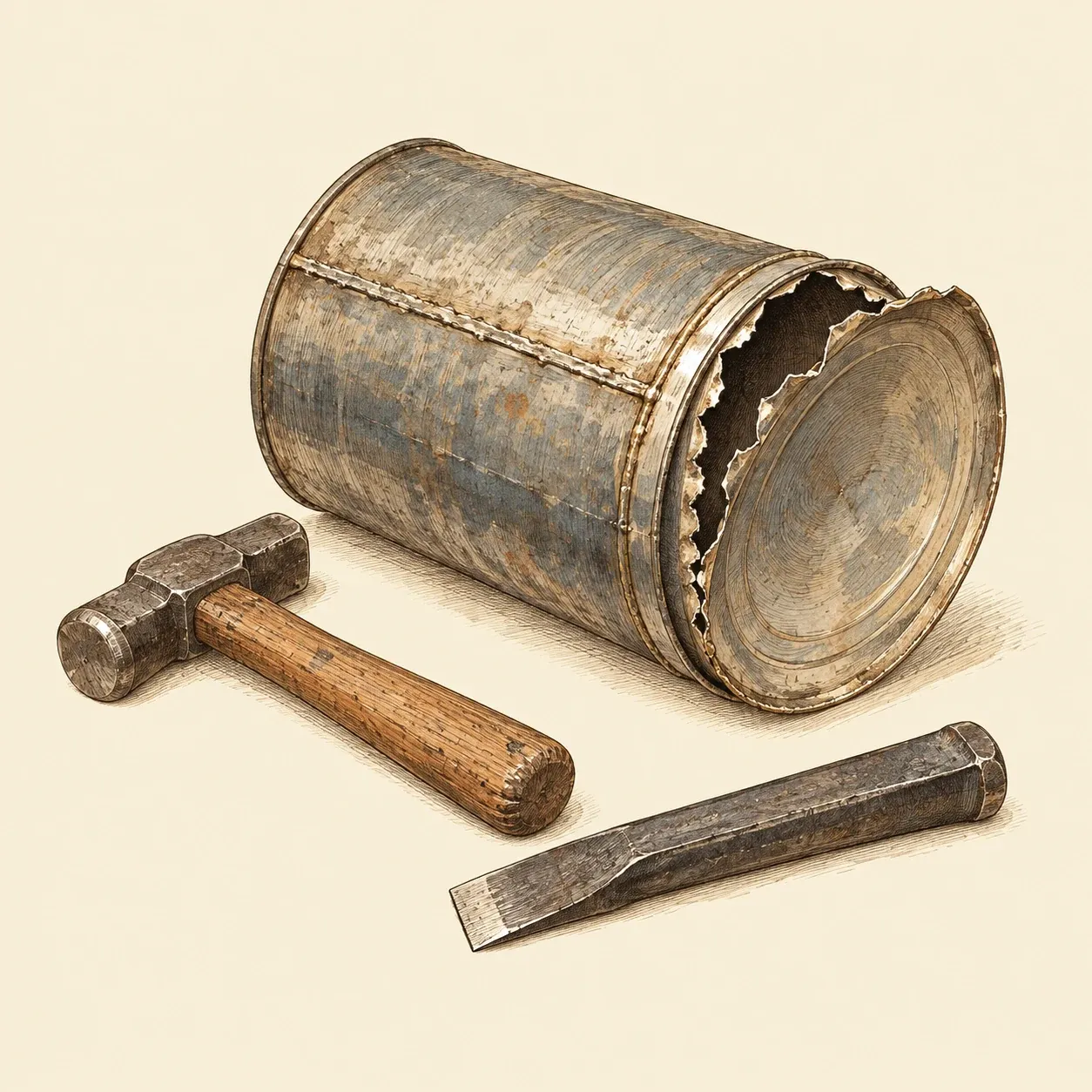 The first cans were opened with a hammer and chisel; can openers came decades later.
That same year Peter Durand took a British patent that included cans of tinplate, thin iron coated with tin. Bryan Donkin and John Hall bought it and opened a cannery in 1812, where each can was soldered by hand. By 1813 they supplied the British army and navy. In 1981 Owen Beattie’s team suggested that lead from badly soldered tins had helped weaken John Franklin’s lost Arctic expedition of 1845; bone studies in 2013 and 2018 found that much of the crew’s lead predated the voyage, and the 2018 results did not support lead as a pivotal cause.
Louis Pasteur showed in the 1850s and 1860s that living microbes cause fermentation and decay, and in 1865 he patented heating wine to stop it spoiling. Pasteurising milk was proposed in 1886. Milk then carried tuberculosis, scarlet fever and infant diarrhoea, but the historian Peter Atkins found that in Britain pasteurisation spread slowly and did little before the 1920s; by 1921 about half of London’s milk was heat-treated.
Canneries adopted steam retorts in the mid-nineteenth century. Machines that closed cans without solder appeared in the 1890s, open-top “sanitary” cans spread early in the twentieth century, and from about 1900 process times were set by bacteriology. From the 1980s welded side seams gradually replaced soldered ones.