Glass
Melted sand you can see through
Plate
- 1Fire chamber
- 2Crucible of molten glass
- 3Working opening (glory hole)
- 4Annealing chamber
- 5Blowpipe with a gather of glass
- 6Marver
Anatomy
Loading the figure…
Glass is sand melted with a flux such as soda and a little lime, then cooled before it can crystallise, so that it sets into a hard solid that lets light through when it is pure. Made first as beads in Mesopotamia, it became an everyday material once glassblowers in the eastern Mediterranean learned to inflate it on a pipe in the first century BCE.
What it is
Glass is a solid without crystals. When sand is melted with the right additions and the liquid cools fast enough, its atoms have no time to line up into a regular lattice. They freeze in place in a disordered network, which is why glass is hard and brittle, and why it softens gradually when heated instead of melting at one temperature. Clear glass lets light through because its ingredients absorb little visible light and a good melt holds no bubbles or crystals to scatter it.
Ordinary glass, ancient and modern, is soda-lime glass. Silica sand forms the network. Soda, from the mineral natron or from the ashes of salt-marsh plants, lowers the melting temperature to a level a wood fire can reach. Lime, often present in the sand as crushed shell, makes the glass stable so that water does not attack it.
The plate shows a round glass furnace of the kind described by Georgius Agricola in 1556, with the blowpipe and marver of the glassblower.
How it works
The furnace has three levels. Wood burns in the lowest chamber. Its flames rise through a round hole into the middle chamber, where clay pots hold the melt; Agricola describes big-bellied pots about two feet high placed through openings in the wall. Heat then passes through a smaller opening into the top chamber, which is cooler and serves for annealing.
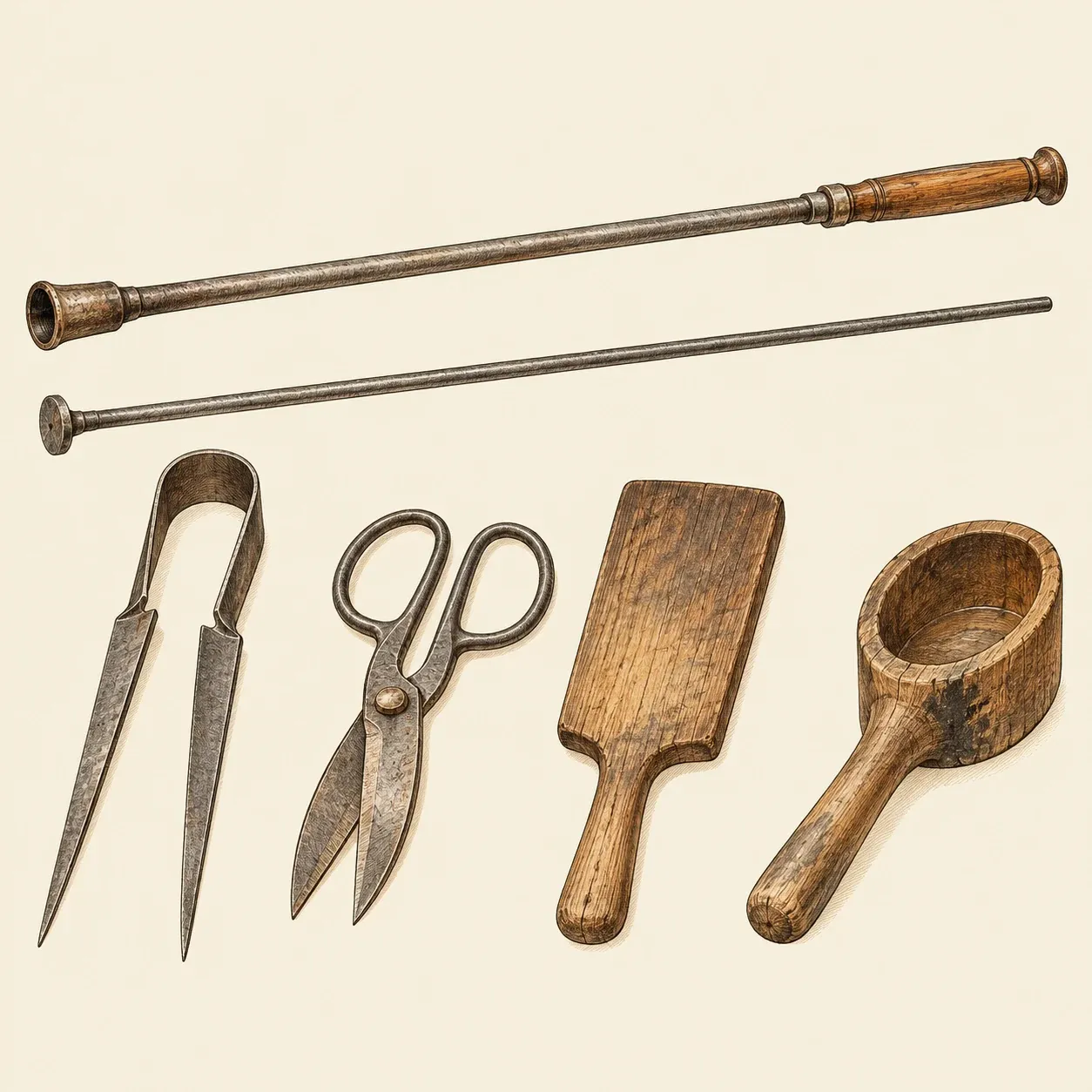 The glassblower’s tools: blowpipe, iron rod, jacks, shears, paddle and wooden block.
A glassblower dips the end of an iron blowpipe into a pot and turns it to wind up a gather of molten glass, like honey on a spoon. Rolling it on the marver, a smooth slab of stone or iron, centres it and cools its skin. A puff of breath makes a bubble. The worker then reheats the piece at the working opening, blows and swings it to stretch it, and shapes it with jacks, paddles and wooden blocks. To finish the rim, the vessel is attached by its base to a solid iron rod, the pontil, and cracked off the blowpipe.
Glass shrinks as it cools, and its outer skin hardens before the inside. A piece cooled in open air keeps stresses locked inside it and can burst hours later. Annealing prevents this: the finished vessels go into a hot chamber and cool slowly over many hours. Agricola noted that vessels not cooled slowly “would burst asunder”.
Colour comes from impurities and additions. Iron in the sand tints glass green or brown; manganese, which Roman-era glassmakers added as a decolouriser, counteracts it, and cobalt gives a deep blue.
How to build it
Glass is gathered from a furnace at well over 1,000 °C and shaped while it is still glowing hot. Learn glassblowing in a hot shop or a glass course with an instructor; studios rent furnace time once you know the basics.
Start from cullet. Beginners work from ready-made glass, bought as cullet made for remelting and melted in the studio furnace. Making glass from a raw batch of sand, soda and lime takes higher temperatures and long melts, and the raw powders are hazardous.
Gather and marver. Preheat the end of the blowpipe, dip it into the pot and turn it steadily to collect a small gather. Roll it on the marver to make it round and even.
Blow and shape. Blow a short puff, cap the mouthpiece with your thumb and let the air warm and expand. Reheat often at the glory hole and keep the pipe turning so the glass does not sag. Shape with wet wooden blocks, paddles and jacks, and use the jacks to form a narrow neck, the jack line, between the piece and the pipe.
Transfer and finish. A helper brings a pontil with a dab of hot glass to the base; chill the jack line with a drop of water from the jacks and tap the pipe to release the piece onto the pontil. Reheat, open the rim with the jacks, then, as the instructor directs, release the piece from the pontil onto a heat-proof support and place it gently in the annealer.
Anneal. The annealing oven holds the piece at a set temperature, then cools it slowly on a schedule matched to the glass and its thickness; for small pieces the cycle usually runs overnight. Handle it only once the instructor’s cycle is complete.
Safety. Furnaces, glory holes and hot glass cause severe burns and fires: wear natural-fibre clothes and closed shoes, tie back hair, and treat every piece of glass as hot until proven cold. Use eye protection made for glasswork against glare and infrared. Silica sand and batch powders must not be breathed in, so leave raw glassmaking to equipped workshops. Anneal every finished piece, and never expose hot glass to water or a sudden draught: it can shatter. Melt only glass the studio has approved, of known composition, in a ventilated furnace: old lead crystal and unknown coloured glass can give off harmful fumes.
History and evolution
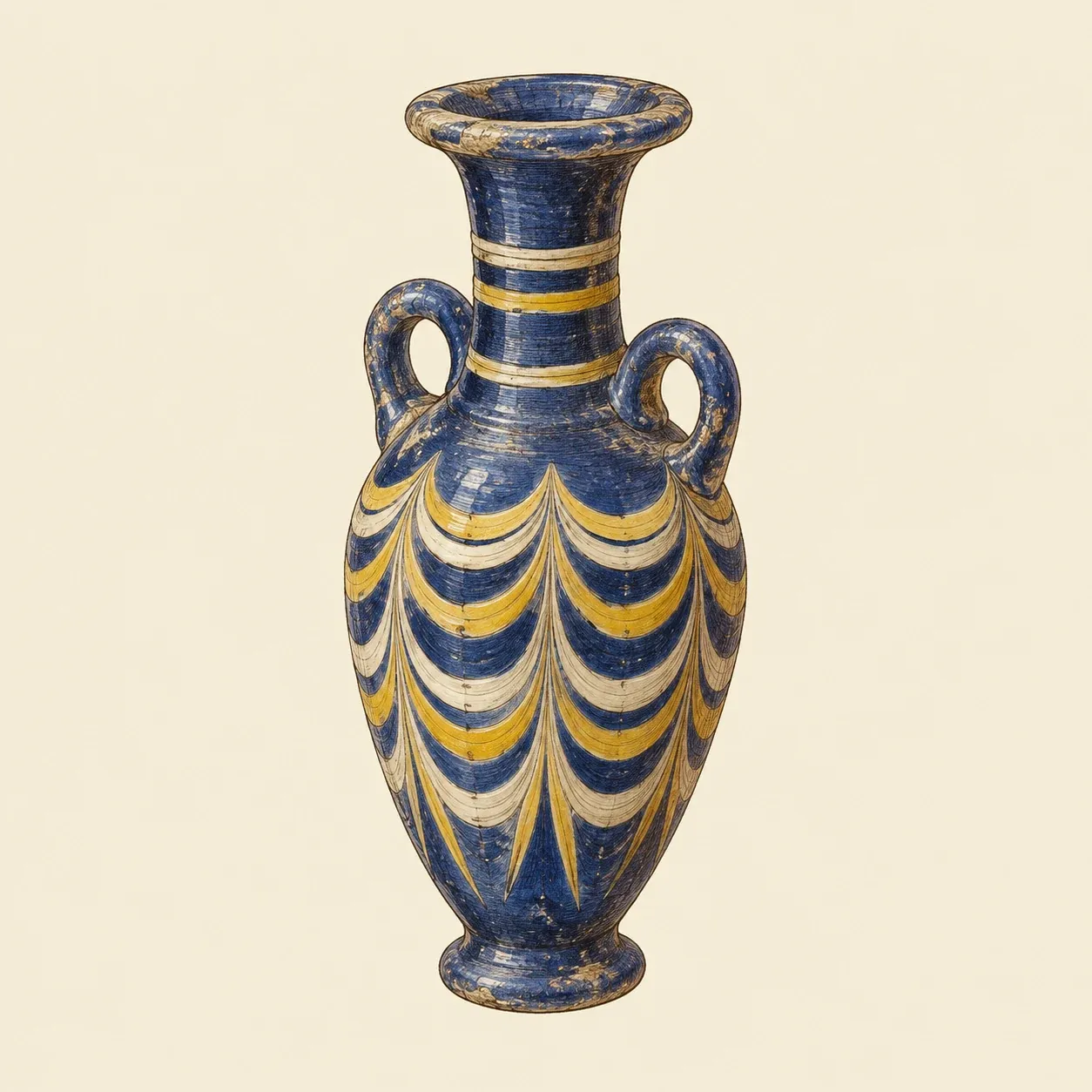 A core-formed flask: before glassblowing, small vessels were built up around a removable core.
Glass first appears as small beads in Mesopotamia in the second half of the third millennium BCE, probably as an offshoot of glazes and faience. The first vessels, from the late sixteenth century BCE, were made in northern Mesopotamia and soon in Egypt by core-forming: hot glass was wound around a core of clay and sand on a metal rod, decorated with coloured trails, and the core was scraped out once the glass had cooled.
Glassmaking later split into two trades. Large furnaces near the coasts of the Levant and Egypt turned sand and natron into raw glass, cast as slabs that could weigh around 10 tonnes; the slabs were broken, and the chunks travelled across the Mediterranean to workshops that remelted and shaped them. This division of work was in place by the middle of the first millennium BCE. In the second half of the first century BCE, craftsmen in this region learned to inflate glass on a blowpipe. The earliest closely dated evidence, glass tubes blown into bulbs, comes from a workshop in Jerusalem. Blowing made glass cheap, and in the Roman empire it became tableware, storage bottles and window panes.
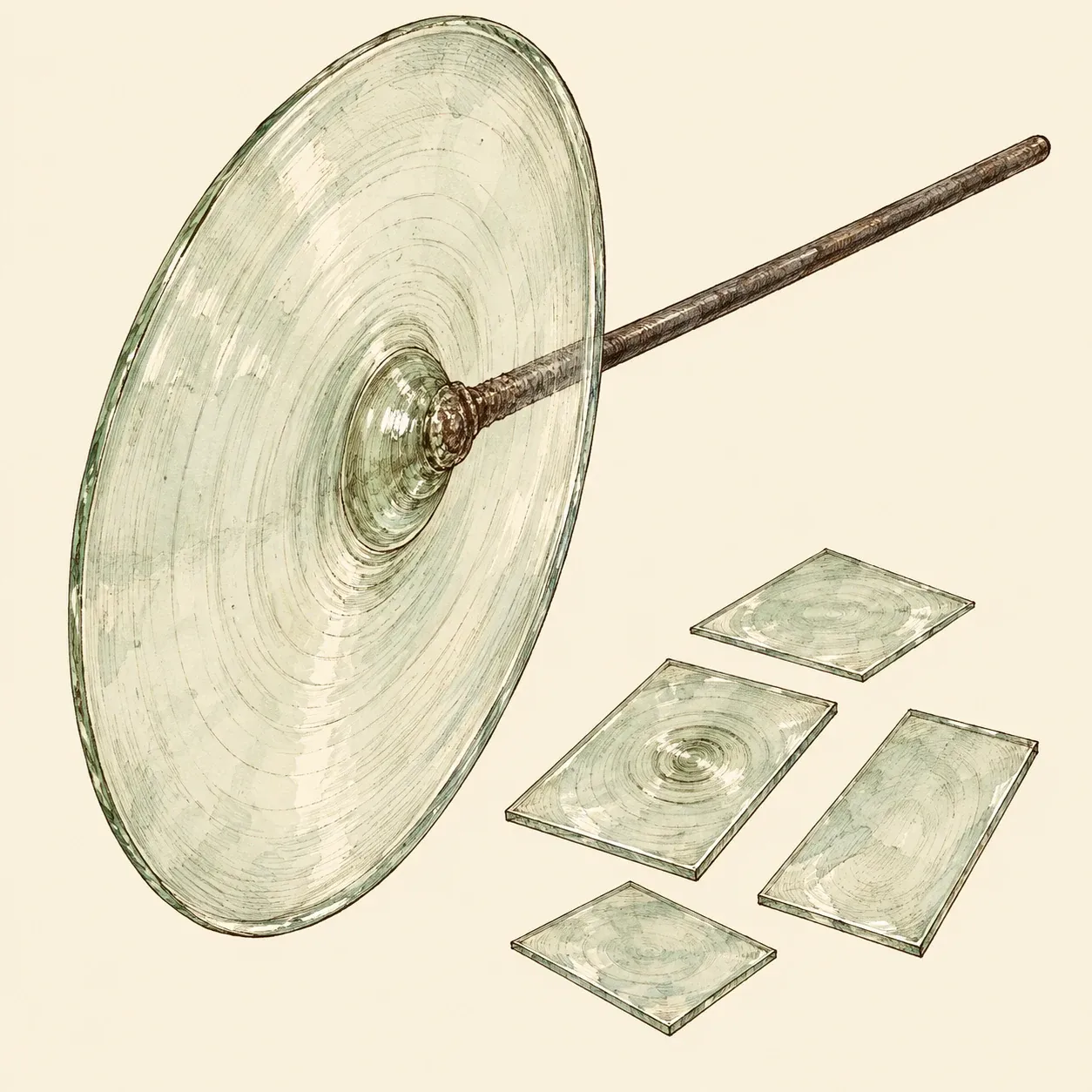 Crown glass: a bubble opened on the pontil and spun into a disc. The thick centre where the rod was attached is the bull’s-eye.
In northern Europe from around 1000 CE, glassmakers used potash from wood ash instead of soda. In 1291 Venice ordered its glassmakers to move their furnaces to the island of Murano. George Ravenscroft, who patented a new clear glass in 1674, is traditionally credited with English lead crystal. For centuries window panes were cut from crown glass, a bubble spun open into a flat disc, or from blown cylinders split and flattened, and both methods limited the size of a pane. In the 1950s Alastair Pilkington and Kenneth Bickerstaff developed the float process at St Helens, in which molten glass spreads on a bath of molten tin into a flat ribbon. It went into profitable production around 1960 and is now the standard way to make window glass.