Penicillin
An antibiotic made by a mould
Plate
- 1Penicillium mould colony
- 2Clear zone around the mould
- 3Bacterial colonies
- 4Glass Petri dish
- 5Brush-shaped spore head
- 6Chain of spores
Anatomy
Loading the figure…
Penicillin is a substance made by Penicillium moulds that kills many kinds of bacteria by stopping them from building their cell walls. Alexander Fleming noticed it in 1928, and an Oxford team turned it into the first mould-derived antibiotic in wide medical use during the Second World War.
What it is
Penicillin is an antibiotic, a drug that kills bacteria or stops their growth. Unlike the synthetic sulfonamides of the 1930s, which came out of research on dyes, it is produced by a living organism. Certain strains of Penicillium, a genus that includes the blue-green moulds seen on old bread and fruit, produce it. Purified, penicillin became the first antibiotic from a mould that doctors could use widely, and it changed the outlook for infections that had often been fatal, such as blood poisoning, pneumonia and infected wounds. Mould on food, by contrast, is not a medicine and can itself be harmful.
The plate shows Fleming’s famous observation on the left: a glass dish of bacterial colonies where a stray mould spore has landed by chance and grown into a colony, with a clear ring around it where the bacteria have died. On the right is the mould itself under the microscope. Its spores grow in chains on little brush-like heads, which gave the genus its name, from the Latin penicillus, a small brush.
How it works
Most bacteria are single cells wrapped in a tough wall that holds them in shape against the pressure of the water inside. The wall is a mesh of sugar chains tied together by short peptide links. As the cell grows and divides, it keeps cutting and rebuilding this mesh.
Penicillin blocks the bacterial enzymes that tie the links. The cell goes on growing, but its new wall is weak. Water pushes in, and the cell bursts. Human and animal cells have no such wall, which is why penicillin can kill bacteria while leaving the patient’s own cells largely untouched. At the heart of the molecule is a strained four-sided ring of atoms, the beta-lactam ring, which reacts with those enzymes and puts them out of action.
Penicillin works best on bacteria with a thick, exposed wall, such as streptococci and pneumococci. The bacterium that causes syphilis has a thin wall tucked between two membranes, yet it too is very sensitive to penicillin. Penicillin has no effect on viruses, which have no cell wall at all.
Bacteria can become resistant. Some make an enzyme, penicillinase, that cuts the beta-lactam ring before it can act. Every use of an antibiotic favours the bacteria that survive it, so resistance spreads where antibiotics are used carelessly. Fleming warned of this in his Nobel lecture in 1945. Some people are also allergic to penicillin, occasionally severely. Antibiotics are medicines to be used only on a doctor’s prescription.
How it is made
Between 1940 and 1945 the ways of growing the mould, extracting the drug from the broth and measuring it all changed several times.
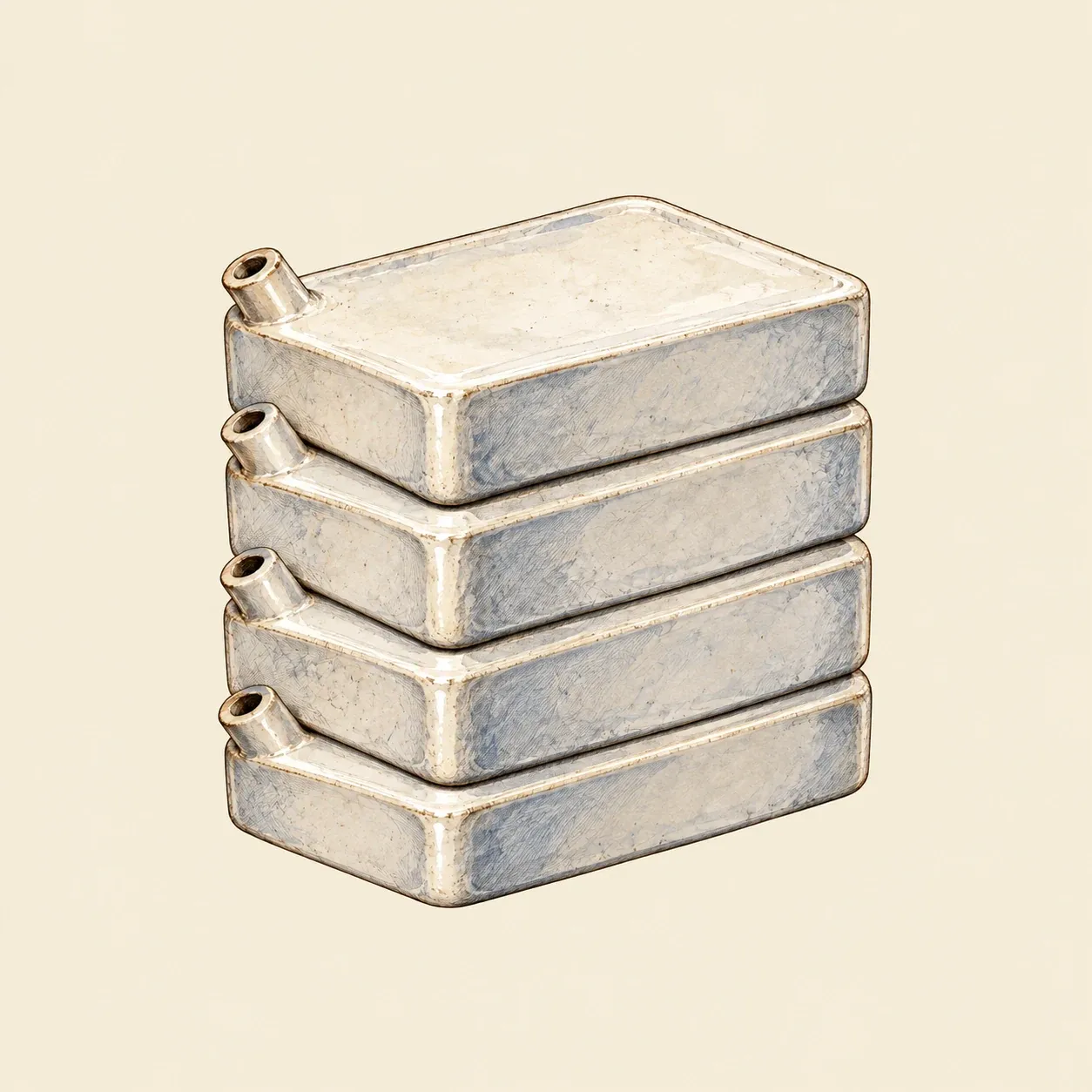 Norman Heatley designed ceramic vessels like these to grow the mould in quantity in Oxford.
Surface culture in Oxford. Florey’s team grew Fleming’s strain of Penicillium notatum as a felt floating on a shallow layer of nutrient broth. Norman Heatley first used anything with a wide flat bottom, including bedpans, biscuit tins and pie dishes, then designed a rectangular ceramic vessel that could be stacked on its side for incubation. A Staffordshire pottery, James Macintyre & Co., made several hundred of them, and the first were seeded at Christmas 1940. A small team of young women, nicknamed the penicillin girls, sowed the spores, drew off the broth once the growing mould had released penicillin into it and kept the vessels going around the clock.
Extraction. The broth held only a trace of penicillin, and the drug broke down within hours when warm or acid. Heatley used the fact that penicillin is an acid. Acidified and kept cold, it passes from the broth into a solvent that does not mix with water, first ether and then the less flammable amyl acetate. Shaken with water made slightly alkaline, it passes back into water as a salt, in a far smaller volume and freed from much of the impurity. Heatley built an apparatus of glass tubes, bottles and pumps that did this continuously. The concentrated solution was then freeze-dried into a brown powder that kept for months, although early batches were mostly impurity.
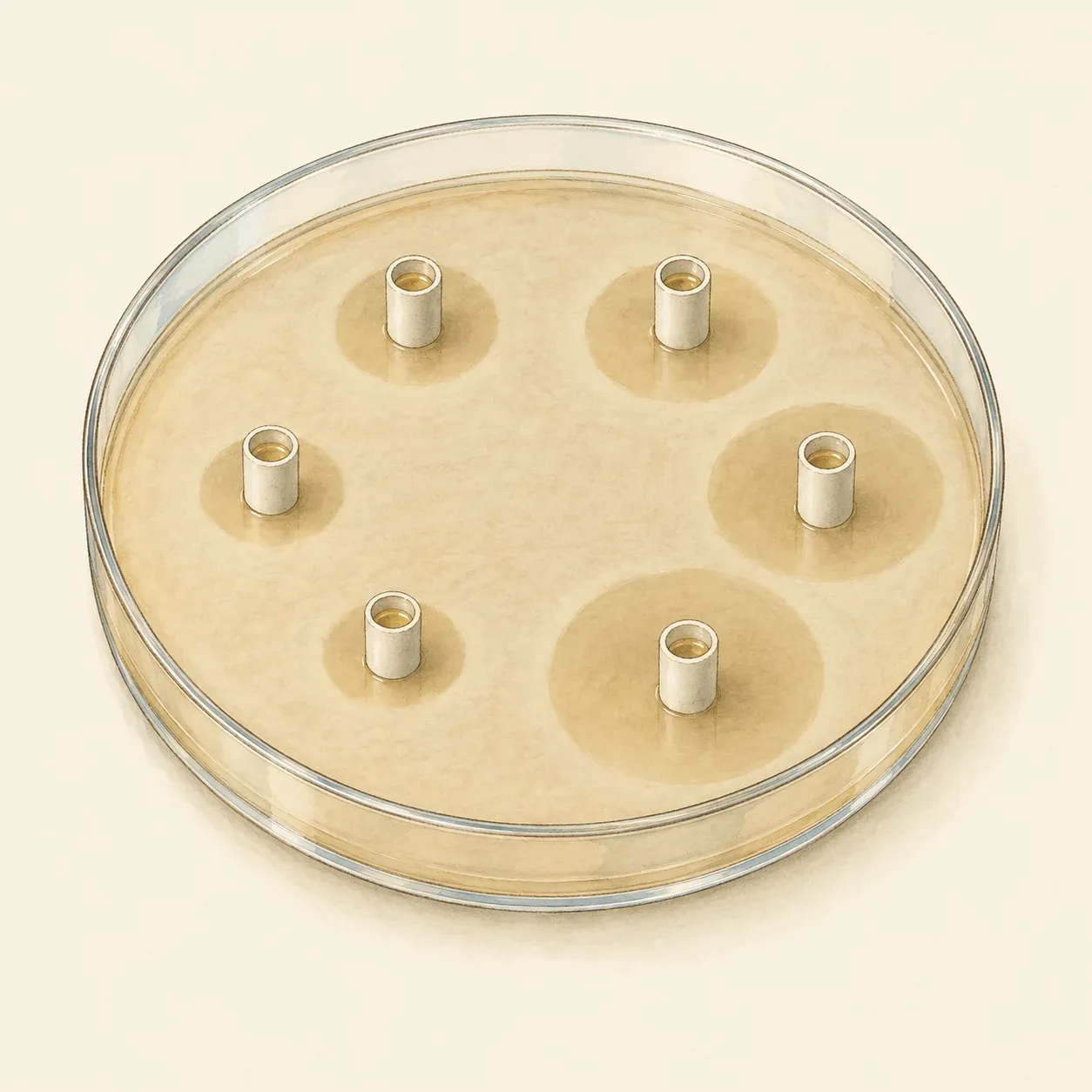 Heatley’s cylinder-plate assay: the stronger the sample in a cylinder, the wider the clear ring around it.
Measurement. Before its structure was known, penicillin could only be measured by what it did to bacteria. In Heatley’s cylinder-plate assay, small open cylinders stand on a dish of agar seeded with staphylococci, each filled with a sample. The penicillin spreads out into the agar, and after incubation the width of the clear ring around each cylinder, compared with that of a standard, gives the strength. The Oxford team defined its own unit this way and sent samples to other laboratories. In 1944 and 1945 British and American scientists agreed an international unit, equal to 0.6 micrograms of pure sodium benzylpenicillin and close to the Oxford unit, and prepared standard samples.
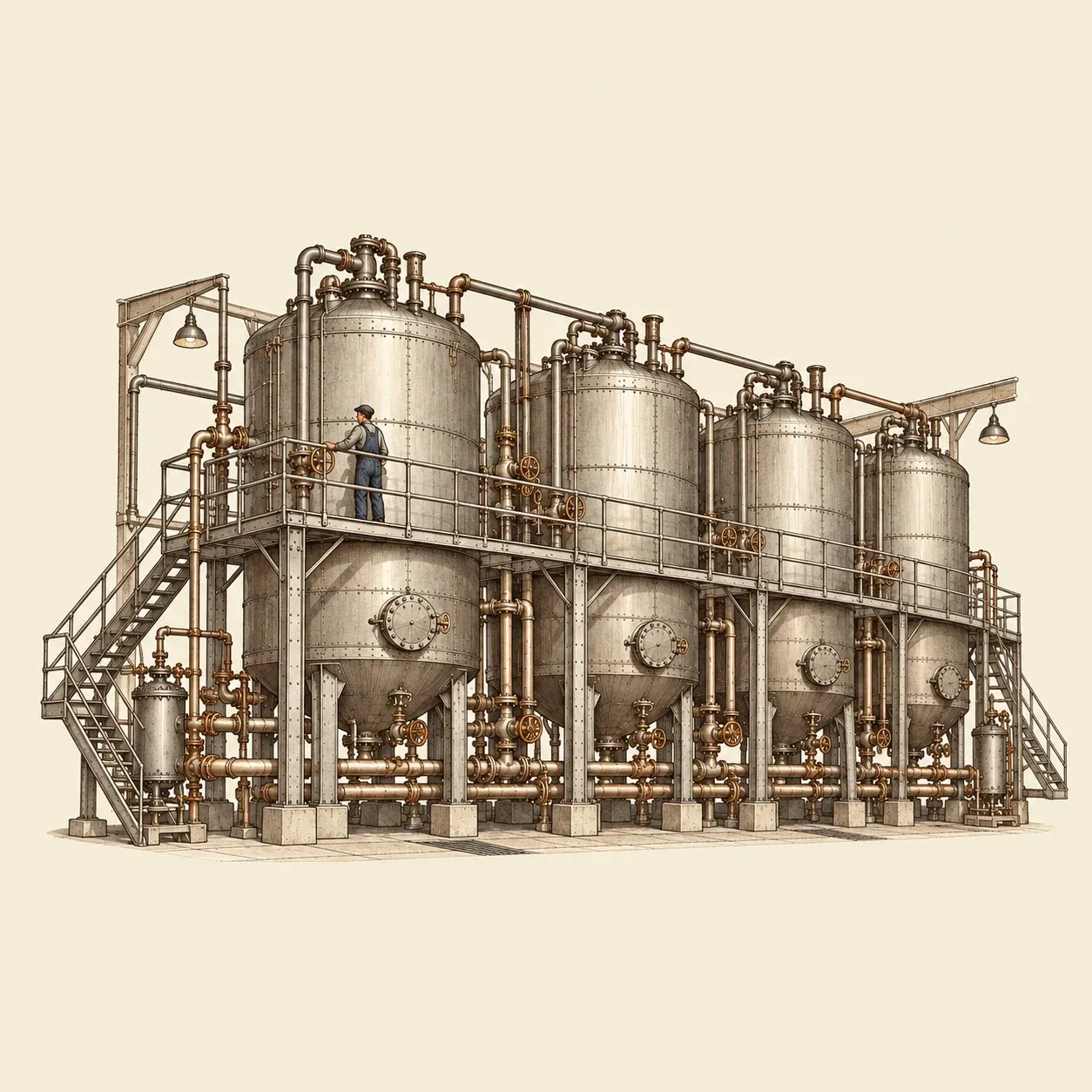 Deep-tank fermentation in the United States turned penicillin into an industrial product.
Deep tanks in the United States. At the Northern Regional Research Laboratory in Peoria, Andrew Moyer, working with Heatley, raised yields about tenfold by late 1941 by adding corn steep liquor, a by-product of making starch from maize, to the broth. The laboratory tested moulds sent from all over the world, and a strain of Penicillium chrysogenum (now classed as P. rubens) from a mouldy cantaloupe bought in Peoria turned out to be the best. Strains bred from it, including mutants obtained with X-rays and ultraviolet light, did better still. The larger change was to grow the mould throughout the liquid instead of on its surface, in closed steel tanks that were stirred and fed with sterile air. Pfizer already used this method to make gluconic acid, and on 1 March 1944 (one account says 1943) it opened the first large plant for penicillin in Brooklyn, a converted ice factory, with fourteen tanks of 7,500 US gallons (about 28,000 litres) each. A single stray microbe could spoil a whole tank, so the broth and the tanks were sterilised before the mould was added, and the air and pipes kept other organisms out while it grew.
Semi-synthetic penicillins. Fermentation mainly yields benzylpenicillin, or penicillin G, especially when the broth is fed phenylacetic acid, which the mould builds into the molecule. In 1957 chemists at Beecham Research Laboratories in Surrey isolated the bare core of the molecule, 6-aminopenicillanic acid, and published the work in 1959. By attaching new side chains to this core, chemists made penicillins that survive stomach acid, resist the bacterial enzyme penicillinase or act on more kinds of bacteria, such as cloxacillin and amoxicillin. Today the core is usually cut from fermented penicillin with an enzyme, and factories test every batch for identity, purity and potency, and injectable forms for sterility, before release.
Safety. This section describes how laboratories and factories produced the drug. Penicillin cannot be made safely at home: mould on bread or fruit contains little or none of it and may belong to species that make toxins, and an impure preparation can cause severe infection or shock. Penicillin can also cause serious allergic reactions, and it is used only on prescription.
History and evolution
People had noticed for centuries that some moulds seemed to help wounds, and in the 1890s several researchers reported that moulds could hold back bacteria. None of these findings led to a treatment.
Alexander Fleming, a bacteriologist at St Mary’s Hospital in London, went on holiday in the summer of 1928. When he came back in early September he found that a dish of staphylococci had been contaminated by a mould, and that the colonies near it had faded away. He grew the mould, showed that its broth killed many kinds of bacteria, named the active substance penicillin and published his results in 1929. But penicillin was unstable and hard to extract, and Fleming did not manage to obtain enough of it in pure form to treat patients.
Ten years later, at Oxford, Howard Florey and Ernst Chain took up the problem. Norman Heatley worked out how to extract and concentrate penicillin, and the team grew the mould in hundreds of vessels. On 25 May 1940 they infected eight mice with streptococci and treated four of them. By the next morning the four untreated mice were dead and the treated ones were still alive. In February 1941 a police constable, Albert Alexander, became one of the first patients. He improved at first, but the supply ran out and he died.
Wartime Britain could not produce penicillin on a large scale, so in 1941 Florey and Heatley went to the United States, where a government laboratory in Peoria, Illinois, and several drug companies took up the work. In March 1942 the American supply was enough to treat a single patient. By 1944 factories were making enough for the Allied armies, and from 15 March 1945 it reached American pharmacies through normal commercial channels.
Fleming, Florey and Chain shared the Nobel Prize in Physiology or Medicine in 1945. In the same year Dorothy Hodgkin worked out the structure of penicillin by X-ray crystallography. The search for other antibiotics had meanwhile produced streptomycin, discovered in 1943; the tetracyclines and many others followed, and chemists later made new penicillins by modifying the molecule.