Solar cell
Sunlight turned into current
Plate
- 1Glass cover
- 2Front contact grid
- 3Thin n-type layer (phosphorus)
- 4p–n junction
- 5p-type base (boron)
- 6Back contact
Anatomy
Loading the figure…
A solar cell is a thin slice of semiconductor in which light frees electrons and a built-in electric field drives them out as a current, with no moving parts and no fuel. Bell Labs showed the first practical silicon cell in 1954, and solar power supplied 8.7% of the world's electricity in 2025.
What it is
A solar cell turns light straight into electric current, with no moving parts and no fuel. Most cells are square slices of silicon a little wider than a hand. Each gives about half a volt in sunlight, so dozens are wired together behind glass to make a panel, like the one of 36 cells on the plate.
The date chosen here is April 1954, when Bell Labs showed a silicon cell that converted about 6% of sunlight into electricity, enough to run real equipment. Becquerel had seen light produce a current in 1839, but the selenium cells made from 1883 converted under 1%.
How it works
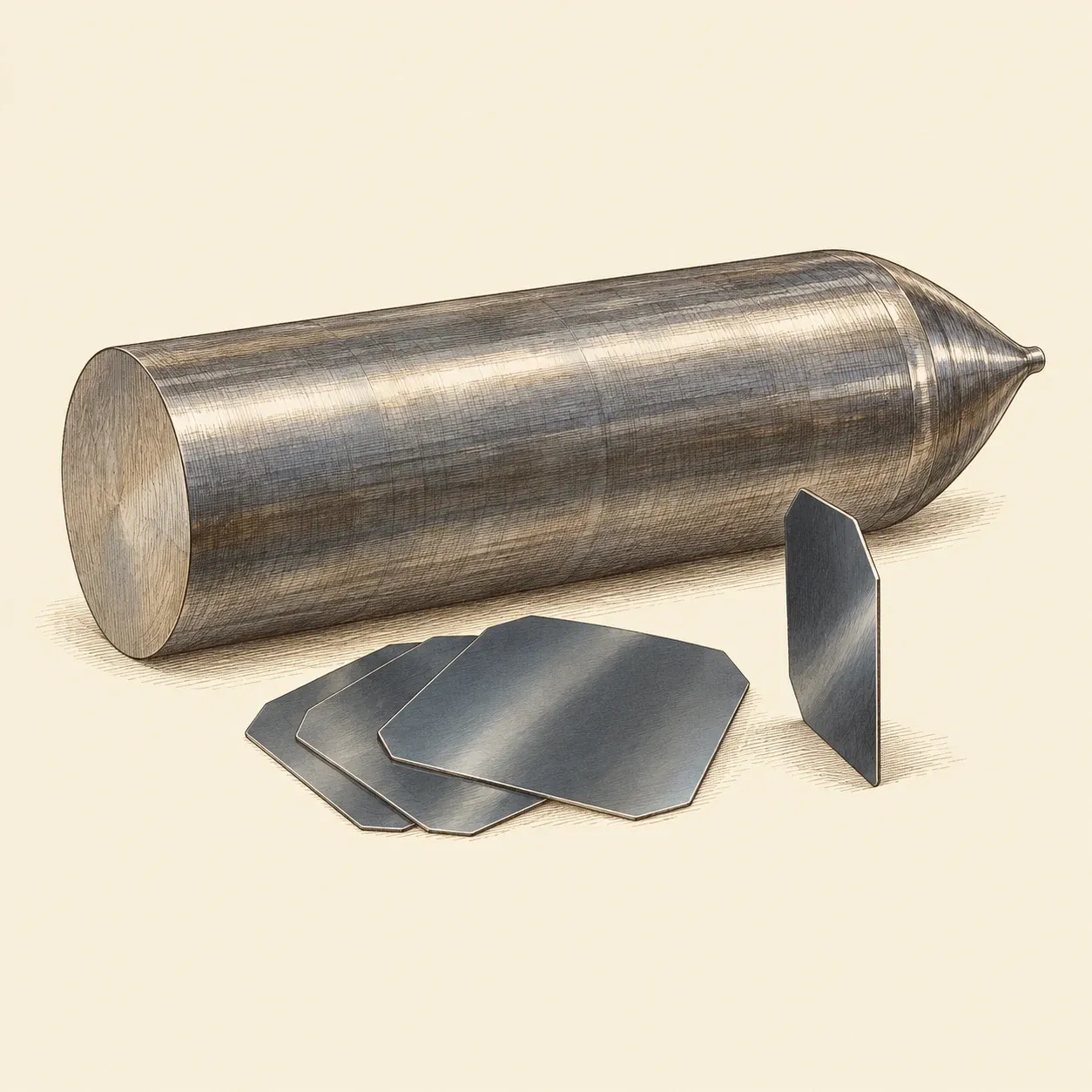 Cells are sawn from a single crystal of silicon grown from the melt; a wafer today is about 0.14 mm thick.
Pure silicon conducts poorly. Doping it with a trace of phosphorus gives it spare electrons (n-type); a trace of boron leaves gaps called holes, which act as positive charges (p-type). A classic cell is a boron-doped wafer whose front face has been soaked with phosphorus to less than a thousandth of a millimetre. Where the two regions meet, electrons and holes cancel out in a narrow zone, leaving fixed charges that hold a permanent electric field across this p–n junction.
A photon of light with enough energy knocks an electron out of its bond and leaves a hole behind. Near the junction, the field pushes the electron to the n side and the hole to the p side. The electrons gather in the front fingers, flow through the outside circuit, lighting a lamp or charging a battery, and return through the back contact.
An unconnected cell shows about 0.6 to 0.7 V, and about 0.5 V while delivering power. The voltage changes little with brightness, but the current follows the light: half the light, about half the current. Cells in series add their voltages, so 36 cells work at about 17 V, enough to charge a 12 V battery. Panels in parallel add their currents. One shaded cell holds back its whole series string, which is why panels carry bypass diodes.
Silicon lets infrared light beyond about 1.1 micrometres pass through unused, and photons with more energy than needed waste the surplus as heat. In 1961 William Shockley and Hans-Joachim Queisser showed that these losses keep a single-junction cell to about a third of sunlight at best. Silicon has further losses inside the crystal itself, which bring its own limit down to about 29%; the best laboratory cell reached 28.1% by 2026. Heat also lowers output: a conventional silicon cell loses about 0.4 to 0.5% of its power for each degree Celsius, mostly through lower voltage.
How to build it
Making cells is factory work. A small 12 V system built from bought panels, with compatible parts and each maker’s instructions, is within reach of a careful amateur.
Size the panel. Four 5 W LED lamps for 4 hours and a 10 W radio for 2 hours use 100 watt-hours (Wh) a day. A panel gives about its rated power × peak sun hours (the day’s sunlight counted as hours of full sun, in the darkest month) × 0.7 for heat, dust and wiring losses. A 100 W panel with 3 peak sun hours gives about 210 Wh, a fair margin.
Choose the battery. Plan for one to three cloudy days. Lead-acid lasts longer if rarely drained below half. Lithium iron phosphate can use most of its capacity, but only with its own management electronics and a controller set for lithium; most must not be charged below freezing. Two days of 100 Wh from a 12 V lead-acid battery used to half call for at least 33 Ah: take 40 Ah.
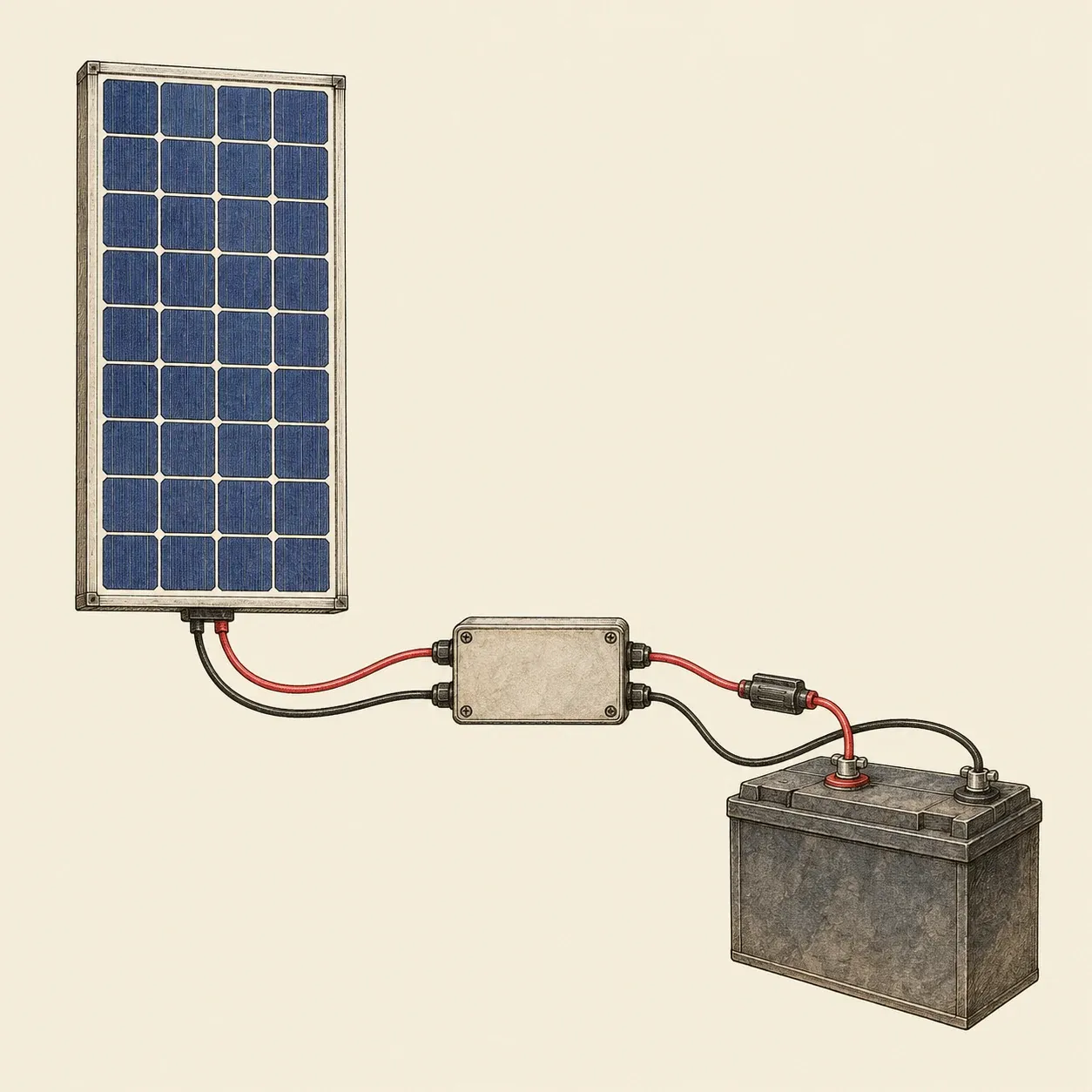 Panel, charge controller and battery, with the fuse on the positive cable next to the battery.
Fit a charge controller. Never wire a panel straight to a battery. The controller tapers the charge so the battery is never overcharged, then holds it full, and loads wired to its load output are cut before the battery runs flat. A simple PWM controller should be rated for at least 1.25 times the panel’s short-circuit current. For an MPPT model, compare its voltage, current and power limits with the panel’s datasheet, remembering that open-circuit voltage rises in cold weather.
Fuse and cables. Fit a fuse rated for direct current in the positive cable, right next to the battery. Its rating must be below the cable’s capacity and above the largest normal current, and it must be able to break the very large current a battery delivers into a short. At 10 A, a panel 5 m away (10 m of copper) loses about 0.3 V through 6 mm² outdoor cable; thinner wire wastes more.
Mount and clean. Face the panel towards the equator, unshaded through the middle of the day, tilted at about the latitude for year-round use. Rinse dust off with water and a soft brush. An inverter can turn the 12 V into mains voltage, as dangerous as the grid itself.
Test one cell. In sun, read a small cell’s voltage on the DC volts setting of a multimeter. Then select DC amps, move the red lead to the 10 A socket and touch the cell’s terminals: this reads its short-circuit current. First check that the current printed on the cell is well below the meter’s 10 A limit, and keep the probes on for only a few seconds. In shade the voltage barely moves while the current drops. Put the red lead back in the volts socket afterwards, and never measure a battery’s current this way.
Safety. A panel makes voltage whenever light reaches it: cover it while wiring. Direct current can hold an arc when a connector is pulled under load, so to work on the system, cover the panel, disconnect the panel first and the battery last, and reconnect in the reverse order. A short across a battery melts tools and starts fires, and the fuse cannot stop a spanner laid across both terminals: use insulated tools and terminal covers. Charging lead-acid batteries release hydrogen: ventilate, no sparks, wear eye protection. On a roof, use a harness and anchor point or call professionals. Anything connected to the mains, including inverters, is work for a qualified electrician.
History and evolution
In 1839 Edmond Becquerel, aged 19, lit electrodes coated with silver chloride in acid and measured a small current. In 1873 Willoughby Smith, testing undersea telegraph cables, found that selenium conducts better in light, and in 1883 Charles Fritts made cells of selenium under see-through gold leaf. In 1905 Albert Einstein explained that light comes in packets whose energy depends on its colour.
In 1940 Russell Ohl at Bell Labs found that a silicon sample with phosphorus on one side and boron on the other gave a current under light: the first p–n junction, about 1% efficient. In 1953 his colleague Daryl Chapin, seeking power for telephone equipment in remote places, got 0.5% from selenium. Calvin Fuller and Gerald Pearson’s doped silicon did much better, and the cell Bell Labs showed on 25 April 1954 drove a toy Ferris wheel.
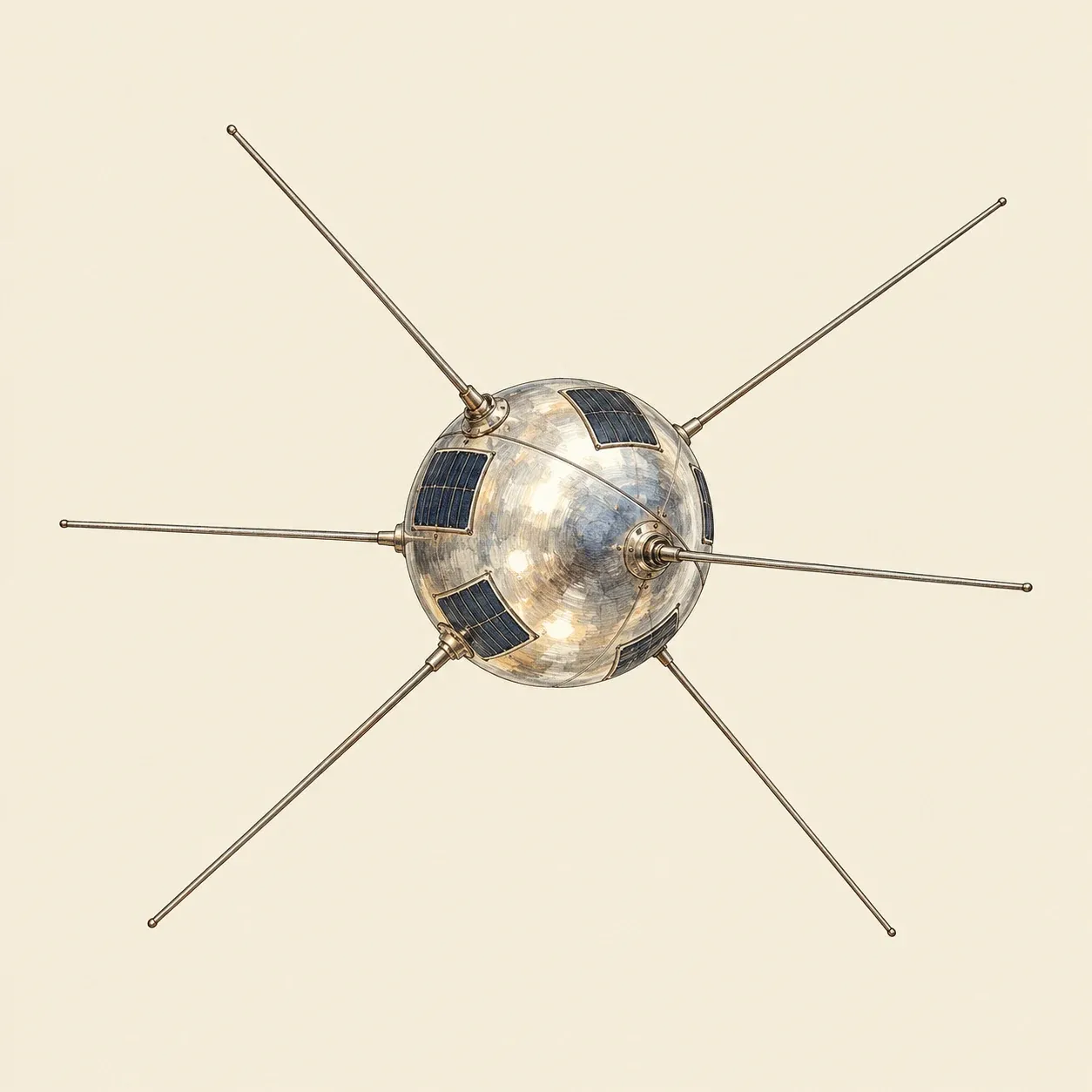 Vanguard 1, 1958: six small panels of solar cells on a sphere about 16 cm across.
The first silicon cells cost far too much for ordinary use, and their first steady customer was space. Vanguard 1, launched in March 1958, carried six small panels of 18 cells each: its battery-powered transmitter stopped in June 1958, the solar one kept sending until May 1964. As factories grew, module prices fell from about $132 per watt in 1975 to $0.27 in 2024 (in 2025 dollars). Most cells made today start from phosphorus-doped wafers with boron at the front. In 2025 solar panels produced 8.7% of the world’s electricity, according to Ember (April 2026).