Steam Locomotive
Steam power on rails
Plate
- 1Firebox
- 2Fire tubes
- 3Blast pipe and chimney
- 4Cylinder
- 5Connecting rod
- 6Driving wheel
- 7Tender
Anatomy
Loading the figure…
A steam locomotive is a steam engine on wheels that carries its own fuel and water and hauls trains along rails. Richard Trevithick ran the first one in Wales in 1804, and Robert Stephenson's Rocket of 1829 set the pattern that most later locomotives followed: a boiler full of fire tubes, a blast pipe under the chimney and cylinders driving the wheels directly.
What it is
A steam locomotive is a steam engine mounted on a wheeled frame, built to haul trains on a railway. It carries coal or coke and water with it, burns the fuel in a firebox, and turns the pressure of the steam into the rotation of its driving wheels through pistons and rods. The iron wheels run on iron or steel rails, which roll far more easily than wheels on a road, so one engine can pull many loaded wagons.
The plate shows Rocket, built in 1829 by Robert Stephenson and Company in Newcastle upon Tyne. It brought together in one machine a boiler crossed by many fire tubes and a blast pipe, and both features stayed standard on later steam locomotives.
How it works
The fire burns on a grate in the firebox at the back of the engine. Its hot gases pass forward through the boiler barrel inside 25 copper tubes, each about 76 mm across, surrounded by water. Many small tubes expose far more metal to the water than one large flue would, so on Rocket the tubes provided several times the heating surface of the firebox walls (the figures given in sources vary). Steam gathers above the water at about 3.4 bar above atmospheric pressure.
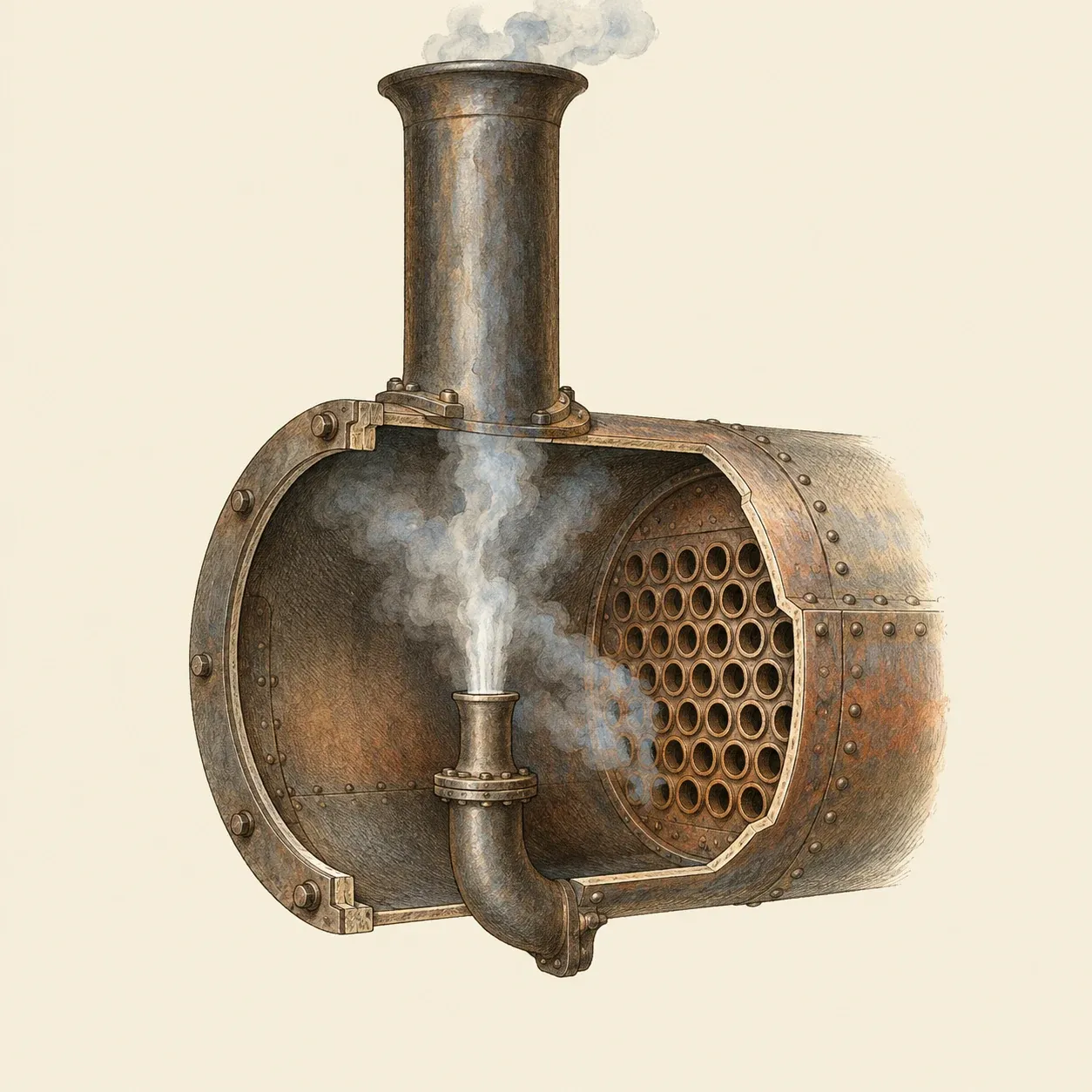 The blast pipe blows used steam up the chimney, drawing the fire harder at every stroke.
From the boiler the steam goes to the two cylinders, one on each side of the engine. A sliding valve lets it in first behind the piston and then in front of it, so the piston is pushed both ways. Each piston rod drives a connecting rod, and the connecting rod turns a crank pin set in the large front wheel on its side. The weight resting on that pair of wheels, about 2.6 tonnes on Rocket, together with the grip between wheels and rails, limits how hard it can pull before the wheels slip.
Used steam leaves the cylinders through a pipe that ends in a nozzle under the chimney, and each puff drags the smoke out with it and pulls fresh air through the fire. The harder the engine works, the stronger the draught, which helps the boiler keep up with the cylinders; the fireman still has to keep the fire fed and the boiler topped up with water.
How to build it
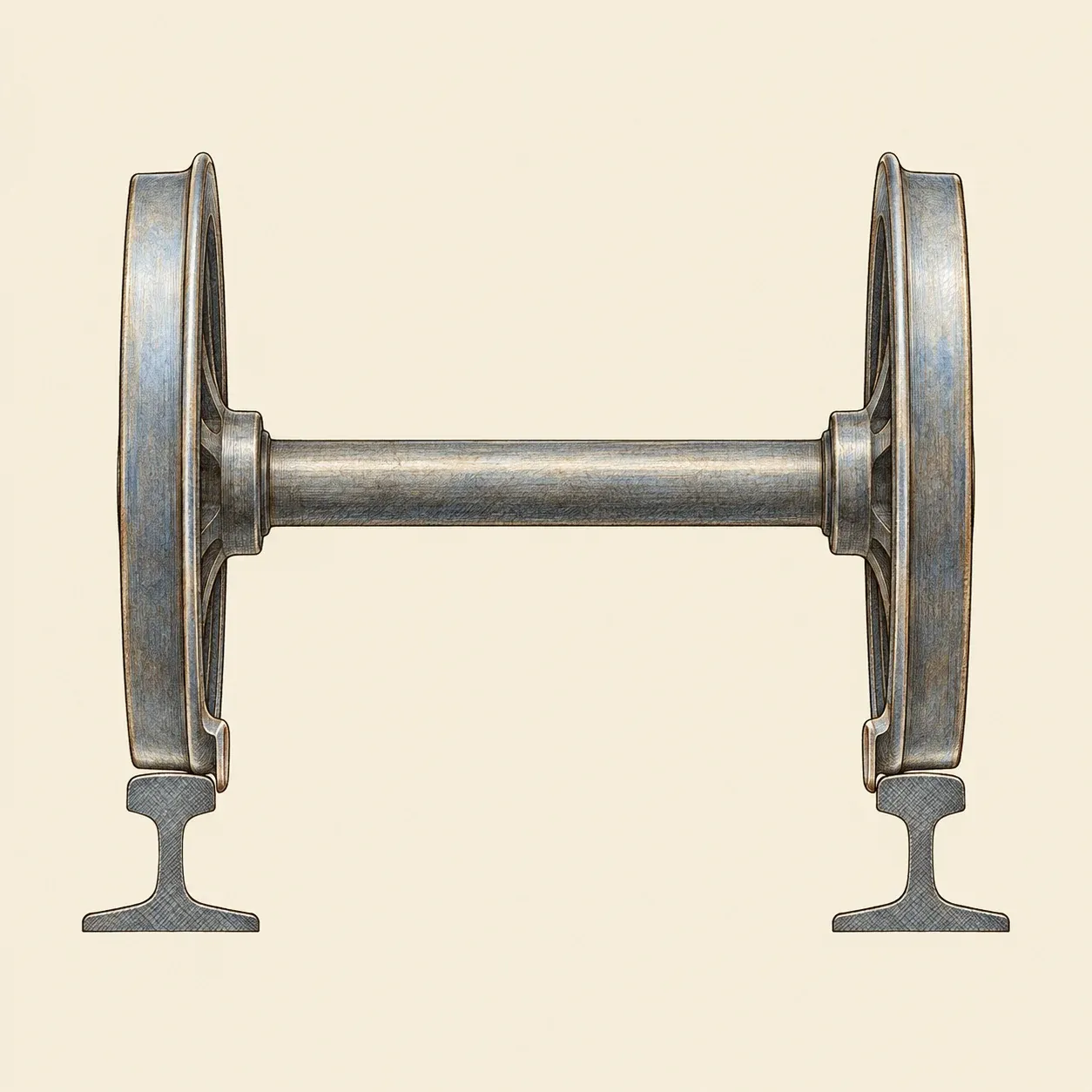 A flange on the inner edge of each wheel keeps the wheelset between the rails.
Full-size locomotives are built in railway works. Boilermakers roll iron or steel plates, rivet them into a barrel and firebox, and fix the tubes into tube plates at each end. Before it may be steamed, the boiler is tested with water at a pressure above its working pressure, set by the applicable boiler code, and examined by an independent inspector. Founders cast the cylinders, machinists bore them and fit the pistons and valves, and the wheels get iron tyres heated and shrunk on. Heritage railways that restore locomotives today are subject to similar testing and inspection.
A model with no steam shows how the wheels are driven.
Cut the wheel. Saw a disc about 20 cm across from plywood. Glue a dowel axle firmly through its centre, and drill a second hole 5 cm from the centre for the crank pin, a short dowel glued in place. Screw two upright blocks to a baseboard and drill each to take the axle loosely, so the wheel turns freely between them.
Make the cylinder. Glue a cardboard or plastic tube about 15 cm long onto a block of wood screwed to the baseboard beside the wheel, so that the tube lies in the plane of the wheel with its axis at the height of the axle and pointing at the axle’s centre. A dowel that slides freely inside it is the piston rod.
Join them. Cut a strip of thin wood about 25 cm long as the connecting rod. Drill one end to fit the crank pin and pin the other end to the outer end of the piston rod with a small nail, so it can pivot. Check that the wheel can make a full turn without the rod hitting the tube.
Run it. Push and pull the piston rod: the wheel turns once for every 10 cm forward and 10 cm back. Note the two dead points, where the crank pin, the axle and the end of the piston rod are in one straight line and pushing does nothing. Real locomotives with two cylinders set the cranks on the two sides a quarter turn apart, so that one is always away from its dead point.
Safety. Never heat water in a closed container or try to make a boiler: steam under pressure can burst a vessel and scald badly. Live-steam models should only be run from commercial kits with tested boilers and working safety valves, under adult supervision. Keep fingers clear of the crank when the wheel turns.
History and evolution
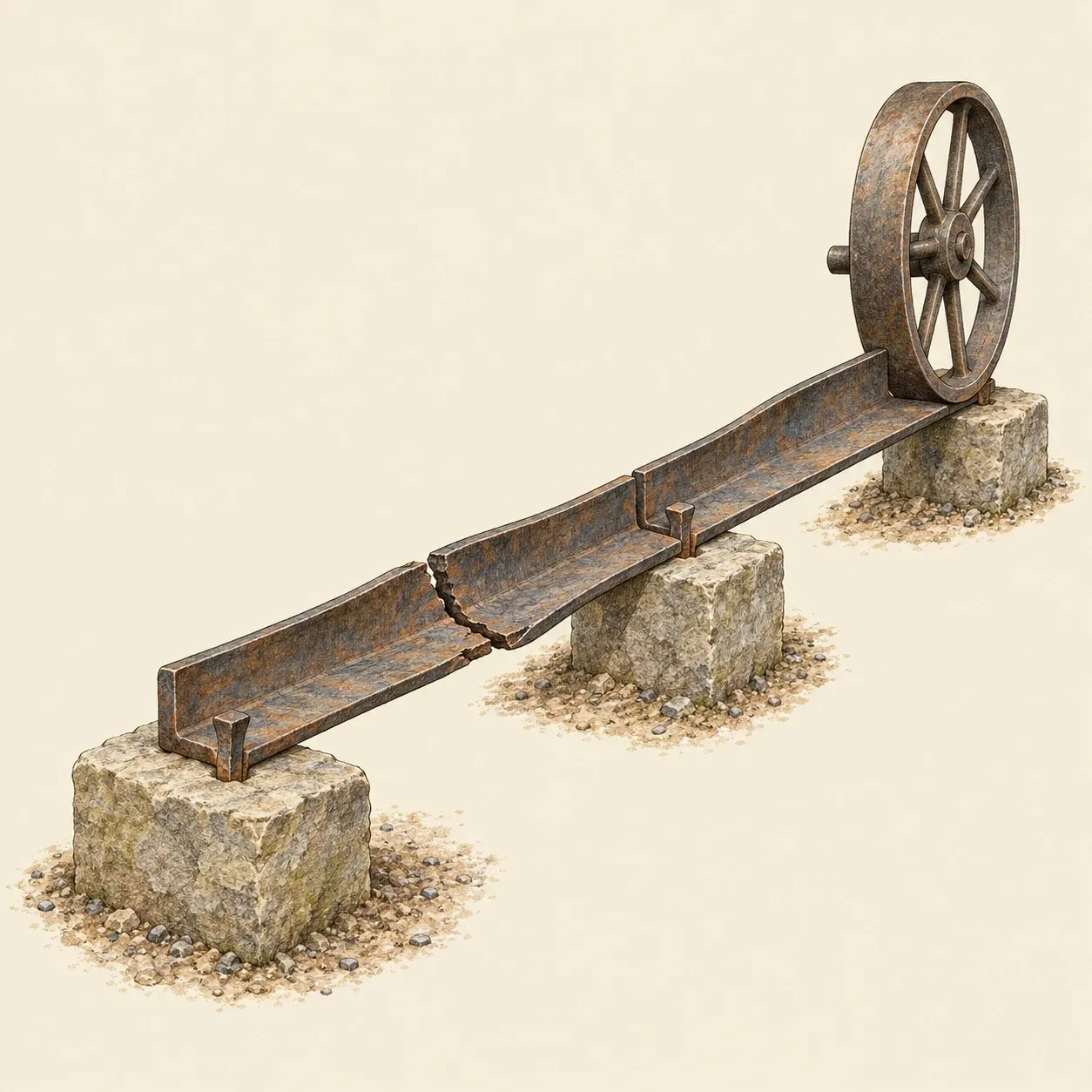 On the Penydarren tramroad, short cast-iron plates spiked to stone blocks guided wheels without flanges, and they cracked under the locomotive’s weight.
Richard Trevithick, a Cornish engineer, built the first locomotive to run on rails for the Penydarren ironworks at Merthyr Tydfil. On 21 February 1804 it hauled ten tons of iron in five wagons, with seventy men riding on them, along the tramroad towards the canal at Abercynon, about 9 miles (14 km), at nearly five miles an hour by his own account. On the way back a bolt sheared and the boiler leaked, and the engine only reached home the next day. It was too heavy for the cast-iron plates of the tramroad and broke them, and it ended its working life as a stationary engine driving a forge hammer.
In October 1829 the Liverpool and Manchester Railway held trials at Rainhill to choose its locomotives. Five machines entered and Rocket was the only one to finish. Its test runs averaged about 12 to 14 mph, depending on how the average is taken; running light it reached about 30 mph. It won the £500 prize and the order for the line’s engines. At the opening of the railway in 1830, Rocket struck and fatally injured the politician William Huskisson. It was heavily rebuilt within eighteen months and set aside within ten years. Its remains went to the Patent Office Museum in London in 1862 and are now in the Science Museum Group collection.
Later locomotives grew much larger, with more coupled wheels to carry the weight and pull heavy trains, and higher pressures. On 3 July 1938 the London and North Eastern Railway’s Mallard reached 126 mph (203 km/h) on a descent south of Grantham, still the record for steam. Mallard was withdrawn in 1963, as diesel and electric traction took over.