Control of Fire
Light, heat and cooked food
Plate
- 1Hearth stones
- 2Firewood
- 3Bow
- 4Spindle
- 5Bearing block
- 6Hearth board and notch
- 7Tinder bundle
Anatomy
Loading the figure…
Controlling fire means keeping a flame alive, moving it, and in the end lighting it at will. Human ancestors used fire at least a million years ago, and it gave them warmth, light, protection and cooked food.
What it is
Fire is a chemical reaction: fuel combines with oxygen from the air and gives off heat and light. People learned to control it in stages: first keeping a fire started by lightning or a bush fire, then carrying it and feeding it for days, and last lighting one at will.
A fire keeps people warm at night and lets them live in colder places. It lights up caves after dark, keeps animals away, hardens wooden spear points and cooks food. Cooked meat and tubers are softer and release more energy in digestion than raw ones.
How it works
A fire needs three things at once: fuel, oxygen and enough heat to keep the reaction going. Take any one away and it dies.
Wood does not burn directly. Heat first breaks it down into flammable gases and leaves charcoal behind. The gases burn in the flame above the wood, and the charcoal glows below. This is why a fire is built from small to large: thin dry twigs heat up and give off gas quickly, and they bring thicker branches up to temperature.
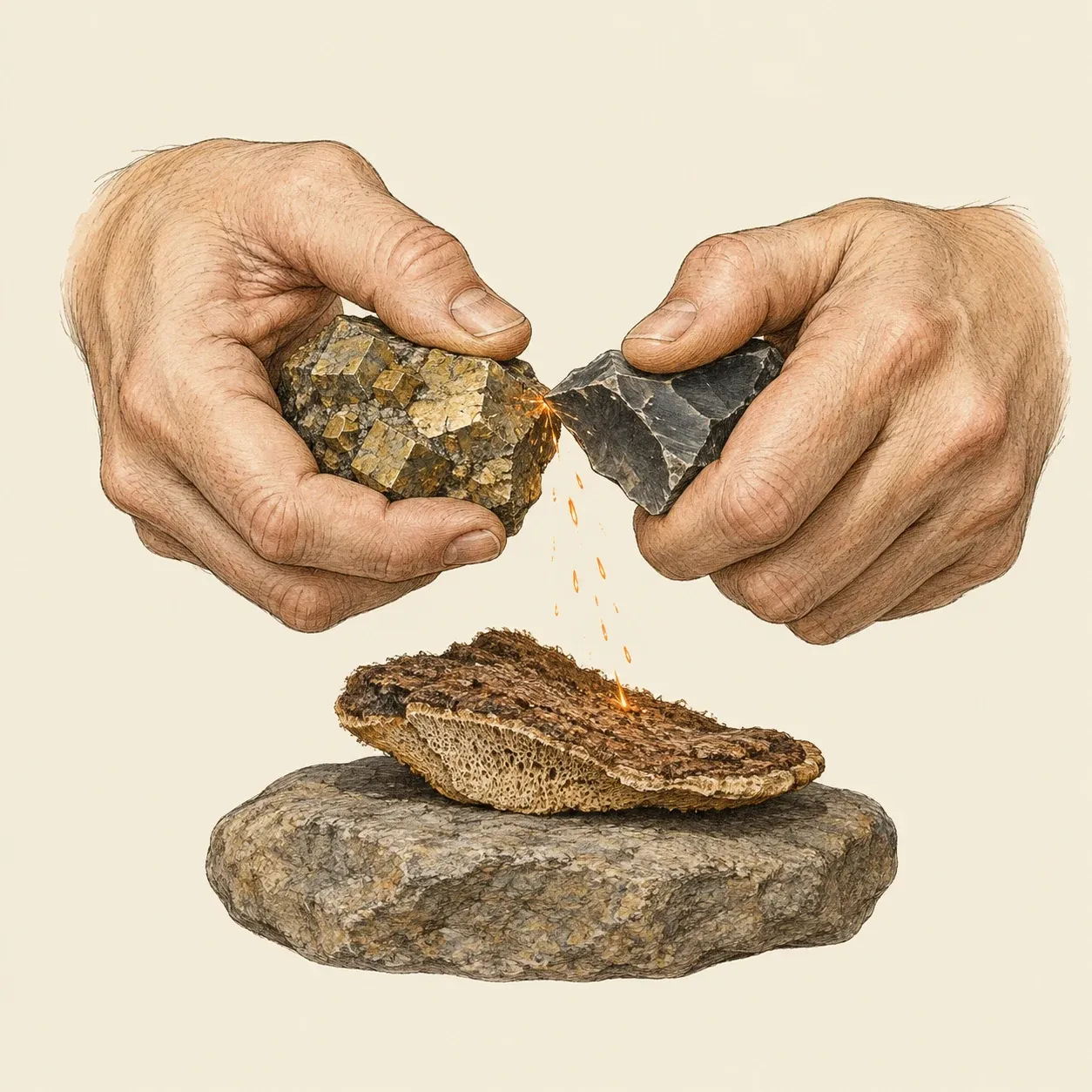 Flint struck on pyrite throws off sparks hot enough to set dry tinder fungus smouldering.
There are two common traditional ways to make fire. Friction methods rub one piece of wood against another until fine, hot wood dust collects and starts to glow. The hand drill spins a stick between the palms; the bow drill drawn on the plate does the same job with a cord wrapped round the spindle, which gives more speed with less effort. The glowing dust is an ember. Placed in a nest of dry grass and shredded bark and blown on gently, it becomes a flame.
Percussion methods strike sparks. When a hard flint edge hits iron pyrite, it tears off tiny grains of the mineral, which burn in the air as sparks. Flint struck on flint gives almost none. The sparks are small and short-lived, so they need tinder that catches easily, such as the inner layer of the hoof fungus, dried and pounded into a soft, fluffy mass.
How to build
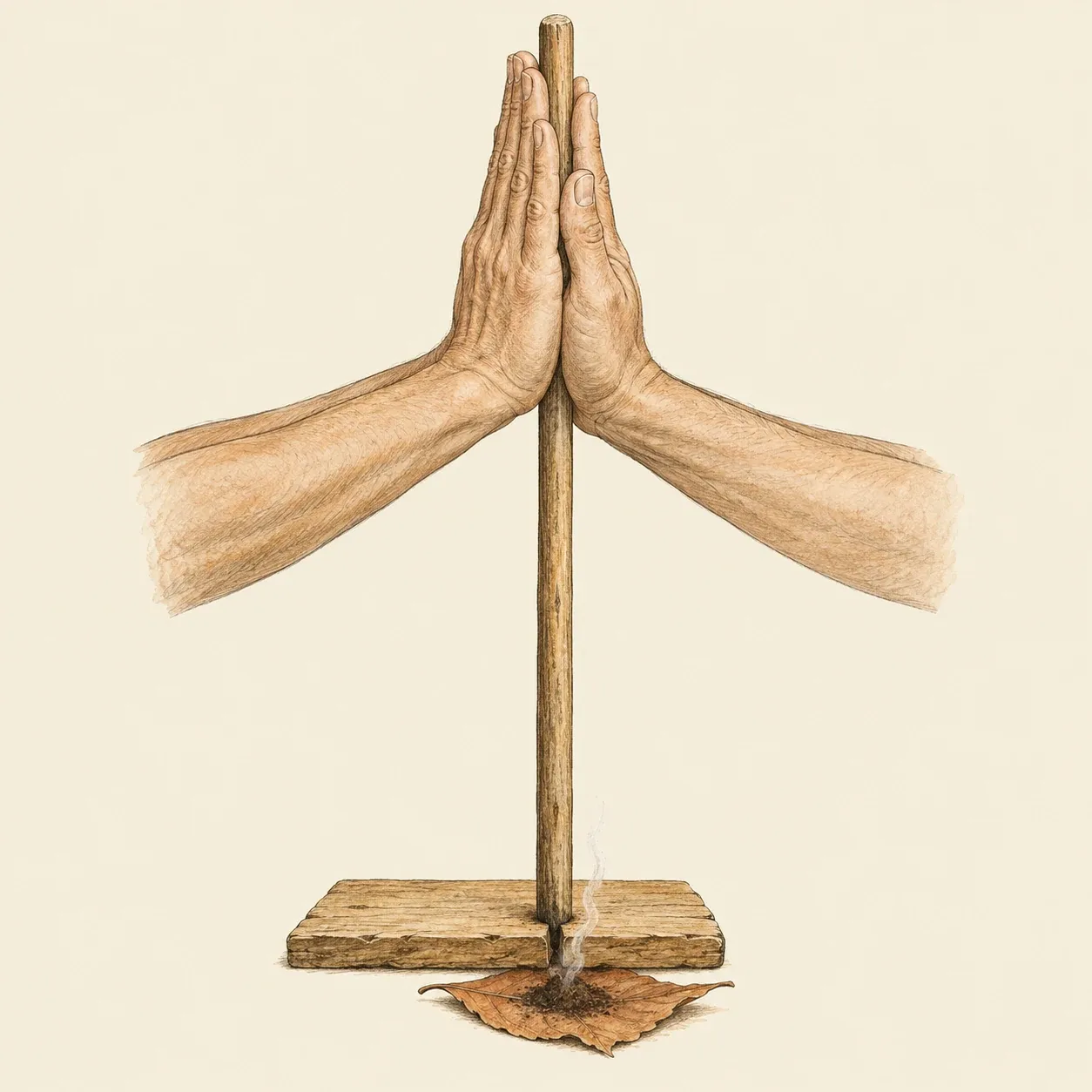 In the hand drill, the palms spin a stick back and forth until the wood dust in the notch starts to glow.
The bow drill is the most reliable friction method to learn. You need a knife or a sharp stone flake, a cord, and dry, dead, medium-soft wood such as willow, lime, poplar or cedar.
Prepare the hearth. Choose bare, level ground away from overhanging branches and dry grass. Clear a circle about three metres across of grass, leaves and twigs, and ring the fire pit with stones. Gather everything first: a double handful of tinder, a bundle of pencil-thin twigs, then sticks as thick as a thumb and as thick as a wrist.
Carve the kit. The spindle is a straight stick about 20 cm long and as thick as a thumb, rounded at the top and blunt at the bottom. The hearth board is a flat piece about 2 cm thick. The bearing block is a palm-sized piece of harder wood or a stone with a small hollow on its underside; a smear of fat or a green leaf in that hollow keeps the top of the spindle from heating. The bow is a stiff, slightly curved stick about as long as your arm, with the cord just slack enough to take one turn round the spindle; once twisted in, it must grip the spindle firmly.
Burn in and notch. Drill a shallow socket near the edge of the board until it is black, then cut a V-shaped notch from the socket to the edge, about one eighth of the circle. Put a piece of bark under the notch to catch the dust.
Drill. Kneel with one foot on the board, brace the wrist holding the block against your shin, press down steadily on the block and saw the bow with long, even strokes. Speed up when the socket smokes. When the notch is full of dark dust that keeps smoking on its own, you have an ember.
Grow the flame. Tip the ember into the tinder nest, fold it closed and blow slowly until it flares. Set it in the pit, lean twigs over it in a cone, and add larger wood only once the twigs are burning well.
Safety. Fire spreads faster than you can run in dry grass or wind. Never light a fire in a drought, under a fire ban or in strong wind, and keep water or loose earth at hand. Do not use wet river stones round the pit: trapped water can make them burst. Never leave a fire alone. To put it out, drown it, stir the ashes and drown it again until everything, buried embers included, is cold to the touch. Practise outdoors only: an open fire in a shelter or cave fills the air with smoke and carbon monoxide, which can kill.
History and evolution
The oldest well-established traces of fire in a human context come from Wonderwerk Cave in South Africa. In 2012, a team found microscopic ash and burned bone there, in layers about a million years old that also held Acheulean stone tools, probably made by Homo erectus. A study published in 2026 found burned bone deeper in the same sequence, in layers dated between 1.07 and 1.79 million years ago, about 30 metres inside the cave, where wildfire could not have reached. Older claims from Kenya, around 1.5 million years ago, rest on reddened soil that a natural fire could also explain.
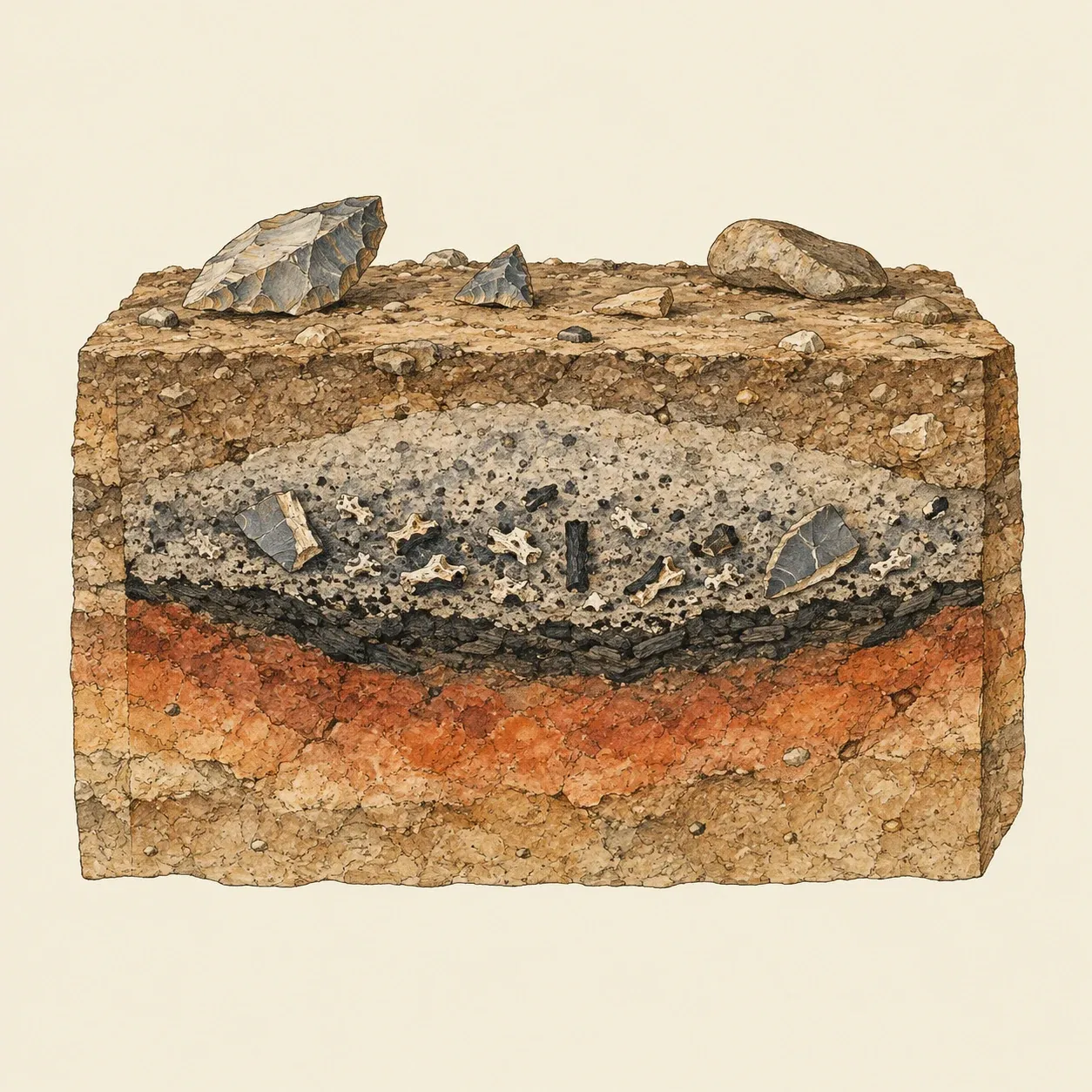 Archaeologists find old fires in section: ash and charcoal on top of earth baked red by the heat.
At Gesher Benot Ya’aqov in Israel, burned seeds, wood and clusters of burned flint suggest fires kept in fixed places about 790,000 years ago. Clear hearths become common only between about 400,000 and 300,000 years ago, in Africa, the Near East and Europe. Until then, people probably collected fire from natural blazes and kept it going.
The oldest evidence of making fire comes from Barnham in Suffolk, England, published in 2025. About 400,000 years ago, people there heated the same patch of clay again and again above 700 °C, and left fire-cracked hand axes and two pieces of pyrite, a mineral so rare in that landscape that it was probably brought in on purpose. The earlier record, from Neanderthal sites in northern France, was about 50,000 years old.