Bread
Ground grain, water and heat
Plate
- 1Saddle quern
- 2Risen dough
- 3Oven dome
- 4Baking floor
- 5Embers
- 6Peel
Anatomy
Loading the figure…
Bread is a dough of ground grain and water, often leavened, baked until it sets. Hunter-gatherers in Jordan were already baking flatbread about 14,400 years ago, before anyone farmed cereals.
What it is
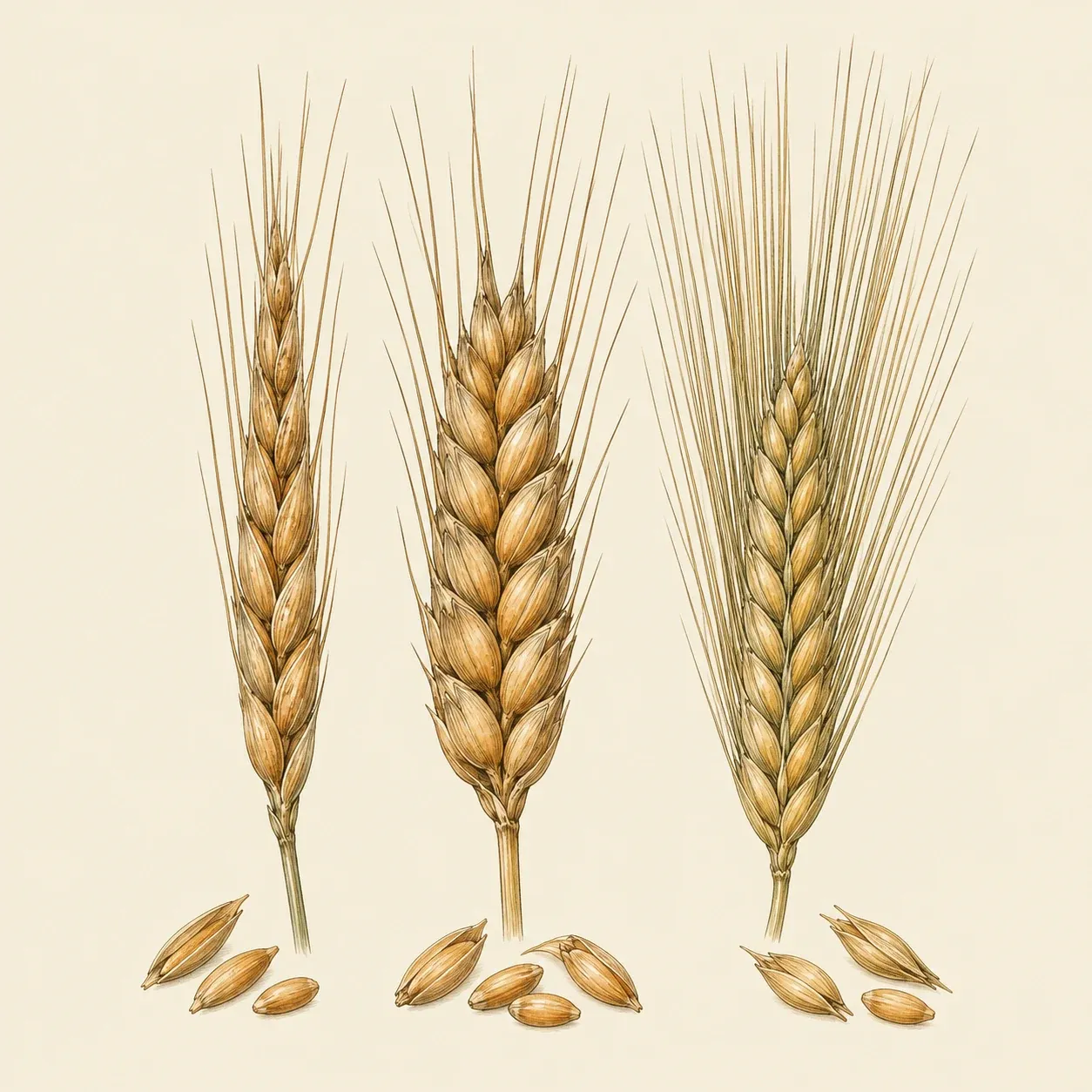 Einkorn, emmer and barley, the cereals of the first breads in the Near East.
Bread is flour mixed with water, shaped, and cooked by dry heat. Salt is almost always added. Most breads are also leavened, filled with small gas bubbles by yeast or by a sourdough culture, so they rise and bake to an airy crumb. Unleavened flatbreads skip that step and bake in minutes on a hot stone or the wall of an oven.
Cooked grain keeps poorly and raw grain is hard to digest. Bread turns cereals into a food that is easy to carry and keeps for days, and in many diets it supplies most of the calories. The plate follows the old sequence: grain ground on a saddle quern, dough left to rise in a wooden trough, loaves baked on the floor of a domed oven.
How it works
Wheat flour holds two families of proteins, glutenins and gliadins. When water is added and the dough is kneaded, they link into gluten, an elastic network that can stretch and hold gas. Rye and barley proteins do not build the same elastic network; rye bread holds together mainly through its starch and gums, which is why such breads are dense.
Yeasts, single-celled fungi present on grain and in the air, feed on the sugars released from starch. They give off carbon dioxide and a little alcohol. The gas collects in tiny pockets trapped by the gluten, and the dough swells. A sourdough culture combines wild yeasts with lactic bacteria, which add a sour taste and help the bread keep.
In the oven, the gas and the water in the dough expand and the loaf rises fast for the first few minutes. Between about 60 and 80 °C the starch absorbs water and swells, and the proteins set; the soft foam becomes a firm crumb. At the surface, where the dough dries and gets much hotter, sugars and proteins react and brown into a crust. A loaf is done when the centre approaches 100 °C.
A wood-fired oven works by stored heat. The fire burns inside the dome until the masonry is hot through, then the embers are raked aside or pulled out and the loaves go in on a peel. The thick walls give back heat for an hour or more.
How to build
You need wheat, a way to grind it, a starter and an oven. The steps below make two wheat sourdough loaves; rye and barley need different recipes.
Make flour. Grind clean, dry wheat or spelt between two stones. Sift out the coarse bran for a lighter loaf.
Start a culture. Mix equal weights of wholemeal flour and water in a jar, cover it loosely and keep it warm. Each day keep about 100 g of it, throw the rest away and feed it with 100 g of flour and 100 g of water, at 20 to 27 °C. After five to ten days it should bubble and double within a few hours of feeding.
Mix and knead. For two loaves take 1 kg of flour, 650–700 g of water, 20 g of salt and about 200 g of active starter. Knead for ten minutes until the dough is smooth and springs back.
Let it rise. Leave the dough covered for four to eight hours depending on warmth, divide it in two, shape each half into a tight round and let it rise again in a floured basket or cloth for one to three hours, until it has grown by about half and a fingertip dent springs back slowly.
Heat the oven. Burn dry hardwood in a clay or brick dome for one to two hours, until the soot on the inside of the dome has burned off and the masonry looks pale. Rake out the embers, wipe the floor with a damp cloth, then slide in the loaves with a peel. Bake for about 40 minutes; the base should sound hollow when tapped.
Safety. Oven floors and walls burn skin badly: use a long peel and thick gloves, and never lean into the mouth. Work in the open air, because a smouldering fire in a closed room gives off carbon monoxide. Throw away grain that is mouldy or carries black, horn-shaped ergot bodies, which are poisonous. Keep the starter jar clean; if any mould appears, throw the whole starter away and scald the jar.
History and evolution
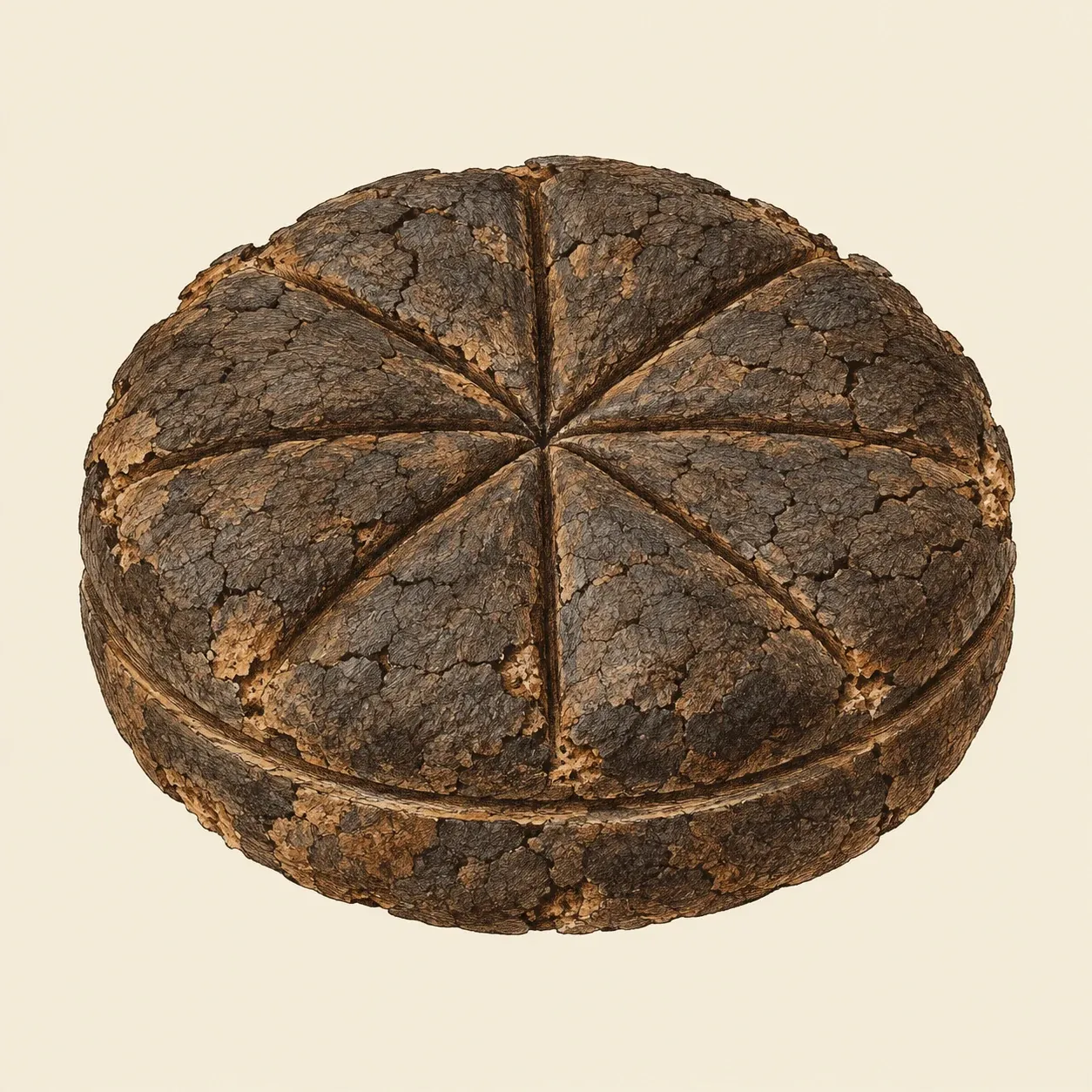 A carbonised loaf buried by Vesuvius in 79 CE, scored into eight portions before baking.
In 2018 a team led by Amaia Arranz-Otaegui described charred crumbs from two fireplaces at Shubayqa 1, a site in north-eastern Jordan used by Natufian hunter-gatherers about 14,400 years ago. Under the electron microscope they proved to be a flatbread-like food of wild cereals such as einkorn, mixed with ground club-rush tubers, made some 4,000 years before farming began in the region.
Ancient Egypt made bread from emmer wheat, which had to be pounded to free the grain from its husks before being ground on saddle querns. The archaeobotanist Delwen Samuel examined desiccated loaves under the microscope and found preserved yeast cells in bread from about 1400 BCE, the earliest direct evidence of yeast in baking.
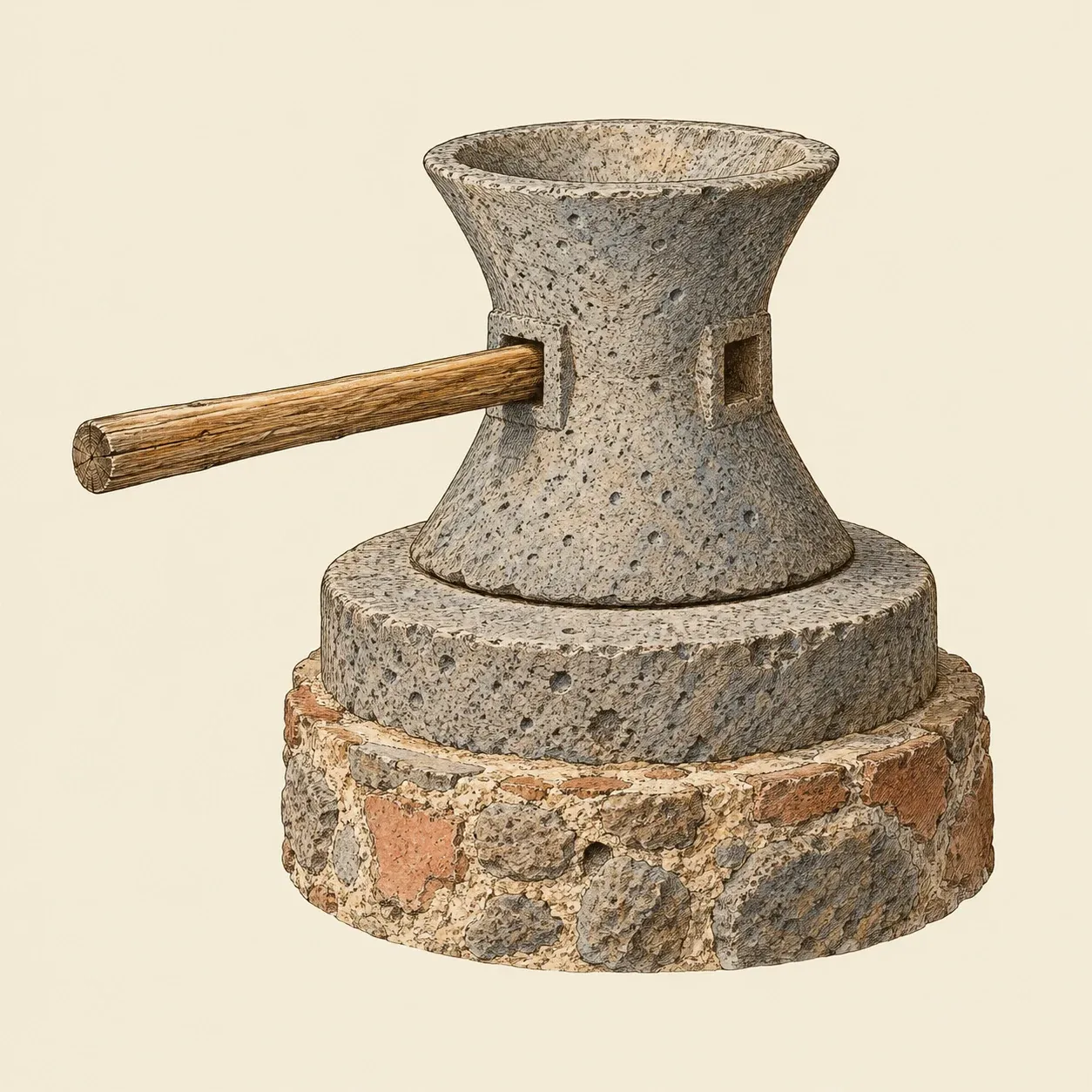 A Pompeian mill: the hourglass upper stone turns over a fixed cone and grinds the grain between them.
In Rome baking became a trade. Archaeologists have documented 39 bakeries at Pompeii, with stone mills turned by donkeys and domed ovens, and loaves carbonised in the eruption of 79 CE survive. Pliny the Elder noted that the Gauls and Iberians used the froth from beer to raise a lighter bread.
For centuries most people ate coarse breads of rye, barley or mixed grain; fine white wheat bread was a luxury. Roller mills in the nineteenth century made white flour cheap, and commercial baker’s yeast replaced the leftover dough and brewers’ barm. In 1961 the Chorleywood process in Britain replaced the long first fermentation with a few minutes of intense mechanical mixing, and most British factory bread is still made that way.