Bow & Arrow
Stored energy released at a distance
Plate
- 1Upper limb
- 2Grip
- 3Lower limb
- 4Bowstring
- 5Section of a limb: sapwood back, heartwood belly
- 6Flint arrowhead bound with sinew
- 7Fletching
- 8Nock
Anatomy
Loading the figure…
A bow stores the effort of the archer's arms in its bent limbs and releases it in a fraction of a second, sending an arrow much faster and farther than a hand could throw it. Small stone points from South Africa suggest that people were shooting arrows about 64,000 years ago, and the bow stayed a weapon of hunting and war until firearms replaced it.
What it is
A bow is a flexible stave, usually of wood, with a string tied between its two tips, and it works as a spring held in the hand. Drawing the string back bends the stave; letting go allows the stave to straighten, and the string throws the arrow forward. The arrow is a light, straight shaft with a sharp head at the front and feathers at the back that keep it flying point first.
The bow on the plate is a self bow, made from a single piece of wood, of the English longbow type: a yew stave about as tall as the archer, flat on the back and rounded on the belly, so its section looks like a letter D. Many bows are built from several materials instead. The composite bows of Asia glue horn, wood and sinew together, and several peoples of North America glued a layer of sinew along the back of a wooden bow.
How it works
The two faces of a bent bow do opposite work. The back, the side facing away from the archer, is stretched; the belly, facing the archer, is compressed. Wood resists both, so the effort spent in drawing is stored in the limbs as elastic energy, as in a wound spring. A hunting bow commonly needs a pull of about 180 to 270 newtons (40 to 60 lb) at full draw, and heavy war bows needed far more.
Yew suits a self bow because a yew trunk contains two kinds of wood. The pale sapwood under the bark stands stretching well, and the darker heartwood stands crushing well. Bowyers leave a layer of sapwood on the back and heartwood on the belly, as the section on the plate shows. With most other woods the bow is cut wholly from sapwood or wholly from heartwood, and its back follows one growth ring along the whole length.
When the archer lets go, the limbs spring forward and the string pushes the arrow. Not all the stored energy reaches it, because the limbs and string are moving too and keep some of it. Light, evenly bending limbs waste less than heavy ones. Arrows from wooden bows typically leave at 40 to 60 metres per second.
The push is so sudden that the arrow bends and vibrates as it leaves, flexing around the handle of the bow. Archers call this the archer’s paradox. For an arrow to fly straight, its stiffness, called its spine, has to suit the draw weight of the bow, taking into account the arrow’s length and the weight of its head, which both change how much it flexes. The feathers at the rear create drag behind the arrow’s balance point, so any wobble turns the point back into the line of flight, as the flights of a dart do. A heavier head moves the balance point forward and steadies the flight, but it also makes the shaft flex more.
How to build it
A self bow needs a hatchet or drawknife, a rasp, a scraper, a knife, a long cord, a spring scale and a tiller stick: an upright post with a rest for the grip at the top and notches down its length.
Choose the stave. Pick a straight-grained length of a tough, springy wood such as yew, osage orange, elm, ash, hickory or maple, free of knots and twists. Split it from the log rather than sawing it, so the grain runs the whole length. Seal the ends and let it dry slowly under cover for several months, ideally a year.
Prepare the back. The back is the side that lay under the bark. On most woods, take the bark off and follow one growth ring along the whole length without cutting through it: a cut ring is where a bow breaks. On yew, keep a thin layer of sapwood.
Rough out the shape. Mark a centre line and draw the outline: a narrow, thick grip in the middle and limbs tapering towards the tips. For a longbow, the stave is about the archer’s height. Remove wood from the belly only, until each limb flexes a little when the tip rests on the floor and the grip is pushed.
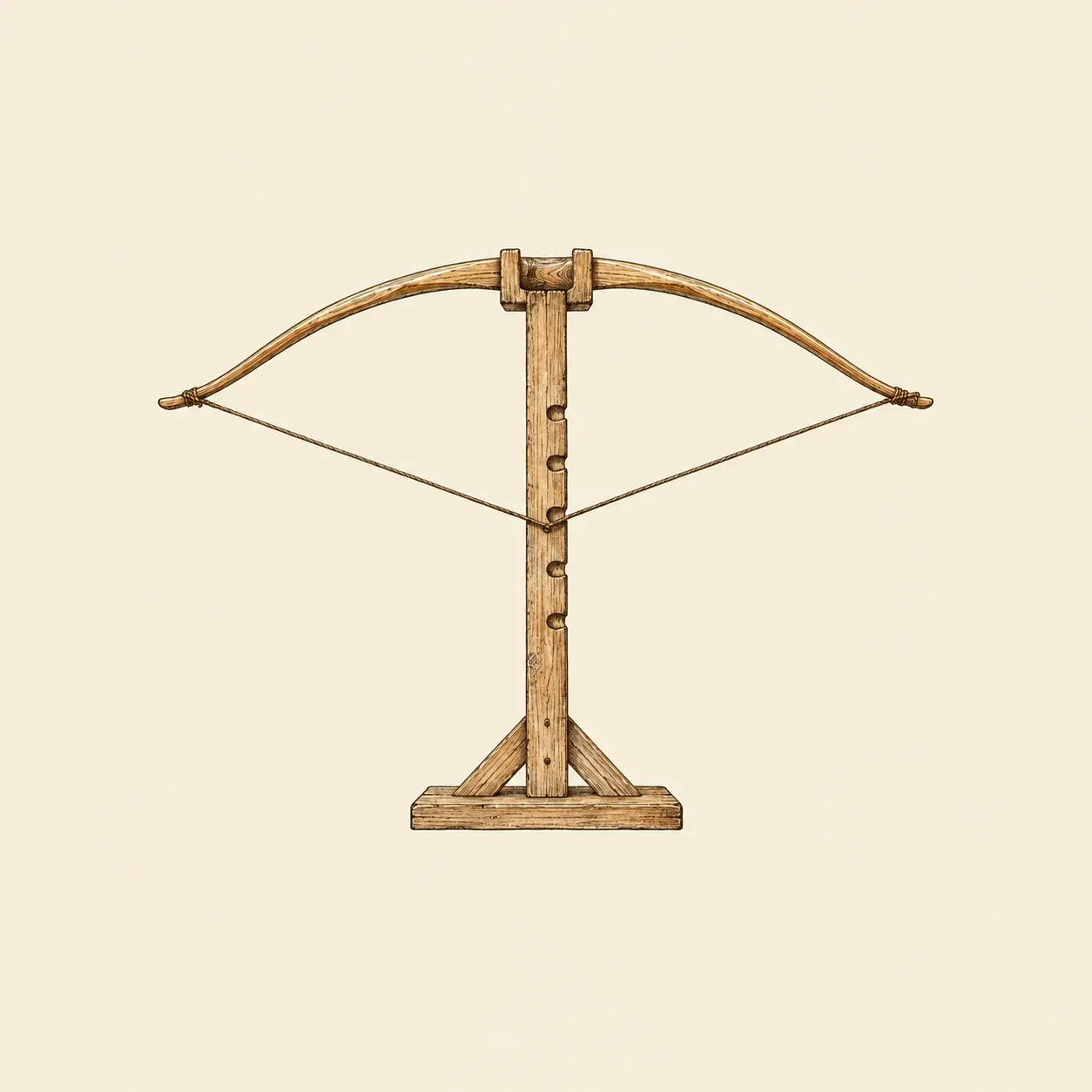 On the tiller, the bow is drawn a little further at each step, so the bowyer can compare the curve of the two limbs.
Tiller the bow. Cut grooves for the string near the tips, fit a long string and rest the bow by its grip on the tiller stick. Pull the string down one notch at a time, read the pull on the spring scale and study the curve. Never pull harder than the draw weight you are aiming for, or the unfinished stave will be overstrained. Both limbs should bend in smooth, even arcs, with no flat or sharply bending spots. Let the string back up slowly and lift the bow off the tiller before you touch it with a tool: never scrape a limb while it is under load. Then scrape wood from the belly where a limb is too stiff, a few shavings at a time, and flex the bow a dozen times between steps. Stop a little short of your full draw length and the weight you want. This is the slowest stage. A short stretch that bends more than the rest, called a hinge, takes too much strain and is where a bow tends to crack.
Make the string. Twist the string from linen, hemp, sinew or modern polyester thread, with a fixed loop at one end and a timber hitch at the other. When the bow is strung, the string should stand about a hand’s breadth from the grip. Put the braced bow back on the tiller with its working string and draw it in stages to full length: both limbs should still bend evenly and the scale should read the planned weight. Take off the last shavings only where this check shows a stiff spot, each time with the string let down and the bow off the tiller.
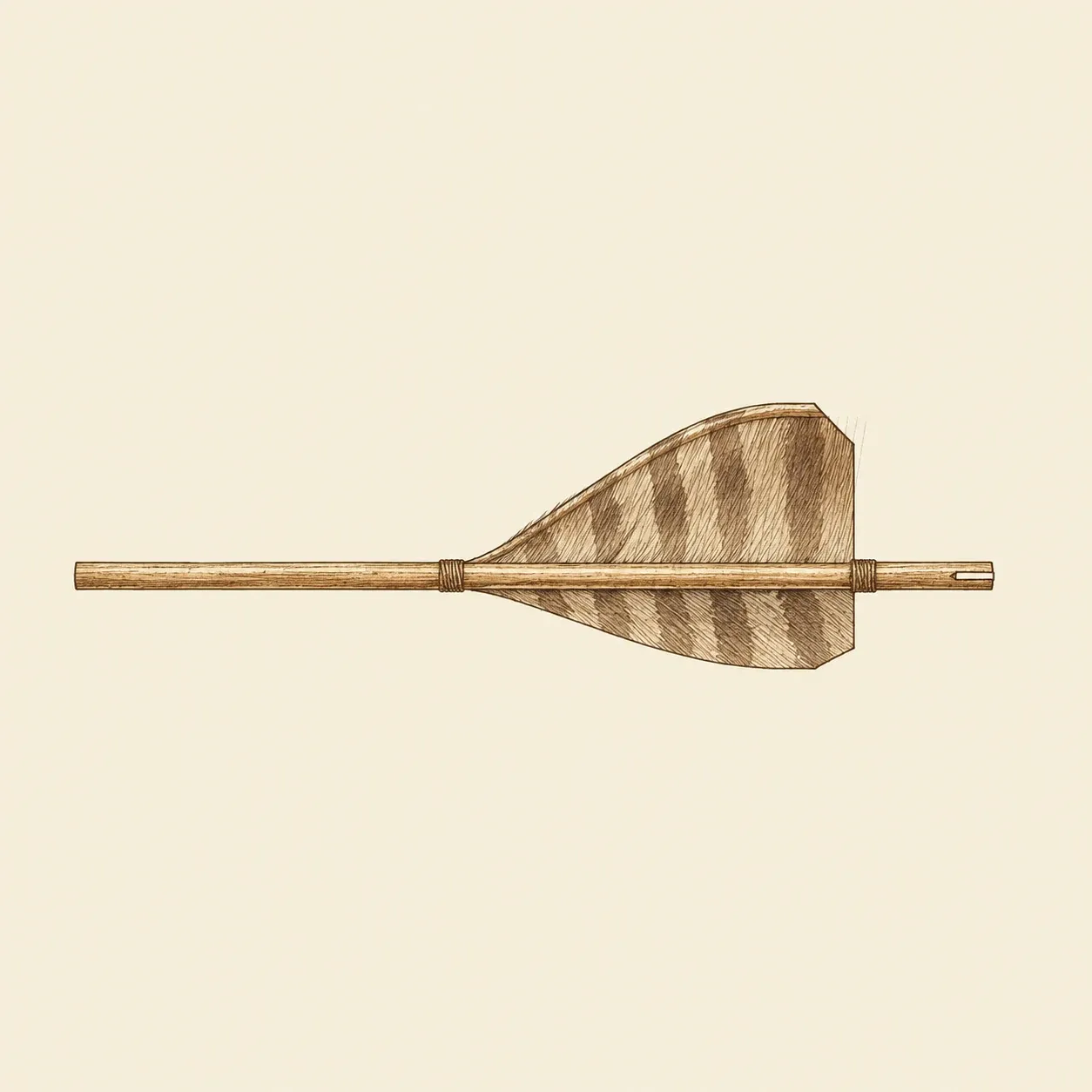 Three feathers from the same wing, glued on and bound at each end, keep the arrow flying straight.
Make the arrows. Cut straight shoots of dogwood, viburnum or hazel, or split shafts from a straight log. Straighten them over gentle heat and scrape them round. Sort them by stiffness, cut them to the same length and fit heads of the same weight, so that the arrows shot from one bow fly alike. Make each arrow long enough for your full draw, with the head still in front of the bow at full draw. Cut a nock for the string at the rear. At the front, bind on a head of stone, bone or metal with sinew and a glue such as birch tar, or use a blunt wooden tip for practice. Glue three feathers from the same wing along the shaft near the nock, evenly spaced, and bind their ends.
Safety. A bow is a weapon at any draw weight. Never aim at anyone, and shoot only on a range with a backstop and nobody beyond it. Never release a drawn string without an arrow on it: the energy goes into the bow, which can break and throw splinters. Wear eye protection when tillering and testing, check the bow, the string and every arrow shaft and nock for cracks before each session, and use arrows long and stiff enough for the bow. Yew dust is toxic and other wood dusts can harm the lungs and skin, so clear dust away at the source and wear a well-fitting dust mask with a suitable filter when rasping and sanding, even outdoors; take care with the heat source when straightening shafts. Hunting with a bow is regulated or banned in many countries.
History and evolution
Bows and arrows are made of wood, sinew and feathers, which rarely survive, so the earliest archery is read from stone points. At Sibudu Cave in KwaZulu-Natal, South Africa, small stone points about 64,000 years old show impact damage, traces of blood and bone, and remains of the plant-resin glue that held them to a shaft, which suggests they tipped arrows. Researchers have proposed older arrowheads, about 74,000 years old, at Shinfa-Metema 1 in Ethiopia, an interpretation that further work has yet to confirm. In Europe, the earliest likely evidence comes from Grotte Mandrin in southern France: flint points about 54,000 years old, left by modern humans and too small to have been thrown by hand.
The oldest known arrow shafts, of pine, come from Stellmoor near Hamburg and are about 12,000 years old. The oldest complete bow, of elm, was found in the Holmegaard bog in Denmark and dates from about 7000 BC. Ötzi, the man who died in the Alps about 5,300 years ago, carried an unfinished yew stave and a deer-hide quiver holding 14 arrows; only two were finished, with flint heads and feathers fixed with birch tar and plant fibre.
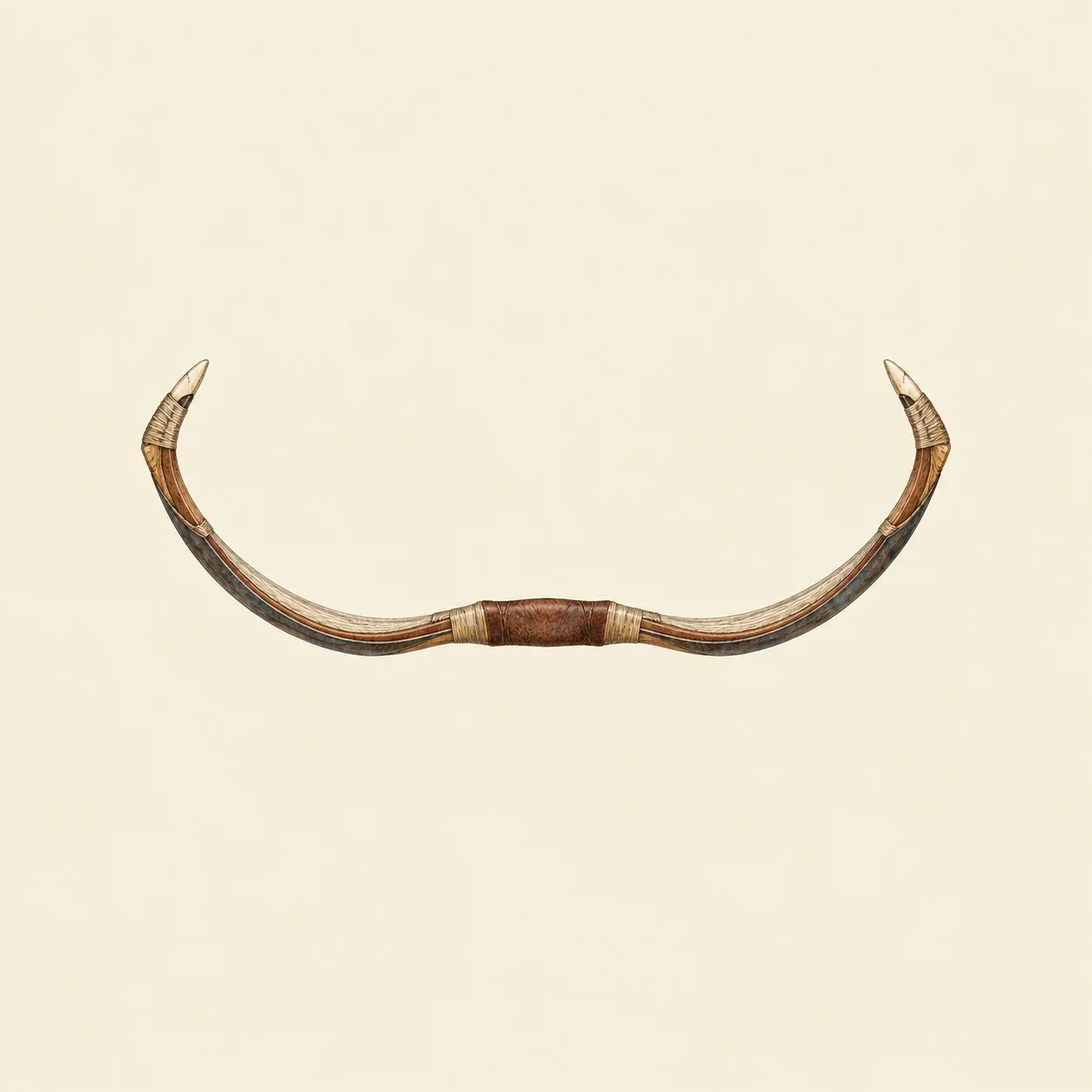 Unstrung, a composite bow curves forward, away from the archer; stringing it bends it back and stores energy even before the draw.
In the steppes of Asia and the Near East, bowyers developed the composite bow, glued from a thin wooden core with horn on the belly and sinew on the back. It is shorter than a self bow of the same power, which suited archers in chariots and on horseback, and it armed the Scythians, the Huns, the Mongols and the Ottoman Turks.
In western Europe, the yew longbow served English armies at Crécy in 1346 and Agincourt in 1415. Henry VIII’s warship the Mary Rose, which sank in 1545, has given up 172 longbows, each cut from a single piece of yew and up to 2.11 m long. Guns took longer to load, but a soldier learned to use one much faster than an archer could be trained, and through the sixteenth and seventeenth centuries firearms pushed the bow off European battlefields. It remained a hunting weapon in many parts of the world, and archery became a sport, practised today with bows of fibreglass and carbon and with compound bows that use pulleys.