Rope & Cordage
Twisted fibres that hold the world
Plate
- 1Fibres
- 2Yarn
- 3Strand
- 4Three-strand rope
- 5Crank and hooks (jack)
- 6Top
Anatomy
Loading the figure…
Traditional rope is made of short fibres twisted into yarns, the yarns into strands and the strands into rope, giving a line far longer and stronger than any single fibre. Neanderthals were already twisting cord more than 40,000 years ago, and people have used rope ever since to tie, haul, lift and rig.
What it is
A rope is a long, flexible line that resists pulling. Traditional rope is built from fibres that are each only a few centimetres to a metre or so long: plant stems and leaves, inner bark, animal sinew or hair. Twisting holds them together. Modern synthetic rope can use continuous filaments, and much of it is braided rather than twisted.
Thin rope is called cord, string or twine. It ties loads, hauls boats and stones, holds up nets and traps, and rigs sailing ships.
How it works
A single fibre is weak and short. When many fibres are twisted together, the twist presses them against each other, and friction keeps them from sliding apart. Pulling on the yarn makes it tighten and press harder, so it grips better the more it is loaded.
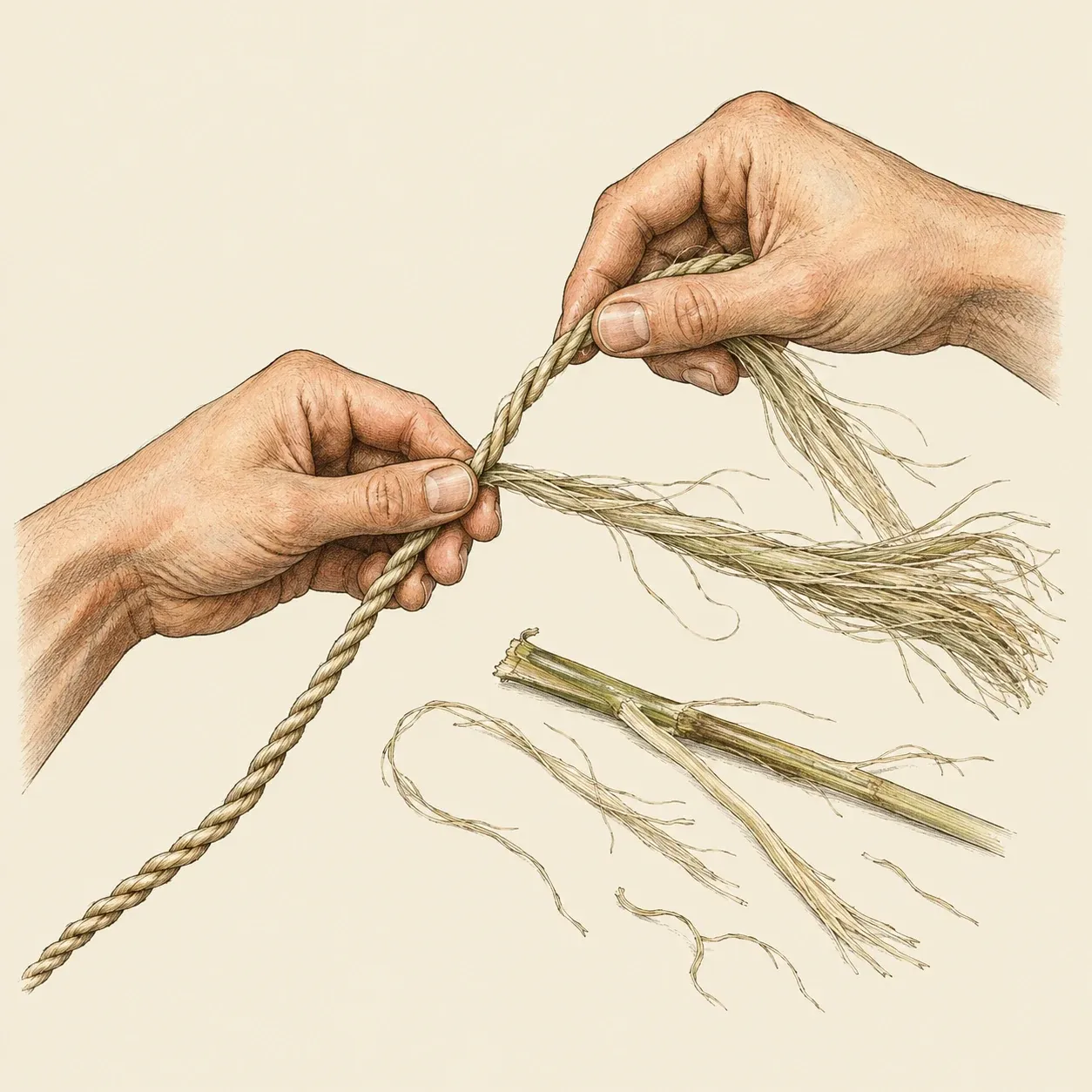 Reverse wrapping: each bundle is twisted one way, then wrapped over the other the opposite way.
A twisted yarn on its own tends to untwist. The answer is to twist again in the opposite direction. Fibres are spun into yarn one way; several yarns are twisted the other way into a strand; three strands are laid together the first way into rope. The leftover twist in each stage pulls in the opposite sense to the twist of the stage inside it, so the forces balance and the rope holds its shape. Three-strand rope built this way is called hawser-laid.
The same rule works at the smallest scale. In reverse wrapping, a simple hand method, two bundles of fibre are each twisted one way, then wrapped round each other the other way, and the result is a two-ply cord that does not unravel. A long rope is made the same way on a larger scale: a crank twists the strands, and a grooved wooden block called the top keeps them apart until they lay up together behind it.
How to build
Good cordage fibres are long and strong: nettle, flax, hemp, the inner bark of lime or willow, cattail leaves, or bought cotton or hemp twine for practice.
Prepare the fibre. Cut nettle stems in late summer, wearing gloves. Crush them flat, split them, take out the woody core and peel off the outer skin with its fibres. Let them dry, then dampen them slightly before use. Lime bark needs several weeks of soaking in water before the fibrous layers separate.
Make cord by hand. Take a bundle and bend it at a point a little off its middle, so the two ends are of unequal length. Pinch the bend. Twist the upper bundle away from you, then lay it over the lower bundle towards you. Repeat, moving the pinch along. When a bundle runs short, lay a new piece of fibre alongside it and twist it in; the uneven ends keep the joins from coming at the same place.
Rig a rope walk. For thicker rope, fix a frame with three hooks that a crank turns together. Stretch three equal lengths of cord or yarn from the three hooks to a single swivel hook on a weighted sledge at the other end. Lock the swivel with a peg for now, and set the top between the strands right next to the sledge, one strand in each groove.
Twist and lay. Turn the crank in the direction that tightens the twist already in the yarn, until each strand is hard and starts to kink when slackened. Then pull the peg so the swivel hook can turn. Keep cranking while a helper walks the top slowly towards the frame: behind it, the strands lay up into rope in the opposite direction, and the sledge creeps forward as the rope shortens.
Finish the ends. Bind each end tightly with thin twine, a whipping, before you cut it, or the strands will unlay.
Safety. A loaded rope stores energy; if it breaks, the ends whip back hard, so never stand in line with a rope under strain. Do not use home-made rope for climbing, for lifting people or for loads above anyone’s head. The crank stores twist too: hold it when you stop, or it will spin back. Wear gloves for nettles and when running rope through your hands.
History and evolution
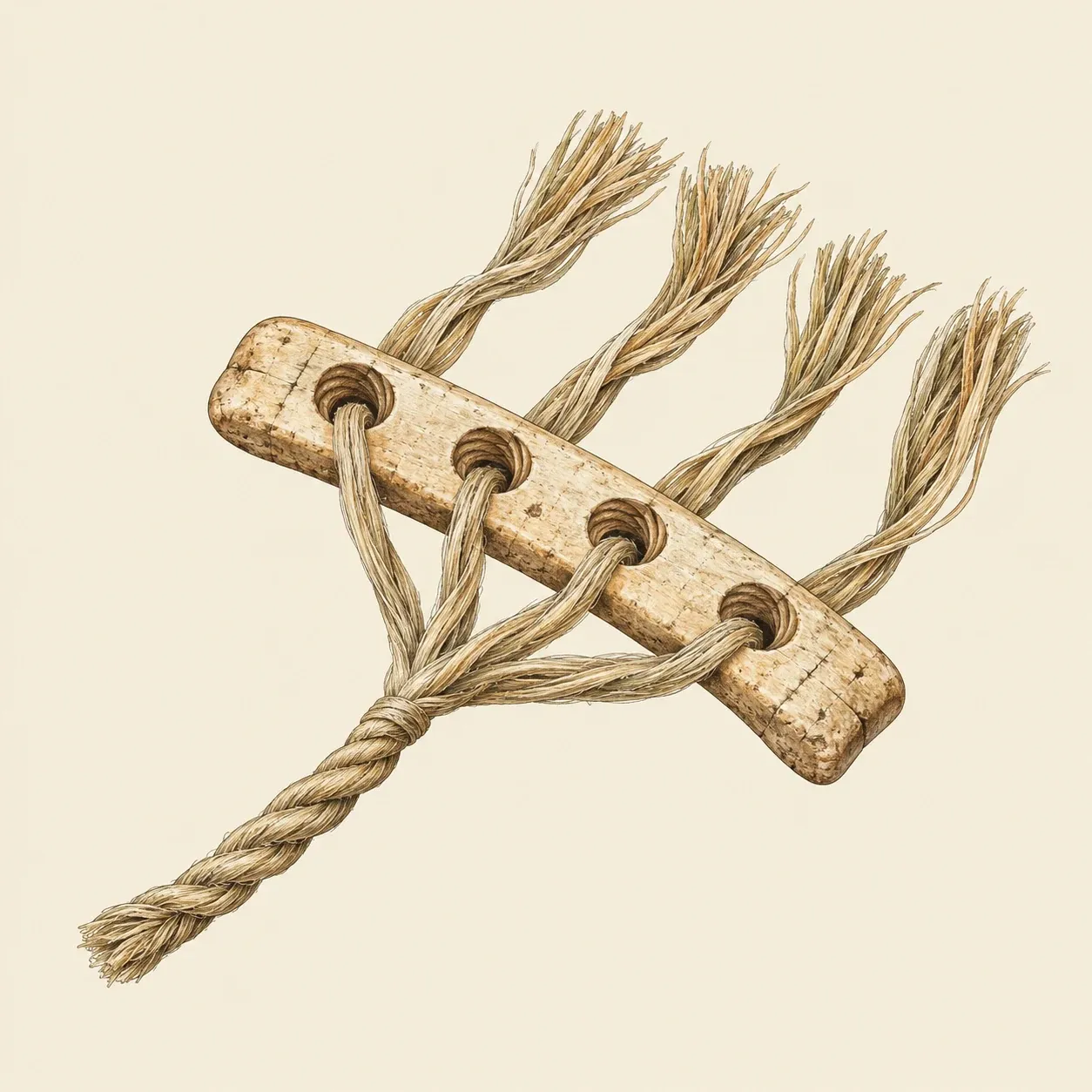 The Hohle Fels ivory tool as reconstructed: fibres fed through its four holes are twisted into rope.
The oldest direct evidence of cord comes from Abri du Maras, a rock shelter in the Ardèche, in France. In 2020, researchers described a fragment about 6 mm long stuck to a stone tool, made of three bundles of fibres from the inner bark of a tree, probably a conifer, twisted and then plied together. It is between 41,000 and 52,000 years old and was made by Neanderthals, who must have known how to twist in two opposing directions.
At Hohle Fels cave in south-western Germany, excavators recovered a strip of mammoth ivory about 20 cm long, with four holes ringed by spiral grooves, dated to 35,000–40,000 years ago. In 2024 Nicholas Conard and Veerle Rots argued that it was probably a rope-making tool: plant fibres were caught in its grooves, and a similar baton from the nearby Geißenklösterle cave has grooves worn as if by fibres pulled through them. With replicas, teams of four or five people made about 5 metres of strong rope in 10 minutes; cattail leaves worked especially well.
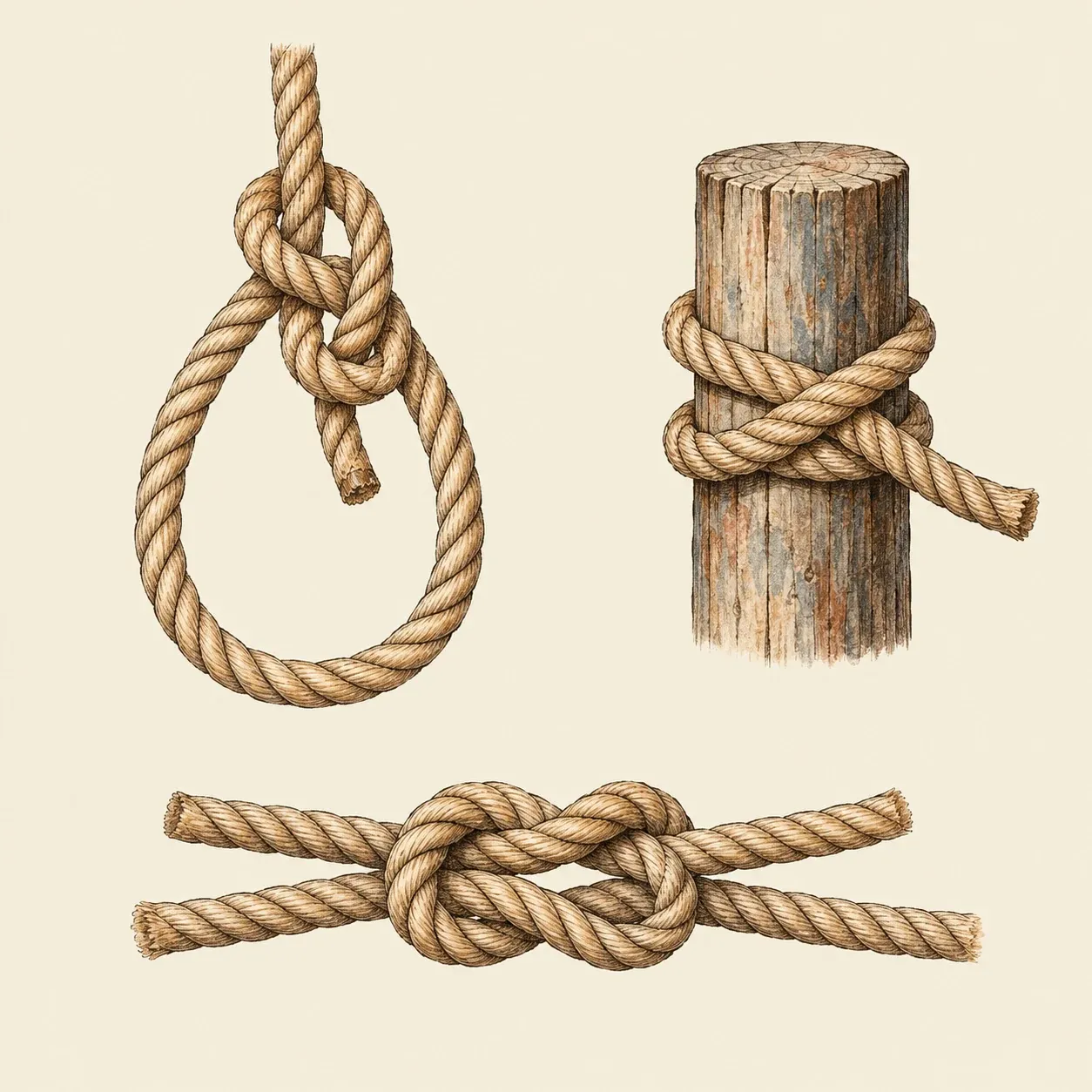 A bowline makes a fixed loop, a clove hitch ties to a post, and a reef knot binds a bundle; it is not safe for joining two loaded ropes.
Farming societies made rope on a much larger scale. Egyptians made rope from reeds, papyrus, palm fibre and flax, and gangs hauling on ropes moved the stones of the monuments. At Wadi Gawasis, a pharaonic harbour on the Red Sea, archaeologists found coils of ship’s rope, neatly knotted and stored in man-made caves used by expeditions to the land of Punt.
In Europe, from the Middle Ages to the nineteenth century, sailing navies made their rope in rope walks, buildings long enough to lay a full-length rope in one piece. The rope walk at Chatham Dockyard in England is nearly 350 metres long, and rope has been made there for more than 400 years. Nylon rope came into use during the Second World War, and from the 1950s synthetic fibres took over most of the work once done by hemp and manila.