Sail
Catching the wind to move a boat
Plate
- 1Mast
- 2Yard
- 3Square sail
- 4Sheet
- 5Steering oar
- 6Lateen sail
Anatomy
Loading the figure…
A sail is a sheet of cloth or matting raised on a mast to catch the wind and move a boat. Set at the right angle, it drives the boat with the wind behind or across it, and by zigzagging, even towards where the wind comes from.
What it is
A sail is a surface spread to the wind to drive a vessel. The earliest were probably mats or skins held up on a pole; later sails were woven from linen, wool or cotton, and today mostly from synthetic fibres. Hung from a mast and adjusted with ropes, a sail moves a boat with no fuel and no rowers.
The plate shows square and fore-and-aft sails. The square sail hangs across the boat from a horizontal spar, the yard, and works best with the wind behind. A fore-and-aft sail lies along the length of the boat. The lateen is a triangular sail hung from a long slanting yard and works well with wind from the side.
How it works
With the wind behind, the principle is simple: the air pushes on the sail as it would on an open hand. On this course a boat cannot go faster than the wind, because the faster it moves, the weaker the wind it feels.
With the wind on the side, the sail works like a wing. Curved and set at a small angle to the wind, it bends the flow of air, and the air pushes back on the sail, mostly sideways and partly forward. The hull, and the keel if there is one, resist sliding sideways because the water pushes back on them, which leaves a forward push. A boat can therefore sail faster across the wind than straight before it.
No sail can drive a boat straight into the wind. A modern sailing boat can hold a course about 40 to 45 degrees off the wind. To reach a point upwind it zigzags, crossing the wind’s direction at each turn. Sailors call this tacking.
The crew adjust the sail with ropes. The sheet (4) pulls a lower corner of the sail in or lets it out to set its angle to the wind. The halyard hoists the yard (2) up the mast (1). On a square-rigged ship the braces swing the yard round. In strong wind the crew reduce the sail’s area, which is called reefing. The steering oar (5), later the rudder, holds the course.
How to build
This outline describes how a small square sail is made. It is not a measured drawing or a plan for fitting a sail to any small boat. Use a rig designed for the specific boat and checked by a qualified boatbuilder or sailing instructor for hull, sail and steering balance, stability and attachment strength.
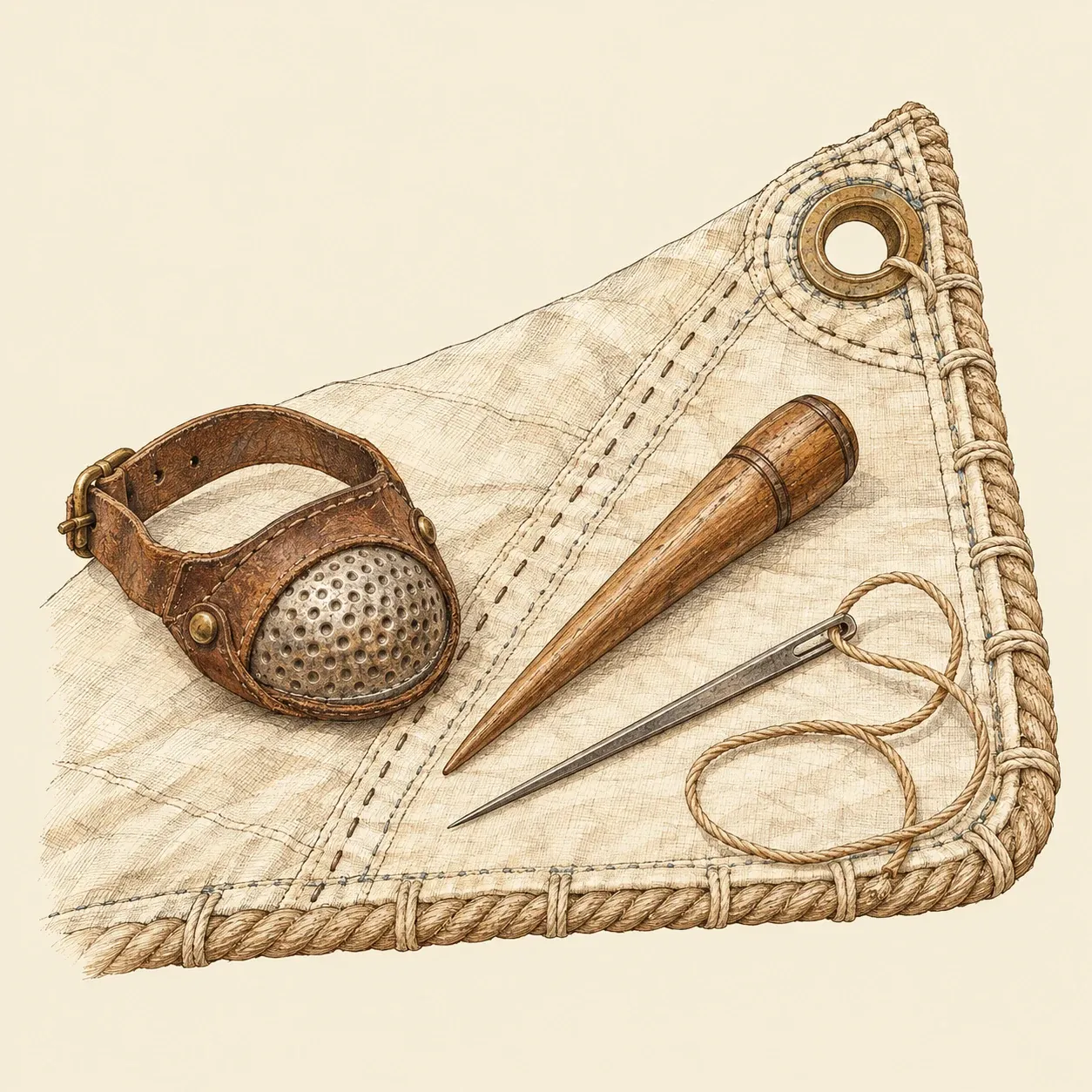 The sailmaker’s palm lets the hand push a heavy needle through several layers of cloth.
Gather the materials. Use the sailcloth, thread, edge rope, yard and fittings specified in the checked rig plan. You also need a sail needle and palm. The mast support and its attachments must follow that plan.
Cut and join the cloths. Lay the canvas strips side by side. Use the seam overlap and stitching specified in the plan for the expected loads.
Hem and rope the edges. Fold and sew the hems as specified in the plan, then sew on the edge rope. The cloth and seams transmit wind loads; the rope reinforces the edges. Reinforce the corners and fit the specified rings or eyes.
Rig it. Follow the checked plan for attaching the sail to the yard and fitting the halyard and sheets. Check that the yard can be lowered and that the ropes run freely.
Practise before sailing. Have an instructor demonstrate how to lower the sail and reduce its pull with this rig, then practise under supervision before going afloat. Releasing the sheets alone may leave a square sail drawing. Make the first sailing trial in sheltered water with light wind and an instructor aboard.
Safety. A gust can capsize a small boat in seconds. Wear a lifejacket, check the forecast, and sail first in light wind close to shore with someone watching. Never tie the sheet off so that it cannot be released quickly. A swinging yard or boom can strike your head, and cold water exhausts a swimmer fast.
History and evolution
Boats are far older than sails: people paddled, poled and rowed long before they used the wind. When the sail appeared is uncertain, because cloth and matting rarely survive. In Kuwait, remains of sea-going reed boats coated with bitumen date to between 5500 and 5000 BCE. Robert Carter discusses them as evidence of early maritime exchange; boat remains alone do not establish that sails were used.
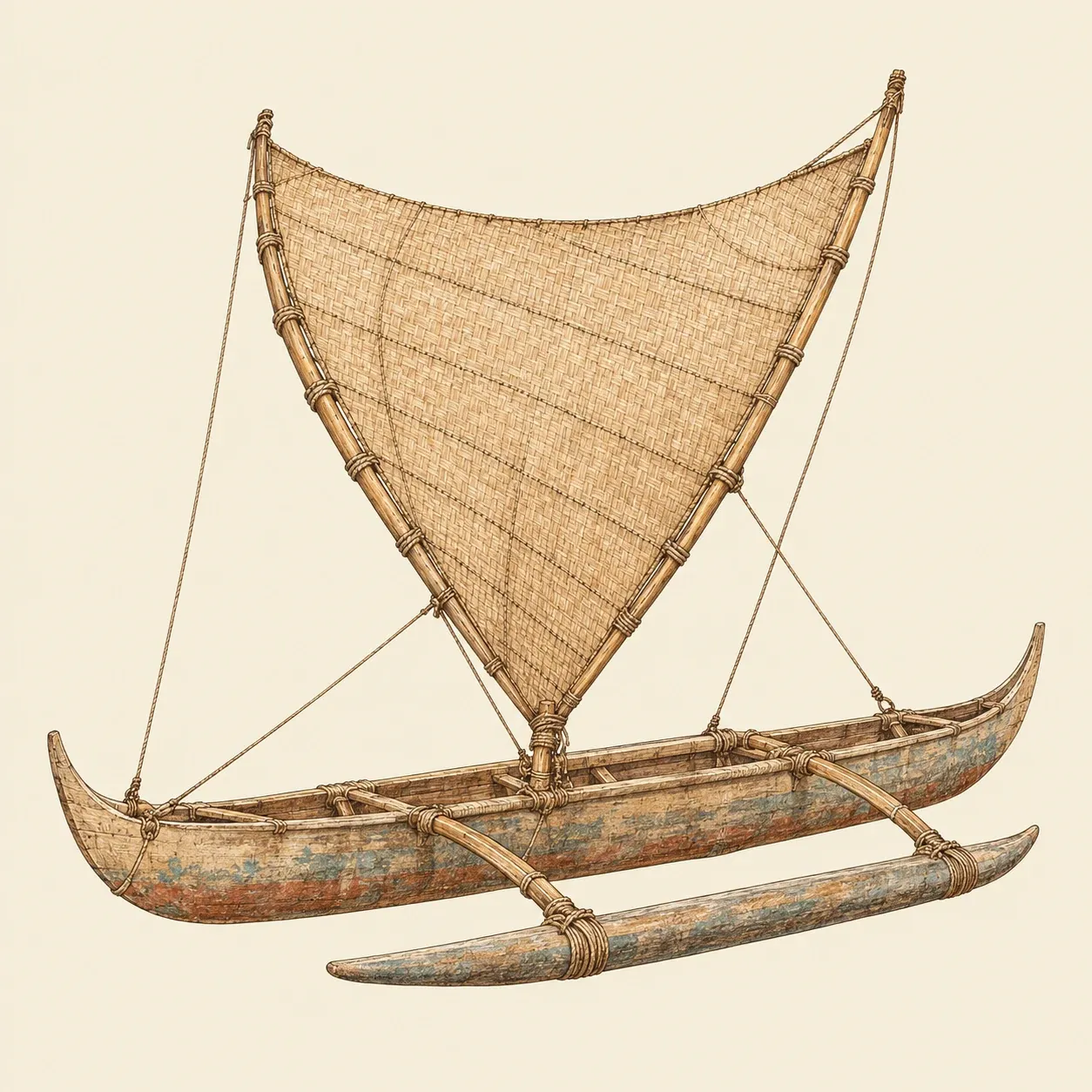 The crab-claw sail, held between two spars, drove Austronesian canoes across the Pacific.
Early possible depictions come from Egypt, around 3200 BCE. A painted Naqada II jar in the British Museum shows a boat with an object on a pole. R. L. Bowen interpreted it as a sail; the alternative reading is a banner. The catalogue uses about 3200 BCE for this possible evidence, not as a known invention date. On the Nile, the current carried boats north and the wind could push them back south.
Square sails were used on Egyptian, Phoenician, Greek and Roman ships, and later on Viking ships, whose sails were often woven from wool. Across the Pacific and the Indian Ocean, Austronesian sailors developed their own rigs. Words for “sail” in their languages go back about five thousand years, and the crab-claw sail carried their outrigger canoes over thousands of kilometres of open sea.
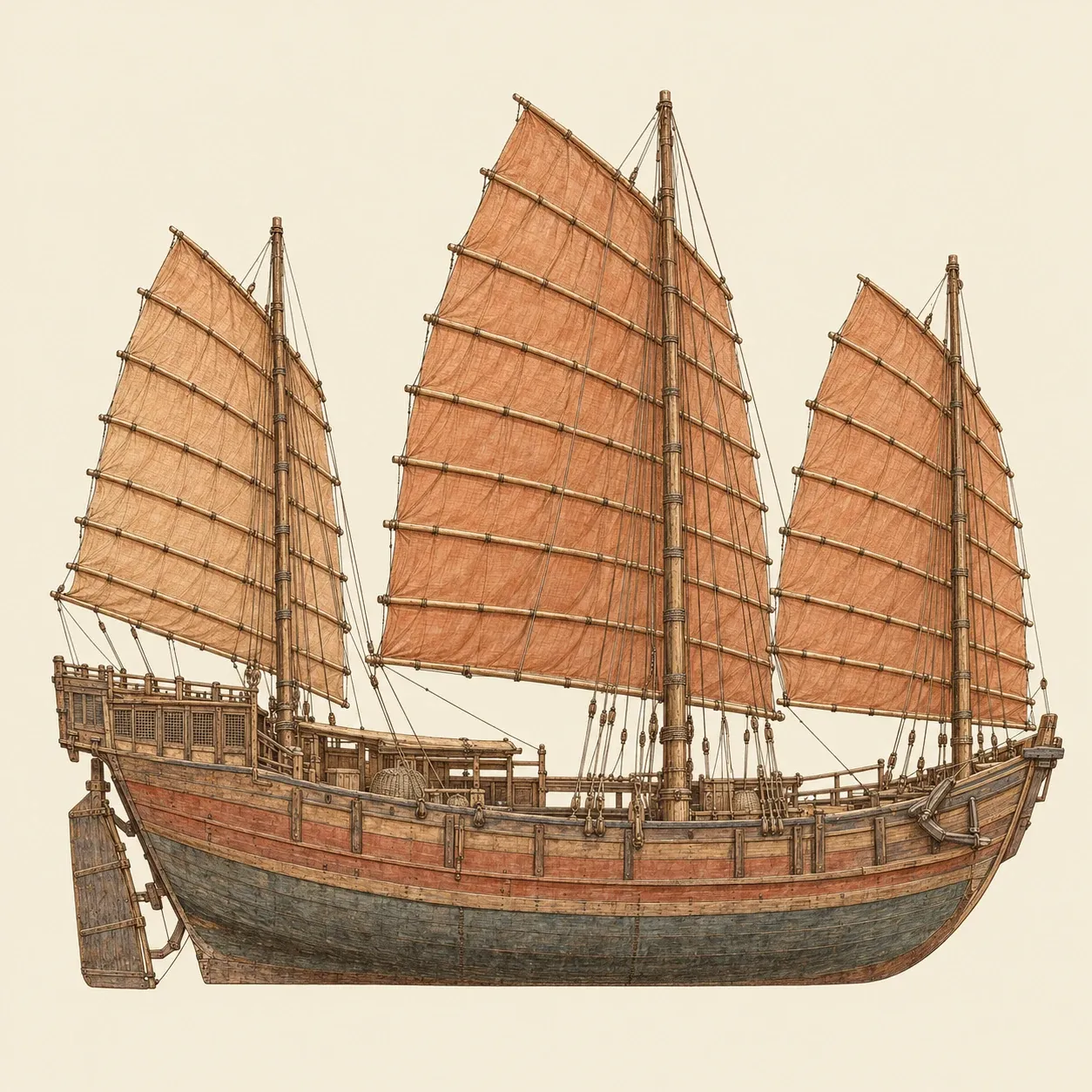 Bamboo battens keep the junk sail flat and stiff.
The lateen sail appears in the Mediterranean by the second century CE and becomes common from the fifth. It cost less to make and maintain than the square sail, though it was not clearly faster. Earlier Chinese ship images show square sails. China may have adopted the battened junk sail, stiffened by bamboo poles, around the twelfth century; this does not establish a uniform replacement of square sails.
From the fifteenth century, European shipbuilders used mixed square and lateen rigs on carracks and some caravels. These traditions contributed to later ocean-going sailing ships. Steam took over commercial shipping in the nineteenth and twentieth centuries. Sails survive on yachts and racing boats, now cut from synthetic cloth.