Measures and standards
The cubit, the balance and the metre
Plate
- 1Cubit rod, the master of length
- 2First palm divided into four fingers
- 3Beam hung at its exact centre, with pointer
- 4Pan hung on cords
- 5Set of stone weights
- 6Grain measure with its strike-stick
- 7Cube made from the rod's unit
Anatomy
Loading the figure…
A measure is a length, weight or volume agreed in advance, and a standard is the object that holds it: a rod, a set of stones or a vessel, kept safe and copied. Egypt measured in cubits, palms and fingers, balance weights spread from Mesopotamia from about 3000 BCE, and the same work of keeping and copying references led to the metre and the kilogram.
What it is
A measure lets people compare things that are not side by side: beams ordered from a distant forest, grain sold by volume, copper sold by weight. The units are arbitrary. What matters is that every copy agrees with every other.
A standard is the object that fixes a unit, such as a rod, a weight or a vessel. An authority keeps it, and working copies are checked against it. The plate shows the basic tools as a rebuilder could make them: a cubit rod, an equal-arm balance with stone weights, a grain measure and a box that turns a length into a volume.
How it works
Length. The oldest units come from the body: forearm, palm, finger, foot. Since bodies differ, a rod fixes the chosen length. The Egyptian royal cubit had 7 palms of 4 fingers, 28 fingers in all, and surviving rods measure about 52 to 53 cm. Kha, an overseer of works buried at Deir el-Medina, received a gilded cubit rod from the king but probably worked with a folding one found in the same tomb. Two rods are compared without numbers, side by side with ends flush.
Weight. An equal-arm balance compares two loads. The beam hangs from its centre and the pans hang at equal distances on either side, so the beam is level only when both pans hold the same weight. Weights are pieces of hard stone or metal ground until they balance a reference, often flattened underneath so they do not roll.
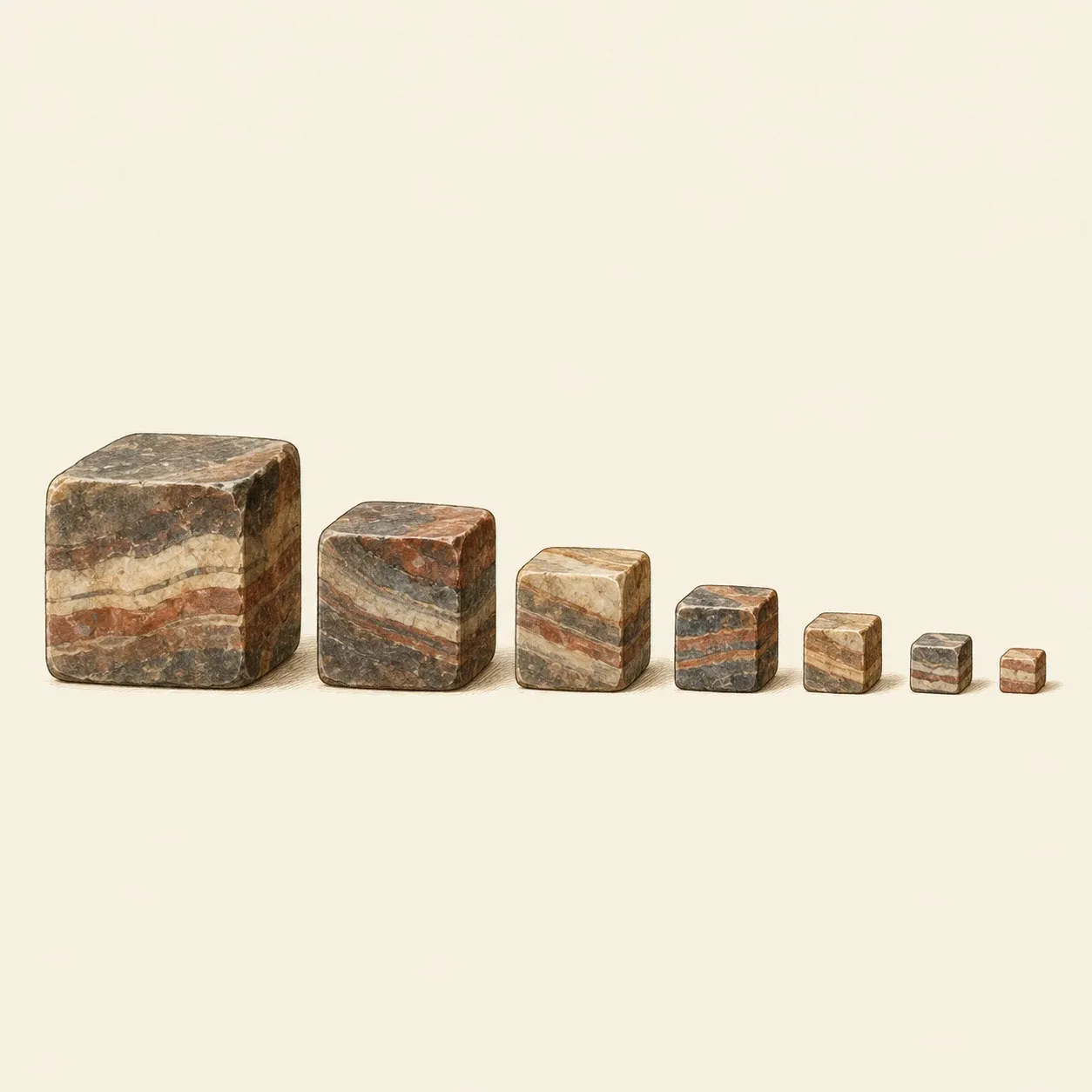 Indus weights were cubes of banded chert; in the smaller sizes, each was about half the one before it.
In the Indus cities of the third millennium BCE, weights were mostly chert cubes. A 1938 study of those from Mohenjo-daro found a unit of about 0.86 g and weights of 1, 2, 4, 8, 16, 32 and 64 units, then larger steps such as 160, 200, 320 and 640. The commonest were 16 and 32 units, about 13.7 and 27.4 g. In several common sizes, individual weights strayed from their mean by only one to two per cent on average.
Volume. Grain, oil and wine were sold with vessels of agreed size, and dry goods were levelled with a straight stick, the strike. A volume can also come from a length: the Roman amphora used as a unit was a cubic foot, and the first kilogram was the mass of a cubic decimetre of water.
How to build
You need a straight, seasoned hardwood bar about 60 cm long, a second bar for the beam, strong cord, two identical bowls, hard fine-grained stones, files, a flat grinding stone, a marking knife, dividers and thin boards.
Choose and copy the master. Any length can be the unit: a forearm, or a metre rule. Cut two fine lines across the rod at its ends; lines last longer than end faces, which wear. Keep this master dry and use it only to check copies. To copy it, lay a blank rod against it, transfer each mark with the knife, then turn the copy end for end, line up its first mark with the master’s and compare the others: a mark that no longer matches shows an error.
Divide without arithmetic. For 7 palms, open the dividers to a guess and step them seven times along the rod. If the last step misses the end line, adjust and start again until it lands on it. Divide a palm into 4 fingers the same way.
Make the balance. Hang the beam by a cord or pin at the middle of its top edge, so that most of its mass lies below the pivot and it returns to level. Hang the pans from notches at equal distances from the centre, fix a pointer and scrape the heavier end until the empty beam hangs level.
Check it by swapping the loads. Balance a stone against sand, then swap the stone and the sand. If the beam stays level, the arms are equal. If not, move one notch slightly, level the empty beam again and repeat the test. Then add small objects to one pan and note the smallest that moves the pointer: weights checked on this balance are no truer than that.
Make weights from a reference. Even an imperfect balance copies a weight by substitution: balance the reference with sand, take it out, and grind a new stone until it balances the same sand. For a series in which each weight is twice the one before, grind a stone to match two units together, then one to match that stone plus the two units, and so on. Check large weights against the sum of the small ones, as errors add up.
Get a volume from the rod. Build an open box whose inside length, width and depth are each one palm. Its water content can mark a level on a vessel, or be weighed to tie a weight to your length; the first kilogram also fixed the water’s temperature. For grain, pour loosely, do not shake, and level with the strike.
Safety. Grinding stone makes fine dust that can contain silica: grind wet, wear eye protection and a P2 or P3 dust mask, and clean up with water, not a broom. Clamp the work when cutting with a knife. Do not make weights of lead. Home-made measures are not legal for trade: in most countries, selling by weight or volume requires verified instruments.
History and evolution
Balance weights appear in Mesopotamia and Egypt around the start of the third millennium BCE. Mesopotamian texts define the shekel, about 8.4 g, as 180 grains of barley, and many weights are polished stones, some carved as ducks or lions. A University of Göttingen team compared 2,274 weights from 127 sites dated about 3000–1000 BCE. Similar units spread from Mesopotamia to Europe, while the Indus had its own system. Around the mean of each unit, the weights scatter with a coefficient of variation (standard deviation divided by the mean) of about 5 to 6 per cent. When the team made 100 copies on replica balances, each from a randomly chosen model, the copies scattered by about as much, 5.4 per cent, and the authors argue that merchants kept the units in step by checking their weights against each other, without a central authority.
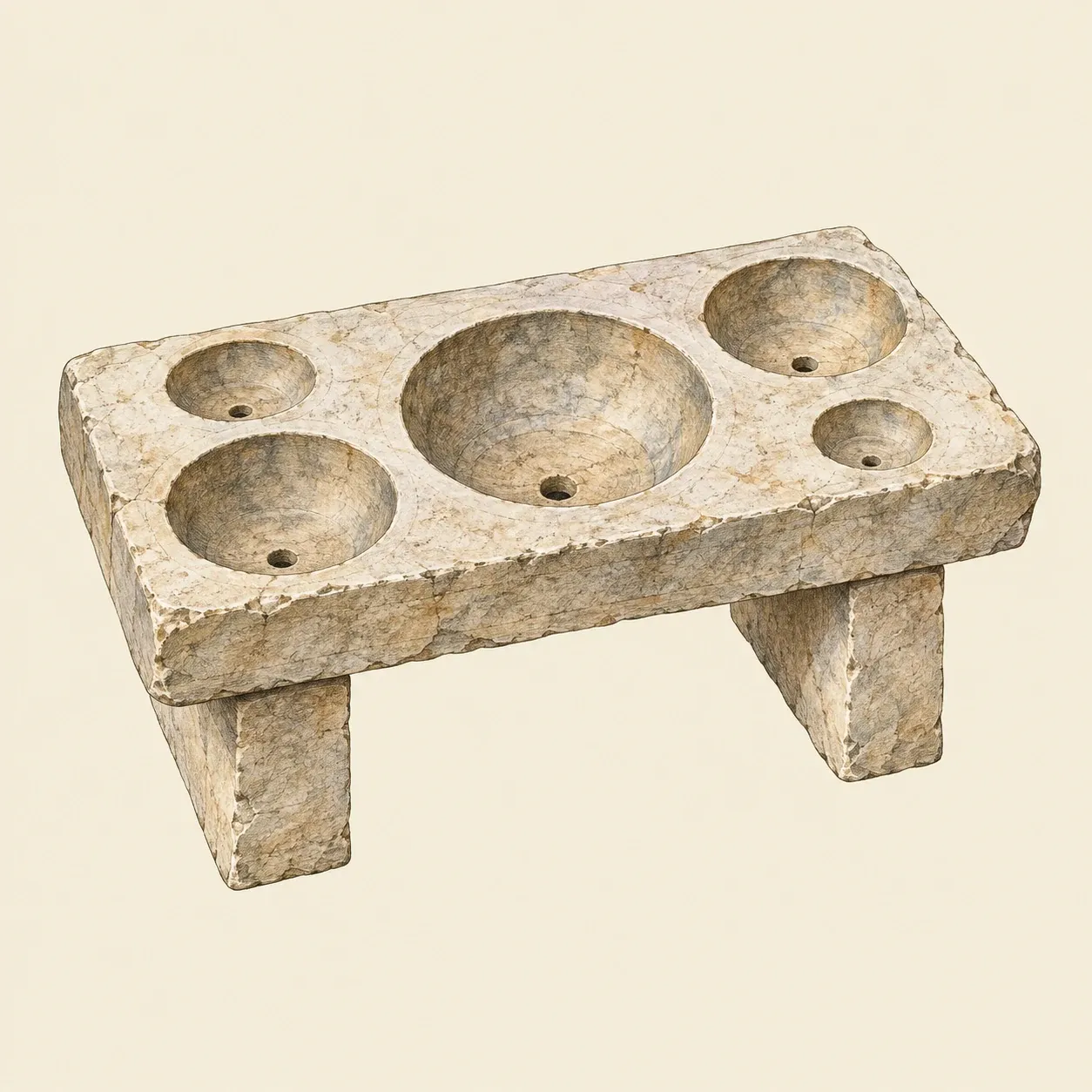 A public measuring table: a buyer filled a cavity, then drained it through the hole below.
Towns still kept official references. At Pompeii a stone table in the forum held cavities sized to the local Oscan measures; after Augustus unified Roman measures, the council had them enlarged and four more cut. Henry VII of England had a bronze standard yard made in 1495–1497 and sent copies to the boroughs; it proved inaccurate and was replaced around 1588.
In 1791 the Paris Academy of Sciences proposed a metre of one ten-millionth of the distance from the pole to the equator, and surveyors measured the meridian from Dunkirk to Barcelona. In 1799 a platinum metre, defined by its end faces, and a kilogram equal to a cubic decimetre of water were deposited in the French Archives. The bar soon became the unit in its own right.
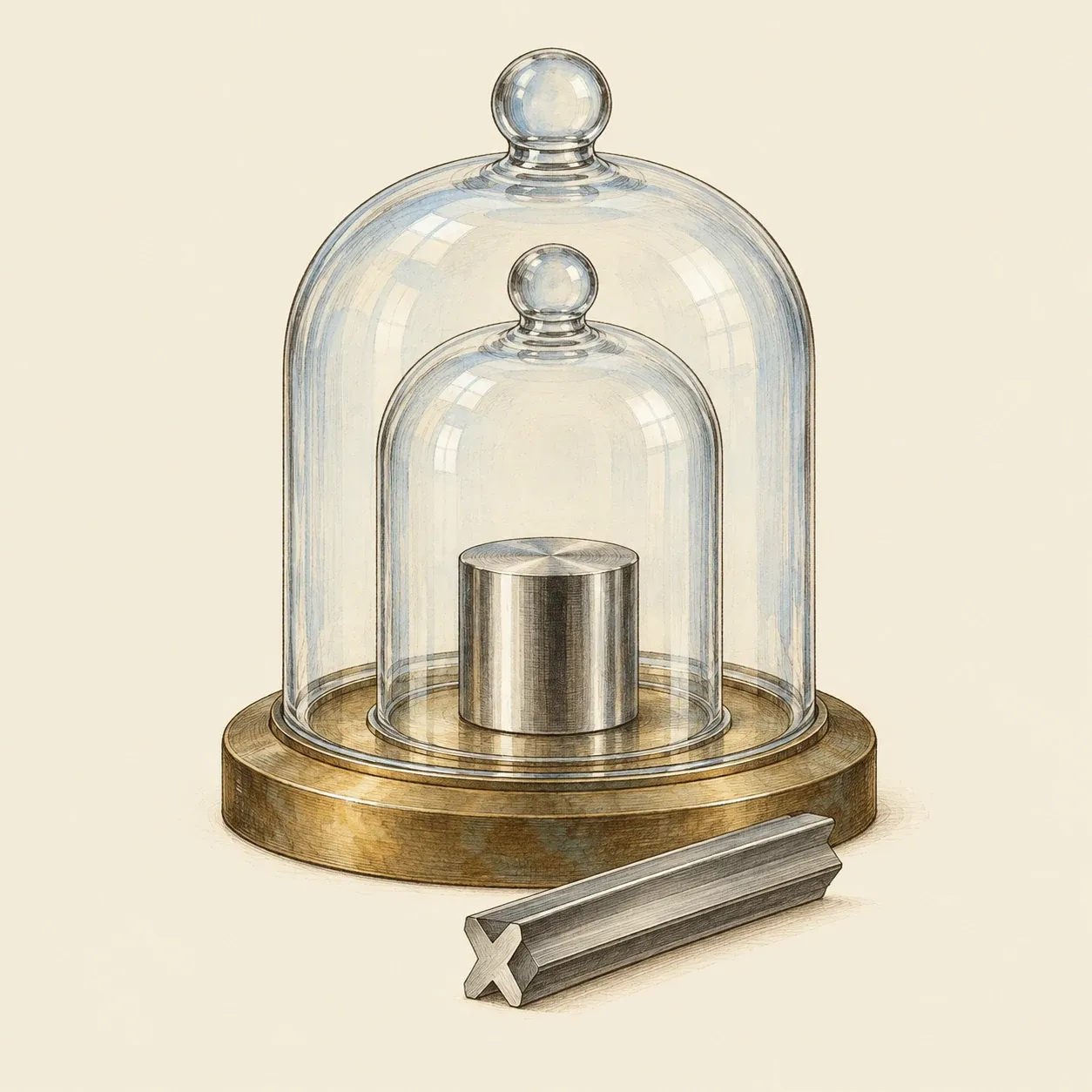 The international kilogram was kept under glass bells; the metre of 1889 was a bar with an X-shaped section.
In 1875 seventeen countries signed the Metre Convention, which created the International Bureau of Weights and Measures near Paris. From 1889 the metre was the distance between two lines on an X-shaped platinum-iridium bar at 0 °C, and the kilogram the mass of a platinum-iridium cylinder, with copies sent to member states. Later checks showed the copies slowly drifting from the original, by a median of about 25 micrograms in 1989–1991. The metre was redefined by krypton light in 1960 and by the speed of light in 1983. Since 20 May 2019 the kilogram has rested on the Planck constant.