Portland Cement
The binder that hardens under water
- 1Crushed limestone and clay
- 2Rotary kiln, flame at the lower end
- 3Clinker nodules
- 4Mill grinding clinker with a little gypsum
- 5Sand, gravel and water for the mix
- 6Wooden formwork holding fresh concrete
Portland cement is limestone and clay burnt together at about 1,450 °C into hard nodules called clinker, then ground with a little gypsum. With water it hardens by a chemical reaction, even under water, and bound with sand and gravel it makes concrete, the most used building material in the world.
What it is
Portland cement is a grey powder: limestone and clay burnt until they partly melt into hard lumps, the clinker, then ground with a little gypsum. With water it forms a paste that stiffens within hours and hardens for weeks.
It hardens by reacting with water, so it sets in a wet trench or under the sea: it is a hydraulic binder. A mortar of air lime instead hardens slowly by carbonation, in contact with air. Roman concrete resisted water thanks to pozzolana, volcanic ash whose silica reacts with slaked lime. In Portland cement, lime and the silica of the clay are already combined in the kiln, so the powder needs only water, and it grows far stronger.
Mixed with sand and gravel it makes concrete, in which these grains and stones fill most of the volume and the cement glues them together.
How it works
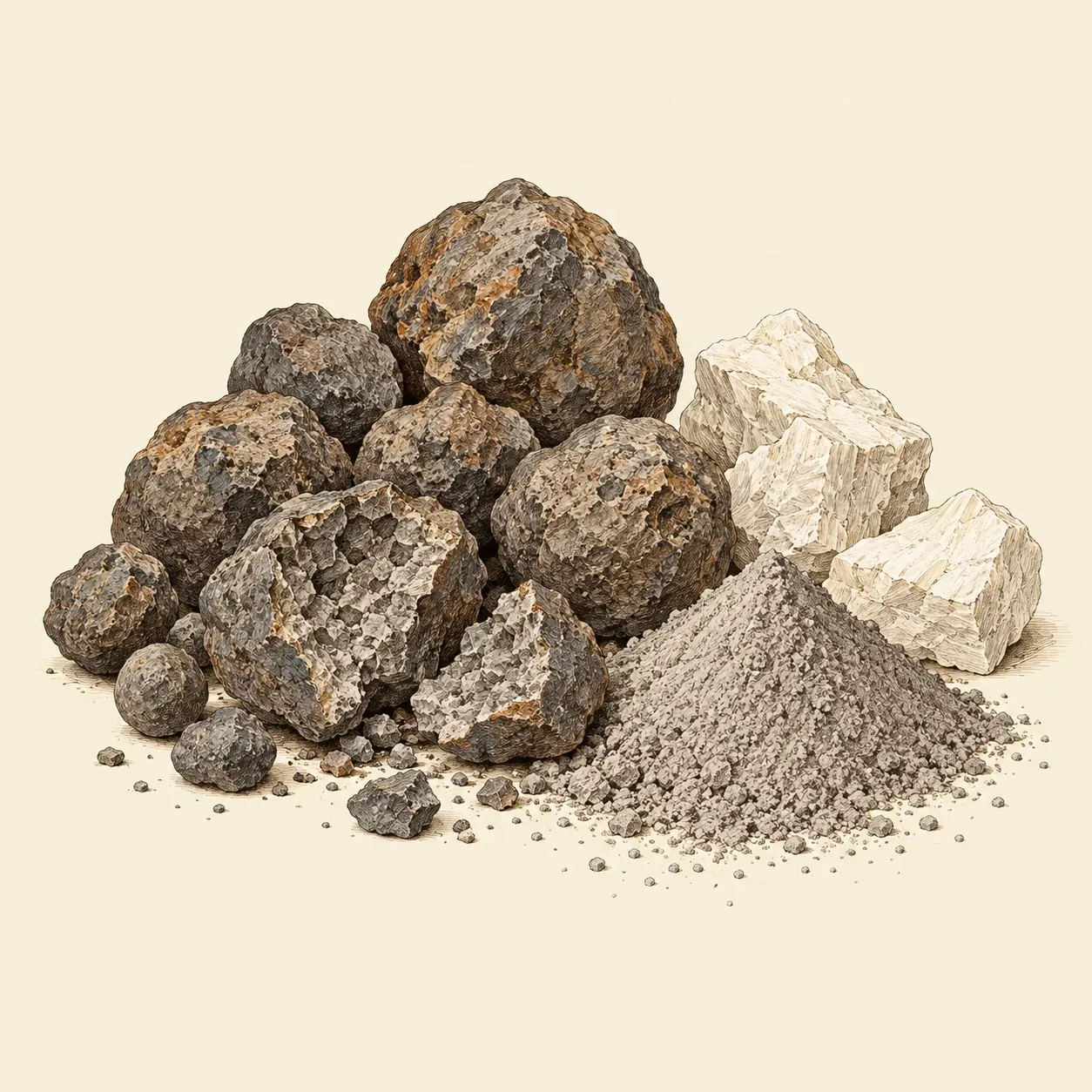 Clinker from the kiln; ground with a little gypsum, it becomes cement.
Burning. The raw mix is typically about four-fifths limestone, with clay or shale to bring silica, alumina and iron oxide. In the kiln the limestone loses its carbon dioxide and becomes quicklime, which then combines with the clay’s minerals. Near 1,450 °C part of the charge melts and the rest sinters into dark nodules. A typical clinker holds about 55% alite and 20% belite, two calcium silicates; alite forms only with hard burning above about 1,300 °C. The clinker is then cooled quickly.
Grinding. The clinker is milled very fine with about 5% gypsum, which keeps its aluminate from stiffening the paste within minutes of mixing.
Setting. In water, alite and belite form calcium silicate hydrates, a poorly crystalline gel that grows from each grain and binds the grains together, giving off calcium hydroxide and heat. Alite gives the early strength, belite the gain after the first week.
Water and strength. Surplus water leaves pores, which weaken the concrete. In 1918 Duff Abrams, at the Lewis Institute in Chicago, showed that strength depends mainly on the ratio of water to cement; most mixes sit between 0.4 and 0.6 by weight. Concrete that dries out early stops reacting, and in some tests it reached only about half the strength of concrete kept moist.
How to build
Clinker needs an industrial kiln, but bagged cement, within its use-by date, can be mixed by hand on a board for a post footing or a garden slab. Anything that carries a building or a vehicle needs an engineer’s design.
Set the formwork. For a slab, dig to firm ground, compact a layer of hardcore and stake boards on edge around it, tops level and inner faces oiled. For a footing, the hole is the mould.
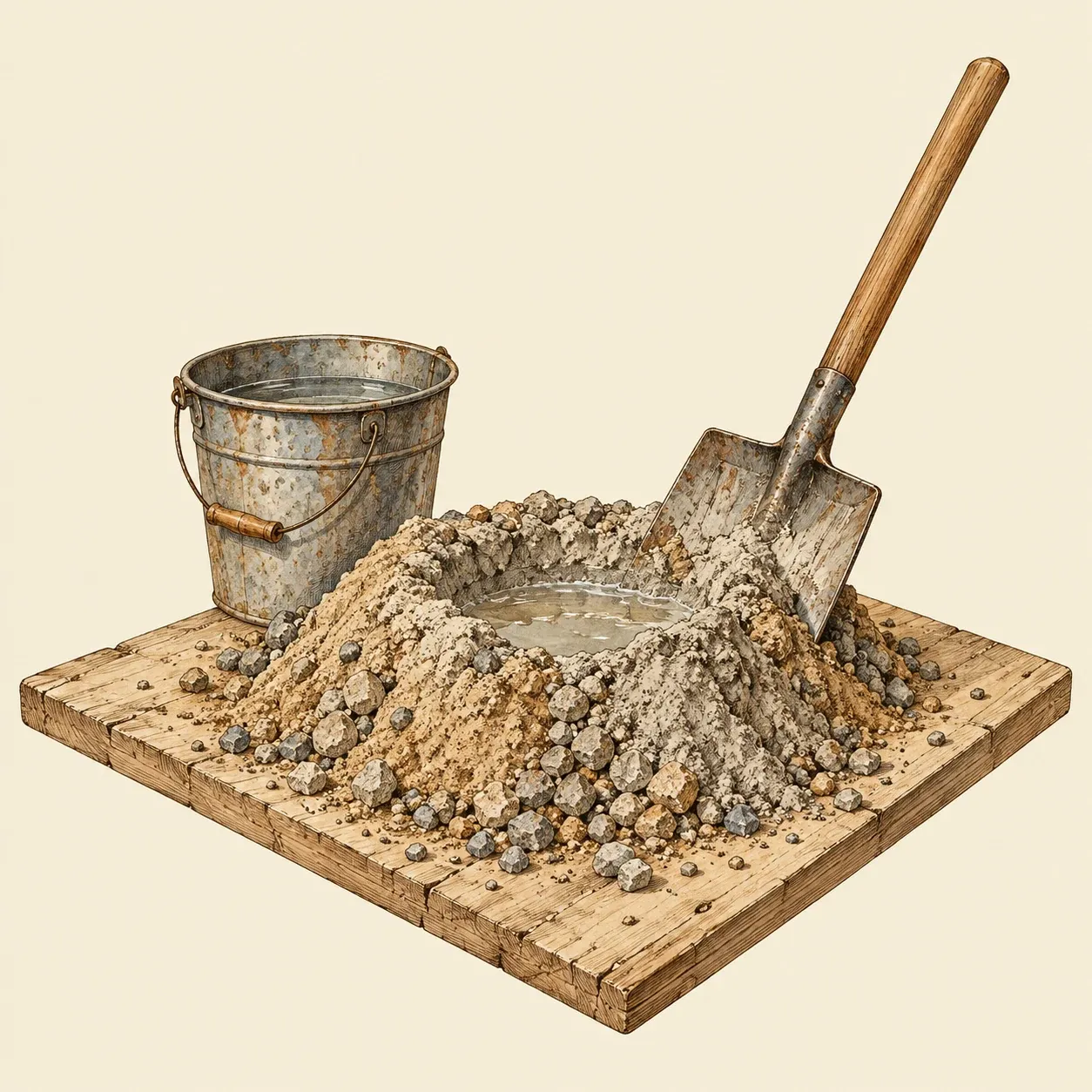 Water goes into a crater in the dry mix and is turned in from the edges.
Mix dry, then add little water. A common guide is one bucket of cement, two of sharp sand and three of washed gravel up to 20 mm. Turn the dry heap until it is evenly grey, then pour water into a crater and shovel the dry edges into it, a little at a time. A ratio of 0.5 means about 12.5 litres for a 25 kg bag, counting the water already in wet sand. Stop when the mix is evenly wet and soft enough to fill the form and be compacted, yet still holds its shape on the shovel: extra water makes it easier to place but the hardened concrete weaker.
Place, compact and keep damp. Fill the form in layers, rodding each and tapping the boards to drive out air; level the top with a plank. Shield the fresh concrete from sun and wind while you work. Once the surface no longer marks, keep it damp under plastic or wet hessian for at least 7 days, longer in cool weather, and protect it from frost.
Test a cube. Fill one or two oiled moulds 10 cm inside from the batch, in two layers, rodding each, and cure them under the same wet cover as the slab. A materials-testing laboratory crushes such cubes in a press at 7 and 28 days and reports their strength; that is how concrete on site is checked. Breaking a cube with a hammer tells you little and throws chips and dust.
Safety. Wet cement is strongly alkaline. Trapped against the skin inside a glove or boot, it can cause serious chemical burns. Wear waterproof gloves, long sleeves, trousers over your boots and eye protection. Wash cement off the skin promptly; if it gets in the eyes, rinse with plenty of clean water for at least 15 minutes and get medical help. The powder irritates the lungs: tip bags outdoors, upwind, wearing an FFP3 mask. Cutting hardened concrete raises silica dust: use a saw with a water attachment and a fit-tested FFP3 mask. A bag weighs 25 kg: lift with bent knees, or with help.
History and evolution
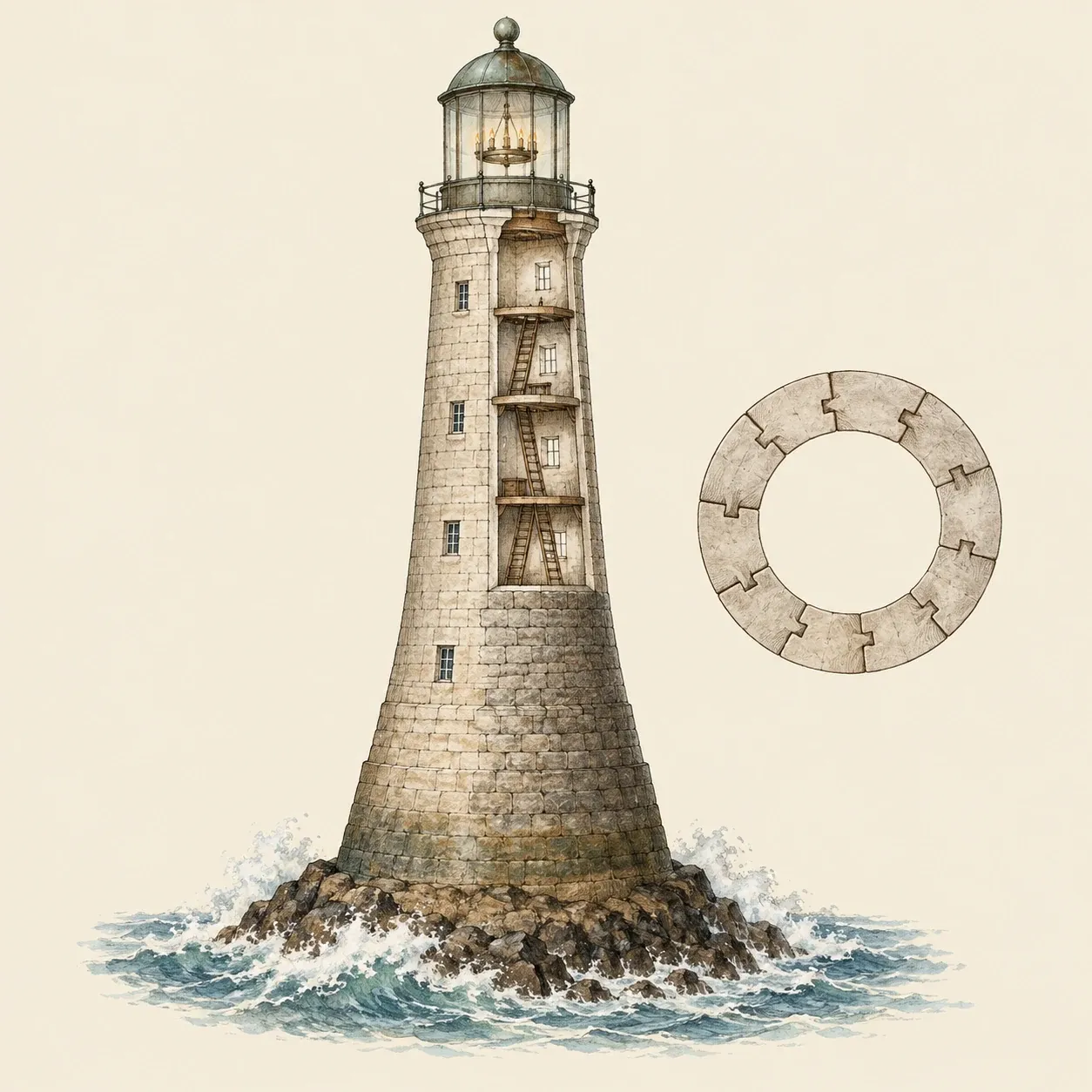 Smeaton’s Eddystone tower, 1759: dovetailed stone in a mortar that sets in sea water.
In 1756 John Smeaton, rebuilding the Eddystone lighthouse off Plymouth, tested limes for a mortar that would set between tides. The best came from limestone containing clay; he laid the tower in hydraulic lime and pozzolana. In 1817–1818 the French engineer Louis Vicat showed how clay makes lime set in water, and made an artificial hydraulic lime from chalk and clay.
On 21 October 1824 Joseph Aspdin, a Leeds bricklayer, patented an artificial stone “which I call Portland cement”, after the pale stone of Portland in Dorset. His product was probably burnt too lightly to count as Portland cement today. In the 1840s his son William and Isaac Charles Johnson, both near London, burned the mix to clinker, which earlier makers had discarded as overburnt; each claimed the discovery. This plate keeps 1824, the year of the name.
Frederick Ransome patented a rotating kiln in 1885. His British trials failed, but an oil-fired one worked in Pennsylvania by 1890, and such kilns soon replaced static ones.
In 2018, according to Chatham House, the world made more than 4 billion tonnes of cement a year, and making it produced about 8% of global CO₂ emissions. More than half came from the limestone itself, giving up its carbon dioxide in the kiln. Replacing part of the clinker with slag, fly ash, calcined clay or limestone lowers that share.