Aqueduct
Water carried by gravity alone
Plate
- 1Arcades (piers and arches)
- 2Water channel (specus)
- 3Waterproof lining (opus signinum)
- 4Cover slabs
Anatomy
Loading the figure…
An aqueduct brings water from a distant spring to a town in a channel that falls very slightly along its length, so that gravity alone keeps the water moving. The Romans built hundreds of them, in tunnels, in covered trenches and on arcades such as the Pont du Gard, and some carried tens of thousands of cubic metres a day.
What it is
An aqueduct is a man-made watercourse that carries water from a source to the place where people use it. Most of its length is hidden: a stone or concrete channel, roofed over, running in a trench or a tunnel along the side of the hills. The tall arcades that people picture are only the places where the channel had to cross a valley without losing height.
The plate shows such a crossing, of the kind built over the Gardon river near Nîmes in the first century CE. The channel runs along the top of the highest tier.
How it works
Where the water runs in an open channel, as it does over most of an aqueduct, the channel must fall steadily from the spring to the town, never rising and never dropping too fast. Too little slope and the water slows and drops its silt; too much and it scours the lining. The aqueduct of Nîmes, about 50 km long, loses only 12 to 13 m between source and town (measurements differ slightly), an average of about 25 cm per kilometre, and much less on some stretches. On the Pont du Gard itself the fall is a few centimetres.
The channel, called the specus, was usually about as wide as a man and a little taller, so that workers could walk inside to clean it. Its floor and walls were coated with opus signinum, a lime mortar full of crushed tile and pottery that sets hard and holds water. Rounded fillets at the foot of the walls closed the corners where leaks begin. Stone slabs or a vault covered the top, kept out dirt and sunlight, and stopped the water from warming up.
Laying out such a slope over tens of kilometres was the surveyors’ work. Vitruvius, writing in the late first century BCE, describes the chorobates, a long wooden table whose plumb lines, or a groove filled with water on windy days, show when it is level. With it and with sighting rods, a team could carry a level line across a whole landscape and mark the fall on stakes.
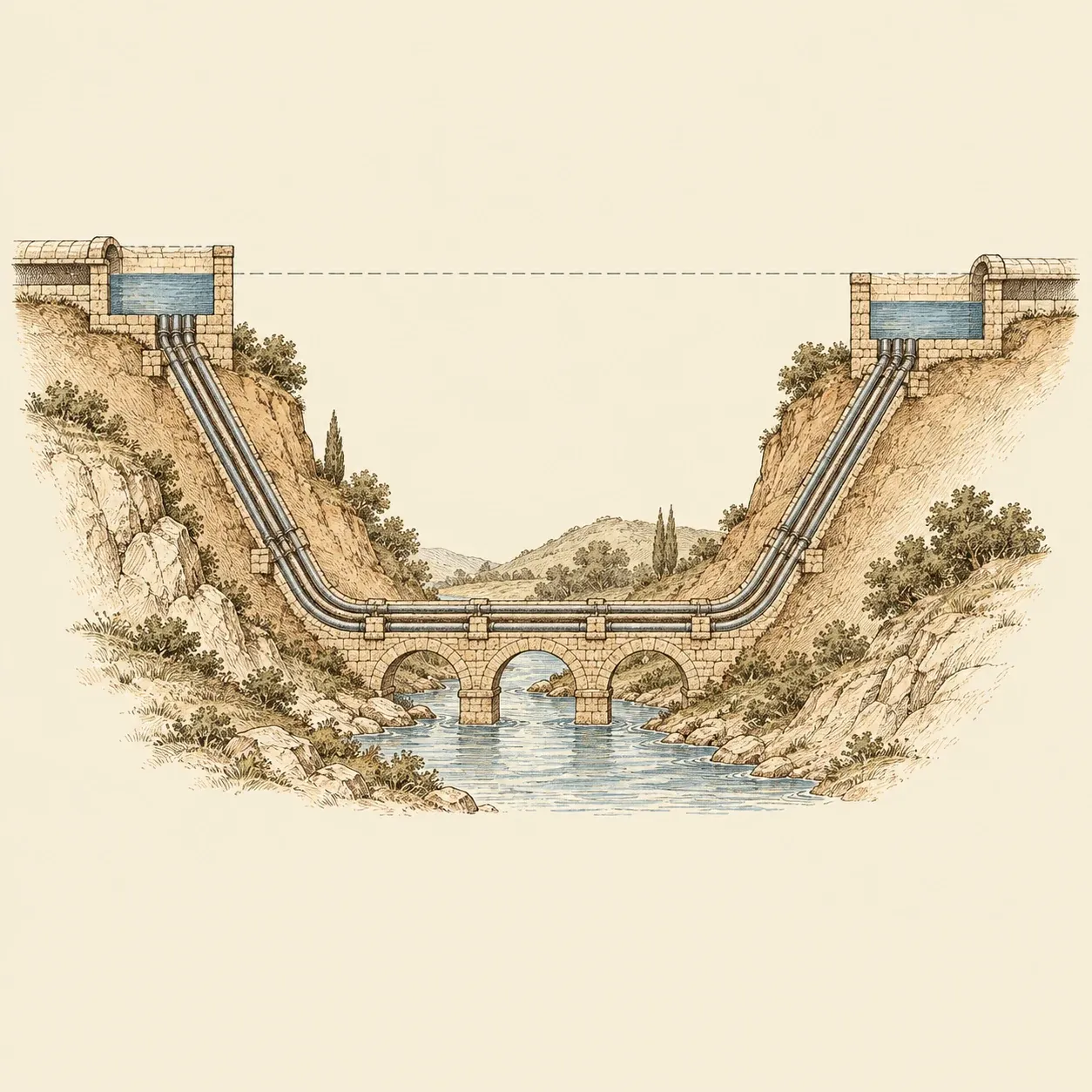 An inverted siphon: the water rises again on the far side, but never quite to its starting level.
Deep valleys could also be crossed by an inverted siphon. The water entered a tank on the near slope, ran down through sealed lead pipes, crossed the valley bottom on a low bridge and climbed the far slope to a second tank set a little lower. Vitruvius already describes this arrangement and calls the long, nearly level stretch across the valley floor the venter, the belly. Siphons saved masonry, but the lead was costly and the joints had to withstand high pressure. Vitruvius’s text, as usually translated, also calls for vents to let trapped air escape, although the exact meaning of his term is debated. For ordinary supply pipes he preferred fired clay, because he believed that water carried in lead was bad for health.
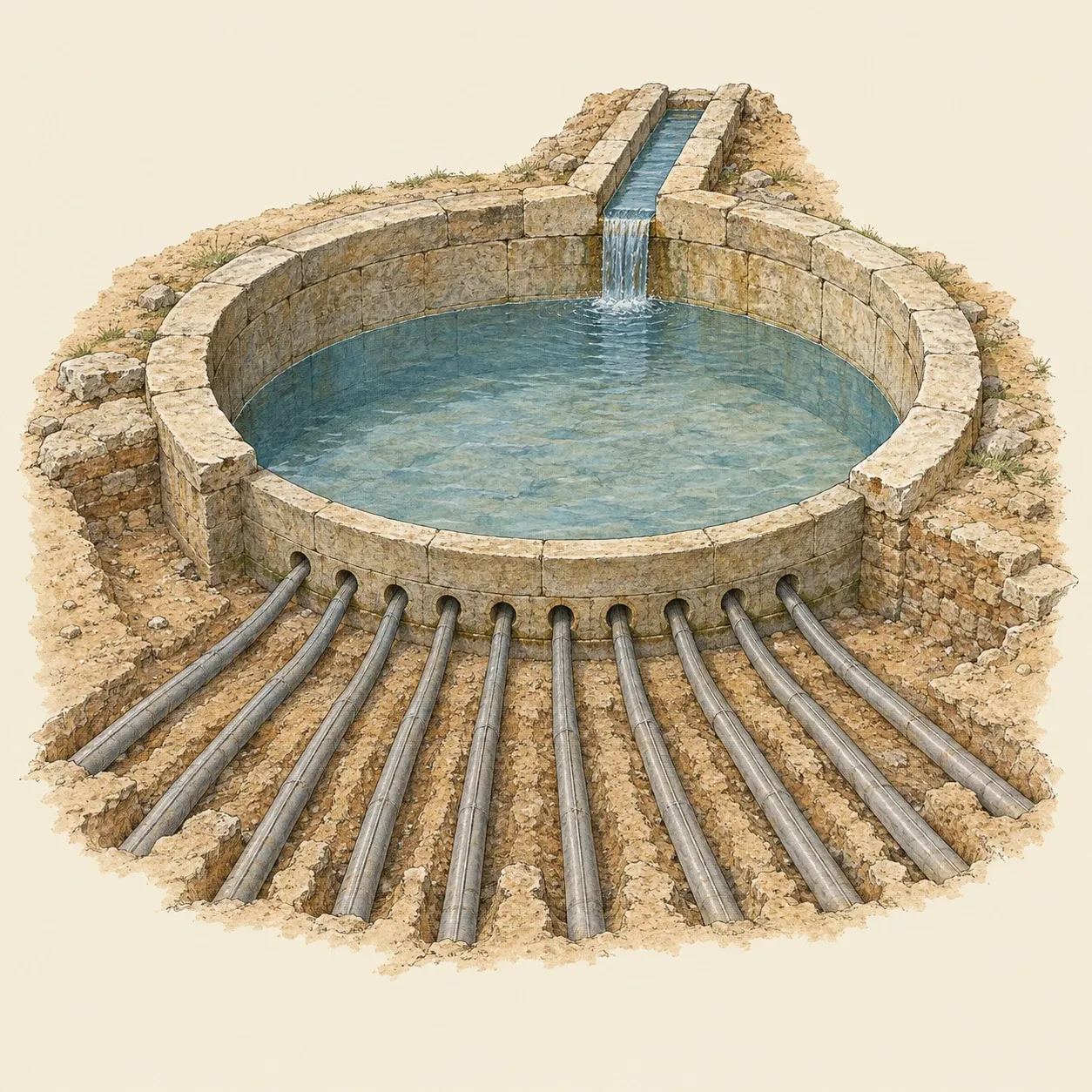 The round distribution basin at Nîmes, where ten lead pipes took the water to the districts of the town.
At the town the water reached a distribution tank, the castellum. Vitruvius describes one divided into three, with separate outlets for the public fountains, the baths and private houses, arranged so that the fountains would be the last to run short. The one that survives at Nîmes is a round basin about 5.5 m across, from which ten lead pipes ran to the districts. Water flowed day and night; what was not used ran on to wash the drains. Vitruvius adds that the rents paid by private households were meant to pay for the upkeep of the aqueduct. Estimates of the flow at Nîmes range from about 20,000 to 40,000 m³ a day, and the water took about a day to arrive from the spring.
How to build it
Large Roman aqueducts took public money, skilled surveyors and big building crews. On a garden scale the same principles bring water from a spring or a roof tank to a pond or a field, without a pump.
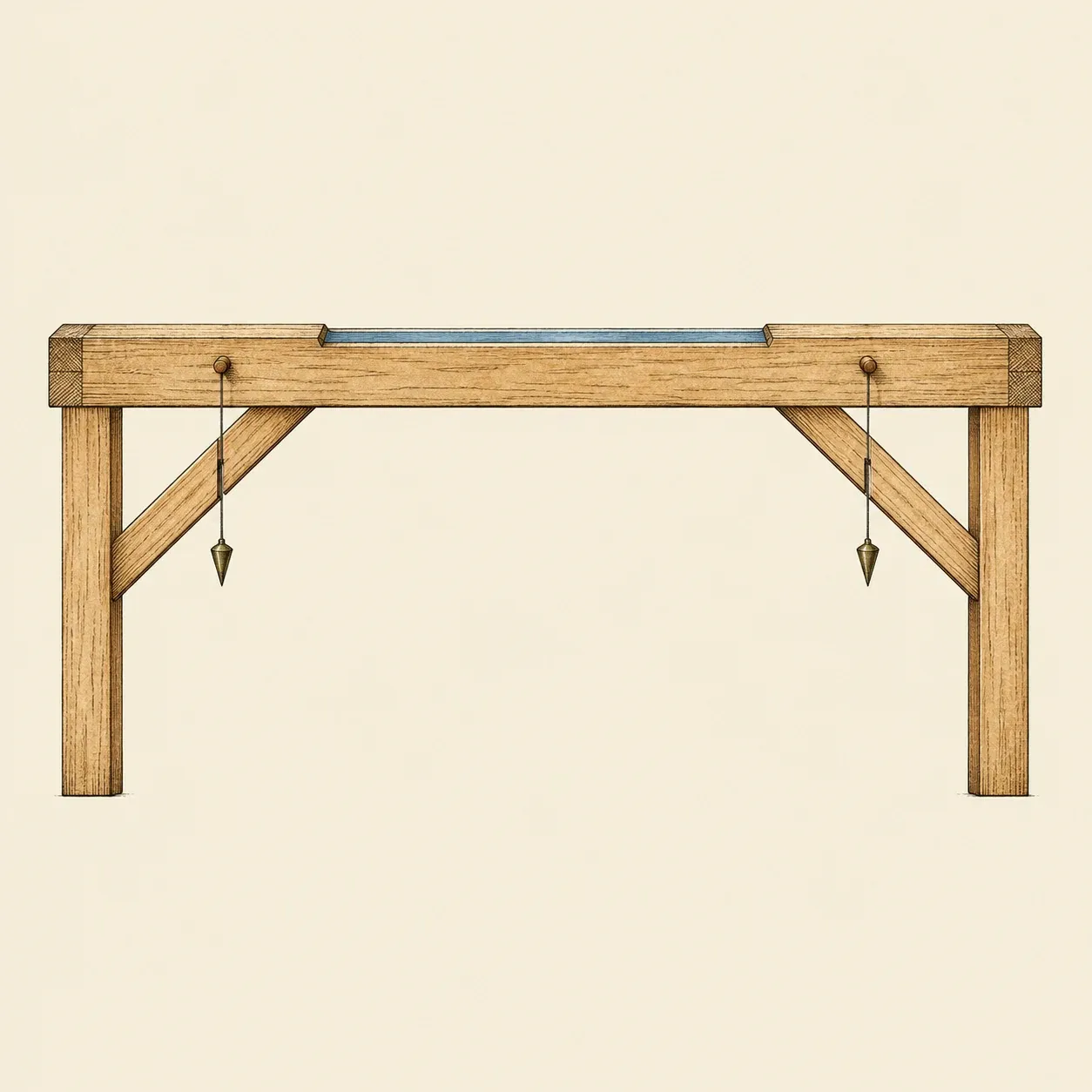 The chorobates: a levelling table about 20 Roman feet long, checked with plumb lines or with water in a groove.
Find the levels. Mark the source and the point of arrival, then measure the height between them. A clear plastic tube filled with water works as a modern chorobates: the water stands at the same height at both ends. Peg the route every few metres and note the height at each peg.
Choose the slope. A smooth channel carrying clean water typically needs a fall of a few millimetres per metre; size it for the flow you expect, and avoid steep stretches where the water would run fast. Spread the fall along the route as evenly as the ground allows, and plan a gentle detour along the contour rather than a hump that would stop the flow.
Dig and lay the channel. Dig a trench to the pegged depths, firm its floor and lay the channel: half-pipes of fired clay, a masonry channel lined with hydraulic lime or cement mortar and left to cure before water is let in, or plain pipe. Check the fall with the tube at every joint. Seal the joints and round off the inner corners if you build in masonry.
Add a settling basin. Just after the source, build a small tank where the water slows down and drops its sand before it enters the channel. Fit a grid against leaves, and an overflow so that a flood does not burst the work.
Cover it. Close the channel with slabs or tiles. Covered water stays cleaner and cooler, and fewer algae grow in it.
Safety. Trench sides can collapse, especially in loose or wet ground: shore them or slope them back before you work in a deep trench, and never work alone in one. Do not use lead pipes or lead solder for water that people or animals will drink, and treat the system as non-potable: do not drink its water. Lime mortar is caustic: wear gloves and eye protection, and a dust mask when mixing dry lime. Any open tank or pond is a drowning risk for small children: fence it or cover it. Building arches or walls above head height means work at height and heavy stones: use proper scaffolding and get advice from a builder.
History and evolution
Channels for water are much older than Rome. The Assyrian king Sennacherib, between about 703 and 690 BCE, had a canal built to bring water to Nineveh, and at Jerwan it crossed a valley on a limestone bridge more than 280 m long. It is often called the oldest known aqueduct bridge.
Rome’s first aqueduct, the Aqua Appia, was begun in 312 BCE under the censor Appius Claudius Caecus, who also built the Via Appia. It ran about 16.5 km, almost entirely underground. Others followed: the Anio Vetus in 272 BCE, the Aqua Marcia in 144 BCE, more than 90 km long, and the Aqua Claudia and Anio Novus, finished in 52 CE. At the end of the first century CE the emperor Nerva named Frontinus water commissioner, and his treatise lists nine aqueducts serving the city, with their lengths and the illegal tapping he uncovered.
The Pont du Gard was probably built between about 40 and 60 CE, although some studies extend the range to 80. Its three tiers have 6, 11 and 35 arches; 12 more of the top tier have been lost. The large limestone blocks of its arches, some of them weighing up to 6 tonnes, are laid without mortar. The Nîmes aqueduct fell out of use as deposits and roots blocked it, probably by the sixth century. The bridge survived partly because people used it to cross the river; in 1743–1747 Henri Pitot built a road bridge against its lower tier, and it became a World Heritage Site in 1985.
Medieval towns and monasteries built smaller aqueducts, and modern supply systems combine gravity channels and tunnels with pressure pipes, pumps and reservoirs. A constant gentle fall still governs canals, sewers and other channels that flow by gravity.