Lock & Key
A bolt that only its key frees
Plate
- 1Bolt
- 2Lock case
- 3Pins
- 4Holes in the bolt
- 5Key
- 6Pegs of the key
Anatomy
Loading the figure…
A lock holds a bolt in place until a key of the right shape releases it. Wooden pin locks were in use in the ancient Near East, and the same principle, refined in the nineteenth century, works in most door cylinders today.
What it is
A lock keeps a door, a lid or a chain closed, and a key-operated lock is meant to open only with the matching key. Every key-operated lock has the same three parts: a bolt that does the holding, something that blocks the bolt, and a key whose shape removes the block.
The plate shows the wooden pin lock often called the Egyptian lock. It needs no metal and no spring, yet it already works like a modern pin-tumbler cylinder.
How it works
The lock case is a block of wood fixed to the inside of the door. A square bolt slides through a tunnel in its lower part, and its end enters a socket in the doorpost. The bolt is hollow, and the top wall of the bolt has a row of holes. Above them, loose wooden pins hang in vertical holes in the case. When the bolt is pushed home, the pins drop by their own weight into the holes and lock it.
The key is a long flat bar carrying pegs that match the holes. The owner slides it into the hollow of the bolt and lifts it. The pegs push the pins up until their lower ends are flush with the top of the bolt, and the bolt, with the key still inside it, can be drawn back. A key with a peg out of place leaves a pin in its hole.
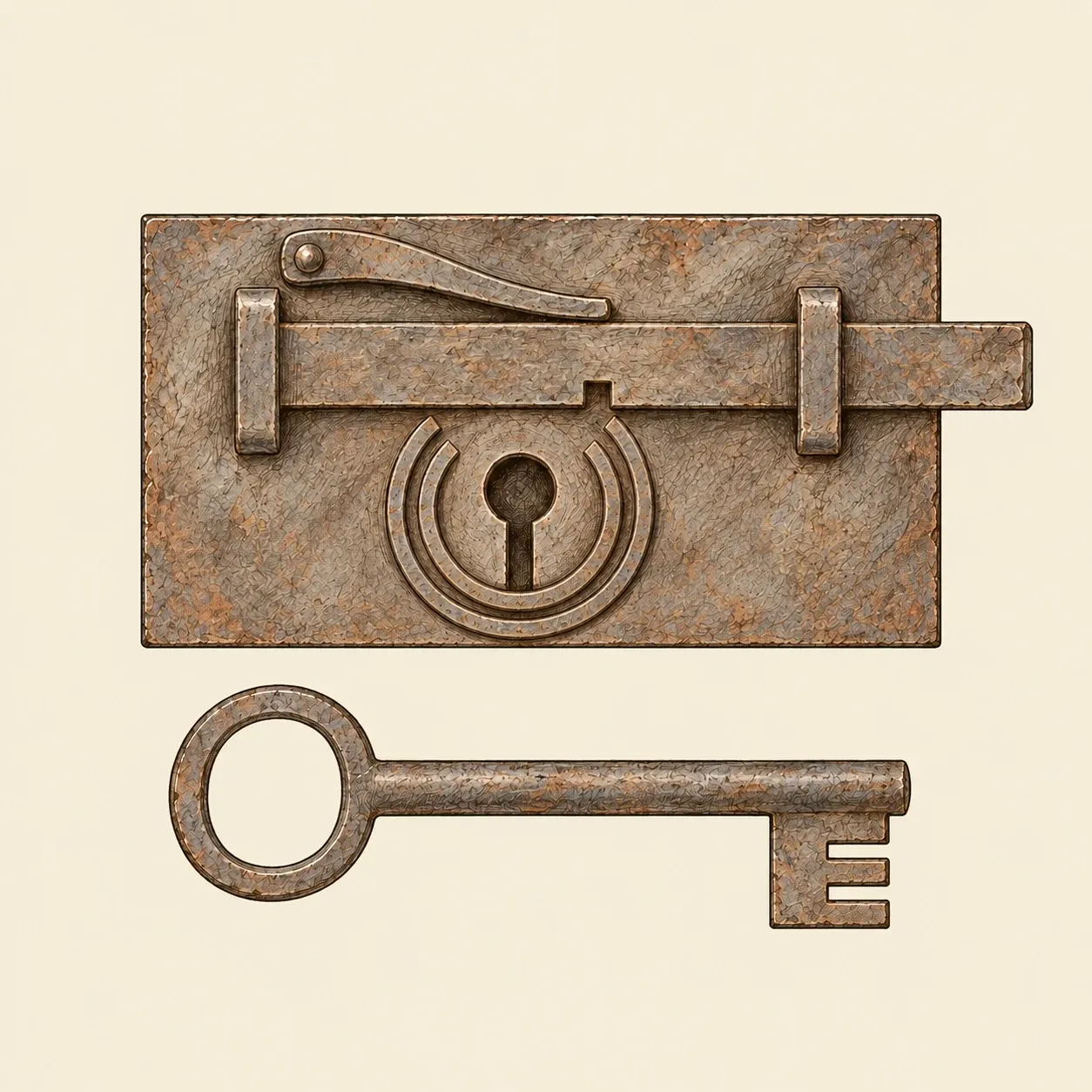 In a warded lock, the slots cut in the key’s bit let it turn past the fixed wards and throw the bolt.
Later locks used other blocking parts. A warded lock has fixed obstacles, the wards, around the path of the turning key, and only a key with cuts in the right places can turn far enough to throw the bolt. A lever lock has a stack of pivoting levers that must each be lifted to exactly the right height before the bolt can pass.
The modern pin-tumbler cylinder keeps the idea of pins that the key must lift to a set height. A brass plug turns inside a fixed housing. Five or six pairs of pins, pushed down by small springs, cross the boundary between them and stop the plug from turning. The notches on the key lift each pair so that the gap between the lower pin and the upper pin lies exactly on that boundary, the shear line, and the plug turns.
How to build it
A wooden pin lock makes a good weekend project for a box or a cabinet. Anyone can open it with a little patience, so treat it as a demonstration piece.
Make the bolt. Take a hardwood bar 40 mm wide, 45 mm high and 40 cm long. Plough a channel 20 mm wide and 30 mm deep into its underside, starting from the inner end and running well past the middle, then glue a thin strip under it to close the channel into a tunnel. The 15 mm of wood left above the channel is the top wall. Drill three or four holes, 10 mm across, through that wall at uneven spacings.
Make the case. Build a block around a square tunnel that the bolt can slide through, either by drilling and chiselling it out or by gluing the block up from four boards around the bolt. With the bolt in its locked position, drill down through the top of the block into the bolt’s holes so that every hole lines up. Cut a 10 mm dowel pin for each hole and glue a short collar of thicker dowel near its top, so that it can fall through the top wall of the bolt and no further: its lower end must stop flush with the roof of the channel, or the key will not go in. Widen the top of each hole in the case to take the collar, then glue a cap over the block so the pins stay inside.
Make the key. Plane a flat bar about 10 mm thick that slides freely in the channel. Glue dowel pegs into it at the same spacings as the holes, each standing 15 mm tall, exactly the thickness of the top wall; bar and pegs together leave 5 mm of clearance under the roof as the key slides in. When the key bar is lifted against the roof, the pegs fill the holes and push the pins up until they are just clear of the bolt. Leave room above the collars so the pins can rise that far.
Fit and test. The pins work by gravity, so mount the case on an upright surface, such as the inside of a cabinet door, with the pins hanging straight down, and cut the socket for the bolt in the frame. Either work the lock from the inside or cut a hand opening beside it. Sand the pins until they drop freely and wax the bolt.
Safety. Clamp the work before sawing or drilling, keep both hands behind the cutting edge of chisels, and wear eye protection when using a drill or a router. Never fit a homemade lock to a door that people may need to open in a hurry, such as a fire exit or a bathroom.
History and evolution
Locks are hard to date because wood rarely survives. The French excavator Paul-Émile Botta found, in the Assyrian palace of Sargon II at Khorsabad, a gate closed by a large wooden lock of the pin type, and Austen Henry Layard recovered a bronze key of the same shape at Nineveh. Popular histories call the Khorsabad lock 4,000 years old, but the palace dates from the eighth century BCE, and the archaeologist D. T. Potts traced that figure to a misread catalogue. He also argued that older Mesopotamian omen texts already name the bolt, the pins and the lock, which would make the design older than any surviving example. The name “Egyptian lock” comes from its long use in Egypt, where it was still in daily use in the nineteenth century.
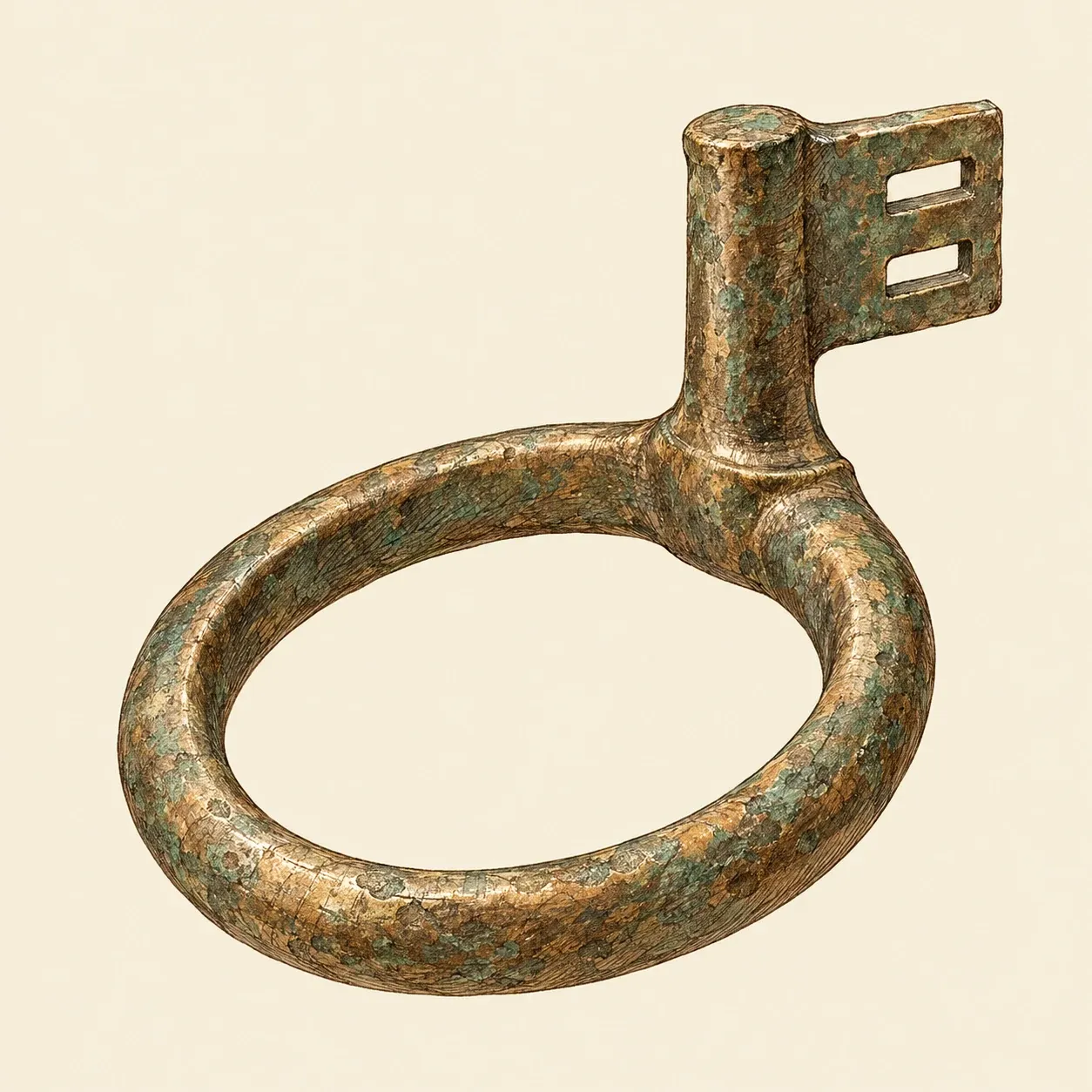 Roman key rings opened small caskets; the slots in the bit let it pass the wards inside the lock.
Greek writers knew keys with several teeth, and Roman smiths made the lock in iron and the key in bronze, added wards and built padlocks. Small Roman keys were often made as finger rings, probably to open caskets and jewel boxes rather than doors; Roman clothes had no pockets, so a key worn on the hand was both safe and at hand. Such rings turn up in numbers on Roman sites in Britain, notably in London and Colchester, where a wooden box was buried in a grave with its key ring still in the lock. Medieval locks were mostly warded, often richly decorated, and easy to pass with a thin tool.
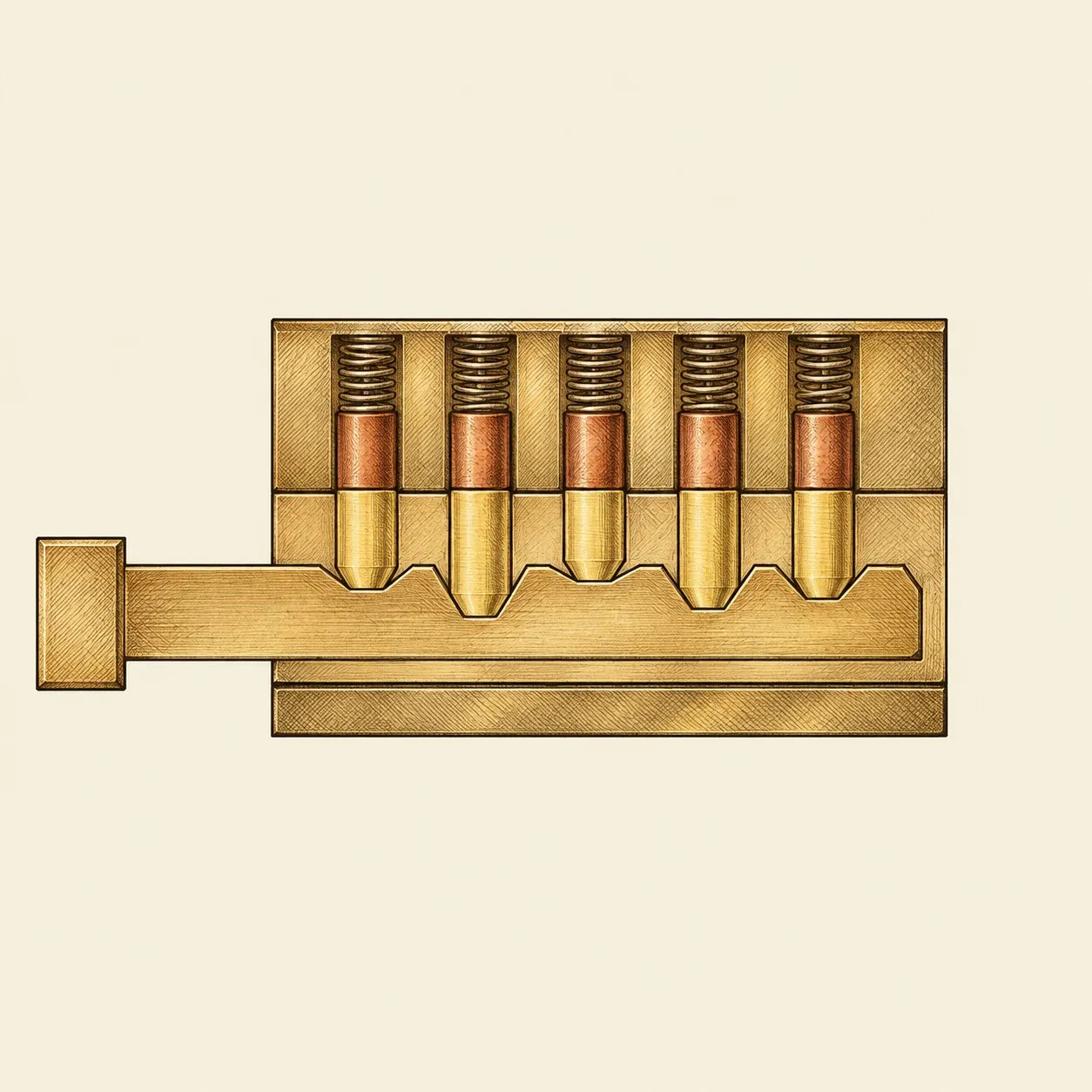 In a pin-tumbler cylinder, the key brings every gap between lower and upper pin onto the shear line.
In England, Robert Barron patented the double-acting lever lock in 1778. Joseph Bramah patented a cylindrical lock with sliding plates in 1784 and later offered a reward to anyone who could pick the one in his London shop window; accounts date the challenge to 1790, while the challenge board kept at the Science Museum is dated 1801. The American locksmith Alfred Hobbs finally opened it during the Great Exhibition of 1851, after about 51 hours of work over 16 days. In 1818 Jeremiah Chubb added a detector to the lever lock: a lever lifted too high jammed the mechanism and showed that someone had tried to pick it. Abraham Stansbury patented a pin-tumbler lock in England in 1805, and Linus Yale Sr. patented his own versions in the United States in the 1840s. His son, Linus Yale Jr., patented a pin-tumbler lock with a round key in 1861, then in 1865 a lock opened by a thin, flat steel key cut along its edge. The cylinder locks on most doors today descend from that design.