Spinning Wheel
Fibre into thread, faster
Plate
- 1Drive wheel
- 2Treadle
- 3Footman (connecting rod)
- 4Drive band
- 5Flyer with hooks
- 6Bobbin
Anatomy
Loading the figure…
A spinning wheel twists loose fibre into yarn with a spindle driven by a large wheel, much faster than a hand spindle. The wheel with a flyer, known in Germany by about 1480, also winds the yarn onto a bobbin while it spins, so that spinning and winding no longer alternate.
What it is
Spinning turns a mass of short fibres, such as wool, flax or cotton, into a continuous thread. Two things happen at once: the fibres are drawn out into a thin, even strand, and the strand is twisted so that the fibres grip each other. Twist is what gives yarn its strength.
For thousands of years this was done with a hand spindle, a stick weighted with a whorl, set spinning by the fingers. The spinning wheel puts the spindle on a frame and drives it with a large wheel by a cord. One turn of the big wheel turns the small spindle many times, so it twists far faster than a hand could.
The plate shows a Saxony wheel, a treadle wheel with a flyer of the kind used across Europe from the sixteenth century, here as an eighteenth-century model.
How it works
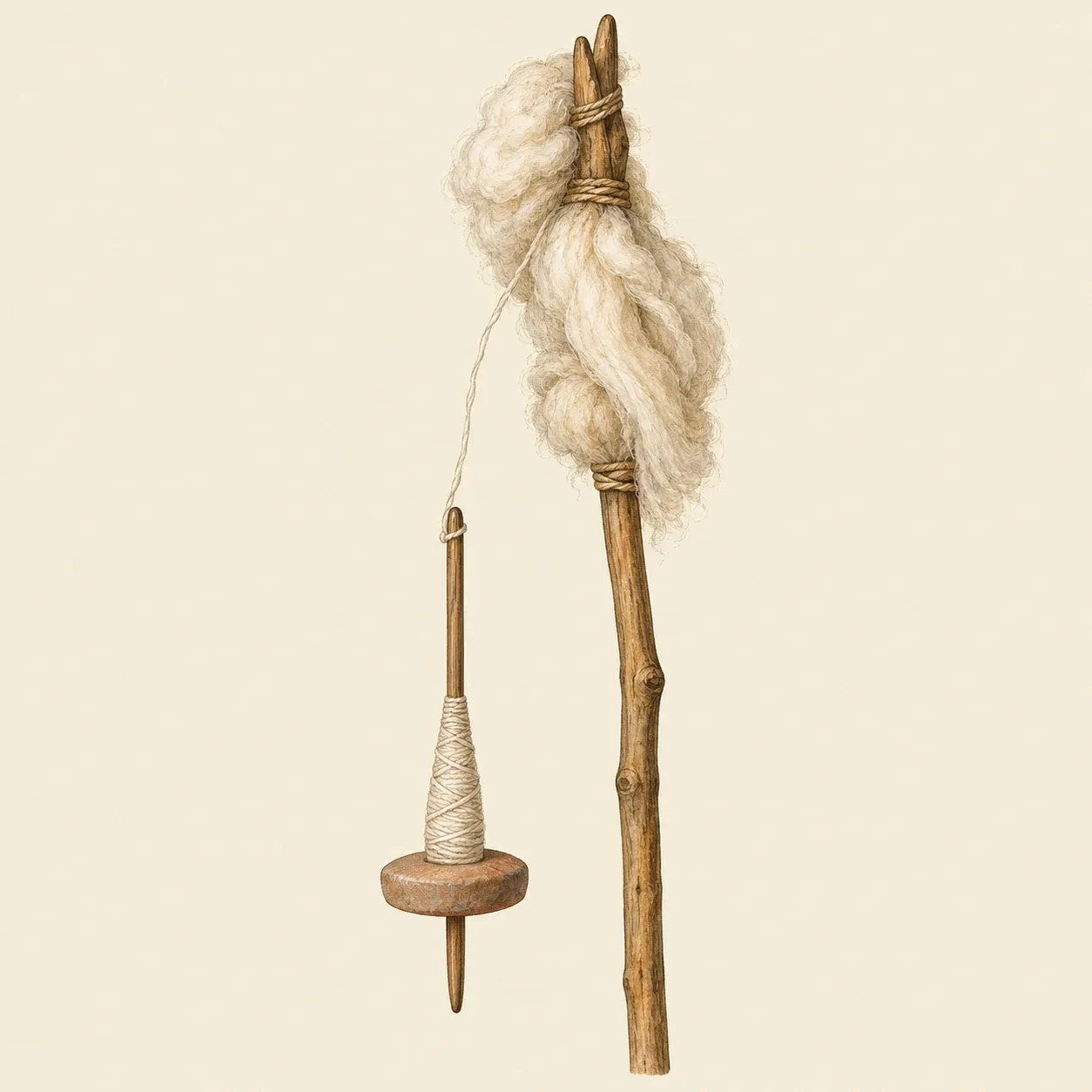 Before the wheel: a hand spindle and a distaff. The whorl keeps the spindle turning.
On a great wheel, an early type, the spindle simply points at the spinner. The spinner turns the wheel, holds the fibre at an angle to the spindle tip, and walks backwards drawing out a length of yarn while the twist runs into it. Then the spinner stops, holds the yarn square to the spindle and turns the wheel again to wind the finished length on. Spinning and winding alternate.
The flyer removes that pause. The yarn enters a hollow spindle through a hole at its front end, the orifice, comes out through a side hole, runs along one arm of a U-shaped flyer and over one of its hooks, and goes onto a bobbin that sits loose on the spindle. Flyer and bobbin each have their own grooved pulley, of different sizes. One continuous drive band goes twice round the big wheel and once round each pulley, so the smaller bobbin pulley turns a little faster than the flyer.
The flyer’s turning twists the yarn. The small difference in speed between bobbin and flyer winds the twisted yarn on as fast as it is made. Now and then the spinner stops the wheel and moves the yarn to another hook so that the bobbin fills evenly, and adjusts a tension screw that moves the flyer assembly along the bench to tighten or slacken the band.
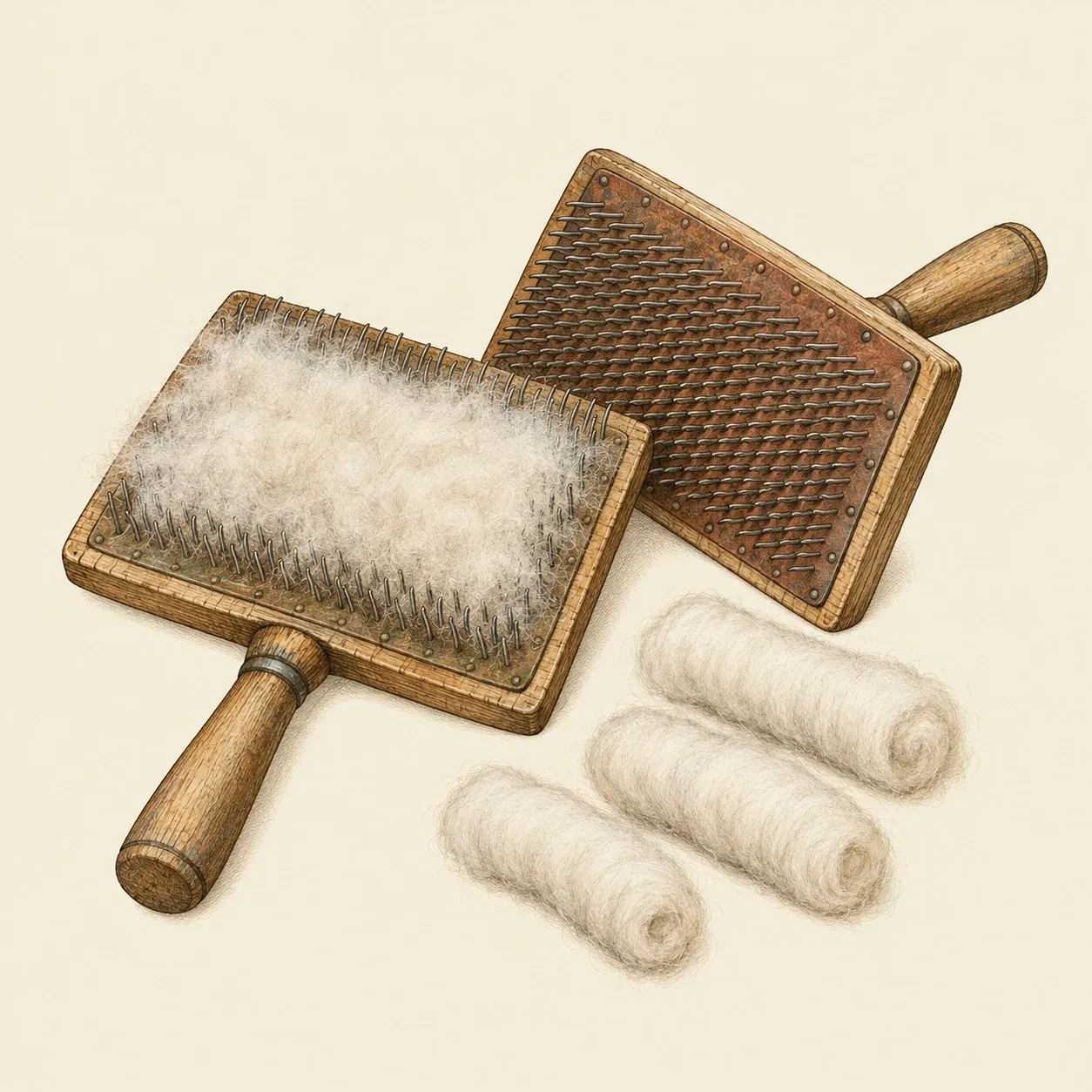 Hand cards: wool is brushed between two cards and rolled into rolags ready for spinning.
The treadle frees both hands. A crank on the wheel’s axle is linked by a wooden rod, the footman, to a hinged board under the spinner’s foot. Each press of the foot gives the wheel a push. One hand feeds fibre from a distaff or from a rolag of carded wool, the other controls the twist. Saxony wheels were used above all for long fibres such as flax and wool. Flax is dressed onto a distaff and drawn from it a few fibres at a time. Wool is first brushed between a pair of hand cards and rolled into a soft tube, the rolag, so that the fibres lie loosely and draw out evenly.
How to build it
A flyer wheel needs turned parts and careful fitting, a project for a skilled woodworker with a lathe. A simpler wheel of the oldest type shows the principle and spins wool.
Make the bench. A solid board about 1 m long on three or four legs, high enough to sit or stand at. At one end, fix an upright post to carry the wheel; at the other, a shorter post for the spindle head.
Fit the wheel. Any large, true-running wheel with a grooved rim will do: a wooden wheel built from a hub, spokes and rim, or an old bicycle wheel with its tyre removed. Mount it on an axle in the post and add a handle near the rim to turn it.
Make the spindle head. Two small uprights on the short post hold a straight steel rod, pointed at one end, in loops of leather or in small bearings. Fix a small grooved pulley on the rod between the uprights. The rod lies across the bench, parallel to the wheel’s axle, with its pulley exactly in line with the groove of the wheel so that the band runs straight; its point faces the side where you stand.
Fit the drive band. Tie a loop of strong cotton cord round the wheel rim and the spindle pulley, tight enough to drive the spindle without slipping. With a wheel about ten times the diameter of the pulley, the spindle turns about ten times for each turn of the wheel.
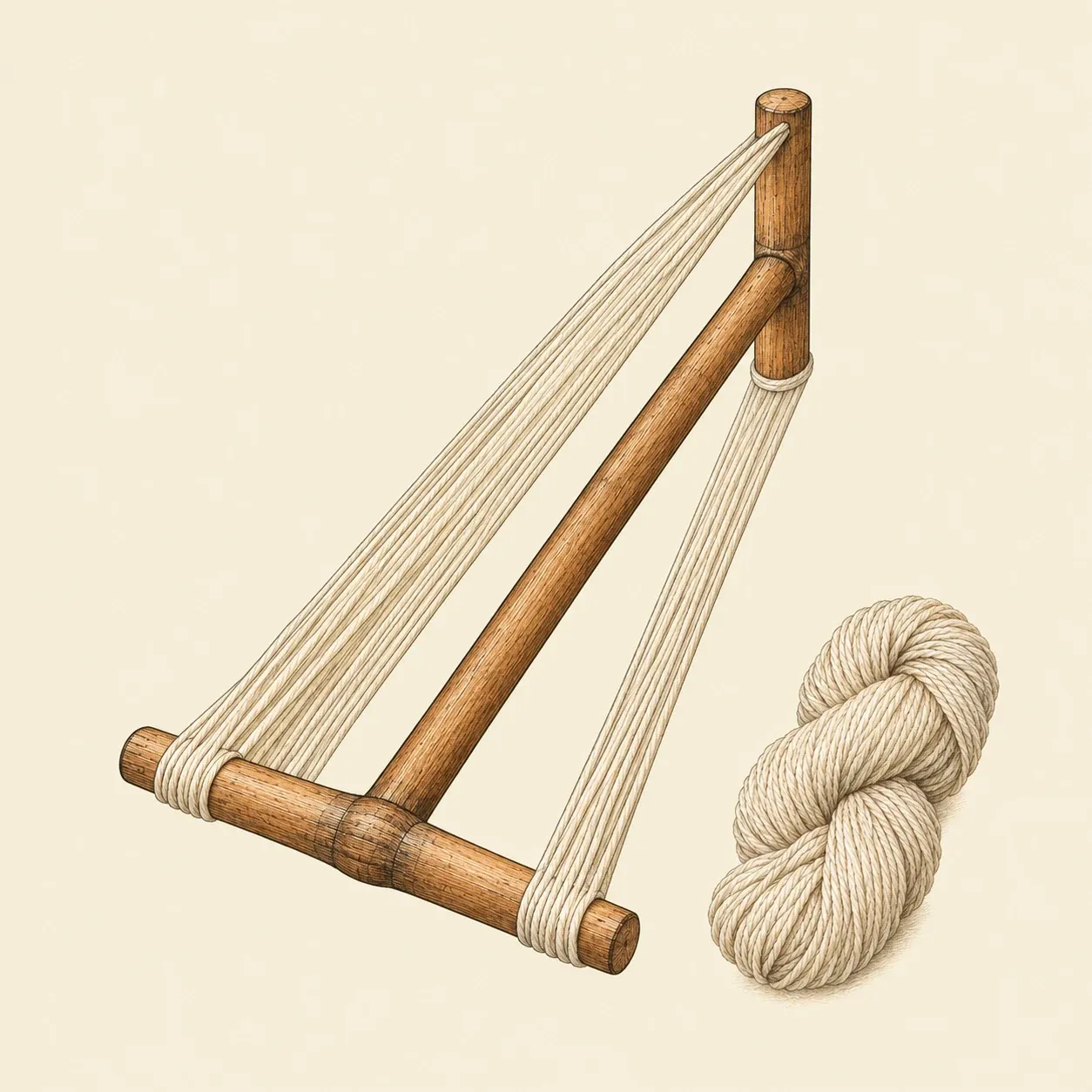 A niddy-noddy: spun yarn is wound into a skein of known length before washing and dyeing.
Spin. Tie a leader of yarn to the spindle shaft, wind on a few turns, then spiral it up to the tip so that it leaves over the point. Overlap its end with carded wool, turn the wheel slowly and draw back at an angle to the tip, letting twist run into the fibre. To wind on, turn the wheel back a little to free the spiral, hold the yarn square to the spindle and turn forward; then spiral the yarn back up to the tip for the next length. When the spindle is full, wind the yarn onto a niddy-noddy, tie the skein loosely in several places, take it off and wash it to set the twist.
Safety. Keep fingers, hair and loose sleeves away from the turning wheel, the drive band and the spindle, stop the wheel before clearing a snag, and fit a cover over the sharp spindle tip when the wheel is not in use. Check that a bicycle wheel or wooden wheel is firmly fixed and does not wobble before turning it fast. Keep small children away from a turning wheel.
History and evolution
Where the spinning wheel was invented is disputed. Some historians place it in India between about 500 and 1000 CE, others in China, where it was in wide use by about 1090, or in the Islamic world, where it is recorded by about 1030 and clearly illustrated in Baghdad in the 1230s. It reached Europe in the thirteenth century; European pictures of it date from about 1280, and the guild rules of Speyer, in Germany, mention it at the end of the thirteenth century (in 1280 or 1298, depending on the source). Wheel and spindle were long used side by side in Europe.
The flyer appears in a German illustration of about 1480, and Leonardo da Vinci also drew one. A treadle was added in the sixteenth century; a story credits a Brunswick craftsman with it in 1533. Compared with the hand spindle, the wheel greatly raised a spinner’s output. The historian Lynn White linked the larger supply of linen rags, and so of cheap paper for printing, to the wheel.
In the 1760s James Hargreaves built the spinning jenny, which drove many spindles at once, and Richard Arkwright’s water frame and Samuel Crompton’s mule of 1779 moved spinning into mills. In the twentieth century Mahatma Gandhi made the charkha, a simple hand-turned wheel, the emblem of Indian self-reliance, and hand spinners still use treadle wheels today.