Windmill
Wind turned into flour
Plate
- 1Sails
- 2Fantail
- 3Brake wheel
- 4Wallower
- 5Great spur wheel
- 6Millstones
Anatomy
Loading the figure…
A windmill catches the wind with large sails and passes that energy, through a train of wooden and iron gears, to a millstone that grinds grain. From the twelfth century to the coming of steam it was, with the water wheel, the main source of mechanical power in Europe.
What it is
A windmill is a machine that turns moving air into rotation, and that rotation into useful work. For most of its history the work was grinding grain into flour. Windmills also drained polders, sawed timber, pressed oil seeds and crushed pigments.
The mill drawn here is a tower mill: a fixed tower of stone with a cap that turns to face the sails into the wind. The design spread across Europe from the late Middle Ages, because a masonry tower can carry large sails and heavy machinery under cover.
How it works
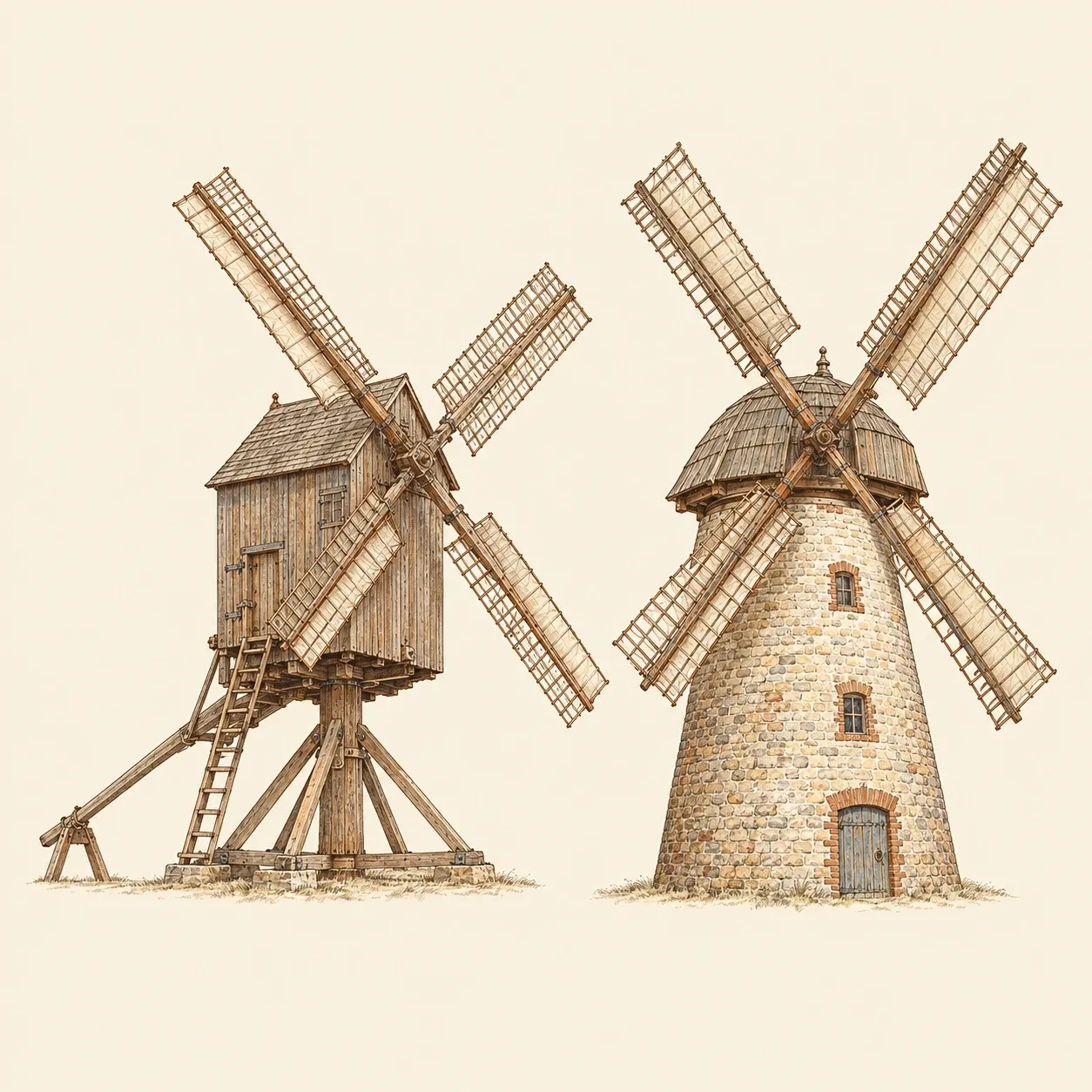 A post mill turns as a whole on its post; in a tower mill only the cap turns.
The wind pushes on the sails, which are slightly twisted and set at an angle. They behave like the blades of a propeller: part of the push becomes torque that turns the windshaft, a heavy, nearly horizontal shaft carried in the cap.
The windshaft carries the brake wheel, a large wheel with its cogs set into one face. It meshes with the smaller wallower on the vertical main shaft, so the drive turns from horizontal to vertical and gains speed. Lower down, the great spur wheel drives a small stone nut on each stone spindle. At Gedney Dyke mill in Lincolnshire, a brake wheel of 96 cogs drove a wallower of 68, and a spur wheel of 120 cogs drove stone nuts of 18: together the two stages made the stones turn about nine times faster than the sails.
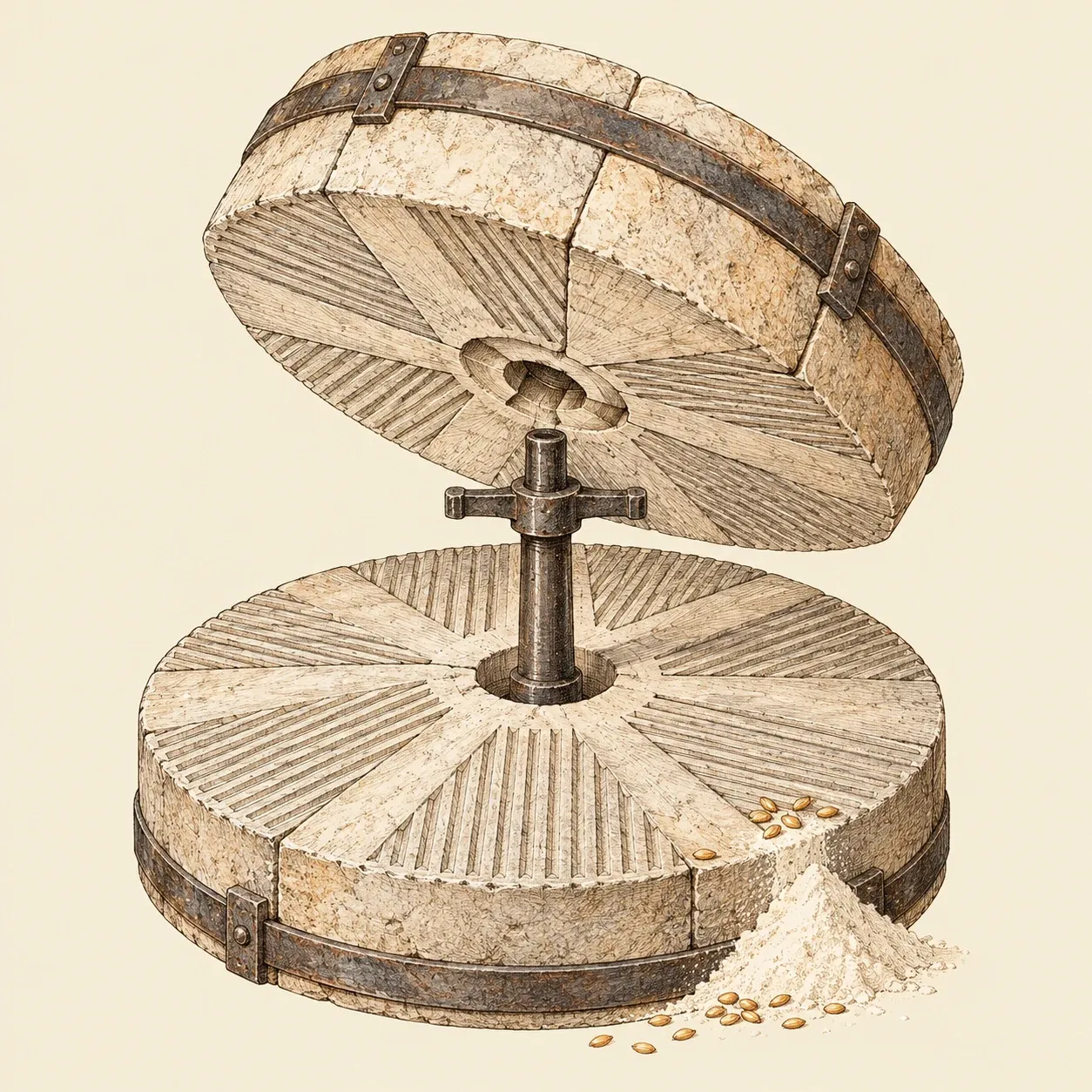 The runner sits on the rynd at the top of the iron spindle, which comes up through the fixed bed stone.
The stone spindle rises through the fixed bed stone. On its top sits the rynd, an iron bar or cross that fits into recesses in the eye of the upper runner stone and carries its whole weight. In some mills the spur wheel sits above the stones and the drive comes down through a short iron shaft called the quant, but the runner still rests on the spindle below. Grain runs from a hopper into the eye. Furrows dressed into both stones cut it and sweep the meal outwards to the rim, where it leaves as flour. The miller raises or lowers the spindle with the tentering gear, and that gap decides how fine the flour will be.
The power carried by the wind grows with the cube of its speed, so a wind twice as strong carries eight times the energy. No rotor can extract more than 59.3% of it, a limit Albert Betz published in 1920. Traditional mills stay far below that figure.
How to build it
A windmill needs an organised community: carpenters, masons, a smith, and a miller who knows how to dress stones. The stages below give the order of work and the choices that matter; the dimensions belong to the millwright.
Pick the site. An open rise, away from trees and buildings, facing the prevailing wind. Downwind of a tree or a house, the air stays turbulent for roughly twenty times its height, so keep obstacles well away on the windward side.
Raise the tower. A tapering tower of stone or brick, with thick walls at the base. The top carries a level curb of timber or iron on which the cap turns on rollers.
Shape the shaft and wheels. The windshaft is hewn from an oak trunk and bound with iron where it wears; from the late eighteenth century many were cast in iron. The wheels are hardwood, and the cogs are separate pieces, often hornbeam or apple wood, replaced as they wear.
Make the sails. Four arms each carry a lattice of laths with canvas spread over it. With the mill stopped and the sails chained, the miller spreads more or less cloth on each sail to suit the wind, much as a sailor reefs a sail.
Choose the stones. The stone must be hard and porous. French burr stone from La Ferté-sous-Jouarre was prized across Europe. It was usually built up from several pieces set in plaster and bound with iron hoops.
Fit the brake. A wooden brake band clamps the rim of the brake wheel. It has to hold the sails in a strong wind, so try it first in a light breeze, and have a millwright confirm that it and the sail chains can hold the mill in a gale before it does any work.
Safety. Never walk through the path of the sails, even when they turn slowly, and never touch a sail before the brake is on and the sails are chained. Watch the weather: take in the cloths and secure the mill before a storm arrives, because in a gale nobody can work on the sails. Inside, keep hands, hair and loose clothes away from turning gears and shafts. An overheated brake can set the cap alight, and many mills burned that way. Flour dust in the air is flammable, so naked flames are never allowed inside.
History and evolution
The first well-documented windmills stood in Sistan, on today’s border between Iran and Afghanistan. Arab geographers describe them in the tenth century, and they may be older. Their sails turn about a vertical axis inside walls that funnel the wind.
The horizontal-axis windmill appears in Europe at the end of the twelfth century. One of the earliest dated records is a post mill at Weedley in Yorkshire, listed in an inventory of Templar lands in 1185. The tower mill, where only the cap turns, spread later and allowed much larger mills.
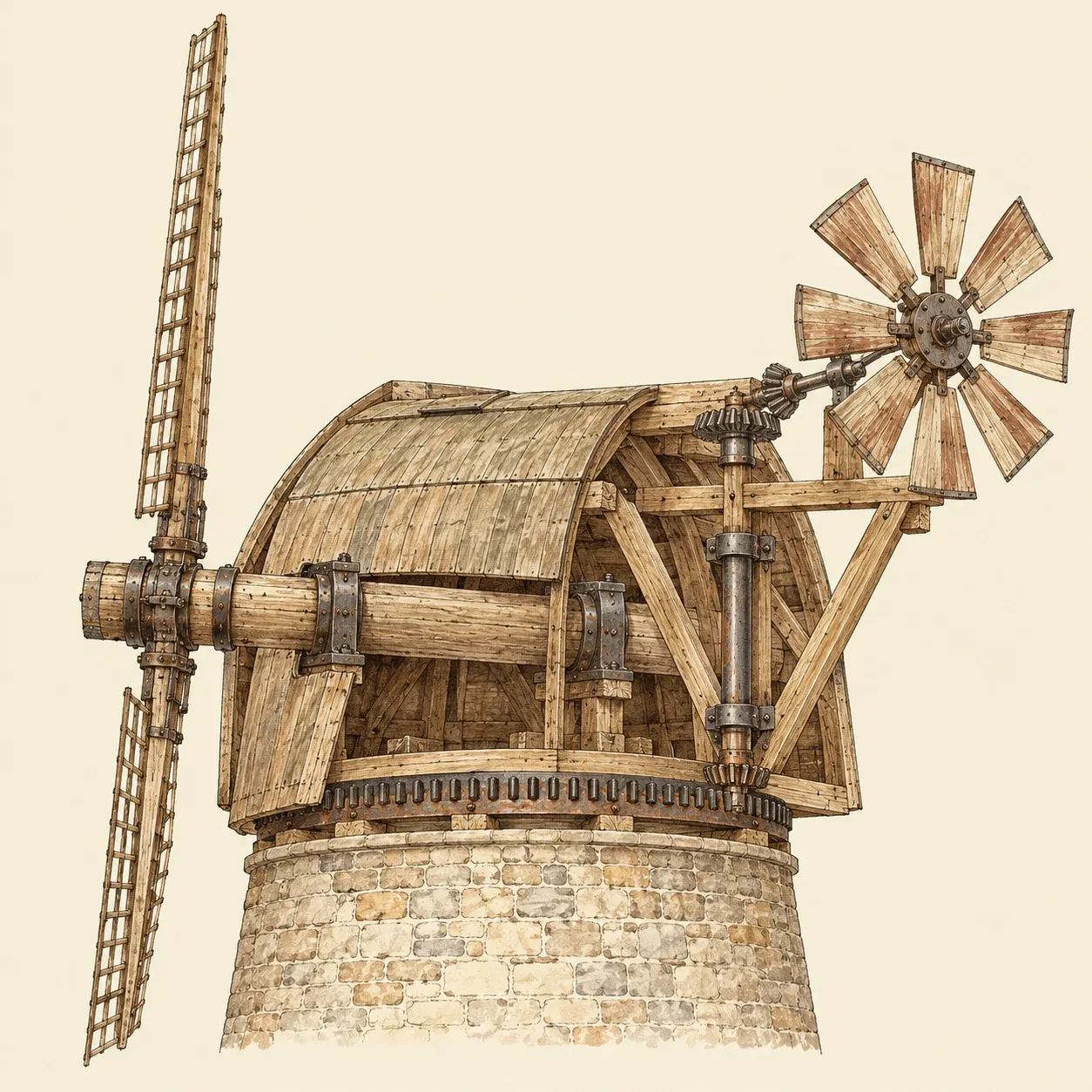 The fantail drives the cap round on its toothed curb until the sails face the wind again.
In 1745 the English blacksmith Edmund Lee patented the fantail, a small bladed wheel at the back of the cap. When the wind shifts, the fantail starts to turn and winds the cap round until the sails face the wind again. In 1772 the Scottish millwright Andrew Meikle introduced spring sails, made of shutters that open by themselves in a gust.
The Netherlands had between nine and ten thousand windmills in the middle of the nineteenth century, used for milling and above all for draining land. Steam engines and then electric motors replaced them, and about a thousand survive there today. Modern wind turbines use the same rotor physics to drive generators.