Wind Turbine
Wind turned into electricity
Plate
- 1Blade
- 2Hub with pitch bearings
- 3Main shaft (low speed)
- 4Gearbox
- 5Generator
- 6Yaw ring and motors
- 7Tower
Anatomy
Loading the figure…
A wind turbine is a rotor of long, wing-shaped blades that the wind turns, driving an electric generator at the top of a tower. Small ones charge batteries; large ones, with rotors more than a hundred metres across, feed the grid through a transformer.
What it is
A wind turbine is a windmill built to make electricity: the rotor turns a shaft, and the shaft drives a generator. The machine drawn here has the layout of almost every large turbine today. Three slender blades (1) face the wind in front of a steel tower (7), and the nacelle on top holds the drive train and turns to follow the wind.
How it works
The power in the wind is P = ½·ρ·A·v³: ρ is the density of air, about 1.2 kg/m³, A the area swept by the rotor and v the wind speed. A rotor 3 metres across sweeps about 7.1 m². At 6 m/s the wind through it carries ½ × 1.2 × 7.1 × 6³ ≈ 920 watts; at 12 m/s, eight times as much, about 7.4 kW. That is why turbines stand on tall towers, where the wind is stronger.
A rotor cannot take all of that power. It extracts energy by slowing the air, but the slowed air must still move away, or no fresh air could come through. Around 1920 the German physicist Albert Betz showed that the best possible share is 16/27, or 59.3%. Real turbines typically capture about 35 to 45% over their working range; a large modern rotor at its best operating point comes close to 48%, and the gearbox and generator lose a little more.
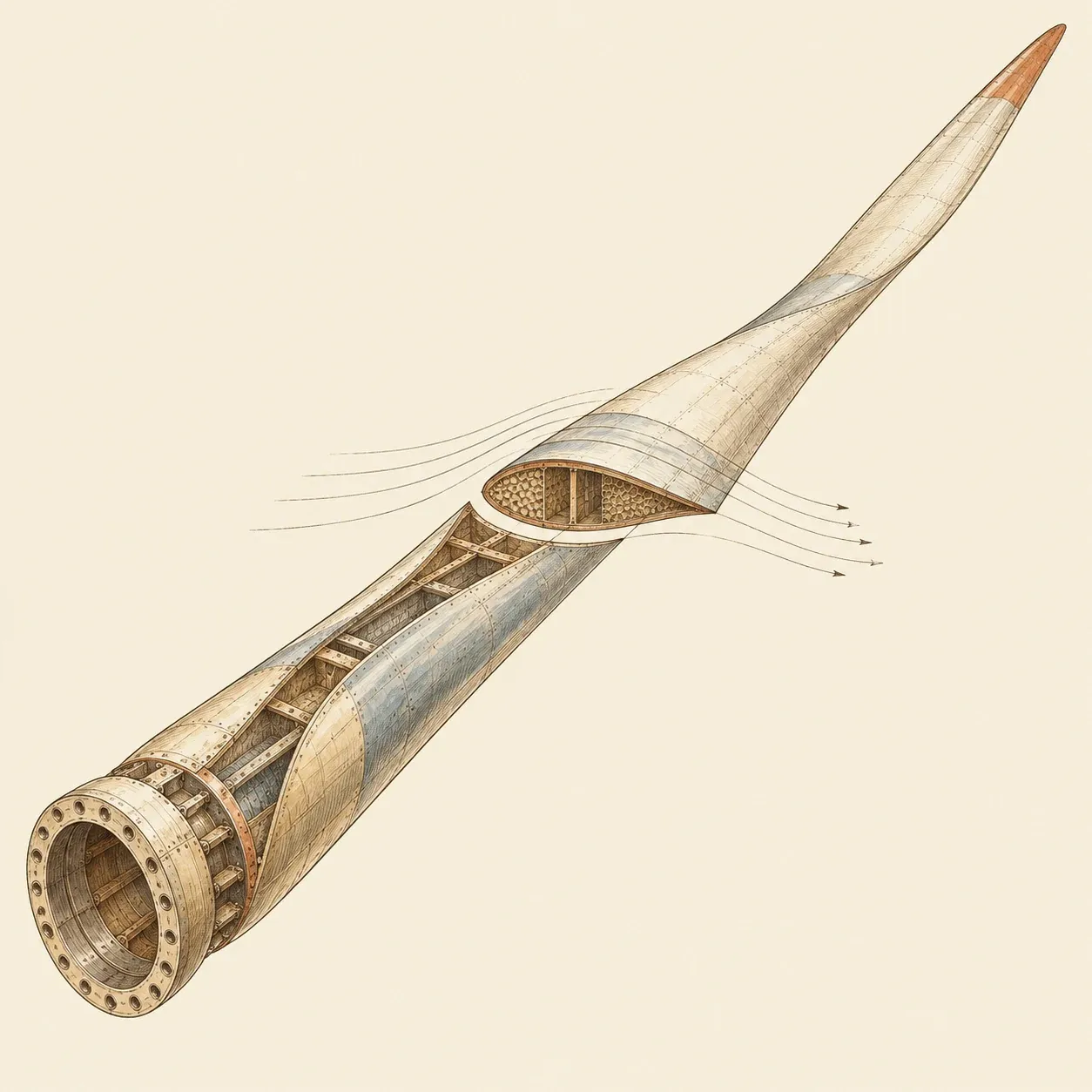 The blade section is a wing. It twists along its length because the tip moves much faster than the root.
Modern blades are aerofoils and work by lift, like an aircraft wing. Moving fast across the wind, a blade meets air coming mostly from the side, and the lift on its section pulls it round. The tip-speed ratio, the speed of the blade tip divided by the wind speed, is about 7 on three-bladed grid turbines: in a 10 m/s wind the tips travel at about 70 m/s.
In the hub (2), each blade sits in a large bearing so that it can be turned about its own axis. This pitch control lets the rotor capture as much as it can below the rated wind speed and limits the power above it. The turbine starts at the cut-in speed, about 3 to 5 m/s, and reaches full power at its rated speed. Above the cut-out speed, about 25 to 29 m/s, it turns its blades edge-on, the rotor slows, and a brake holds it. A wind vane on the nacelle signals the direction, and yaw motors (6) turn the nacelle on a toothed ring, as the fantail did on a windmill.
On large machines the main shaft (3) turns at about 8 to 20 revolutions a minute. In a classic drivetrain, a gearbox (4) speeds this up about a hundredfold for the generator (5), which turns at more than a thousand revolutions a minute. Other designs use a medium-speed generator with less gearing, or no gearbox at all and a large, slow generator with many magnet poles. Power electronics match the output to the grid’s frequency, and a step-up transformer raises the voltage.
How to build
A small turbine can charge a 12-volt lead-acid battery. Build it from a published, tested plan that specifies the blades, the mast and the overspeed protection; the steps below show what such a plan covers. Check local planning rules and talk to the neighbours first.
Choose the site. Near the ground the wind is weak and turbulent. A common rule puts the bottom of the rotor at least 9 metres above any obstacle within 90 metres. An anemometer at the planned height gives a first idea after a few weeks; a full year shows the seasons.
Pick the generator. A permanent-magnet DC motor, for example from a treadmill, works as a generator. Turn it with a drill at known speeds, with a 12-volt load connected, and measure voltage and current: it should deliver a useful current above about 14 volts at a few hundred revolutions a minute, a speed the rotor can reach.
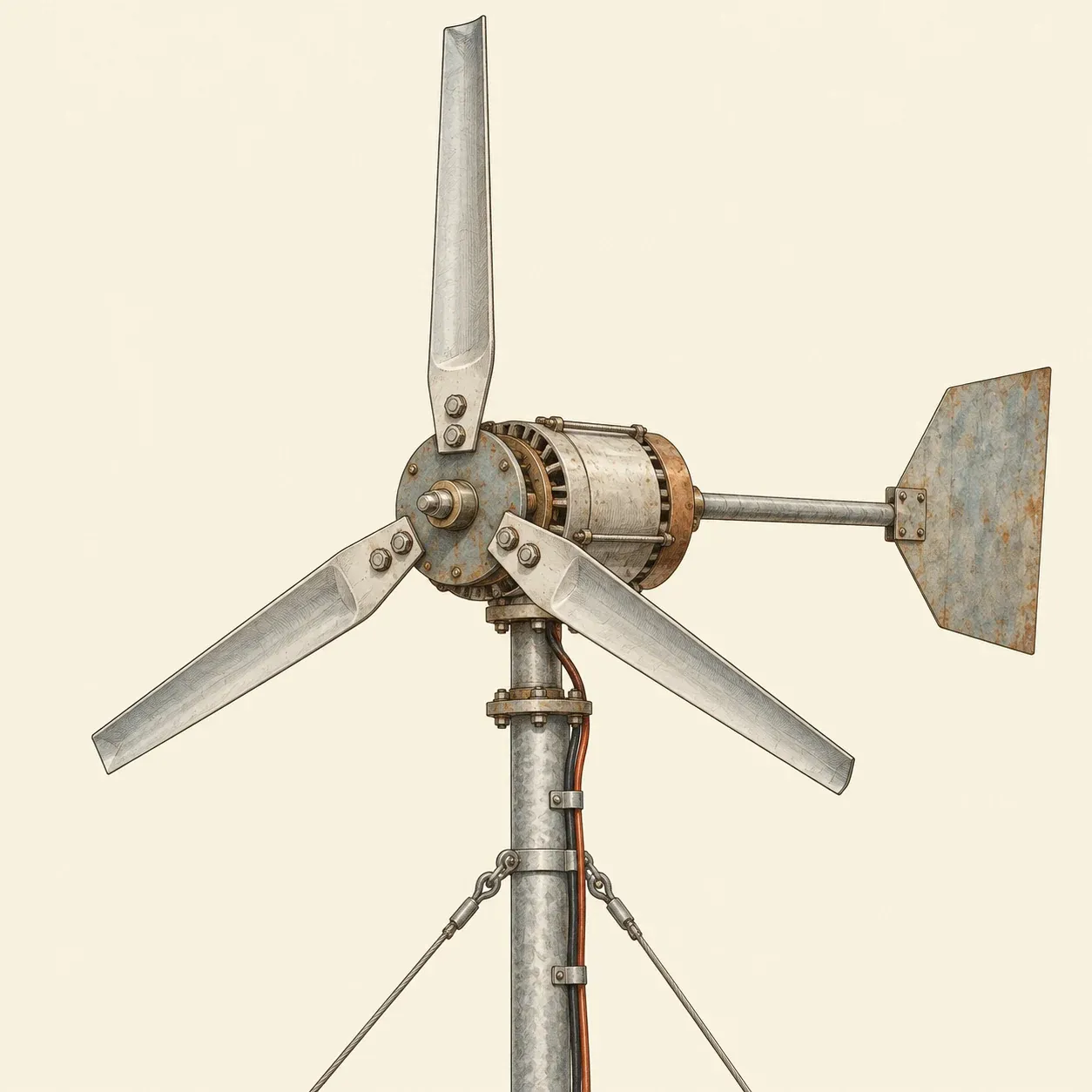 Blades cut from plastic pipe, a treadmill motor and a sheet-metal tail.
Make the rotor. Plans for small machines often cut the blades from plastic pipe or carve them from light, straight-grained wood. Use the plan’s pipe grade, wall thickness and blade shape: pipe blades tire and can crack at the root. Clamp each root between two metal plates on the hub, balance the rotor until it stays put in any position, and replace a blade at the first crack. A rotor 1.1 metres across catches about 70 watts of wind at 5 m/s; 10 to 20 watts at the battery is a rough guess that only a measurement can confirm.
Mast and tail. A flat tail vane on a boom keeps the rotor facing the wind. Mount the motor on a pivot at the top of a steel pipe with a hinged foot, and anchor guy wires at half to three-quarters of the mast’s height from its base, so that it can be tilted down. Use the plan’s mast, anchors rated for the load and a hand winch to raise it.
Protect it from overspeed. In a gust, or without an electrical load, a rotor can spin until it breaks. An outdoor turbine needs automatic protection: many small turbines have a hinged tail that furls, turning the rotor out of strong wind; others rely on stall or on blades that change pitch. Without such protection a turbine must not run outdoors, and even with it, stop and lower a small turbine before a storm.
Wire it. Connect the generator to the battery through a fuse and a blocking diode, which stops the battery from driving the motor. A diversion charge controller, rated for the generator’s current and wired as its own diagram shows, watches the battery voltage and switches the power into a dump load once the battery is full: resistors rated for the full output at battery voltage, since a mains heater takes far too little at 12 volts. A switch that shorts the generator slows the rotor in light wind but does not lock it; tie a blade to the mast before handling the rotor.
For a desk version, put a toy motor with card blades in front of a fan and measure the voltage at each fan speed.
Safety. Blade tips move much faster than they seem: never stand in the plane of the rotor. Never climb a mast while the turbine can turn; stop it and tilt the mast down. Keep people farther away than the mast’s height while raising or lowering it, and keep the whole mast and its fall zone well clear of overhead power lines. Lead-acid batteries contain sulfuric acid and give off explosive hydrogen while charging: keep them in a ventilated box, away from sparks and living rooms. A short circuit across a battery can melt wires and start a fire. Never connect a turbine to a building’s wiring or to the grid yourself; that needs an approved inverter and a qualified electrician.
History and evolution
In July 1887 James Blyth, a Glasgow professor, put up a windmill with four cloth sails at his holiday cottage in Marykirk, Scotland. Its dynamo charged accumulators that lit the cottage. A wind-driven dynamo had been shown in Vienna in 1883, but Blyth’s is the first well-documented one in regular use.
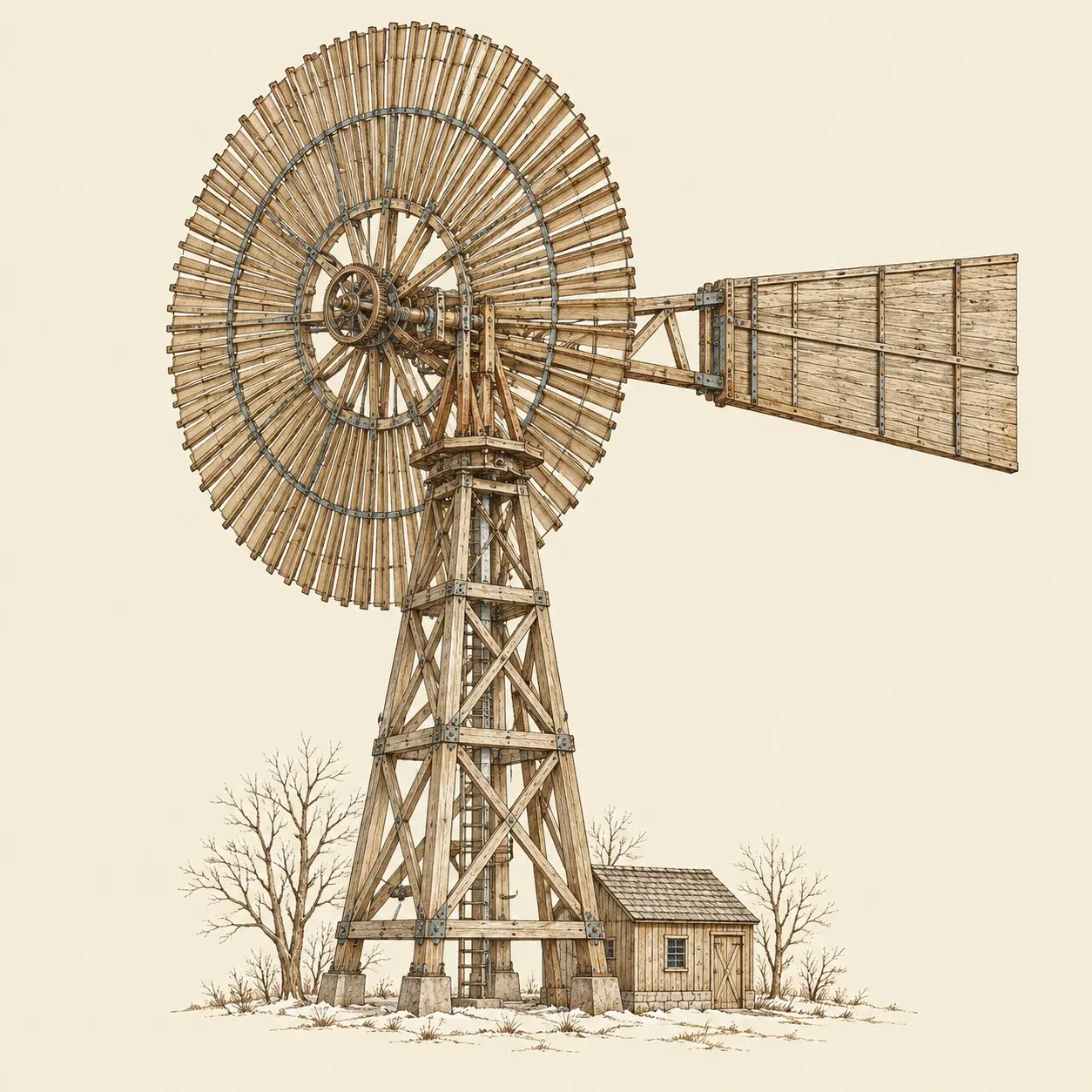 Brush’s machine in Cleveland: 144 cedar blades on a rotor 17 metres across.
In the winter of 1887–88 Charles F. Brush built a wind dynamo in Cleveland, Ohio, with 144 cedar blades on an 18-metre tower. It charged 12 batteries. Its dynamo is usually given as 12 kW, though a later newspaper account says 1.2 kW. From 1891 Poul la Cour tested turbines at Askov in Denmark; later he also trained rural electricians to build them.
American farms bought battery-charging turbines in large numbers; the Jacobs brothers alone made about 20,000 before closing in 1956, once the grid reached the farms. On 19 October 1941 the two-bladed Smith–Putnam turbine in Vermont, rated at 1.25 MW, was connected to the grid; it lost a blade in 1945. In 1957 Johannes Juul built a 200 kW turbine at Gedser, Denmark, with three blades, stall control and an induction generator. This “Danish concept” shaped the turbines built from the late 1970s.
In 2025 a 26 MW prototype with a 310-metre rotor went up for testing in China. That year wind produced 8.5% of the world’s electricity.