Radio
Messages without wires
Plate
- 1Morse key
- 2Induction coil
- 3Spark gap
- 4Aerial
- 5Coherer
- 6Tapper
Anatomy
Loading the figure…
Radio sends signals through space as electromagnetic waves, made by a rapidly oscillating current in one wire and picked up by another wire far away. Guglielmo Marconi turned laboratory experiments into a working wireless telegraph in 1895, and broadcasting of speech and music followed in the early twentieth century.
What it is
A radio transmitter makes a current swing back and forth very fast in a wire, the aerial or antenna, which sends out electromagnetic waves travelling at the speed of light. Where the waves meet another wire, they set up a tiny copy of the original current, and a receiver turns it into sound or into marks on paper.
The plate shows the first practical system, Marconi’s spark telegraph of 1896, which could send only the dots and dashes of Morse code. By the early 1920s, stations were broadcasting speech and music to receivers in people’s homes.
How it works
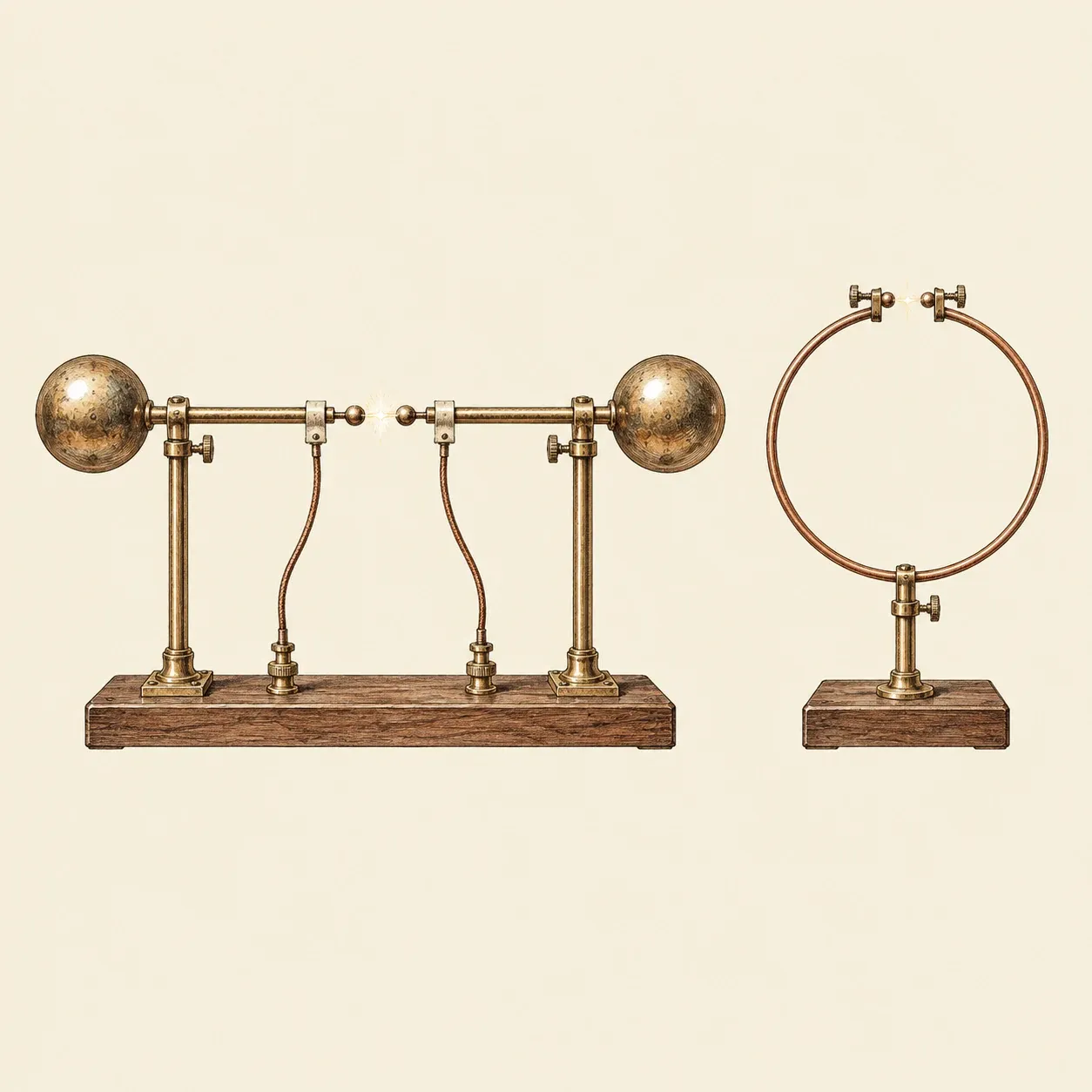 When a spark crossed Hertz’s oscillator, a tiny spark jumped the gap in the ring across the room.
In the transmitter, a battery feeds an induction coil through the Morse key. The coil steps the voltage up to many thousands of volts and charges two brass balls separated by a small gap. When the voltage is high enough, a spark jumps the gap and, while it lasts, lets the charge surge back and forth through the aerial at very high frequency. Each spark sends out a short burst of waves. A brief press of the key gives a dot at the receiver, a longer one a dash.
Marconi raised a long vertical wire on a mast and connected the other side of the spark gap to a metal plate buried in the ground. With this grounded aerial the range grew from a few hundred metres to kilometres.
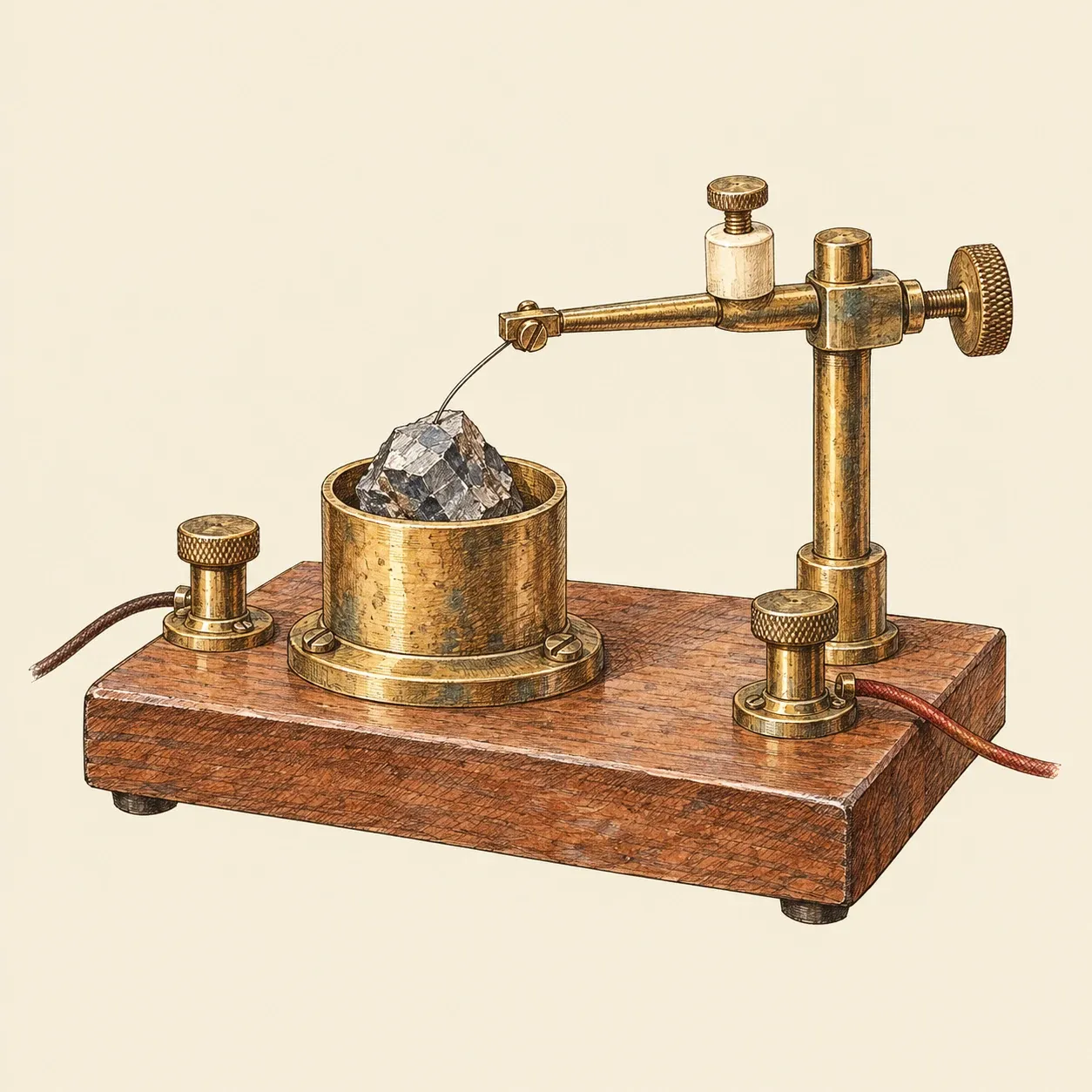 In a cat’s whisker detector, a fine wire on a galena crystal lets current pass in one direction only.
The receiver also had an aerial and an earth, with a coherer between them: a small glass tube of loose metal filings between two silver plugs. The filings normally conduct badly. Arriving waves make them cling together and conduct, so a local battery can push current through them and work a relay, which drives a bell or a Morse inker. A small hammer, the tapper, then knocks the tube to shake the filings loose for the next signal.
Spark transmitters spread their energy over a wide band of frequencies and interfered with one another. Tuned circuits, made of a coil and a capacitor, let each station keep to its own frequency. Later transmitters sent a continuous wave and varied its strength to follow a voice, which is amplitude modulation, or AM. In the receiver a detector, first a crystal and later a vacuum tube, removes the radio wave and leaves the sound.
How to build it
The simplest working radio is the crystal set. It needs no battery, since all its power comes from the station’s waves. The coil and capacitor below tune over much of the medium-wave AM band, depending on the aerial, and the set works best within reach of a strong transmitter.
Put up an aerial. Stretch 15 to 30 metres of copper wire as high and straight as you can between two trees or posts, with insulators at both ends, and bring a lead-in wire down to the set.
Make an earth. Drive a copper or galvanised rod a metre into damp ground and connect it with a short, thick wire. Never use a gas pipe.
Wind the coil. On a cardboard or plastic tube about 8 cm across, wind 60 to 90 turns of enamelled copper wire 0.3 to 0.5 mm thick, side by side. Make a tap every ten turns and scrape the enamel off where you will connect.
Add a tuning capacitor. A variable capacitor with a maximum of about 350 to 500 picofarads, bought or taken from an old battery radio, goes across the coil and tunes between stations. Do not open old mains-powered sets: their capacitors can hold a dangerous charge long after unplugging. Without a variable capacitor, you can still tune roughly by moving the aerial from tap to tap.
Fit a detector. A germanium diode is easiest. A lump of galena touched lightly by a fine wire also works, with patience.
Wire and listen. Connect the earth to the bottom of the coil and the aerial to one of the taps: fewer turns tune higher frequencies, more turns lower ones, and a long aerial often works best on a tap partway up. Connect the detector and the earpiece in series, and put that pair across the coil as well. Use a high-impedance crystal earpiece with a resistor of about 50 to 100 kilohms across it, or old high-impedance headphones; modern low-impedance earbuds load the circuit too heavily. Turn the capacitor slowly.
Safety. An outdoor aerial attracts lightning: disconnect it and connect it to earth before a storm approaches, and never touch it during one. The earth rod of the set is not lightning protection; a permanent outdoor aerial needs a proper arrester and earthing installed to local rules. Keep every wire well away from power lines, since contact can kill, and do not climb roofs without a secure ladder and a second person. Do not build a transmitter: most transmitters need a licence, and spark transmitters are banned everywhere because they jam other services. Induction coils produce thousands of volts and give painful, dangerous shocks.
History and evolution
In 1865 James Clerk Maxwell predicted that electric and magnetic fields could travel together as waves. Between 1886 and 1888 Heinrich Hertz, in Karlsruhe, produced such waves with sparks, detected them across his laboratory with a ring of wire and showed that they behaved like light. Édouard Branly (1890) and Oliver Lodge (1894) developed the coherer, a tube of metal filings that conducts when the waves arrive. On 7 May 1895 Alexander Popov showed a receiver with a self-tapping coherer in St Petersburg, built to record distant lightning.
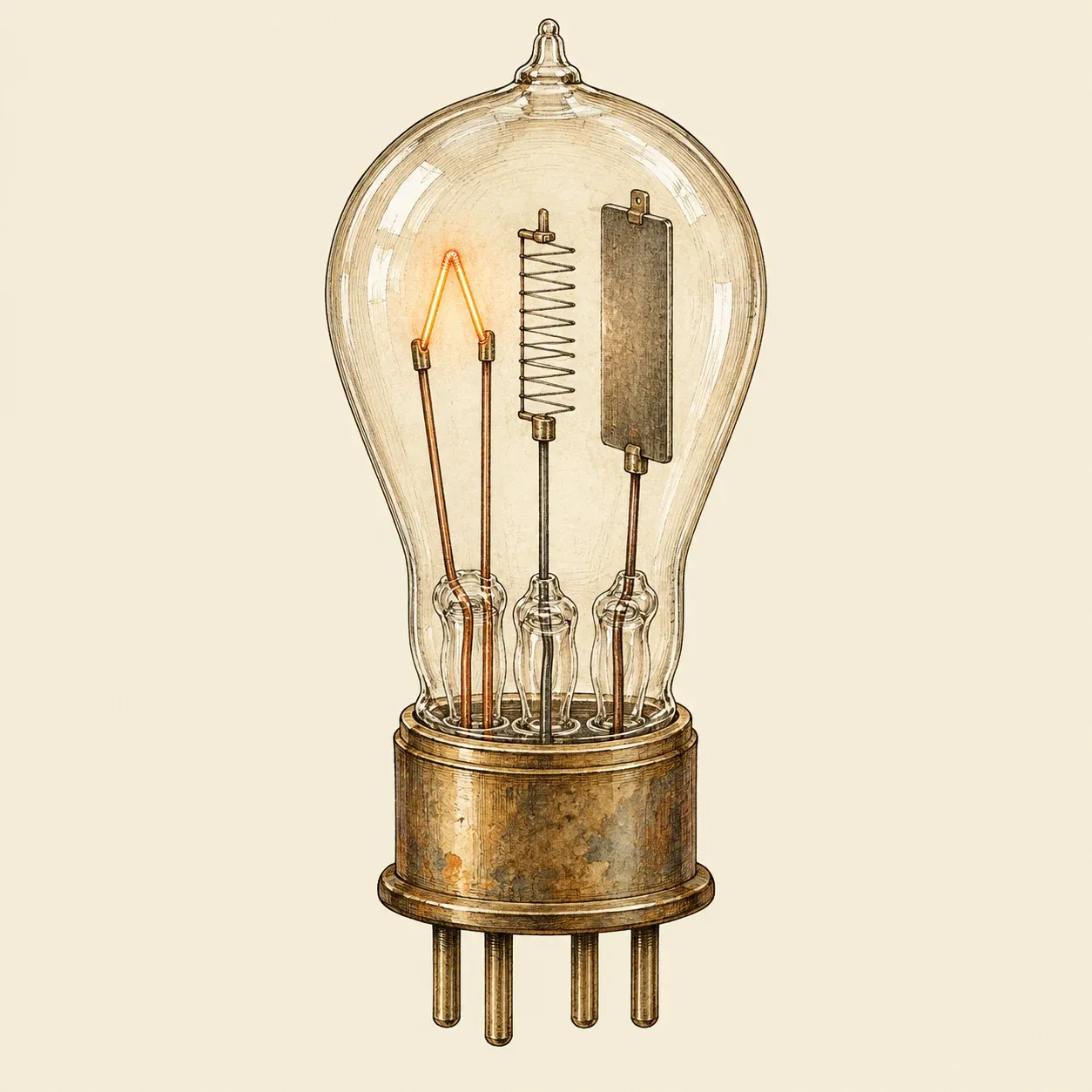 The triode valve amplified weak signals, which improved reception and helped broadcasting spread.
Guglielmo Marconi, working at his family’s Villa Griffone near Bologna, aimed at telegraphy from the start. In summer 1895, with a grounded vertical aerial, he sent signals about two kilometres past the Celestini hill, and a helper on the far side fired a shot to confirm them. In 1896 he moved to England and filed his patent. On 12 December 1901, at Signal Hill in Newfoundland, he and George Kemp heard the three dots of the letter S sent from Poldhu in Cornwall, through a wire held up by a kite. Some historians think they heard only static, but regular transatlantic service began in 1907.
On 21 December 1906 Reginald Fessenden sent speech and music by radio from Brant Rock, Massachusetts, before invited witnesses. He later wrote that on Christmas Eve he broadcast a programme to ships at sea; that account dates from 1932, and no record of it from 1906 has been found. On 2 November 1920 the Westinghouse station KDKA in Pittsburgh broadcast the results of the presidential election, and transistors made radios pocket-sized in the 1950s.