Horse Collar
The horse pulls with its shoulders
- 1Padded collar
- 2Hames
- 3Hame tug
- 4Trace
- 5Back band
- 6Whippletree
The horse collar is a stiff, padded ring that rests against a horse's shoulders, with the traces hooked to it near the shoulder joints. The horse can throw its weight into the load without pressing on its windpipe, and in medieval Europe it took over much of the ploughing and hauling once done by oxen.
What it is
A horse collar is a stiff ring of leather packed with straw, shaped to sit at the base of the neck against the front of the shoulders. Two curved bars of wood or metal, the hames, are strapped into a groove around it, and the traces that pull the load hook onto them. A back band keeps the traces level, and a wooden crossbar, the whippletree, joins their ends to the plough or cart.
In this harness a horse pushes with its chest and shoulders, the way a person leans into a handcart. With the nailed horseshoe and the heavy plough, the collar helped horses replace oxen on many farms of medieval northern Europe.
How it works
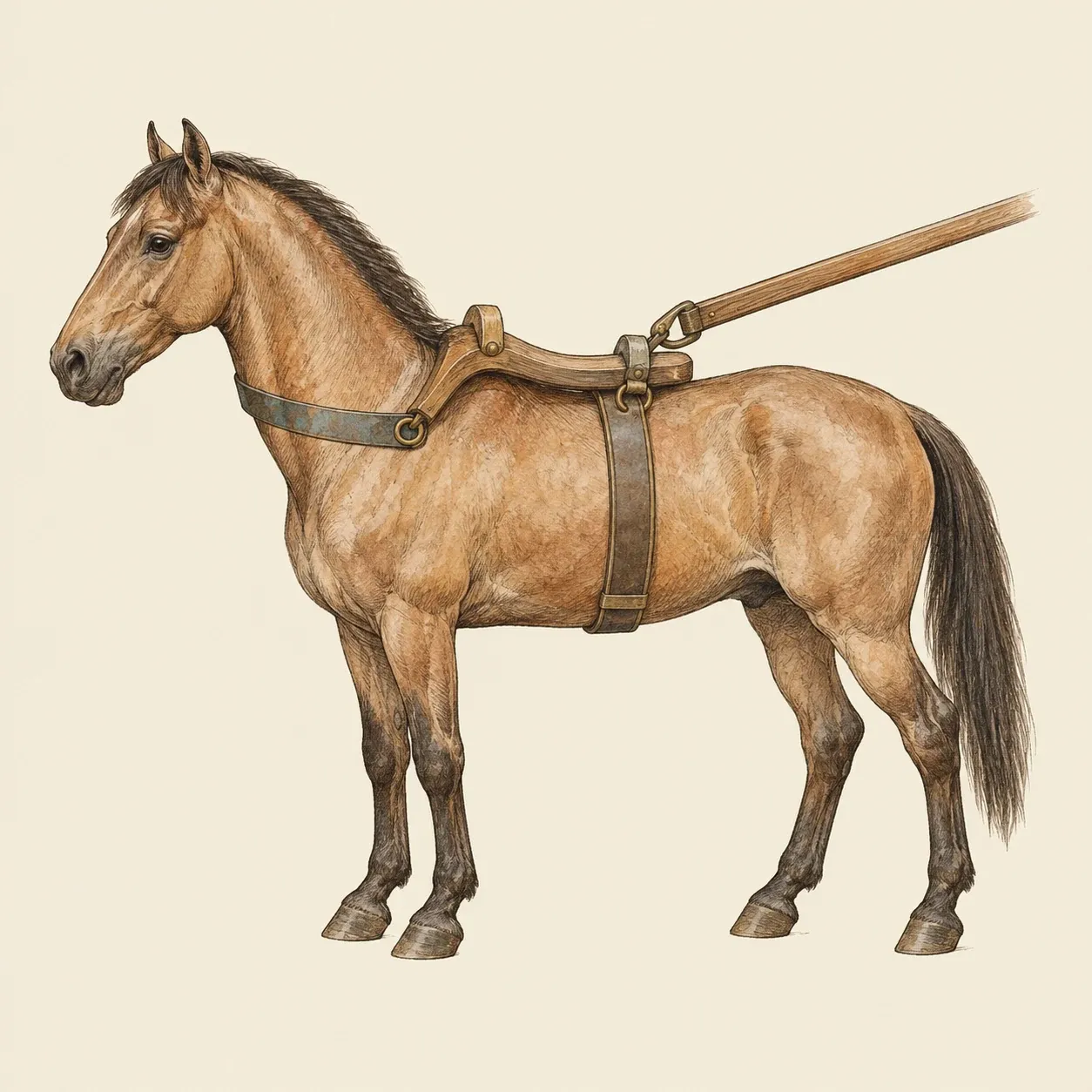 The “throat-and-girth” harness as historians long drew it: a yoke on the withers, a neck strap and a girth.
Horses were first put to a yoke, like oxen. The pole of a chariot ran to a yoke on the pair’s necks or withers, the ridge above the shoulders, held by a strap around each neck. Egyptian chariot horses wore forked yoke saddles that bore on the shoulders, and Greek and Roman teams pulled largely against a chest strap. Richard Lefebvre des Noëttes reconstructed all of this as a strap that rode up and pressed on the windpipe. Later experiments disagree with him (see History).
Oxen suit a yoke better. Their neck is short and thick, and many breeds have a hump or ridge of muscle in front of the withers for the beam to push against. A head yoke is lashed to the horns; a withers yoke rests on the neck in front of the shoulders. A horse has a long neck with the windpipe just under the skin.
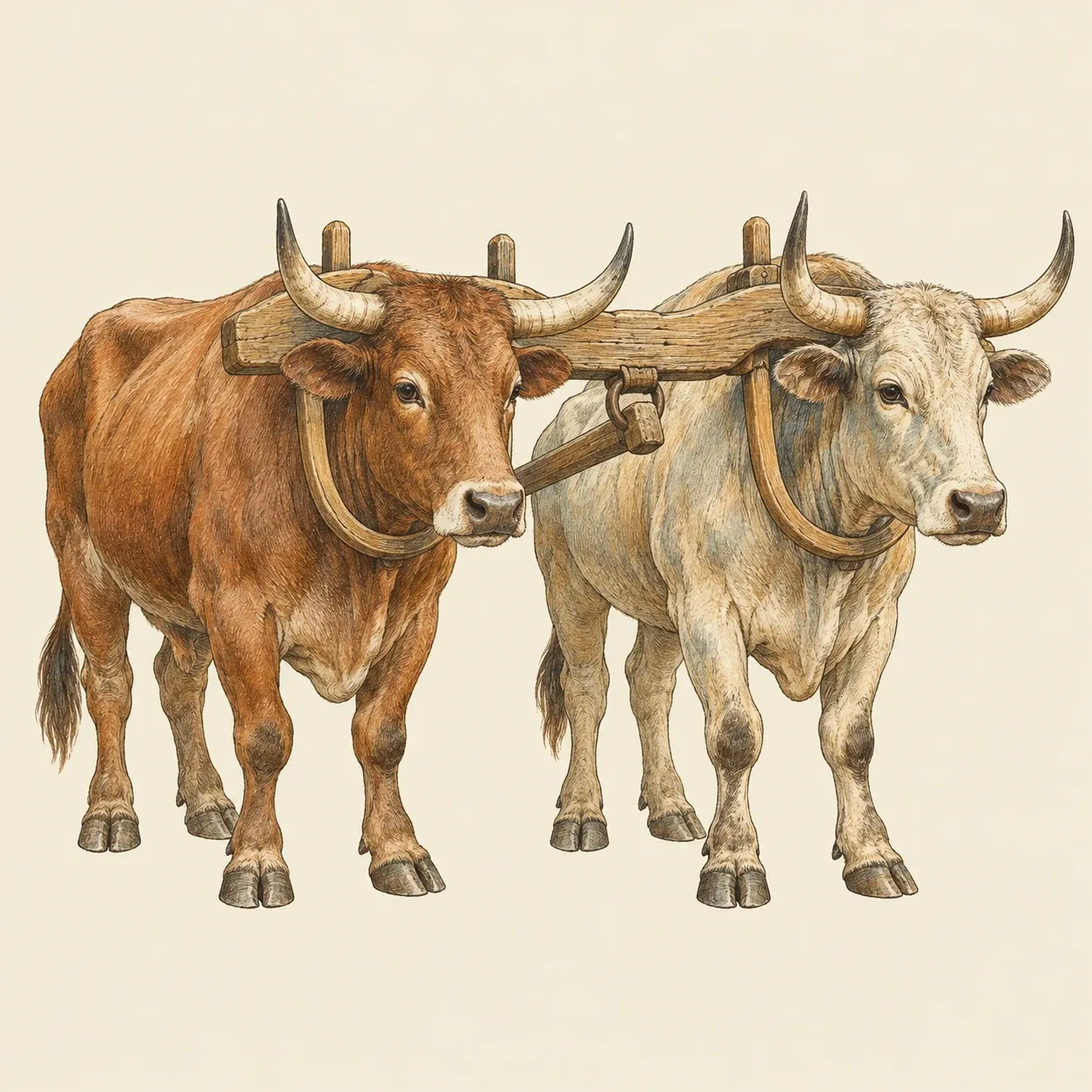 Oxen under a neck yoke: the beam bears on the neck in front of the shoulders, and wooden bows close it underneath.
The breast strap came first: a broad band across the chest, below the windpipe, with the traces running back from its ends. It is light and still serves for light carriages, but under a heavy, jerky load it slips and rubs.
The collar spreads the push over a larger, stiffer surface. Its face lies on the muscles in front of the shoulder blades and leaves a gap at the throat. The hames make a rigid frame, so each trace pulls on the whole collar. For draught cattle, W. Micuta of the Bellerive Foundation estimated the contact of a padded collar at about 1,200 cm² over both shoulders, against about 200 cm² for a neck yoke.
The line of draught matters as much as the padding. The tugs on the hames sit a little above the point of the shoulder, and each trace should leave at a right angle to the slope of the shoulder. If the traces climb towards a high hitch, they lever the collar up against the throat. The whippletree pivots at its centre, so the horse can swing its shoulders as it walks without jerking the load.
How to build
Collars are stitched by harness makers, with a hard roll of straw at the front and a smooth face against the horse. A sound second-hand collar, carefully fitted, is usually a better choice than a home-made one.
Choose the size. Collars are measured inside, from top to bottom: 16 inches (41 cm) or less for a pony, 24 inches (61 cm) or more for a heavy draught horse. A thick-necked horse also needs a collar that is wider at the top.
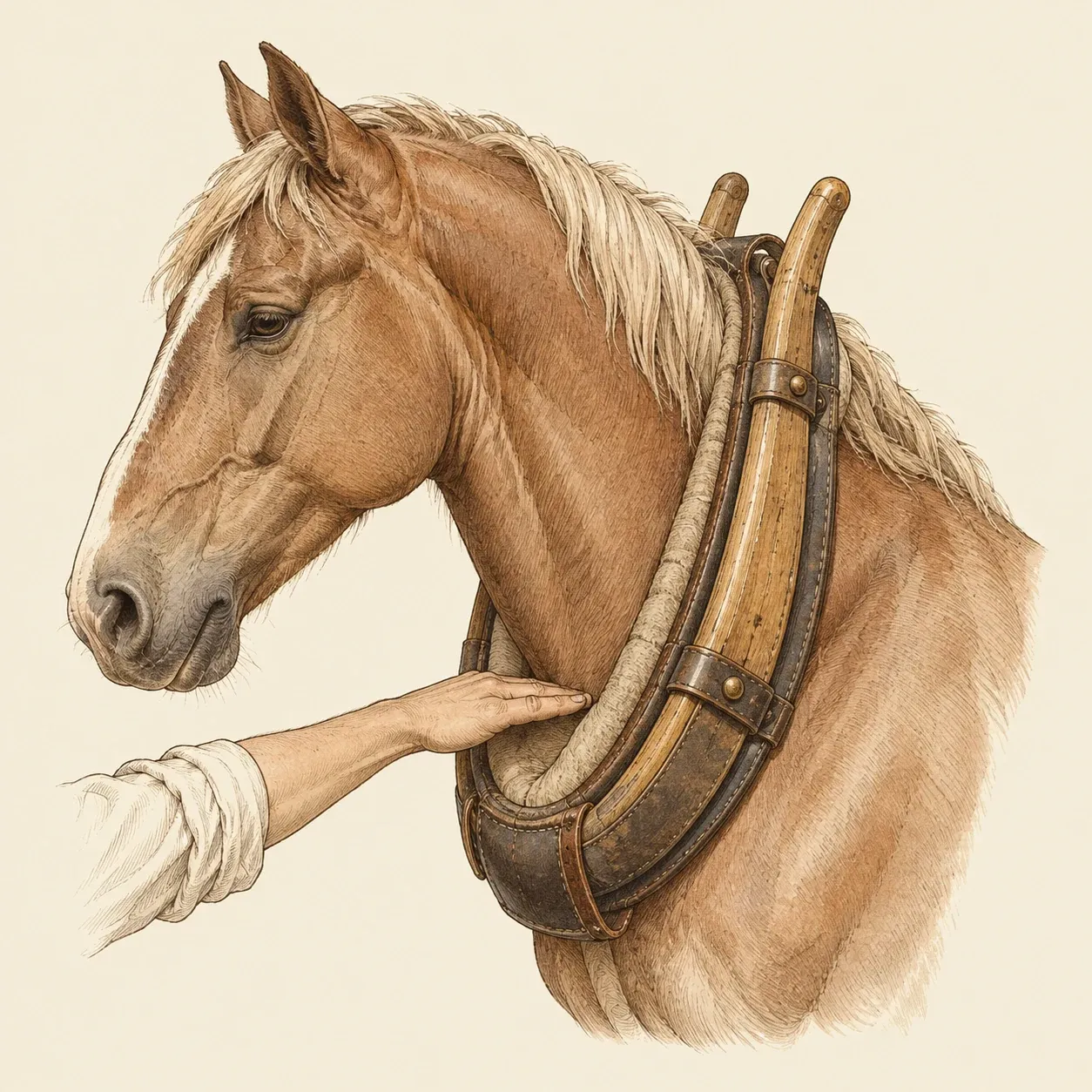 Check the gap at the throat with the collar pressed back onto the shoulders.
Check the fit. Press the collar back onto the shoulders, as if under load. At the sides your fingers should slide in flat between rim and neck, but not your whole hand. Leave about 5 cm at the throat. A collar that is too short rides up and chokes; one that is too long drops onto the point of the shoulder and rubs.
Fit the hames. They should lie flat in the groove along their whole length. Fasten the bottom strap first, then pull the top strap straight across.
Set the traces. The back band carries the traces at the right height, and the belly band stops them rising under load. Adjust both so each trace leaves its tug at a right angle to the shoulder, and hitch low enough that the traces never pull the collar upwards.
Watch for sores. Hair worn short on the shoulder is the first warning: correct the fit before the skin breaks, and rest a sore horse until it heals. A horse that loses weight will need a pad or a smaller collar. At each halt, lift the collar to let the shoulders cool; at night, clean both collar face and shoulders.
Safety. A draught horse can weigh close to a tonne and can kick, bolt or pin you against the vehicle. Learn from an experienced teamster, and have a helper hold the horse while you hitch or unhitch. Follow the hitching and unhitching sequences your teacher showed you, the same way every time. Never step over a trace or stand between horse and load, and never tie a line from the load to your body. Speak before you touch the hindquarters. Give rests and water, and stop if the horse is distressed or the harness slips.
History and evolution
China left the yoke behind first. A lacquer box from the state of Chu, painted in the fourth century BCE, shows horses pulling against a bar across the chest, and the softer breast strap is common on Han dynasty reliefs. The earliest clear image of a collar harness is a mural in Mogao cave 257 at Dunhuang, dated 477–499 CE, though its padding is not drawn clearly. Pita Kelekna places both the breast strap and the collar in the first millennium BCE.
The collar reached Europe in the early Middle Ages, probably by way of Central Asia. Lynn White placed it in Carolingian lands around 800; W. Micuta gives the eleventh century. By the twelfth it was common. With horseshoes for wet ground and oats from the three-field rotation, horses took over ploughing in parts of the north, working faster than oxen.
For decades historians held that ancient harness strangled horses. Lefebvre des Noëttes tested a reconstruction in 1910 and found that two horses could pull little more than 500 kg. In experiments published in 1977, Jean Spruytte rebuilt Egyptian, Greek and Roman harnesses, showed that the earlier reconstruction was wrong, and pulled about a tonne on sand with one of them. This work leaves the collar a useful advance for slow, heavy pulling such as ploughing, and it removes the idea that ancient horses were choked by their harness.