Hot-Air Balloon
Rising on warm air
Plate
- 1Envelope
- 2Open neck
- 3Wicker gallery
- 4Brazier
- 5Rising warm air
Anatomy
Loading the figure…
A hot-air balloon rises because the heated air inside its envelope is lighter than the cooler air around it. The Montgolfier brothers, who had flown a small model indoors in 1782, first showed one in public in France in 1783, and on 21 November of that year their balloon carried two men over Paris, the first human flight in free air.
What it is
A hot-air balloon is a large, light bag, the envelope, open at the bottom and filled with heated air. Warm air is less dense than cold air, so the bag and what hangs below it weigh less than the outside air they push aside, and the whole rises. Nothing drives it: a balloon climbs when the air inside is heated, sinks as it cools, and drifts with the wind.
The balloon on the plate is the one built by Joseph and Étienne Montgolfier, paper makers from Annonay, for the first free flight with people aboard, on 21 November 1783. Accounts give it a height of a little over 20 m. It was made of cloth, described as linen or taffeta, lined with paper and coated with a varnish containing alum as protection against fire, and painted blue and gold. A ring-shaped wicker gallery hung round the open neck for the two aeronauts, and an iron brazier burning straw hung in the middle of the opening.
How it works
At sea-level pressure, a cubic metre of air at 20 °C weighs about 1.2 kg. Heated to 100 °C, the same volume of air weighs only about 0.95 kg, because the air has expanded and part of it has spilled out of the open neck. Every cubic metre of hot air inside the envelope therefore gives about a quarter of a kilogram of lift, which must carry the envelope and its equipment before any passenger. A balloon needs a great volume to carry anything: the Montgolfiers’ envelope of 1783 held more than a thousand cubic metres.
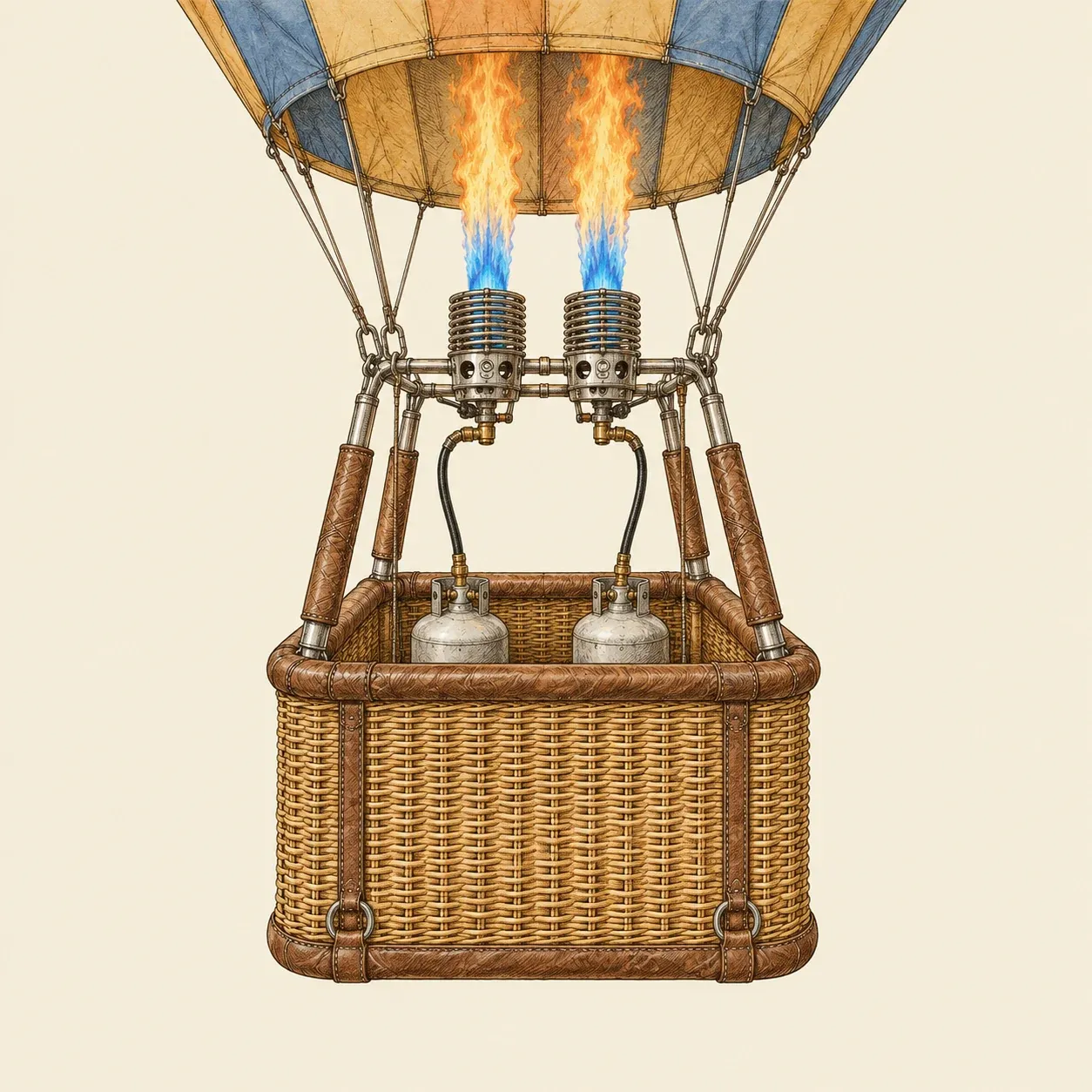 A modern balloon: propane cylinders in a wicker basket and a burner under the open mouth of a nylon envelope.
The warm air rises into the dome and pushes against the fabric. The heat slowly escapes through the cloth and the neck, so the air must be heated again and again. In 1783 the aeronauts forked straw into the brazier through openings in the gallery; to go higher they added fuel, to come down they let the fire die. The envelope caught fire several times during the first flight, and they put out the burning spots with wet sponges.
A modern balloon works the same way with better materials. The envelope is nylon or polyester, the basket wicker, and a propane burner gives short, powerful blasts of flame into the mouth of the envelope. The pilot climbs or descends to find winds blowing in different directions, which is the only way to steer.
How to build it
A model of tissue paper filled with warm air from a hair dryer shows the principle without any flame. It has to be large and light, because air from a dryer is only moderately hot.
Cut the gores. Make a card template for one gore: a long pointed leaf shape 2 m long and 40 cm across at its widest point, with the bottom end cut straight across where it is 8 cm wide. Cut eight gores from the thinnest tissue paper you can find, joining sheets with a glue stick where needed.
Glue the envelope. Glue the gores edge to edge, overlapping about 1 cm, so that their points meet at the top and their straight bottom ends form a round mouth. Close the top with a small round patch. Glue the mouth to a ring of thin wire or light card 20 cm in diameter so that it stays open.
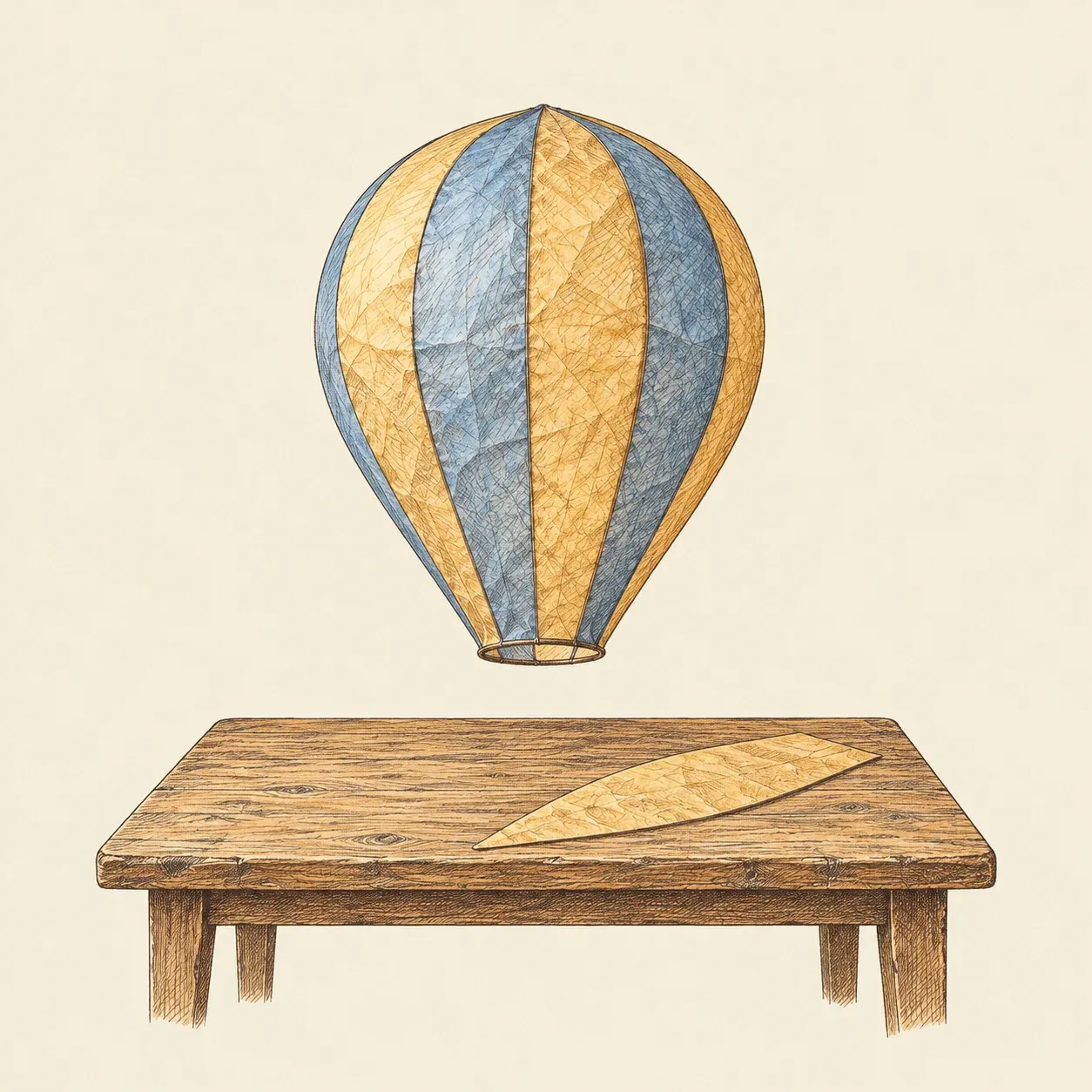 A model of eight paper gores: warm air from a hair dryer can lift it when the paper is light enough.
Fill it. Indoors, in a cool room without draughts, have a helper hold the envelope upright by the top with the mouth down. Blow air from a hair dryer on its hottest setting into the mouth from about 20 cm below for two or three minutes, keeping the dryer moving and its air intake clear. Switch the dryer off and pull it away before letting go, so that only the warm air inside does the lifting. If the bag pulls upward it will rise toward the ceiling and sink as the air cools; if it does not, the air is not hot enough for its weight, and thinner paper or a bigger envelope will help.
Safety. Never heat a paper balloon with a candle, a burner or any flame, and never release flying lanterns: they come down still burning and start fires. Keep the hair dryer at least 20 cm from the paper, never block its air intake, and stop at once if the tissue starts to brown or smell of scorching. Real hot-air balloons are flown only by licensed pilots with certified equipment.
History and evolution
Joseph Montgolfier made a small silk balloon fly indoors in November 1782 and then built larger ones with his brother Étienne. On 4 June 1783, in the market square of Annonay, they sent up an unmanned balloon of cloth and paper about 11 m across, which rose high above the town and came down more than a kilometre and a half away after about ten minutes.
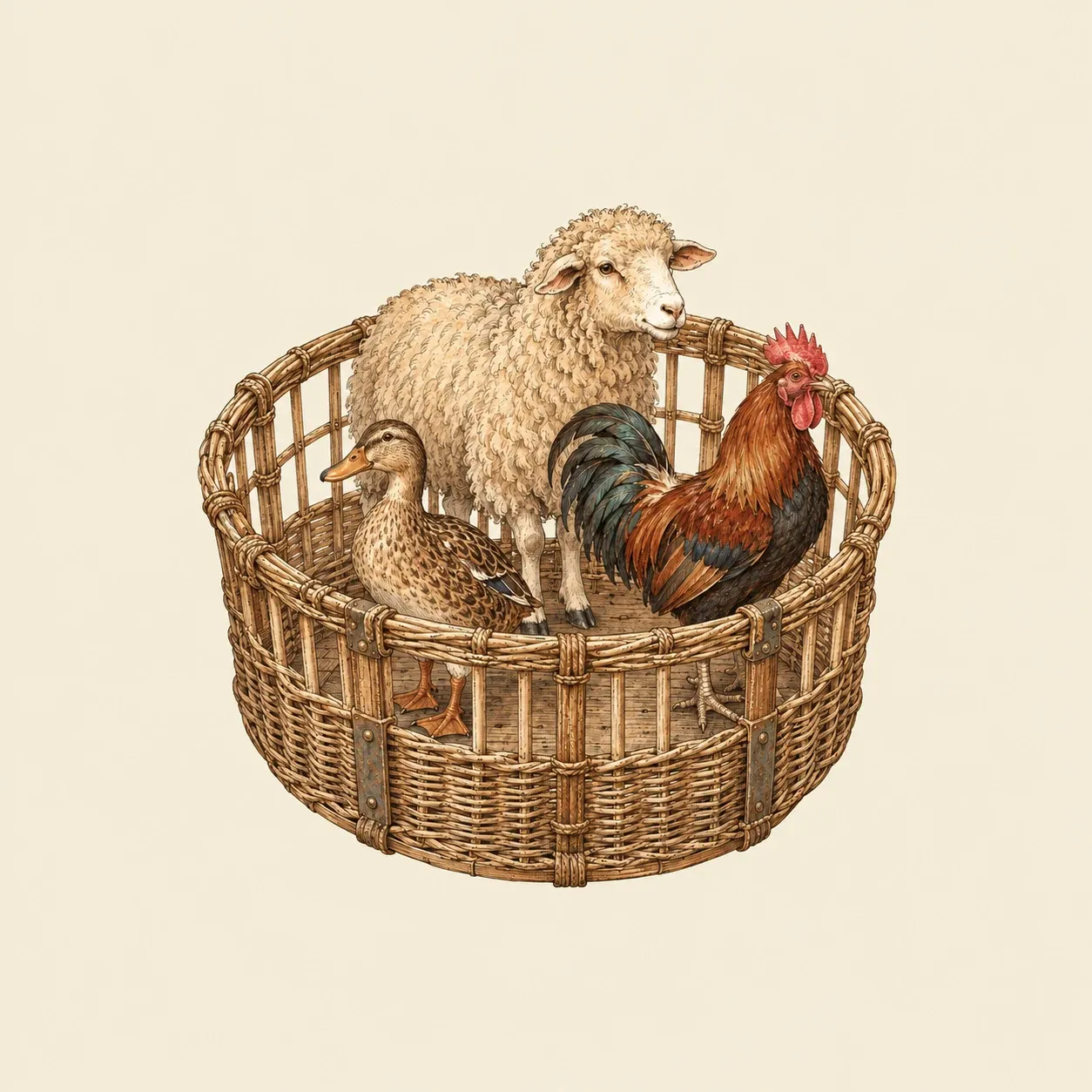 The first passengers, at Versailles in September 1783: a sheep, a duck and a rooster.
On 19 September 1783, at Versailles, in front of Louis XVI and Marie-Antoinette, a balloon carried a sheep, a duck and a rooster in a basket. Two months later, on 21 November, Jean-François Pilâtre de Rozier, a teacher of science, and the Marquis d’Arlandes, an army officer, took off from the grounds of the Château de la Muette, by the Bois de Boulogne on the western edge of Paris. They flew for about 25 minutes, some 900 m up at most, and came down in open ground near today’s Place d’Italie, about 9 km away. Ten days later Jacques Charles and Nicolas-Louis Robert flew a hydrogen balloon from the Tuileries. Gas balloons could stay up far longer, and hot air was little used afterwards.
The hot-air balloon came back in the late 1950s, when Ed Yost in the United States combined an envelope of synthetic fabric with a burner running on bottled propane. His flight from Bruning, Nebraska, on 22 October 1960 is counted as the first of a modern hot-air balloon, and from 1961 his company, Raven Industries, sold hot-air balloons for sport.