Hydrogen fuel cell
Electricity from hydrogen and oxygen
Contents
- 1Tube filled with hydrogen
- 2Tube filled with oxygen
- 3Strip of platinized platinum
- 4Cup of dilute sulfuric acid
- 5Wire joining one cell to the next
A hydrogen fuel cell makes electricity by combining hydrogen with oxygen on two electrodes separated by an electrolyte, with water and heat as the only products. Unlike a battery it is fed from outside and works as long as gas arrives. Christian Schönbein observed the effect in 1838, he and William Grove reported it in 1839, Grove built a gas battery of fifty cells in 1842, and in the 1960s fuel cells powered the Gemini and Apollo spacecraft.
What it is
A fuel cell is an electrochemical cell that is supplied continuously with its reactants. In a hydrogen fuel cell, hydrogen reaches one electrode and oxygen, usually from the air, the other, and the cell delivers a direct current for as long as the gases keep coming. A battery carries a fixed store of chemicals that run down; in a fuel cell the electrodes and the electrolyte are meant to stay unchanged.
The reaction is the reverse of water electrolysis: hydrogen and oxygen combine into water, and part of their chemical energy comes out as electricity instead of heat. With pure hydrogen the only products are electricity, water and heat. Because no fuel is burned to drive an engine, the conversion can exceed 60 percent efficiency.
How it works
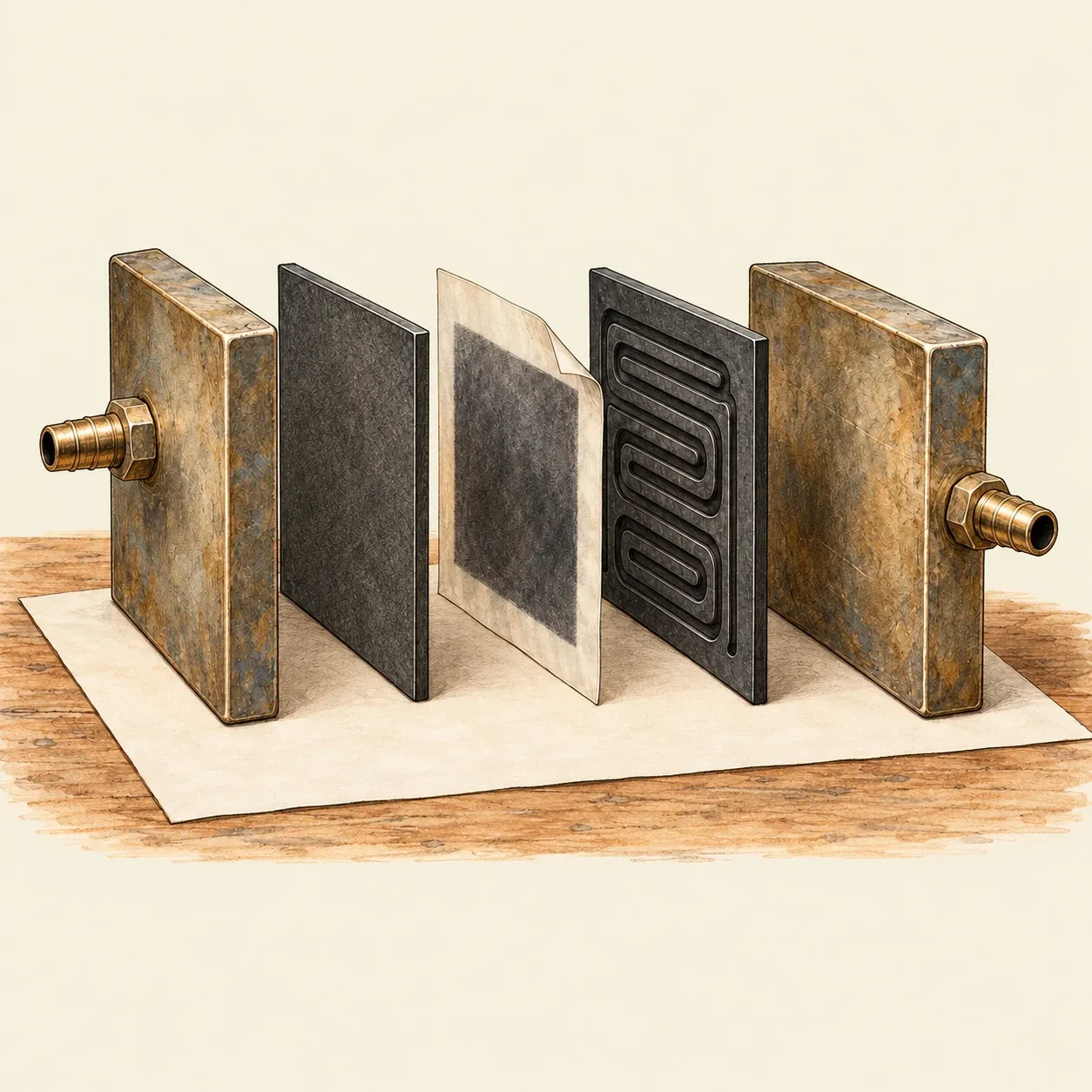 A modern cell is a sandwich: grooved plates bring hydrogen to one face of the membrane and air to the other.
The electrodes carry a catalyst, often platinum. The electrolyte between them lets ions through but not electrons, which have to go round through the external circuit, where they do work in a lamp or a motor. In a proton exchange membrane cell, hydrogen gives up its electrons at the negative electrode, the anode, and becomes hydrogen ions; these cross the membrane to the positive electrode, the cathode, where they meet the returning electrons and oxygen and form water. An alkaline cell moves hydroxide ions the other way: they form at the cathode from oxygen, water and electrons, cross the electrolyte to the anode and combine there with hydrogen, so the water appears at the anode.
The reaction can only happen where gas, electrolyte and catalyst touch, so the electrodes are made porous to give that meeting line as much length as possible. Grove saw this in 1842: on plain platinum foil the action took place only at the water line, so he coated his strips with fine platinum deposited from a solution. Modern electrodes are thin sheets with a water-repellent layer, an active layer of catalyst on carbon and a conducting layer.
A single cell gives a low voltage, so cells are stacked in series to reach a useful one. In proton exchange membrane cells the electrolyte is a thin plastic membrane that passes only hydrogen ions. Alkaline cells, the kind Bacon developed, use an alkaline solution. Other types run hot on molten carbonate or on a solid ceramic electrolyte. A working system also needs pumps or blowers, a way to remove the water and heat, sensors and controls.
How to do it
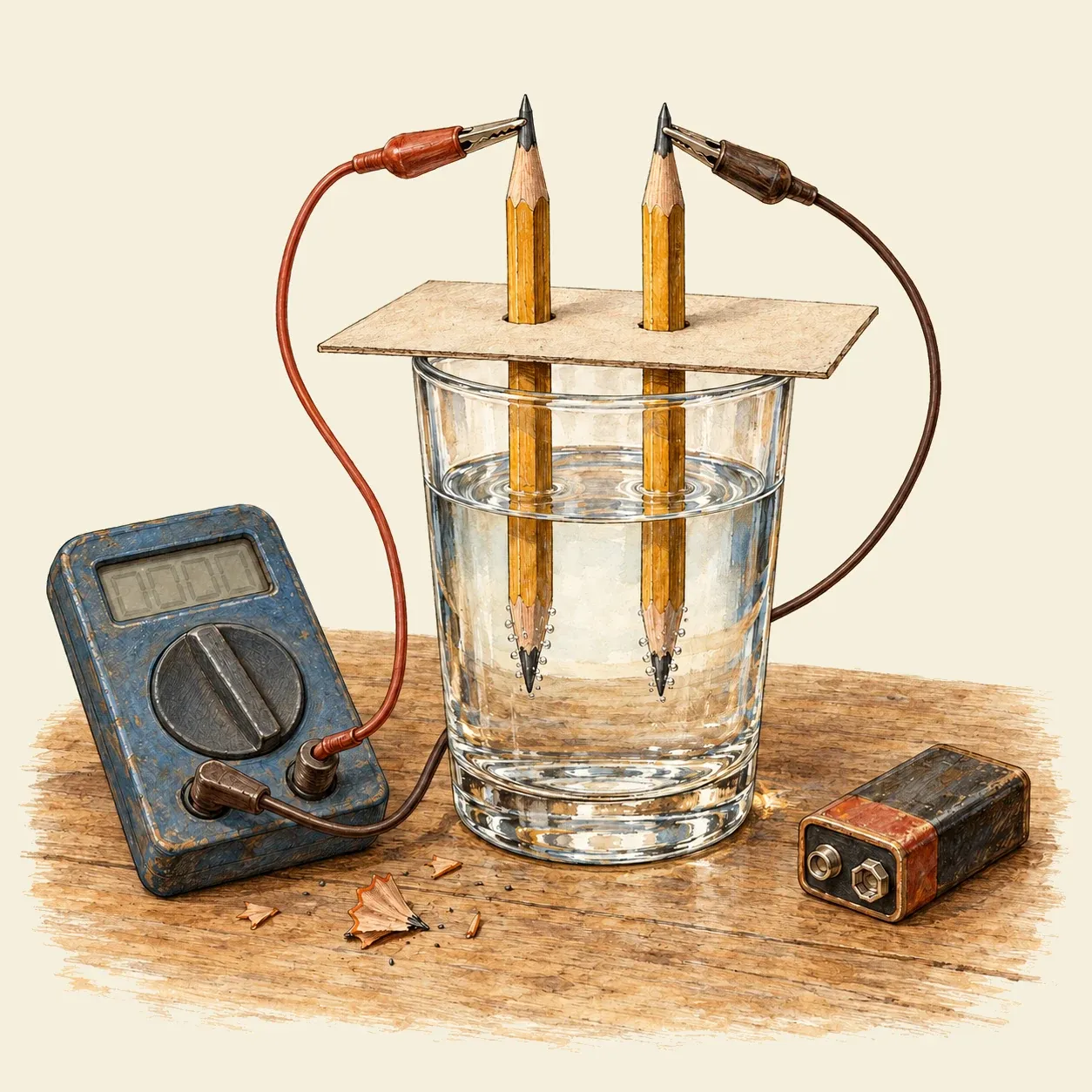 With the battery removed, the gas left on the pencil leads turns them into a tiny fuel cell.
A fuel cell can be seen at work on a tiny scale. Set up the pencil cell described under water electrolysis: two wooden pencils sharpened at both ends, pushed through a card laid on a glass of water with a little Epsom salt dissolved in it, their lower tips in the liquid and not touching. You also need a 9-volt battery, two crocodile-clip leads and a multimeter set to measure direct-current volts.
Clip the battery to the two upper tips until bubbles rise from both leads. Part of the hydrogen and oxygen stays held on the graphite. Unclip the battery and clip the two pencils to the multimeter instead, the pencil that was on the negative terminal to the meter’s black lead.
The meter shows a voltage: the hydrogen held on one lead and the oxygen on the other recombine through the solution and drive a current through the meter, as on Grove’s platinum strips. Clip the battery back on to make fresh gas.
Safety. The bubbles contain hydrogen, which forms explosive mixtures with air and burns with an almost invisible flame. Keep flames and sparks away from the glass and never catch the gas in a container.
History and evolution
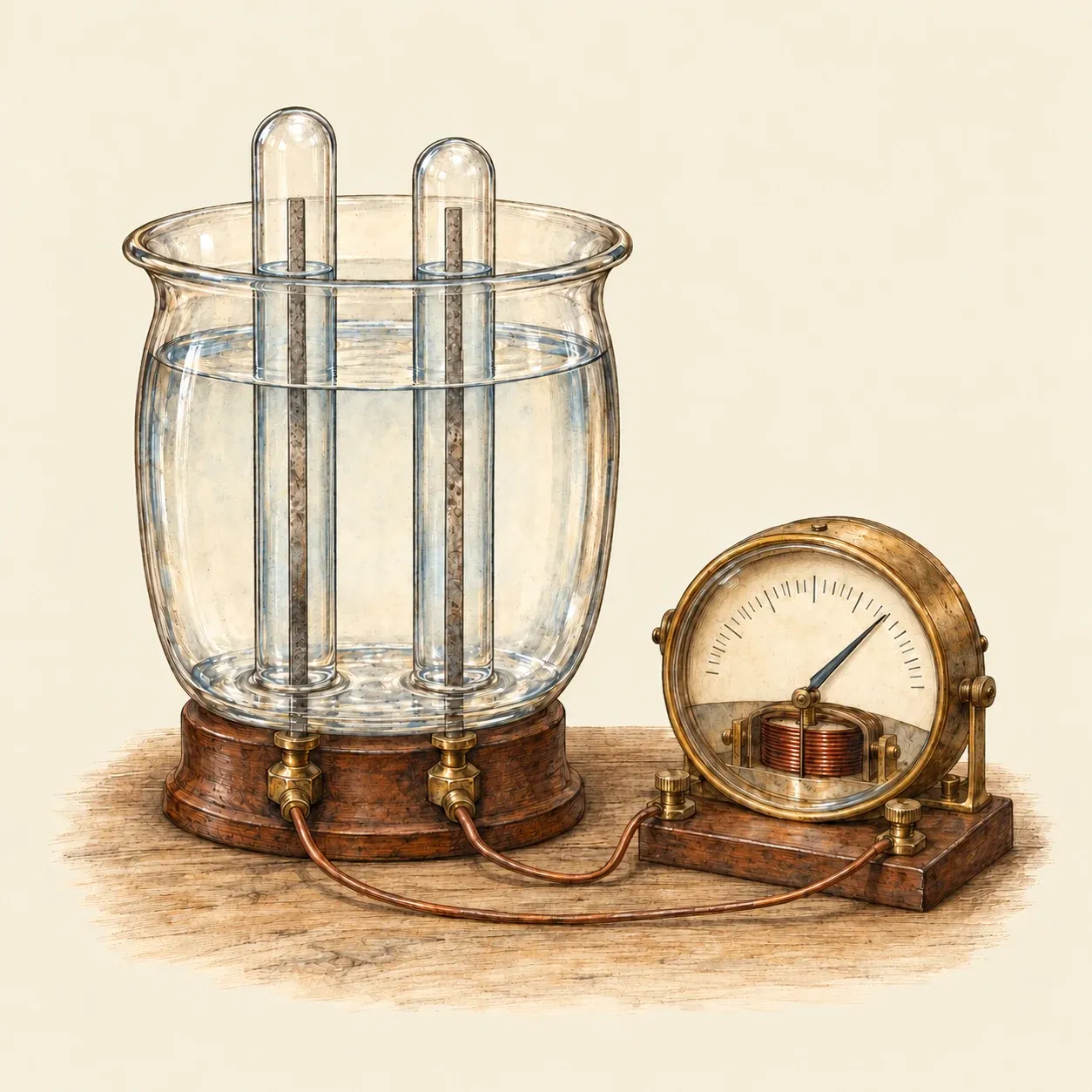 In February 1839 Grove reported a galvanometer needle swinging when one platinum strip reached into hydrogen and the other into oxygen.
Christian Friedrich Schönbein, professor of physics and chemistry at Basel, observed the effect in 1838. In a letter dated December 1838 and printed in the January 1839 issue of the Philosophical Magazine, he described how platinum wires that had served as electrodes in acidulated water lost or gained voltaic power in hydrogen or oxygen, and traced the resulting currents to the union of the two gases. In the February issue, William Robert Grove, later professor of experimental philosophy at the London Institution, described the effect at the end of a paper on the combination of gases by platinum. He sealed two platinum strips through the bottom of a glass vessel filled with water acidulated with sulfuric acid and inverted a tube of oxygen over one and a tube of hydrogen over the other. As soon as the strips touched the gases, a galvanometer joined to them deflected, and over the following hours the liquid rose in both tubes, more in the hydrogen one. Grove ended by hoping “to effect decomposition of water by means of its composition”.
In December 1842 he described a “gaseous voltaic battery” of 50 pairs of tubes, each holding a strip of platinized platinum, standing in dilute sulfuric acid. It gave a shock, a spark between charcoal points and enough current to decompose water. His assistant noticed that the hydrogen was used up twice as fast as the oxygen.
In the late 1880s Ludwig Mond and Carl Langer made cells that lasted longer by holding the electrolyte in a porous non-conducting material. Francis Thomas Bacon took up the hydrogen-oxygen cell while working for the engineering firm C. A. Parsons, continued at King’s College London and, from 1946, at Cambridge, where he developed practical alkaline cells with gas-diffusion electrodes. Spaceflight then created a demand for light, efficient power. Fuel cells supplied the Gemini and Apollo spacecraft and later the space shuttle; those of Apollo grew out of a 6 kW unit built for Bacon’s project by the Cambridge engineering firm Marshall. They are now used in vehicles, in buildings and as backup power, while the cost of platinum and the storage of hydrogen still limit their spread.