Water electrolysis
Splitting water into hydrogen and oxygen with a current
Contents
- 1Voltaic pile
- 2Negative electrode, where hydrogen forms
- 3Positive electrode, where oxygen forms
- 4Tube collecting hydrogen
- 5Tube collecting oxygen
- 6Water made conductive with a little acid
Water electrolysis passes an electric current through water to split it into hydrogen and oxygen, which rise as bubbles at the two electrodes, twice as much hydrogen as oxygen. Two Dutch chemists reported decomposing water with electric discharges in 1789; the voltaic pile made it a steady process in 1800, and it is now one of the ways hydrogen is made.
What it is
Electrolysis of water is the splitting of water into its two elements with an electric current. Two electrodes dip into the water and are connected to a source of direct current. Bubbles of hydrogen form on the negative electrode and bubbles of oxygen on the positive one, and the volume of hydrogen is about twice that of oxygen, the proportion in which the two gases combine to make water.
The process turns electrical energy into chemical energy stored in the gases. Burning the hydrogen, or recombining it with oxygen in a fuel cell, gives part of that energy back. Industry uses electrolysers, stacks of cells in which the two gases are kept apart by a separator, to make hydrogen and oxygen.
How it works
Pure water conducts electricity very poorly, so the water is made conductive by dissolving a little acid, alkali or salt in it. The current is carried through the liquid by ions, charged particles that drift towards the electrode of opposite sign.
At the negative electrode, the cathode, electrons from the circuit turn hydrogen ions or water into hydrogen gas. At the positive electrode, the anode, oxygen is released and electrons return to the circuit. The two gases appear only at the surfaces of the electrodes, never in the bulk of the liquid between them.
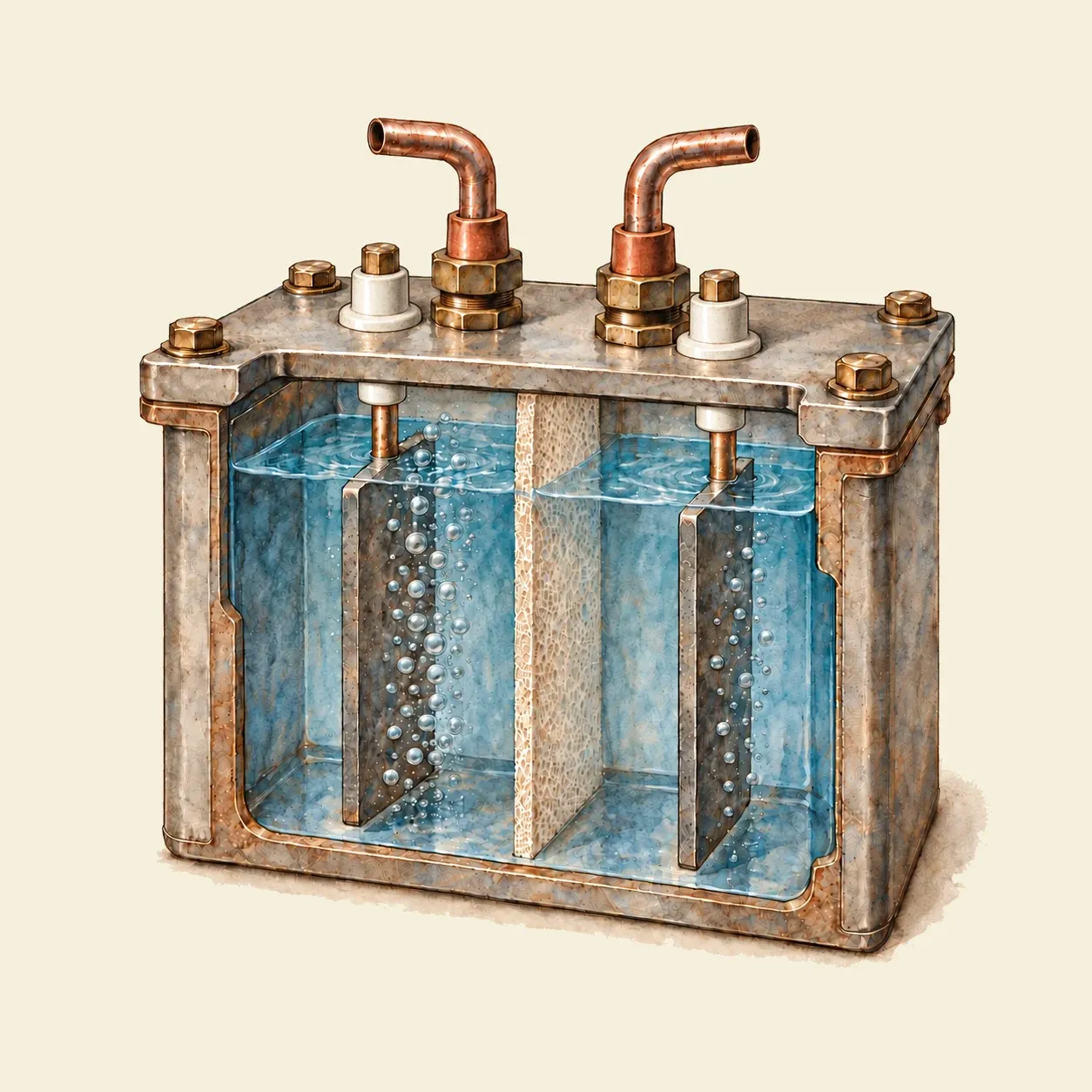 In an alkaline cell a porous separator lets the liquid conduct but keeps the hydrogen and oxygen apart.
The material of the electrodes matters. Platinum and gold are not attacked and give off both gases. Graphite, the lead of a pencil, also gives off a gas at each electrode, though it slowly wears away. In Nicholson and Carlisle’s tube of water, a brass wire tarnished where platinum gave off gas. Industrial alkaline cells have used iron, steel and nickel electrodes; nickel is among the metals that best resist the alkali. A dissolved chloride, such as table salt, gives chlorine, a toxic gas, at the positive electrode in place of oxygen.
Industrial electrolysers come in three main kinds. Alkaline cells use a solution of potassium or sodium hydroxide with a porous separator. Proton exchange membrane cells use a thin solid plastic that lets only hydrogen ions through. Solid oxide cells use a ceramic that conducts oxygen ions and run at very high temperatures, where heat from another source can replace part of the electricity.
How to do it
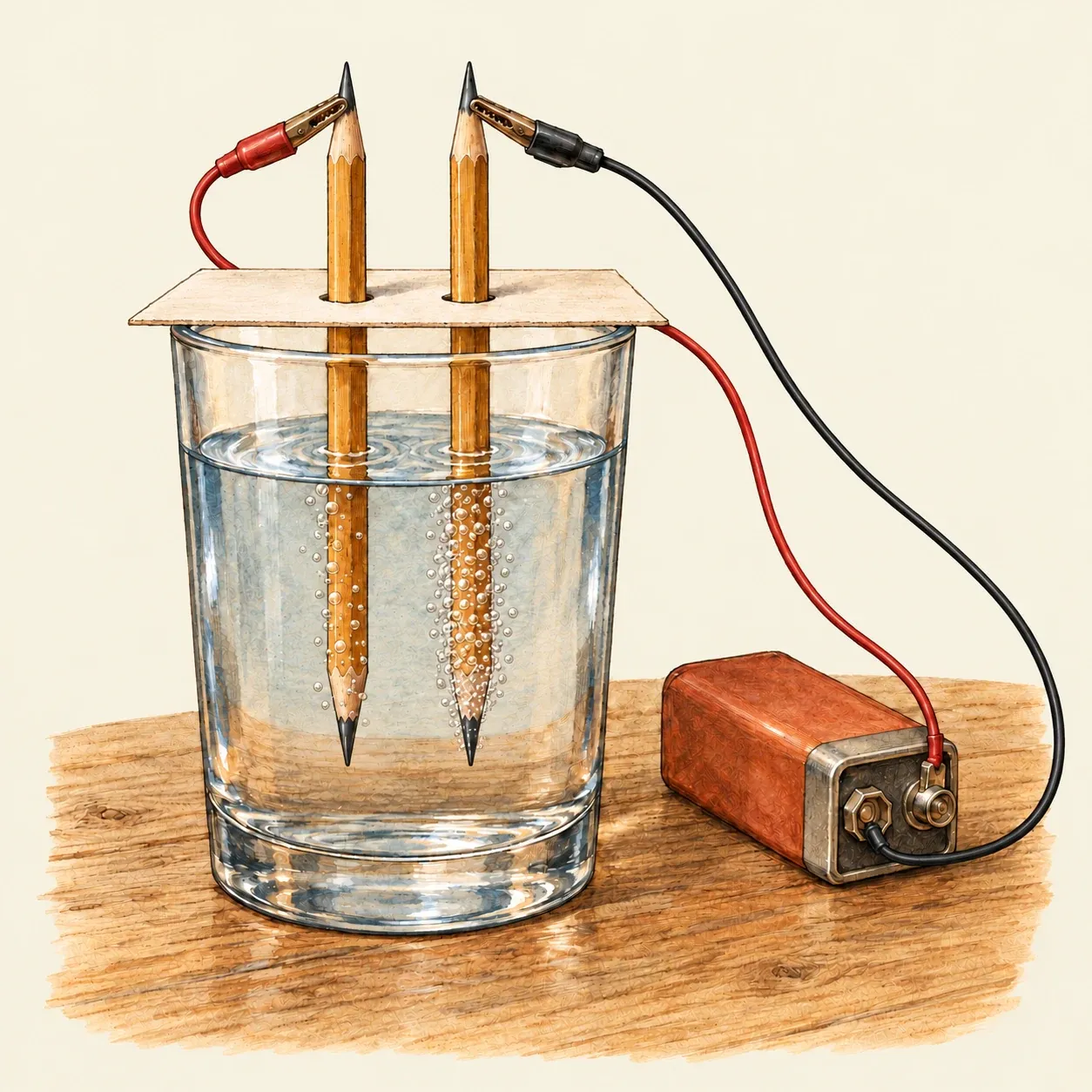 Two pencil leads and a 9-volt battery are enough to split water; the bubbles are thicker on the negative lead.
You need two wooden pencils, a sharpener, a stiff card, two crocodile-clip leads, a 9-volt battery, a glass of water and a little Epsom salt (magnesium sulfate). Use Epsom salt rather than table salt, which would give off chlorine.
Sharpen both pencils at both ends so the graphite shows. Dissolve the Epsom salt in the water. Push the pencils through the card and lay the card on the glass so the lower tips are in the water and do not touch. Clip one lead from each battery terminal to the upper tip of a pencil.
Fine bubbles rise from both leads, more of them on the pencil connected to the negative terminal: that is the hydrogen. Swap the two clips on the battery and the thicker stream moves to the other pencil. Watch for a few minutes, then unclip the battery. The pencil tips slowly wear away as they work.
Safety. Hydrogen mixed with air explodes when lit and burns with an almost invisible flame. Keep flames and sparks away from the glass and let the bubbles escape: never catch them in a tube or a closed container.
History and evolution
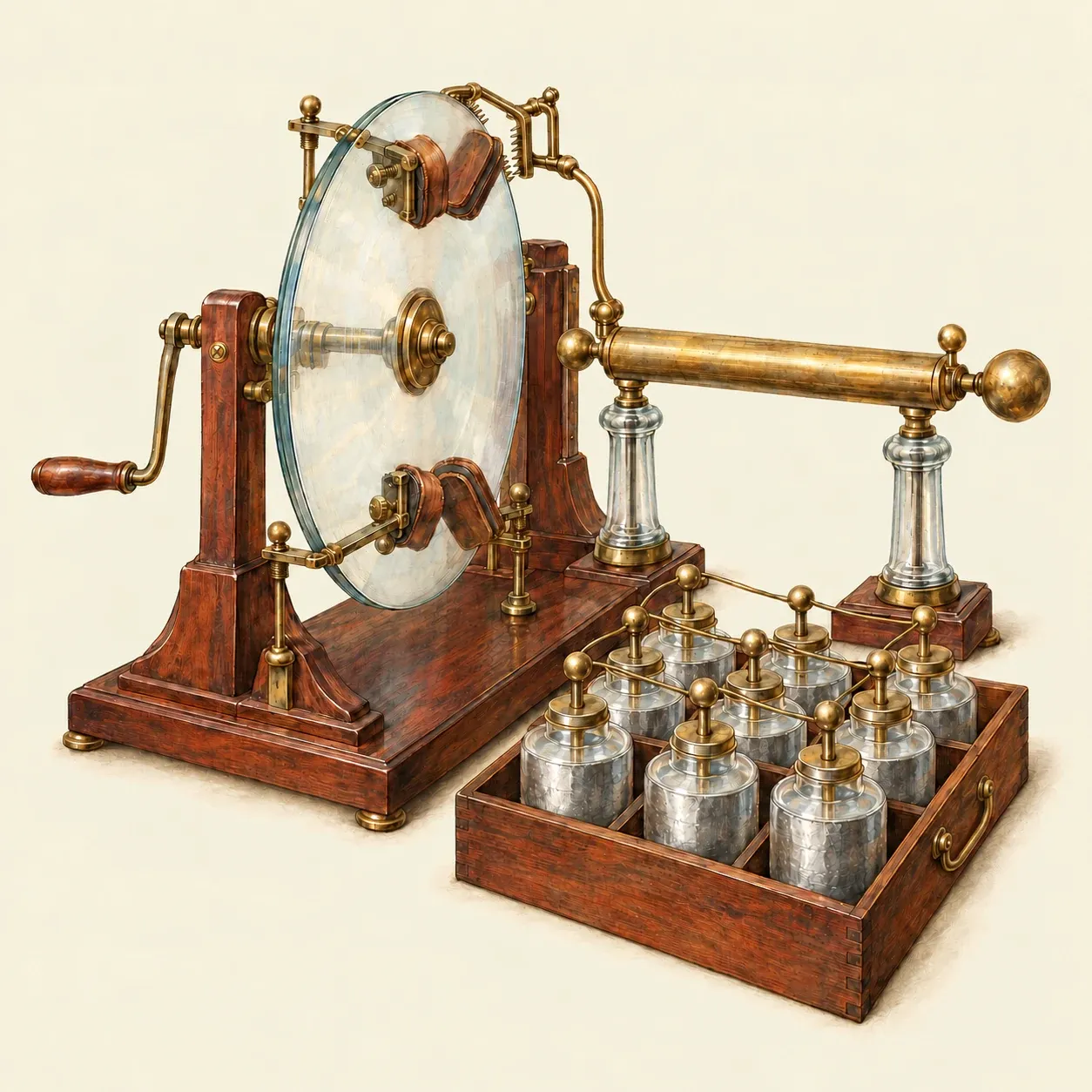 The decomposition of water in 1789 used the sparks of a frictional machine charging Leyden jars.
In 1789 two Dutch chemists, the Amsterdam merchant Adriaan Paets van Troostwijk and the physician Jan Rudolph Deiman, reported in the Journal de physique that they had turned water into “inflammable air” and “vital air”, hydrogen and oxygen, with electric discharges. They sent through water the discharges of a large frictional machine, stored in Leyden jars. The instrument maker John Cuthbertson built their apparatus. The amounts of gas were very small, and the historian E. L. Scott notes that they could not show conclusively which gases they had. With Cuthbertson, the English physician George Pearson repeated the work in the 1790s and gave a more convincing proof. In Haarlem, Martinus van Marum designed an apparatus in 1791 to show the reverse at Teylers Museum: hydrogen and oxygen, lit by electric sparks in a glass flask, formed water, and the gases combined two volumes to one.
The battery changed the scale of the experiment. Alessandro Volta described his pile in 1800, and a few weeks later William Nicholson and Anthony Carlisle connected a pile of 36 pairs of half-crowns and zinc discs, separated by pasteboard, to two brass wires in a tube of water. Hydrogen bubbled from one wire while the other tarnished. With platinum wires they got both gases.
By 1902 more than 400 industrial water electrolysers were at work. Some made hydrogen by electrolysing a solution of caustic soda between iron electrodes. The alkaline cell is still the classic electrolyser. Membrane cells and high-temperature ceramic cells came later, and electrolysers now range from units the size of an appliance to plants connected directly to a power station.