Capacitor
Holding electric charge between two plates
Contents
- 1Brass knob and rod
- 2Inner tin-foil coating, seen through the glass
- 3Glass wall
- 4Outer tin-foil coating
- 5Fixed plates
- 6Moving plates on a spindle
A capacitor holds electric charge on two conductors kept apart by an insulator. Connected to a voltage it fills with charge, and it can give that charge back to a circuit in a fraction of a second. The first was the Leyden jar, found in 1745 by Ewald von Kleist in Pomerania and early in 1746 in Leiden. Capacitors now tune radios, smooth power supplies and store energy for short bursts.
What it is
A capacitor is two conductors, called plates, separated by an insulator, the dielectric. When it is connected to a voltage, charge flows onto one plate and an equal charge leaves the other, until the voltage between the plates matches that of the source. Disconnected, it keeps that charge, and when its plates are joined through a circuit the charge flows back out. Its capacitance, the charge it holds for each volt, is measured in farads, after Michael Faraday. One farad is a great deal: the small capacitors of electronics are counted in millionths or billionths of a farad.
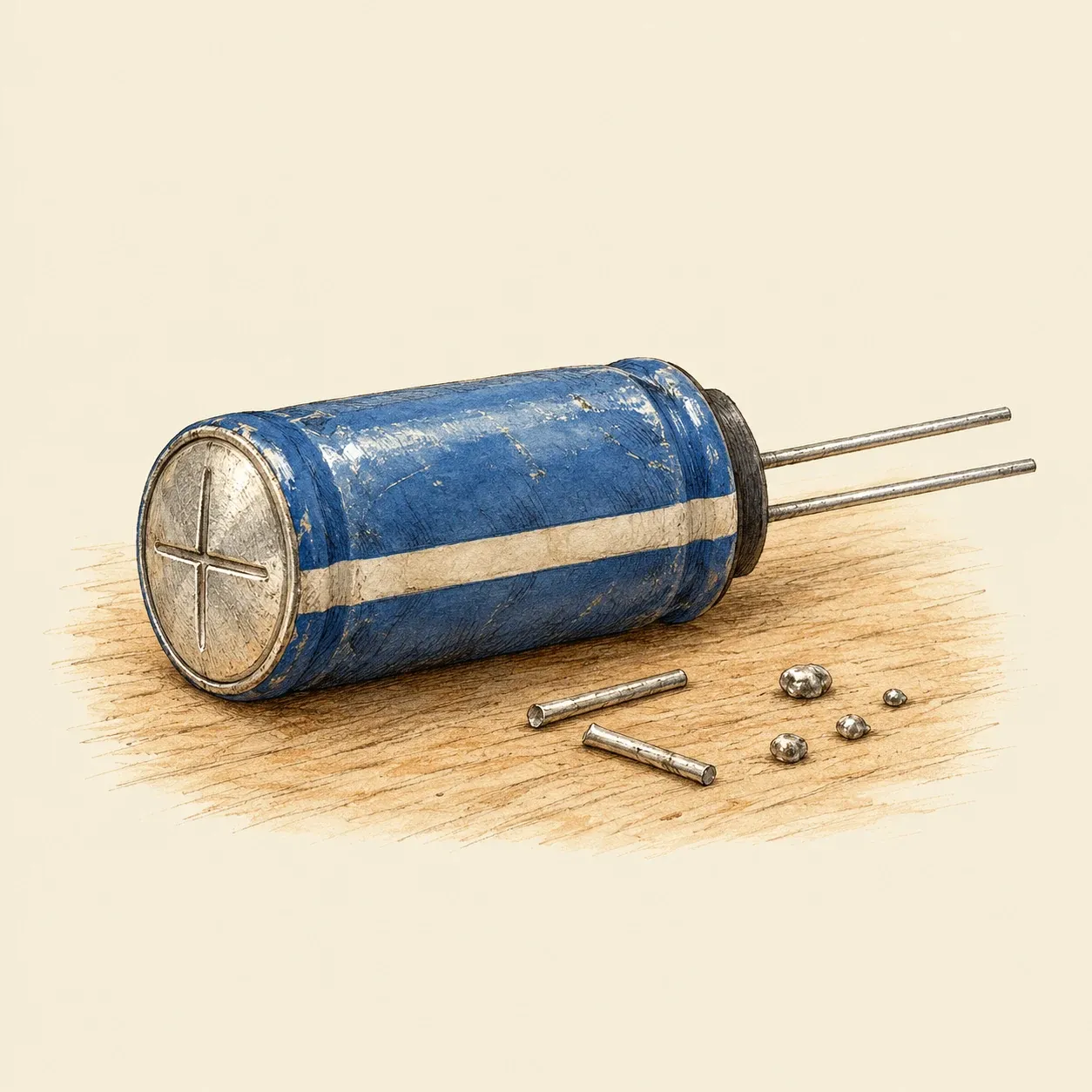 An electrolytic capacitor: a stripe on its sleeve marks the lead that must go to the negative side.
Capacitors are in almost every circuit. With a coil they form the tuned circuit that picks one station out of all those reaching a radio aerial. In power supplies they smooth out the dips of the current, and in a camera flash they gather energy slowly and release it at once. The ENIAC computer, unveiled in 1946, had about 10,000.
Many kinds are made, and they are named after their dielectric: air, mica, waxed paper, ceramic, plastic film. In an electrolytic capacitor the insulator is a film of oxide grown on aluminium foil, and since it is only 10 to 100 billionths of a metre thick, a small can holds a large capacitance. Such a capacitor has a positive and a negative lead and must be connected the right way round.
How it works
The capacitance grows with the area of the plates that face each other, falls as the gap between them widens, and rises with an insulator that takes up more charge than air would, such as glass, mica or certain ceramics. In the variable capacitor of an old radio, one set of plates turns on a spindle and slides between fixed plates without touching them. Turning the knob changes how much of each plate faces its neighbours, and with it the capacitance and the station received.
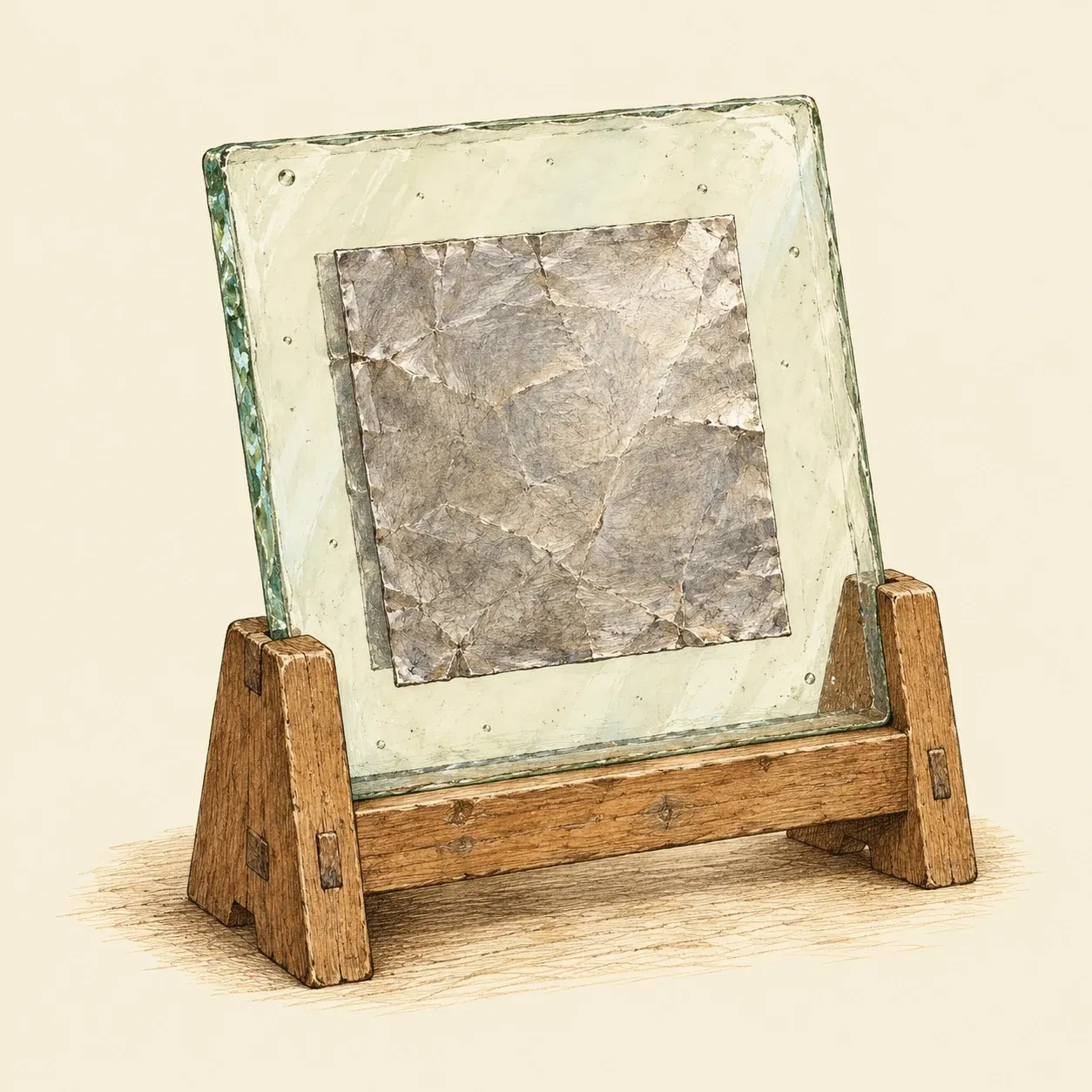 A coated pane: two sheets of metal foil on the two faces of a pane of glass form a capacitor.
The energy stored grows with the capacitance and with the square of the voltage: at twice the voltage a capacitor holds four times the energy. Once charged, it passes no steady current, but an alternating current, which keeps reversing, flows in and out of it continually. A capacitor gives its charge back far faster than a battery. A battery stores energy in chemical changes of its electrodes and releases it more slowly, but holds much more for its weight.
A supercapacitor, or electrochemical double-layer capacitor, is a different device. Its two electrodes are porous carbon soaked in an electrolyte. Charge gathers in a layer of ions only a few tenths of a billionth of a metre from the carbon surface, over a surface that can reach a thousand square metres in each gram of carbon. Per square centimetre, its capacitance is some ten thousand times that of an ordinary capacitor, but each cell can take only about 3 volts before the electrolyte breaks down. It stores three to four times less energy than a battery of the same weight, charges and discharges much faster and, under suitable conditions, can last up to a million cycles.
A charged capacitor can hold a dangerous charge long after the equipment has been switched off and unplugged. Those in televisions, microwave ovens, camera flashes and power supplies can give a shock that kills. Never open such equipment; discharging and repairing it is work for a qualified technician.
History and evolution
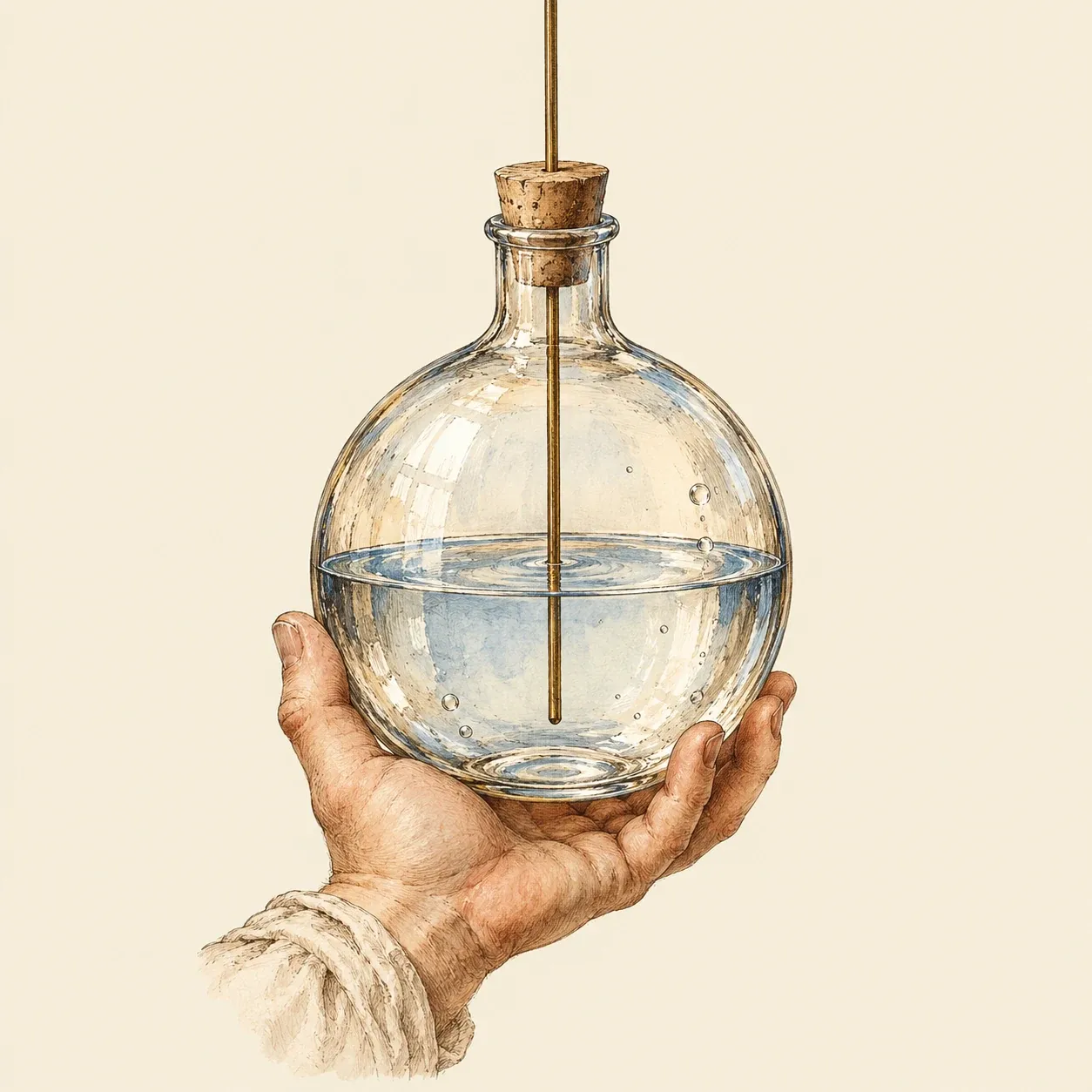 The first Leyden jars were bottles of water held in the hand, with a wire through the stopper.
In the 1740s experimenters charged objects with friction machines and drew sparks from them. In 1745 Ewald Georg von Kleist, a cleric in Pomerania, charged a glass vessel holding water through a wire and received a strong shock when he touched the wire while holding the vessel; he reported it in letters at the end of the year. In Leiden in January 1746 Pieter van Musschenbroek and his friend Andreas Cunaeus made the same discovery. Cunaeus held a glass of water connected to the machine in one hand and touched the wire with the other. On 20 January 1746 Musschenbroek wrote to René de Réaumur in Paris, and the Abbé Nollet repeated the experiment and read the letter at the Academy of Sciences in April. The device took the name of Leyden jar. It was soon coated inside and outside with metal foil.
Benjamin Franklin studied the jar in Philadelphia. In a letter to Peter Collinson dated 29 April 1749, he concluded that the power of the bottle lies in the glass itself, the conductors on either side only bringing and taking away the charge. He made flat versions, panes of glass coated on both faces, and joined eleven large panes of window glass faced with thin lead plates into what he called an electrical battery.
The capacitors of the twentieth century followed from the needs of radio and electronics: rolled waxed paper and foil, mica, ceramic discs, and electrolytic capacitors with their thin films of oxide. In 1954 Howard I. Becker of General Electric applied for a patent on a low-voltage capacitor with porous carbon electrodes in a solution of sulphuric acid or ammonium chloride; granted in 1957, it reported 0.8 farad from a test cell 5 cm long. The Standard Oil Company of Ohio then built cells with an organic electrolyte charged to about 3 volts. The Japanese firm NEC, licensed by Standard Oil, put supercapacitors on sale in the 1970s.