Sitar
Gourd, movable frets and sympathetic strings
Contents
- 1Gourd resonator
- 2Hollow neck
- 3Movable fret and its binding
- 4Main bridge with a curved top
- 5Sympathetic strings under the frets
- 6Pegs of the sympathetic strings
The sitar is a long-necked lute of North India, plucked with a wire plectrum. A dried gourd forms its body, curved metal frets tied to the hollow neck can be moved to suit each raga, and fine sympathetic strings under the frets ring when the played strings sound their notes. Mughal paintings show it in the first half of the eighteenth century.
What it is
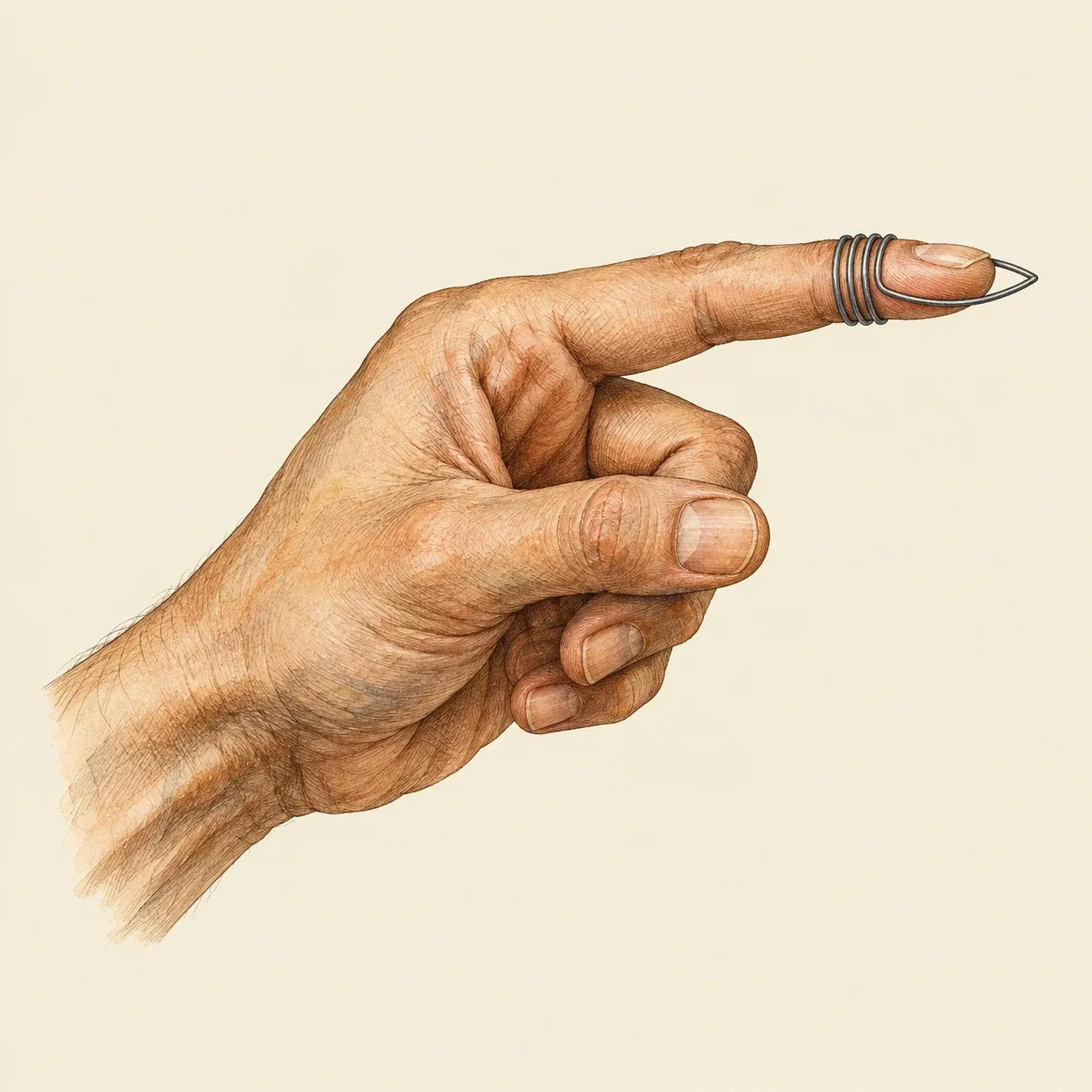 The mizrab, a plectrum of twisted wire, is worn on the right index finger.
The sitar is a plucked lute with a long neck, played in Hindustani classical music. Its body is a large dried gourd, cut open and closed with a thin wooden soundboard. The neck is a long hollow piece of wood with a flat face, and curved metal frets are tied to it with cord, so that they can be slid up or down. Many sitars carry a second, smaller gourd behind the top of the neck.
About seven metal strings are plucked. They run over the frets to a wide bridge standing on the soundboard. Under the frets lies a second set of finer strings, often a dozen or so, that are not normally plucked. They pass over a small bridge of their own and are tuned with small pegs along the side of the neck. The player sits cross-legged with the gourd on the floor and the neck tilted upwards, and plucks with a mizrab, a plectrum of twisted wire worn on the right index finger.
How it works
Some of the played strings carry the melody. The others, called chikari, are tuned to the tonic and its fifth and struck between the melody notes to mark the rhythm. The strings pass their vibration through the bridge to the soundboard, and the soundboard and the gourd behind it pass it on to the air.
In 1921 the physicist C. V. Raman identified the bridge as the main source of the sitar’s particular tone. Its top is wide and very slightly curved, so that the string lies along it for a short distance instead of crossing a sharp edge. As the string swings, it presses on the curved surface and lifts off it, and the point where it leaves the bridge moves back and forth. Its vibrating length changes slightly at every cycle, which feeds energy into the high overtones and gives the buzzing, shimmering sound that changes as a note dies away. Shaping this surface is called jawari. It takes a skilled hand, and the bridge needs reworking from time to time.
The sympathetic strings, or taraf, are tuned to the notes of the raga being played. When a played string sounds one of those notes, or a note whose overtones match one of them, the corresponding sympathetic string starts to vibrate by itself and goes on ringing. Their small bridge is curved too, which adds to the halo of sound around each note.
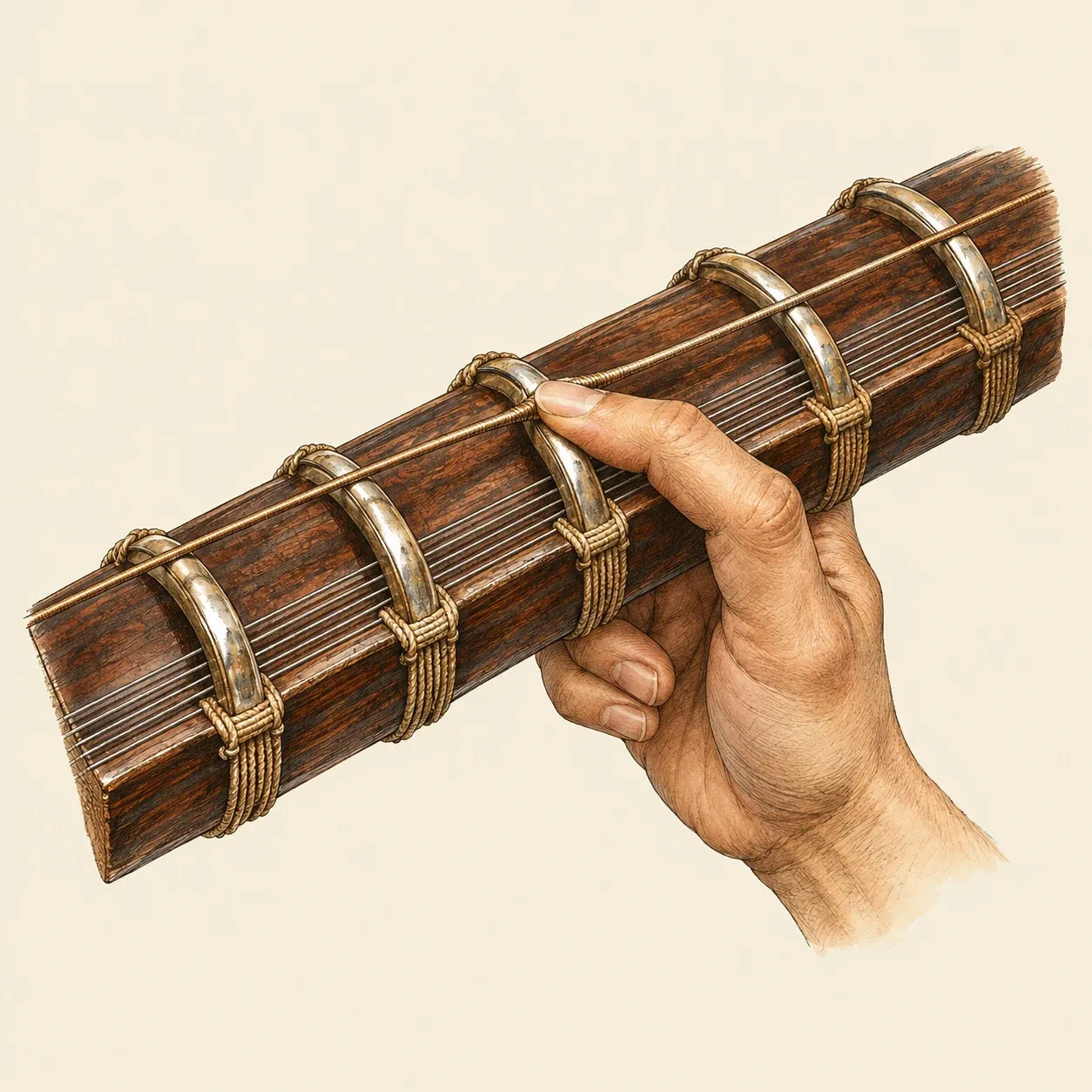 Pulling the string sideways along the fret makes it tighter and raises the note without lifting the finger.
The frets are arched, high enough above the neck for the sympathetic strings to pass underneath. Since they are only tied on, the player moves them before playing so that they give the scale of the chosen raga. Willard observed in 1834 that several ragas could be played without touching the frets, while others needed them shifted to a new mode. The fingers of the left hand stop the string against a fret. Pulling the string sideways along the fret tightens it and raises the pitch, so a single pluck can glide through several notes. This gliding, called meend, lets the sitar follow the curves of a singing voice.
How to do it
A concert sitar is made by specialised workshops. In Miraj, in Maharashtra, makers use gourds grown for the purpose in fields of Solapur district and tun wood brought from Karnataka for the neck. The Mulla family of makers there hang the gourds to dry for months, join the neck to the gourd with resin, a flour paste or modern glue, and fit the frets and pegs last, when they check the tone.
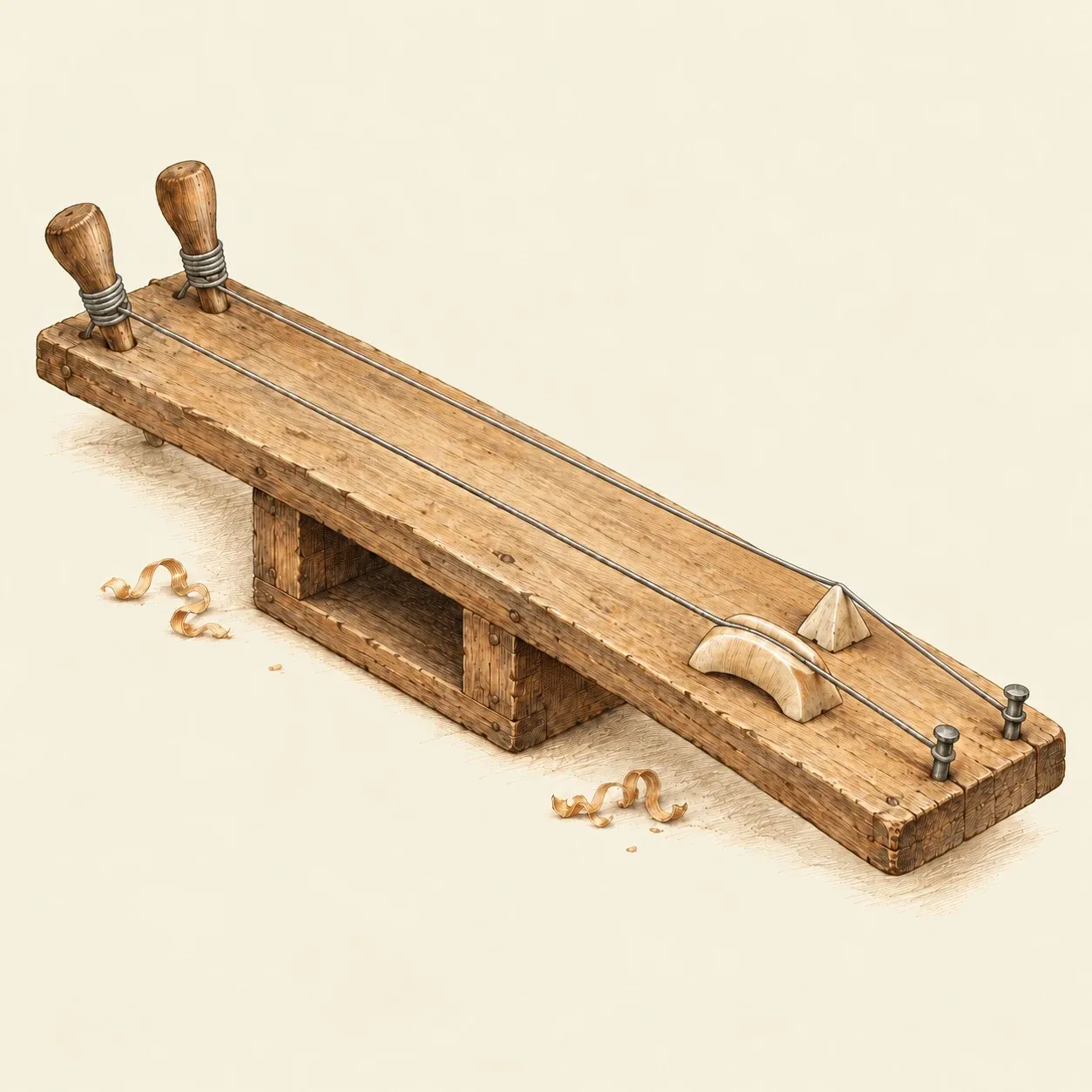 Two strings, two bridges: the sharp edge gives a clear note, the wide curved top a buzzing one.
The two effects that make the sitar’s sound can be heard on a simple board. Take a hardwood plank about 80 cm long and fix it on a small hollow wooden box. At one end fit two wooden or metal tuning pegs, at the other end two strong pins, and stretch between them two plain steel first strings for the guitar, 0.010 in (0.25 mm) thick. Set the bridges so that each string vibrates over about 65 cm, the length these strings are made for on a guitar. Under the first string, set a hardwood bridge with a narrow, sharp top. For the second, file a piece of bone or hard plastic so that its top is about a centimetre wide and almost flat, with a very gentle curve rising towards the pegs. Tune both strings to the D above middle C (294 Hz), a tone below the E they are made to reach at that length.
Pluck the first string: the note is clear and fades evenly. Pluck the second: it buzzes and sounds brighter, and its colour changes as it dies away. Adjust the curve with a fine file a little at a time; a flatter top gives more buzz, a rounder one less. Then leave the second string free, pluck the first hard and, after a moment, damp the first with your hand: the second goes on sounding, set going by the first through the bridges and the board, as a sympathetic string does.
Safety. Steel strings under tension can snap and whip. Wear safety glasses while stringing and tuning, raise the pitch slowly and never go above the D given here: on a longer vibrating length or at a higher note, the tension rises quickly. Bend or cover the cut ends, which are sharp. Clamp the bridges when filing, and wear a dust mask when filing bone.
History and evolution
In 1834 Captain N. Augustus Willard wrote, in his treatise on the music of Hindustan, that the sitar was “a modern instrument” invented by “Umeer Khosro of Delhi”. Popular tradition has taken this name to be Amir Khusrau, the poet who served the sultans of Delhi around 1300. His biographer Mohammad Wahid Mirza found no mention of a sitar in Khusrau’s writings or in those of his contemporaries, and the musicologist Lalmani Misra also rejects the attribution, noting that Willard is the first to make it.
The name comes from the Persian seh-tar, “three strings”. Grinnell College’s musical instrument collection traces the sitar to the Persian setar, present in North Indian courts from the thirteenth century, and dates the use of the name to about the beginning of the eighteenth century, for a three-stringed long-necked lute. Misra argues instead for descent from Indian lutes of the vina family. The historian Katherine Butler Schofield places the appearance of the sitar in the eighteenth century.
Mughal paintings in the Victoria and Albert Museum show women playing it, one of about 1740 and another of the first half of the eighteenth century. The Metropolitan Museum of Art holds a painted sitar with a gourd body, dated to the eighteenth century, from Deolia in Partabgarh.
Willard’s sitar had three strings, one of steel and two of brass, and usually seventeen frets of silver or brass tied on with gut or silk; he added that more recent players had made several additions. Around the time Willard wrote, the playing of Masit Khan of Delhi gave its name to a style of sitar composition, the masitkhani gat. Grinnell’s notes date the chikari strings to the middle of the nineteenth century and the sympathetic strings to its end. A sitar acquired by the India Museum in London in 1855, now at the Horniman Museum, already has holes and pegs for sympathetic strings. In 1965 George Harrison played a sitar on the Beatles’ song “Norwegian Wood”, and the instrument’s sound reached rock and pop audiences in the West.