Threshing machine
Beating the grain out with a spinning drum
Contents
- 1Feed board
- 2Fluted feed rollers
- 3Drum with four beater bars
- 4Curved casing (concave)
- 5Revolving straw rake
- 6Fanner
A threshing machine knocks the grain out of the ears and separates it from the straw with moving beaters. The first, patented by the Edinburgh advocate Michael Menzies in 1734, worked a row of flails with a crank. The design that lasted was Andrew Meikle's of 1786, in which rollers feed the sheaves to a fast drum carrying beater bars; horses, water, wind and later steam drove it.
What it is
A threshing machine does the work of the flail. It breaks the ripe ears of wheat, barley or oats and frees the grain, using a drum that spins a few hundred times a minute with bars fixed along its surface. The sheaves go in ears first, the bars strike them over and over, and the machine sends the straw one way and the grain with its chaff another.
In the Scottish barn machines of around 1800, a worker spread each sheaf on a sloping feed board (1), and two fluted rollers (2) drew it in. The drum (3) carried four beater bars, and a curved casing (4) held the straw close to them. A revolving rake (5) carried the long straw off at the back, and a fanner (6), a box with a turning fan, blew the chaff away from the grain. Outside the barn, horses walking in a circle turned the drum through a train of gears.
How it works
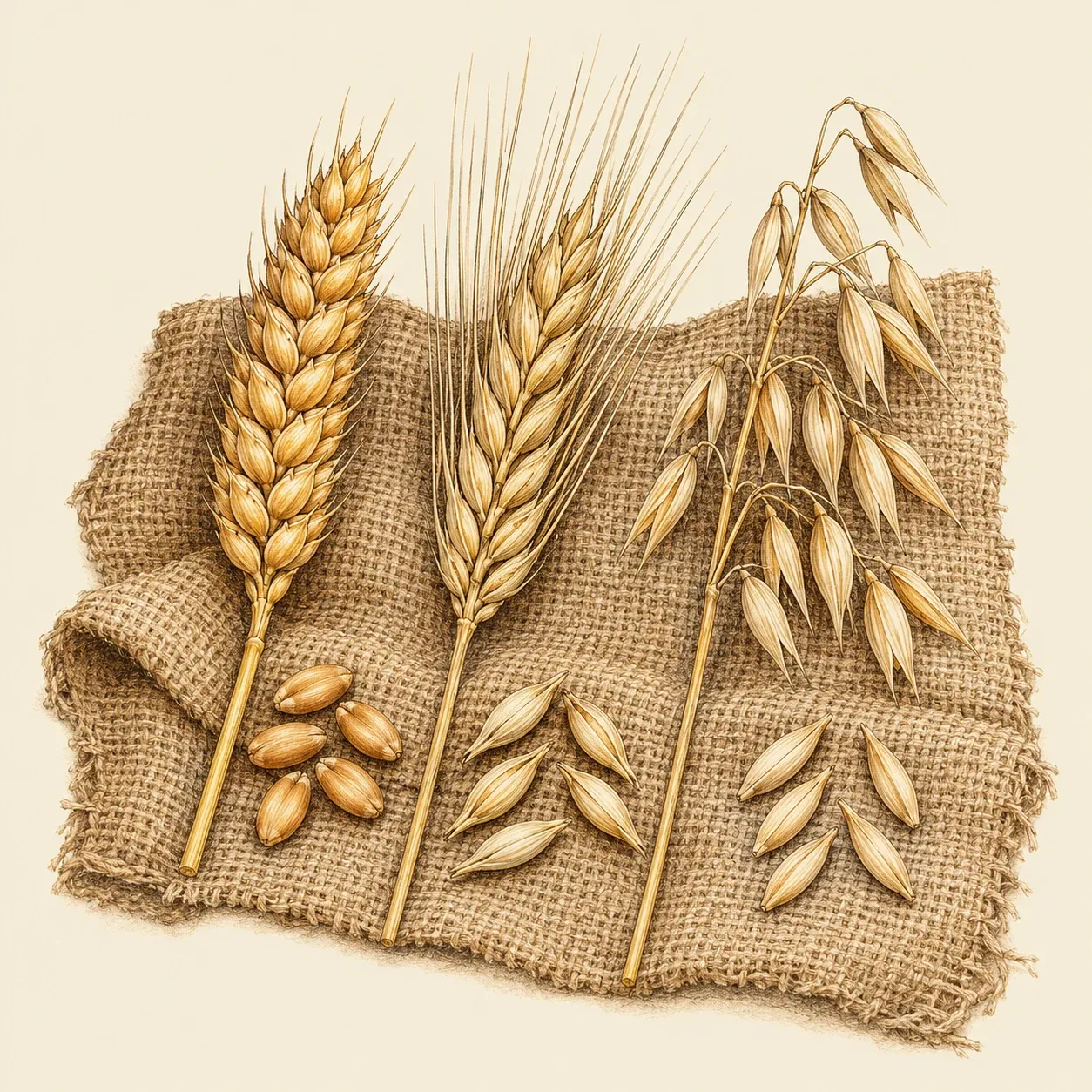 Threshed wheat comes out as bare kernels; barley and oats keep their hulls.
Threshing works by impact: each blow breaks the ear and knocks the grains loose from it. Bread wheat comes out as clean kernels, while ordinary barley and oats keep their hulls, which are removed later by pearling or dehulling at the mill. A drum with four bars gives four blows at every turn. The Encyclopaedia Britannica of 1815 describes a drum 3½ feet (about 1.07 m) across making 300 turns a minute; the historian Elizabeth Schafer gives more than 200.
The feed rollers matter as much as the drum. They grip the straw and let it in slowly, so that the ears hang in the path of the bars and are beaten before the straw passes through. A loose sheaf would be snatched in whole. Beating also spares the grain. An earlier machine built in Northumberland in 1772 rubbed the ears between a fluted drum and rollers pressed against it by springs, and it bruised so much grain that it was given up.
In Meikle’s machine a wooden cover sat a little above the drum and kept the sheaves against the bars. Later machines placed a curved grate, also called the concave, close under the drum, and the grain fell through its bars. The gap between bars and concave and the speed of the drum decide how hard the ears are treated. Too wide a gap or too slow a drum lets whole ears through with the straw; too narrow a gap or too fast a drum cracks the kernels. Farm advisers still tell combine drivers to close the gap before raising the speed, and to run the drum no faster than needed.
What leaves the drum is a mixture. Grain, chaff and broken straw fall through the slatted rack, while the long straw rides on top and the rake pushes it off the back. A sieve, the riddle, holds back short straw and lets grain and chaff through. In the fanner a current of air crosses the falling stream: the light chaff is blown out and the dense grain drops into the chute, as in winnowing by hand.
A drum turning hundreds of times a minute needs gearing. In the horse machine described in 1815, a great horizontal wheel with 276 cogs drove the drum through two pairs of gears, so that it turned about a hundred times for every round the horses walked. The same machine could be driven by a water wheel or a windmill.
How to do it
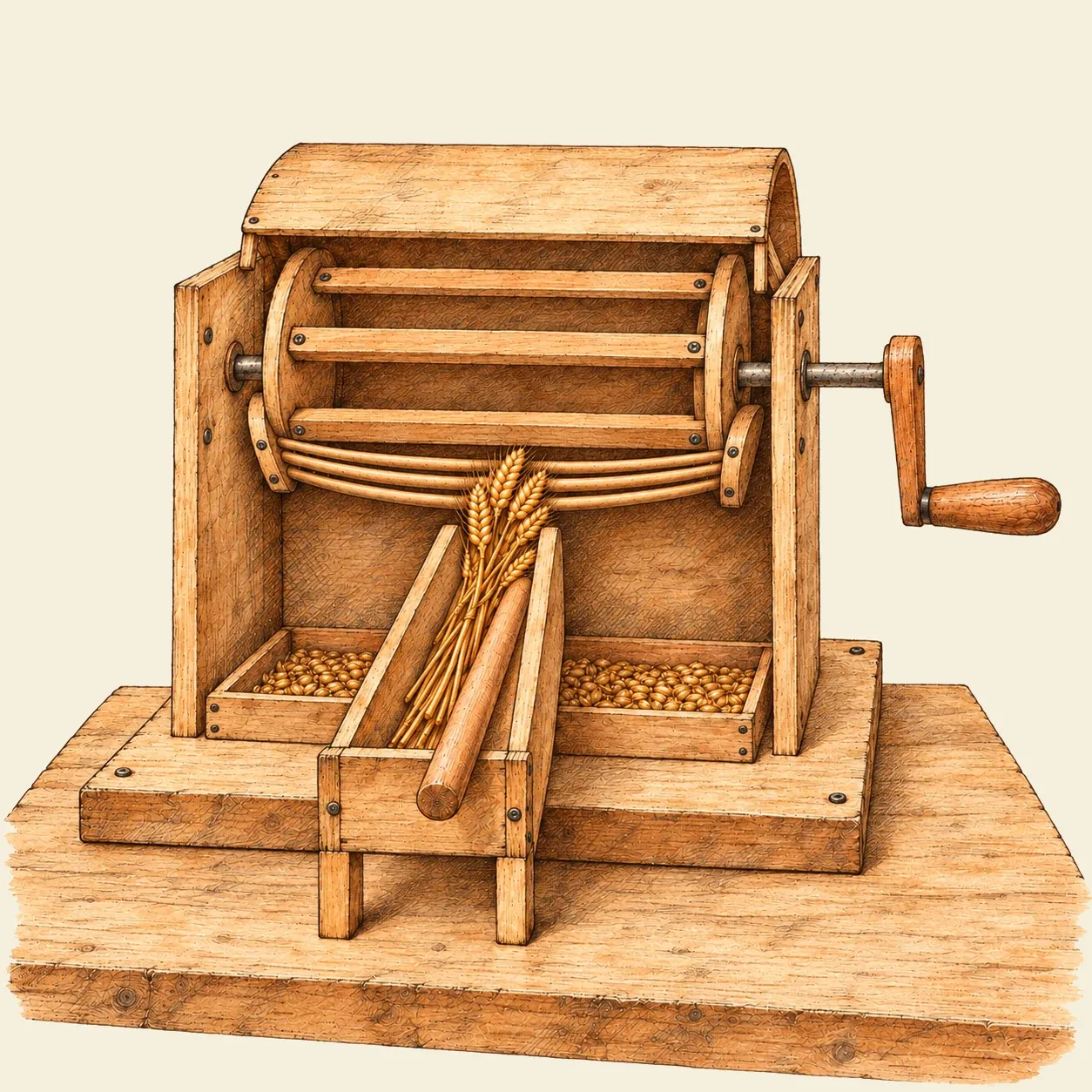 A table model: the hood covers the turning strips, and the ears are pushed along the chute with a stick.
A table model threshes a few ears at a time and shows the whole principle. Cut two discs of plywood about 10 cm across, drill a hole at the centre of each and fix them 20 cm apart on a steel rod of 8 mm, each with a flanged shaft collar screwed to the disc and clamped on the rod, so that the rod turns the discs. Screw four strips of hardwood about 1 cm square across the rims of the two discs at equal spacing: this is the drum with its beater bars. Fit a wooden crank arm with a handle on one end of the rod.
Cut two side plates of plywood about 25 cm square and screw them upright to a base board. Drill the bearing holes at the same height in both, a little wider than the rod, and rub them with candle wax. Under the front half of the drum, make the concave: two curved strips of plywood that follow the drum, with round dowels glued across them, leaving gaps through which a grain of wheat can pass. Set it so that the strips of the drum clear the dowels by a little more than the thickness of a grain. Screw a hood of thin plywood over the top and back of the drum, so that the turning strips cannot be touched from above or behind. In front, fix a sloping chute about 30 cm long that ends at the gap, and slide a tray under the concave.
Thresh dry ears cut with a hand’s length of stalk. One person turns the crank steadily and briskly; the other lays the ears in the chute, heads first, and pushes them along the chute into the drum with a stick. Grain and chaff fall on the tray, and the empty ears come out over the concave. If grain stays in the ears, turn faster or bring the concave closer; if kernels break, widen the gap. Then winnow the grain in a light breeze to blow the chaff away.
Safety. Turning parts catch fingers, hair and clothing. Work only with the hood in place and feed only with a push stick. Before clearing a jam or reaching under the drum, stop turning and hold the drum still. Tie back long hair and take off scarves and loose sleeves. Wear safety glasses, since kernels fly out, and work outdoors or wear a dust mask against chaff dust. Children use the model only with an adult beside them. Old full-size threshers and their belts are far more dangerous: never stand near one that is running without guards.
History and evolution
The first machines copied the flail. Michael Menzies, an Edinburgh advocate, took out a patent for a threshing machine in 1734: a row of flails fixed to a horizontal axle that a crank swung back and forth over sheaves laid on either side. He showed it to the Society of Improvers in Agriculture, whose Transactions of 1743 report that its members thought well of it, but it never became a practical success. Schafer also gives 1734, while the 1810 Encyclopaedia Britannica and Grace’s Guide date the machine to about 1732. In the 1810 Britannica, an account from the son of Michael Stirling, a farmer of Dunblane, says that in 1758 his father completed a water-driven machine in which four arms tipped with iron plates whirled horizontally inside a round wooden box, and that he threshed with it for years. Schafer also credits Stirling with revolving beaters in the 1750s.
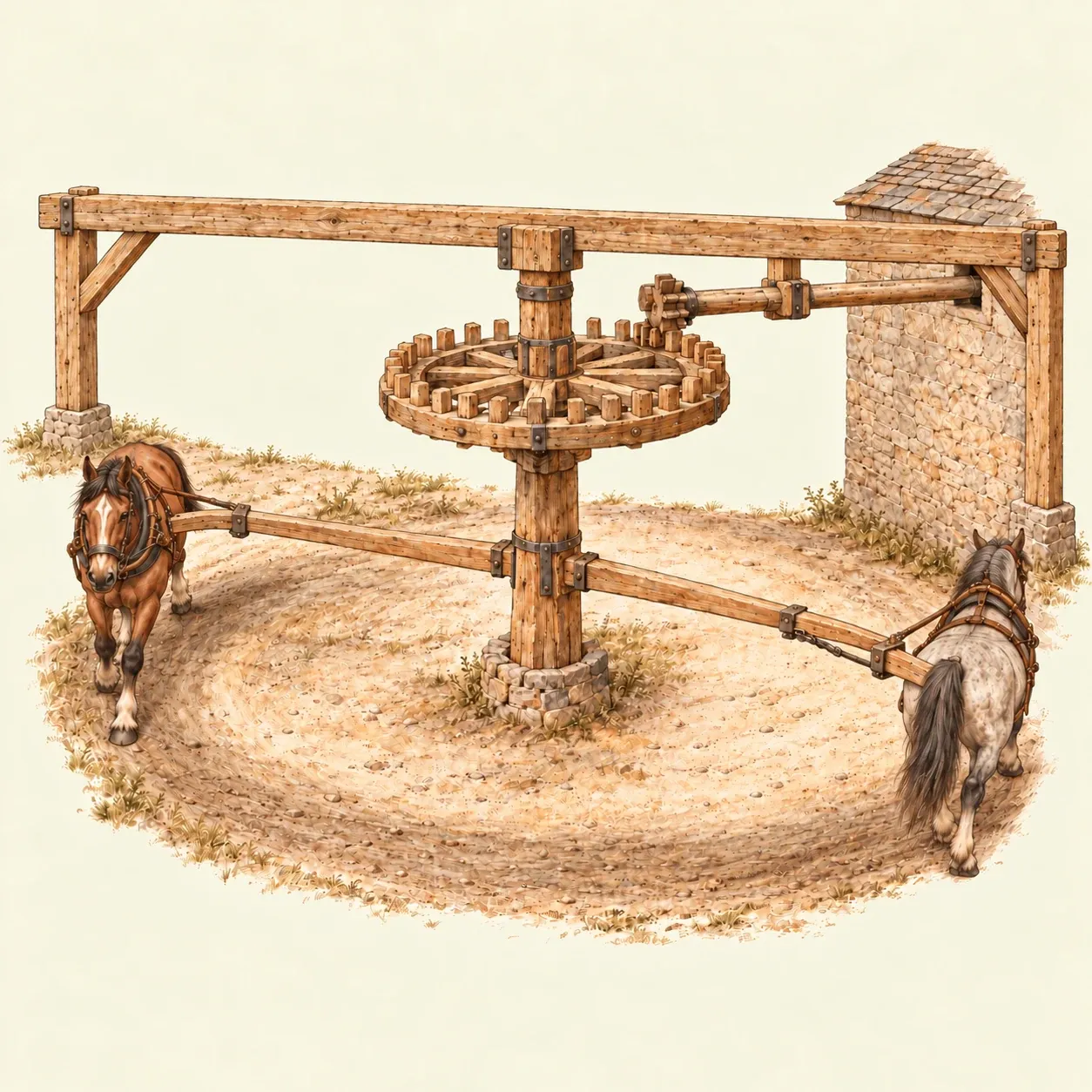 A horse gin: the horses’ slow circle becomes the fast turn of a shaft that enters the barn.
Andrew Meikle, a millwright of Tyninghame in East Lothian, tried flails with joints in 1776, without success. According to the 1815 Britannica he made a model on a new principle in 1785, and in 1786 his son George set up the first machine built on it near Alloa for a farmer named Stein. The Science Museum in London and the historian Stuart Macdonald also date Meikle’s machine to 1786. Schafer records a public trial of a water-driven machine at Knowes Mill in February 1788 and a patent that year. Copies of his drum machine, rather than of the flail machines before it, spread across Scotland and the rest of Britain and earned Meikle little. In 1815 a machine driven by horses cost about 70 pounds, and one driven by a windmill 200 to 300.
Steam came early. The ironmaster John Wilkinson, who bought the Brymbo estate in Wales in 1792, threshed there with steam; the Dictionary of Welsh Biography calls his machine the first steam thresher in North Wales. In 1811 Richard Trevithick built a high-pressure engine to thresh corn for Sir Christopher Hawkins at Trewithen, in Cornwall, and it worked until 1879. Later in the century, portable steam engines on wheels drove threshers by a long leather belt. Labourers who lost their threshing work to the machines resented them, and in 1830, during the Swing riots, men in Kent and other southern counties broke threshing machines at night. In 1878 a British law required the drum and the feeding mouth of every threshing machine to be fenced while it worked.
In the United States, Hiram and John Pitts of Winthrop, Maine, patented in 1837 a machine that threshed with a toothed iron cylinder and cleaned the grain with a fan in the same pass. Its descendants, large separators with straw racks, shaking sieves and fans, were driven by horses, then by steam engines and tractors. Combine harvesters, which cut and thresh in the field, replaced them over the middle of the twentieth century.