Harvest and threshing
From standing wheat to stored grain
- 1Sickle
- 2Sheaf bound with a straw band
- 3Stook drying in the field
- 4Flail
- 5Threshing sledge, underside set with flints
- 6Winnowing basket
- 7Storage jar raised off the ground
Harvesting cuts the ripe cereal, threshing knocks the grain out of the ears, and winnowing blows the chaff away before the grain is dried and stored. Foragers in the Levant were reaping wild cereals with flint sickles about 15,000 years ago, and hand methods of this kind fed most of the world until the reaping machines of the nineteenth century.
What it is
Ripe wheat has to be cut, dried, beaten out of its husks, cleaned and kept dry before it can be milled or sown. Until the nineteenth century almost all of this was done by hand, with a sickle, a flail, a basket and a hard, clean floor.
The plate follows the grain from left to right. Stalks are cut with a sickle (1), bound into sheaves (2) and stood in stooks (3) to dry. On the threshing floor the ears are beaten with a flail (4) or crushed under a sledge studded with flints (5). The winnowing basket (6) parts grain from chaff, and a sealed jar (7) keeps the crop through the year.
How it works
Wild wheat and barley drop their grains as soon as they ripen: the ear breaks apart and scatters the seed, so a harvester has to cut just before. Domesticated cereals hold their grains, and the farmer can wait. Wheat is ready at the hard dough stage, when a thumbnail barely dents the kernel, which still holds about 30 to 35 percent water, and the stalk under the ear has turned yellow.
The cut stalks go on drying in the field. Stood upright in a stook, ears at the top, the sheaves let the rain run off and the wind through. After several days, longer in damp weather, the straw is dry and the kernels hard.
Threshing works by impact. Each blow breaks the ear and knocks the kernels out of their husks. Bread wheat and durum give clean grain this way. Hulled wheats such as einkorn, emmer and spelt break only into spikelets, each grain still closed in tough husks, and need a second pounding.
Winnowing relies on weight. Poured in a steady breeze, the dense grain falls almost straight down while light chaff drifts away. Two sieves finish the job: a coarse one lets the grain through and holds back straw and unthreshed ears, a fine one keeps the grain and lets dust and small seeds fall. Stones the size of a kernel have to be picked out by hand. Wheat dried to 14 percent moisture and kept cool, in a sealed jar or a bin off the ground, keeps for up to nine months, and longer at 13 percent; barley needs about half a point less, and grain stored through a warm season needs to be drier still. Wetter grain heats, moulds or sprouts.
How to build
You need a sickle, two straight sticks and some leather for a flail, a hard floor or a heavy sheet, a shallow basket, a sieve and containers that close tightly.
Cut at the right moment. On a dry day at the hard dough stage, gather a bundle of stalks in one hand, keep that hand above the blade, and draw the sickle through the stems a hand’s width above the ground, away from your legs. Lay each handful down with the ears pointing the same way.
Bind and stook. Twist a few long stalks into a band, wrap it round a bundle as thick as two hands can circle, and tuck the ends under. Keep all the ears at one end, or threshing takes much longer. Lean eight to ten sheaves together in two rows, ears up, and leave them until a kernel cracks between the teeth instead of squashing.
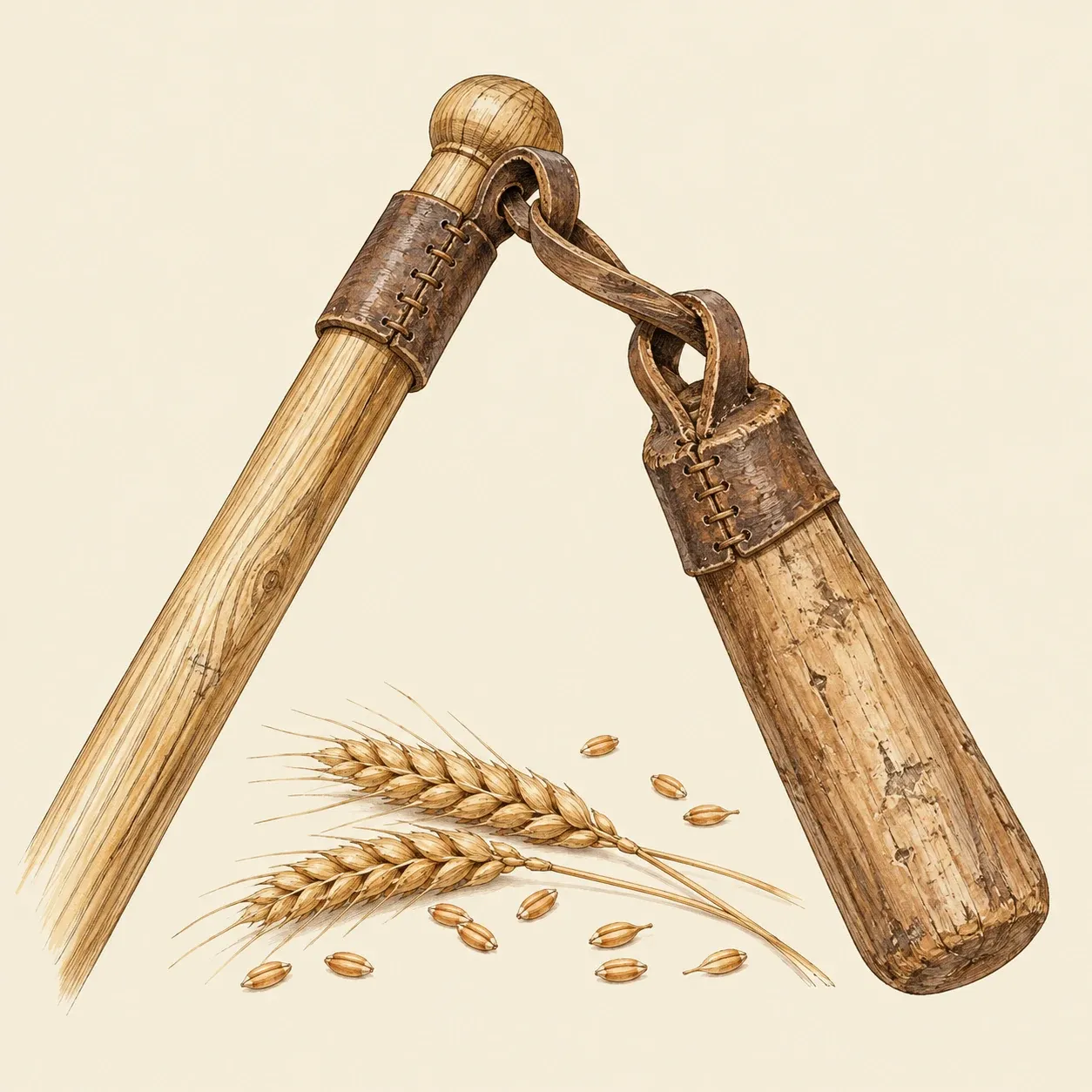 The two loops turn freely in each other; a controlled swing brings the beater down flat.
Make a flail. Take a straight pole of ash or hazel about 1.2 m long for the hand staff and a heavier stick of about 70 cm for the beater, the swingle. Fix a leather cap with a loop, or a hoop of bent wood, to the end of each and link the two loops, so that the swingle swings freely.
Thresh. Spread the sheaves on a swept floor of beaten clay, stone or boards, ears towards the middle. Swing the staff over your shoulder so the swingle lands flat along its whole length. Two people strike in turn. Turn the layer, beat again, then shake out the straw.
Winnow and store. Stand with your back to a light, steady breeze and pour the threshed mixture slowly from shoulder height onto a sheet. Repeat two or three times, sieve, then spread the grain on a pale cloth and pick out the stones. To check dryness, use a grain moisture meter, or grind 100 g of grain, dry it in a thin layer in an oven at about 115 °C and weigh it every half hour until the weight stops falling: if it ends below 86 g, the grain holds more than 14 percent water. Spread it thinly in the sun and bring it in before evening. Store it in sealed jars raised off the floor, check it every few weeks for warmth, smell or insects, and set traps rather than poison.
Keep the edge. Whet a steel blade often with a wet stone. Thin scythe blades of the Austrian type are made to be peened: when the stone no longer restores a fine edge, hammer the edge cold on a small anvil to thin it, then whet again. Blades that the maker says are not for peening are ground instead.
Safety. A sickle or scythe cuts deeply. Carry and store blades covered, out of reach of children, and never leave one in the stubble. Keep the hand that holds the stalks above the cut and other people at least two scythe lengths away; leave a clear circle round anyone using a flail. Threshing and winnowing raise dust and mould spores that harm the lungs and eyes: work outdoors with the wind at your back, wear a dust mask and throw away mouldy grain. Lift sheaves and sacks with bent knees and a straight back, and keep sacks light.
History and evolution
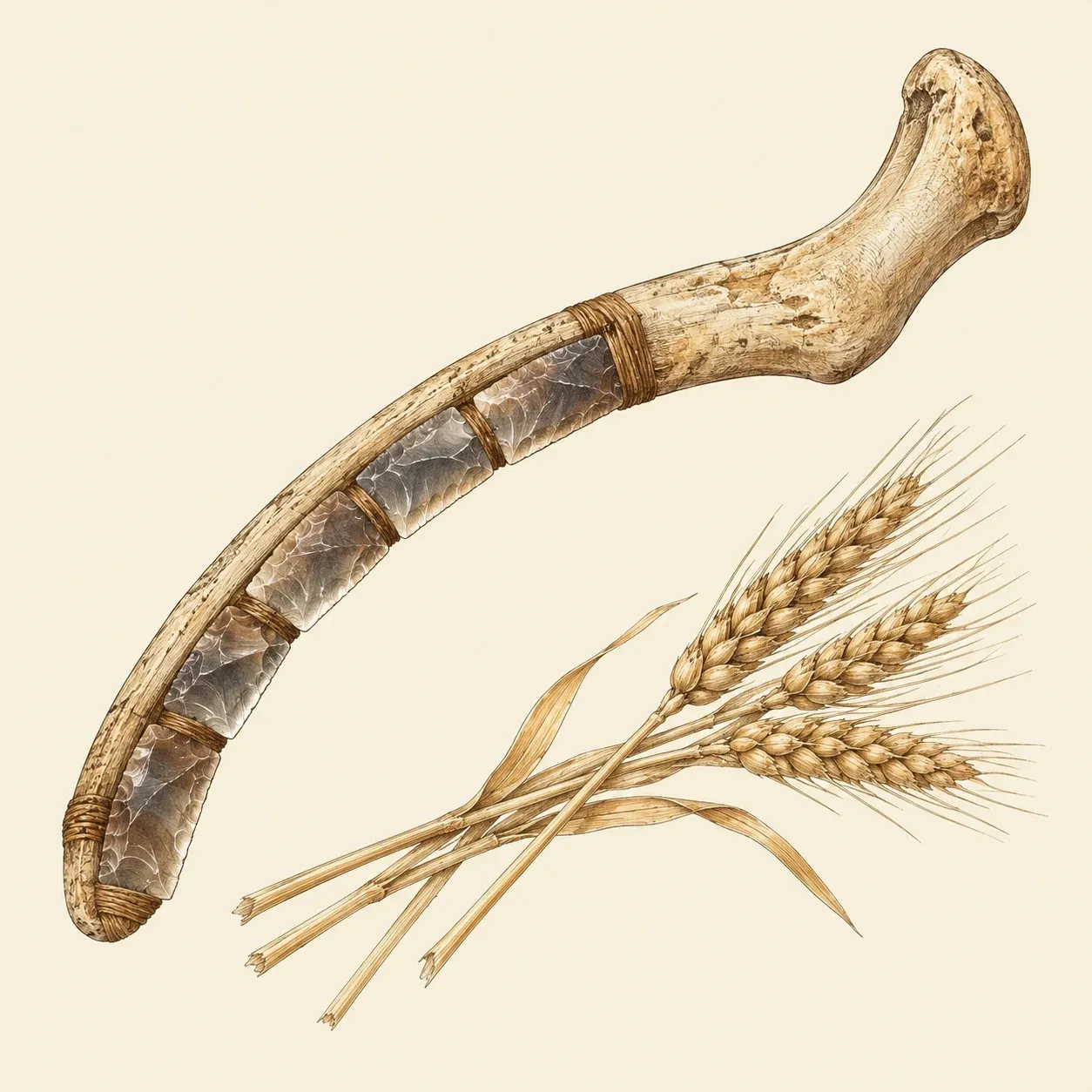 A composite sickle: small flint blades set in a grooved handle, polished by the stems they cut.
Cutting cereal stems leaves a glossy polish on flint, and archaeologists use it to recognise sickle blades. The oldest, five blades from Ohalo II on the Sea of Galilee, are about 23,000 years old. Around 15,000 years ago the Natufians of the Levant used sickles regularly, with flint blades set in handles of bone or wood. Wear on 158 of their blades shows that they began cutting half-ripe stands and kept reaping for weeks. Neolithic blades, more numerous and more polished, mark a yearly harvest once cereals were farmed.
In the third millennium BCE, villages in northern Mesopotamia threshed with boards set with flint blades made in workshops, and used the chopped straw in mud bricks and as fodder. The Roman writer Varro described such a board drawn by oxen, and in Spain sledges were still photographed at work in 1977.
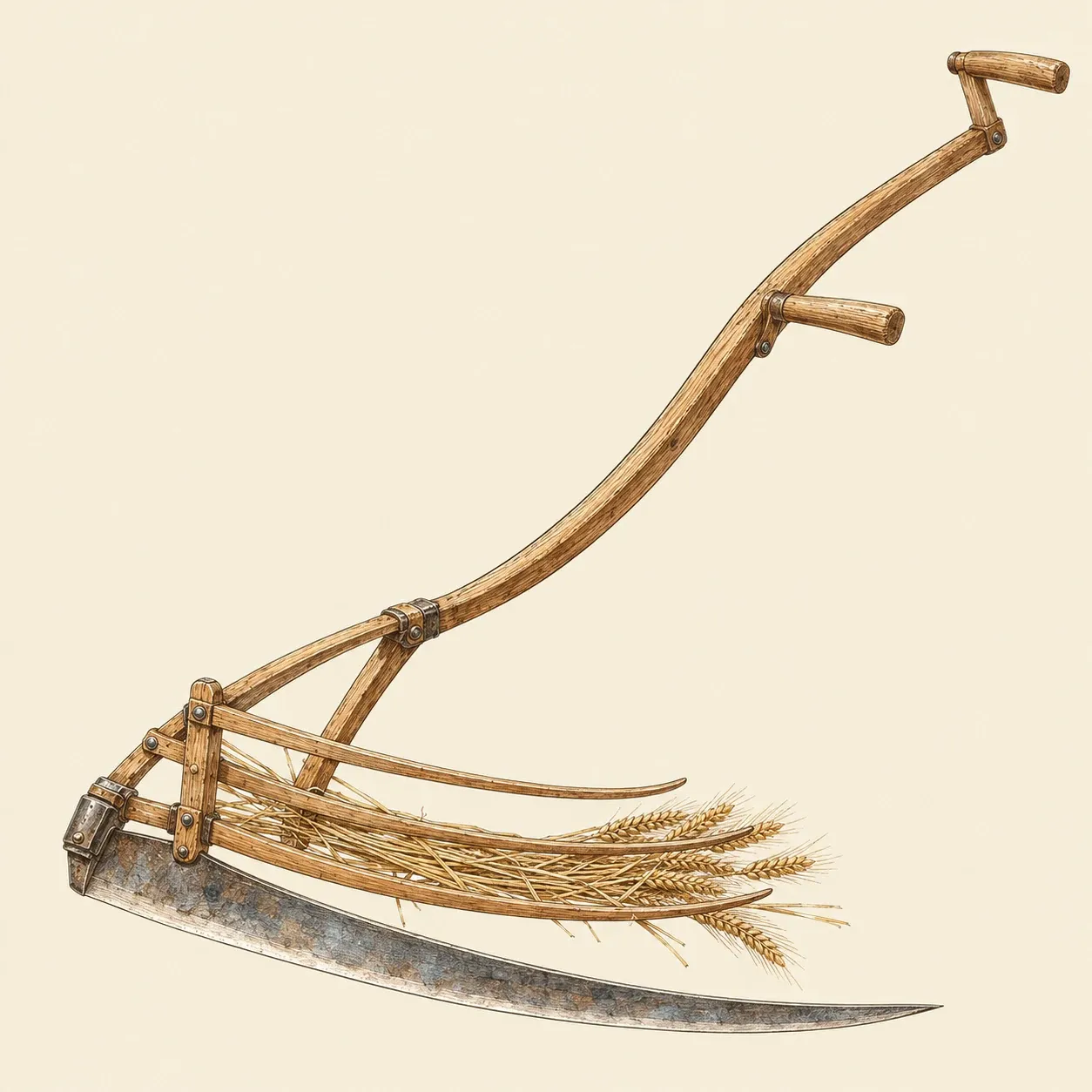 The cradle catches the cut stalks and lays them in a row, ready for binding.
Iron sickles later replaced flint ones. In England the scythe took over the grain harvest in the nineteenth century; fitted with a cradle of wooden fingers, it laid the stalks in rows for binding. Patrick Bell built a reaper in Scotland in 1827–1828, pushed by a horse. In 1831 Cyrus McCormick showed a horse-drawn reaper in Virginia: a reel pressed the stalks against a vibrating blade, and a worker raked them off a platform. In 1834 Hiram Moore and John Hascall built a machine in Michigan that reaped and threshed in one pass, patented in 1836. The modern combine harvester, its descendant, also cleans the grain before it leaves the field.