Atmospheric diving suit
A rigid shell that keeps the diver at surface pressure
Contents
- 1Rigid body of cast magnesium alloy
- 2Head dome with viewports
- 3Oil-supported joint at the shoulder
- 4Pincer at the end of the arm
- 5Umbilical and lifting eye
An atmospheric diving suit is a rigid shell, shaped to hold one person, that keeps its diver at the air pressure of the surface however deep it goes, so that the diver needs no decompression afterwards. The oldest known ancestor is the oak barrel in which John Lethbridge, of Newton Abbot in Devon, worked under water from 1715, his arms out in the sea through two holes.
What it is
An atmospheric diving suit is a hard, watertight shell with arms and legs, worn by one diver, that keeps the air inside at the pressure of the surface. A diver breathing air or gas at the pressure of the water around him absorbs some of that gas into the body and can need decompression afterwards. A diver in a rigid suit breathes air at one atmosphere throughout, however deep the suit goes, and can be brought straight back to the surface. The suit itself takes the whole load of the water.
A modern suit has a body and a head dome with viewports, arms and legs made of rigid segments joined by sealed joints, and hands replaced by pincers worked from inside. The diver breathes from a closed circuit that removes carbon dioxide and adds oxygen. A cable called the umbilical, from the surface or from a submersible, carries communication and often the lifting load and power. The JIM suits of the 1970s had a body of cast magnesium alloy, a hinged head dome for entry, joints at the shoulders, elbows and hips and two independent oxygen rebreathers. Weights fixed outside held them down, and in an emergency the diver could release them together with the umbilical and float back to the surface.
These suits are working equipment for salvage, the offshore oil industry, navies and research, operated by specialist teams with certified equipment.
How it works
At sea level the air presses on everything with one atmosphere. Under water the pressure rises by about one more atmosphere for every 10 m of seawater. A diver’s body cannot resist that difference, so a diver in an ordinary suit breathes gas at the pressure of the water. A rigid suit works the other way round: its walls carry the difference between the sea outside and the air inside, as the hull of a submarine does, and the diver’s body never feels it.
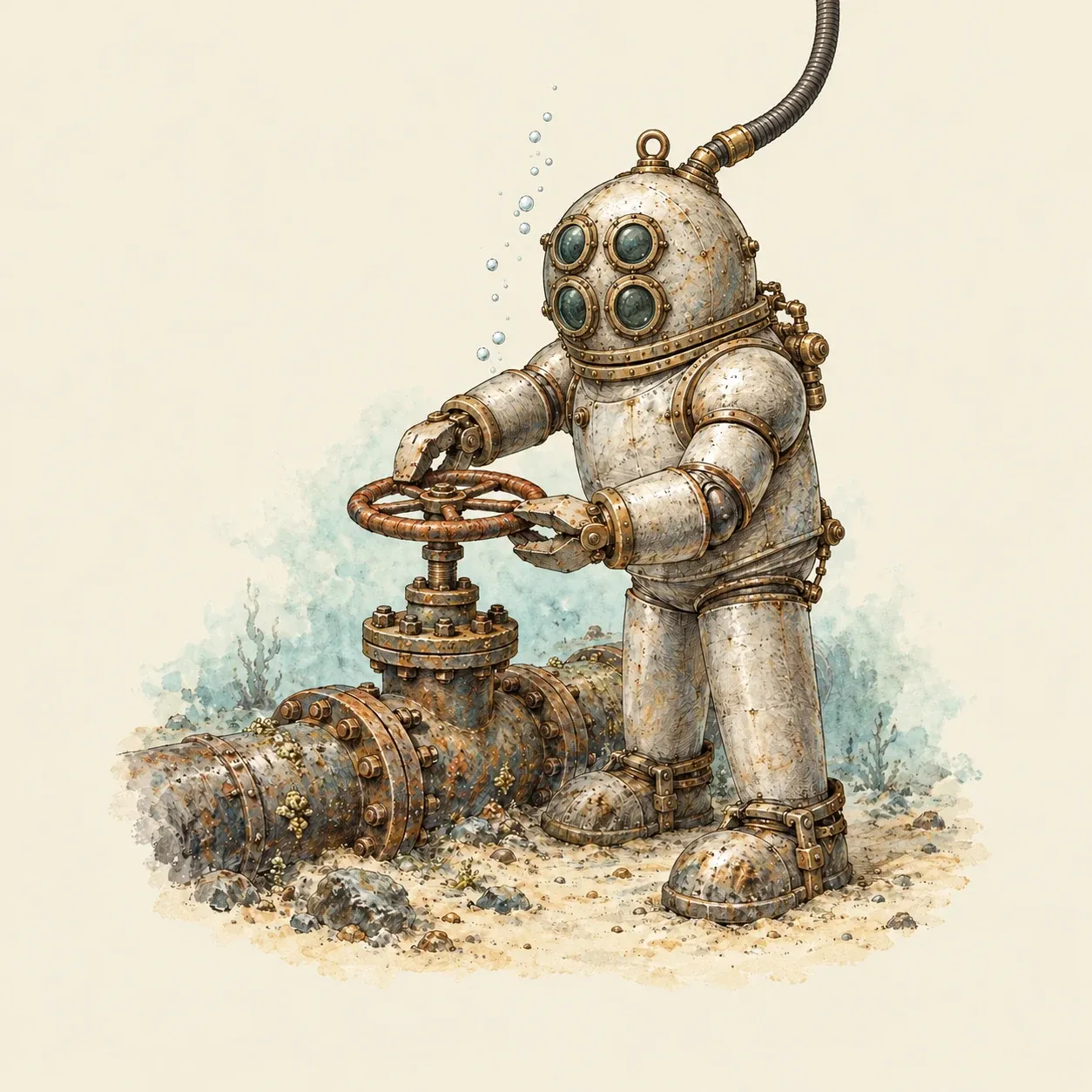 A diver in a rigid suit works at one atmosphere and turns a valve with the pincers at the ends of the arms.
A sealed shell is easy to make; a sealed shell that can bend is not. Every joint must turn while staying watertight, and the pressure of the water tends to squeeze its parts together until they bind. Early suits such as that of the Carmagnolle brothers used strips of fabric and leather between metal parts, which never sealed perfectly. The answer of Joseph Peress, an engineer working in England in the 1920s and 1930s, was a joint filled with oil or another fluid, which carries the load and lets the surfaces move. The JIM suit used six joints of this kind. Later suits, such as the Newtsuit of the Canadian Phil Nuytten, used oil-filled rotary joints, each turning about its own axis, several of which together let an arm or a leg bend.
Even so, a diver in a rigid suit moves slowly. In the first JIM suits the legs did not bend at the knee, so the diver walked by swinging them from the hips, and a US Navy evaluation of 1976 found the suit best at short, broad movements such as sawing. The pincers grip tools and valves, but cannot do what a bare hand does. Against these limits the suit offers long working time at great depth and no decompression at the end of the dive.
History and evolution
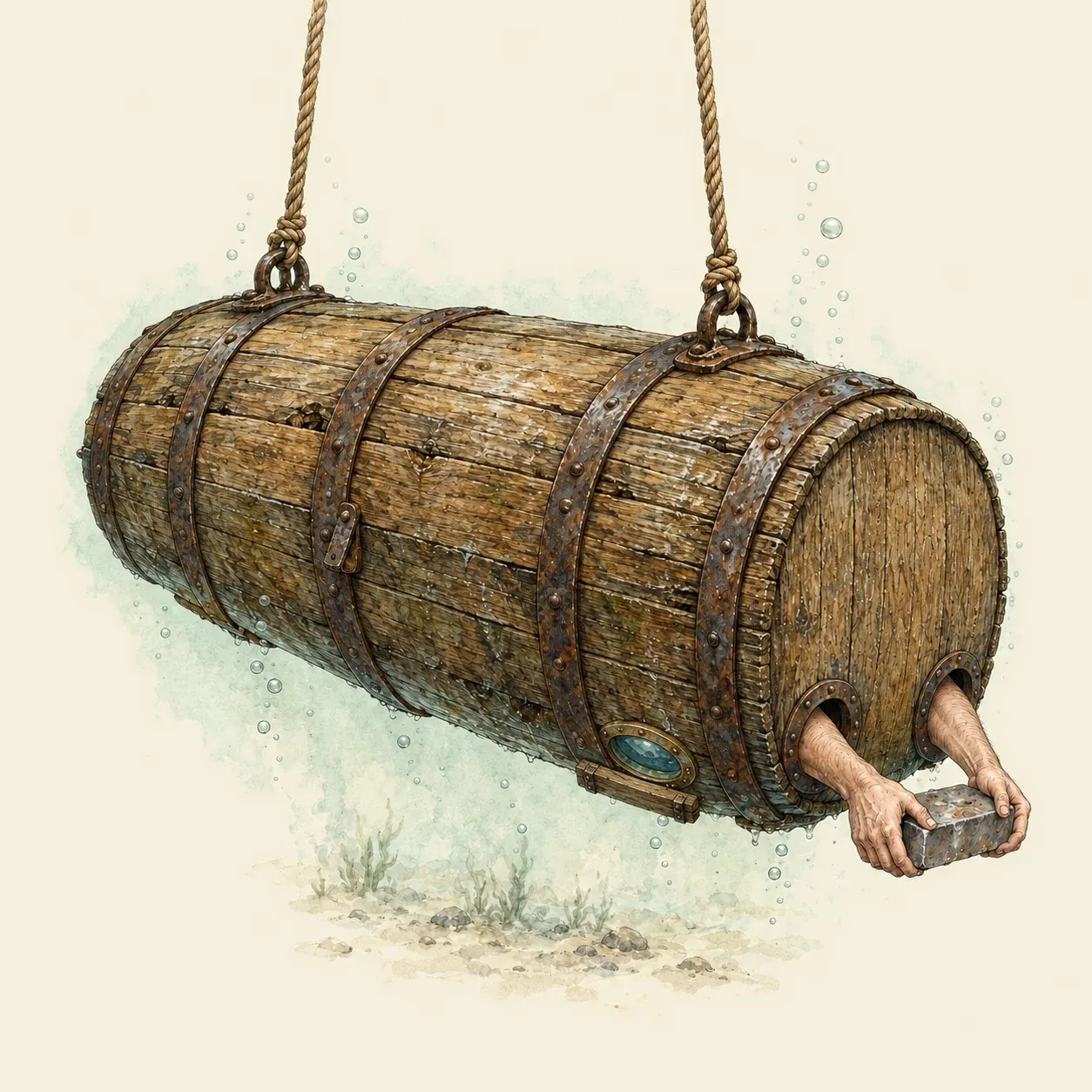 Lethbridge lay face down in his barrel, with his arms out in the sea through two holes.
The first known machine of this kind was built by John Lethbridge, a wool merchant of Newton Abbot in Devon, in 1715. He described it himself: a perfectly round barrel of oak wainscot, bound with iron hoops inside and out, with a thick glass in its lower part in line with his eye and two holes for his arms. After trials in a garden pond, he worked lying on his chest inside it, lowered from a ship, and the air was renewed with bellows each time the barrel was brought up. He worked on the wrecks of warships, East Indiamen and Spanish galleons. From 1725 he recovered silver from the Dutch ship Slot ter Hooge, wrecked off Madeira. His body stayed at the pressure of the surface, but his arms were in the water, sealed at the holes, and leaks there limited the depth he could reach.
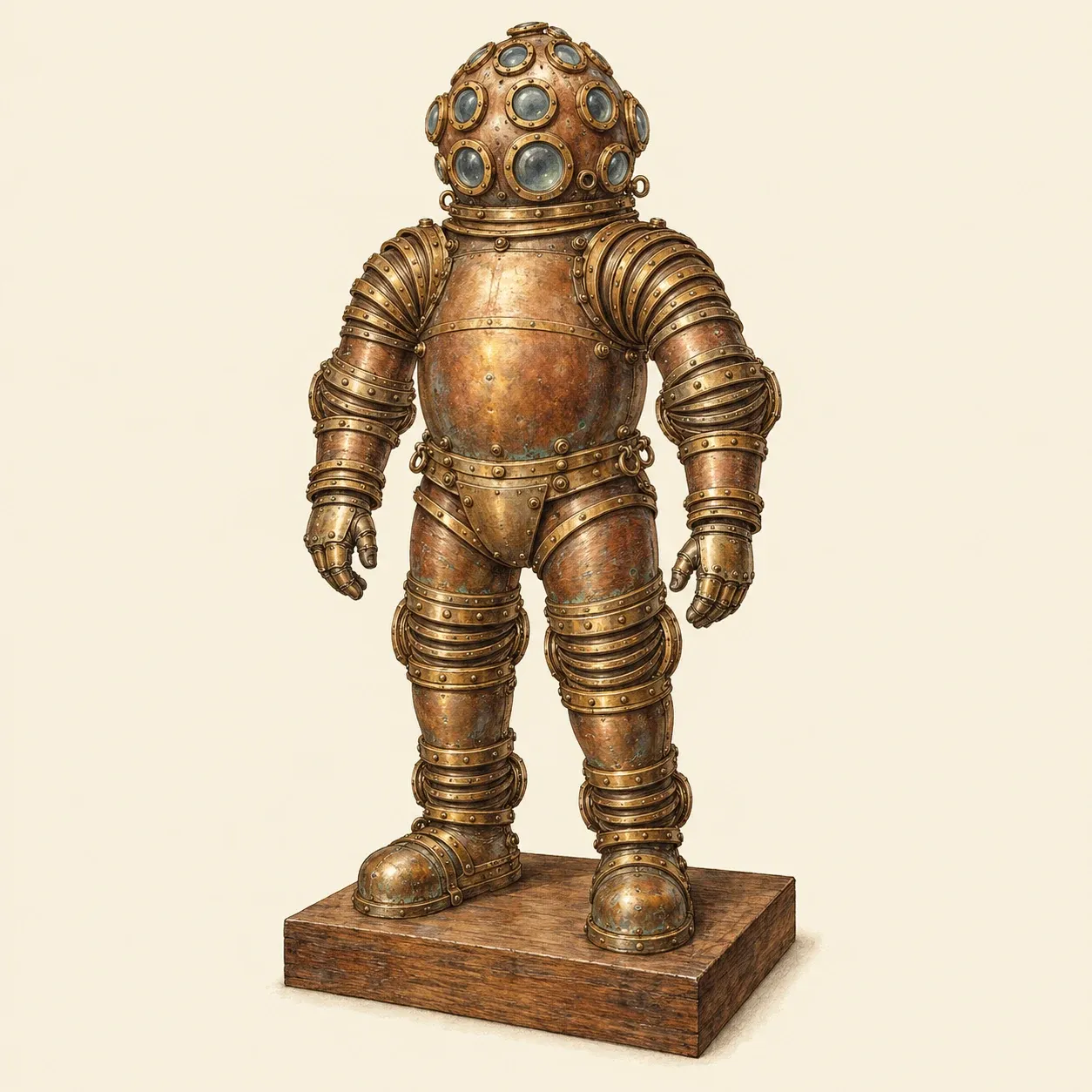 The Carmagnolle brothers’ armour of 1882 had joints all along its limbs, but they never sealed perfectly.
In 1882 the brothers Alphonse and Théodore Carmagnolle had a full suit of metal armour made, jointed all along its limbs and with a helmet set with small portholes, to go deeper than a diver in a helmet and rubber suit could. The strips of fabric between its metal parts never sealed well enough. The prototype, once owned by Louis Denayrouze, is now in the Musée national de la Marine in Paris.
Joseph Peress’s Tritonia, shown in public in 1930, had a magnesium body and joints filled with oil, and in 1935 his chief diver Jim Jarrett went down in it to the wreck of the Lusitania, more than 90 m deep. It found no buyer, and the suit was put aside. In 1965 the engineers Mike Humphrey and Mike Borrow persuaded Peress to return to the work, and their JIM suit, named after Jarrett, made its first dive in 1971. From the mid-1970s JIM suits worked for the oil industry, and in 1976 Walt Thompson completed a working dive of nearly six hours at 905 feet, about 276 m. On 19 September 1979, off Oahu, the American biologist Sylvia Earle rode a small submersible down to 381 m in a JIM suit, stepped off and walked on the sea bed, untethered from the submersible, for more than two hours. In 1984 Phil Nuytten patented the oil-filled rotary joint on which his aluminium Newtsuit was built.