Tin Smelting
Heavy black ore washed, then reduced with charcoal
Contents
- 1Water wheel
- 2Bellows
- 3Furnace, charged with layers of ore and charcoal
- 4Iron block holding the bellows nozzle
- 5Stone trough receiving the molten tin
- 6Mould stone
Tin smelting turns cassiterite, a heavy black tin oxide, into metal by heating it with charcoal in a strong blast of air. The tin melts at only 232 °C and runs out of the fire. Crucibles with tin-rich residues from Göltepe in Turkey, of the third millennium BCE, are the oldest published evidence, and tin made bronze possible.
What it is
Tin is a soft, silvery metal that melts at 232 °C. A tenth of tin in copper makes bronze, harder than copper and easier to cast. Most tin comes from one mineral, cassiterite, a heavy tin oxide, dark brown to black. Washed out of its rock, it collects in river gravels, where its weight makes it settle with the coarse sand.
Tin smelting takes the oxygen out of cassiterite. The ore is washed until it is mostly cassiterite, then heated with charcoal in a blast of air. Tin deposits are rare and scattered, in places such as Cornwall and Devon, Iberia, the Taurus Mountains of Turkey and Central Asia, so for thousands of years tin travelled long distances to reach the bronze founders.
How it works
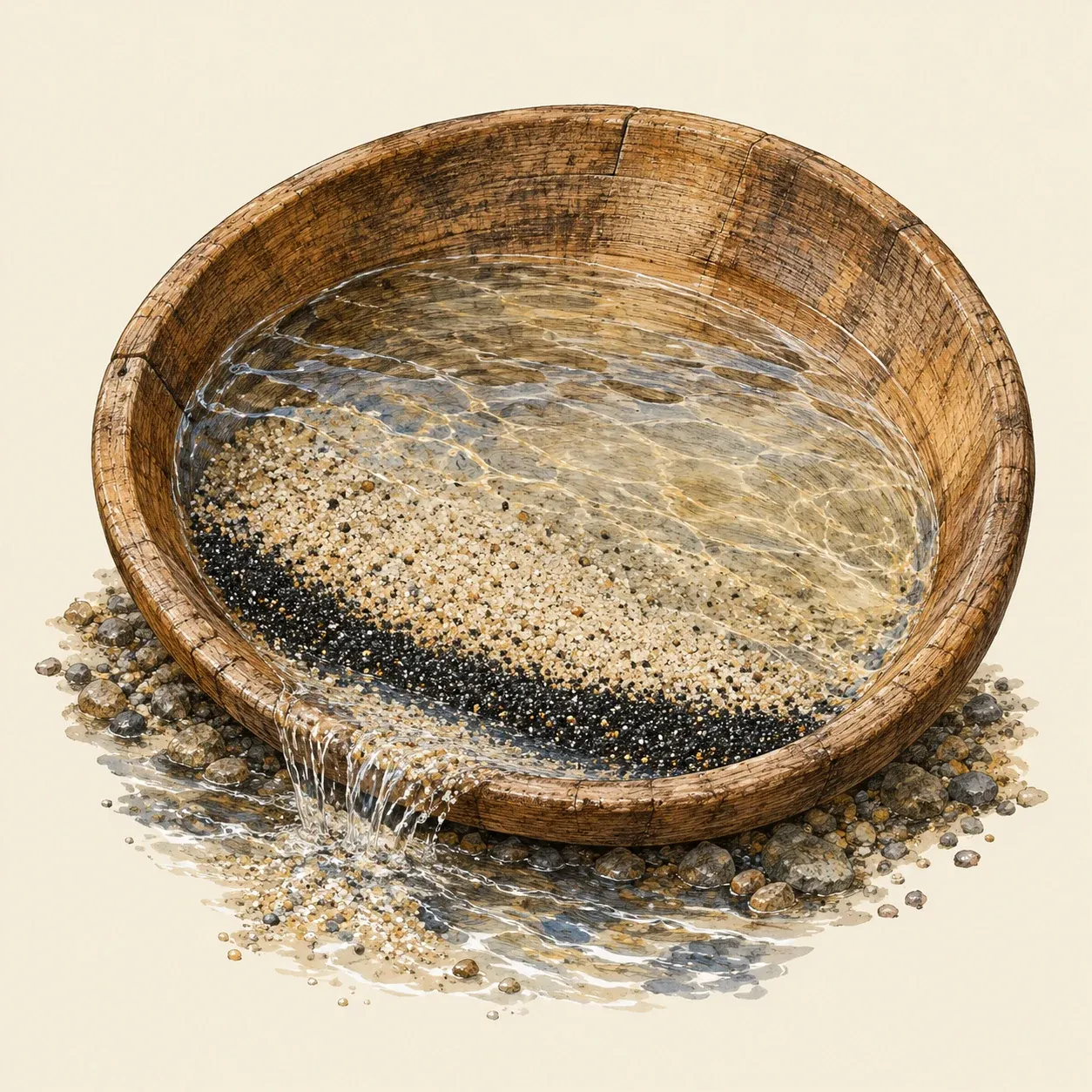 Washing in a pan: the light quartz sand is carried off with the water, the heavy cassiterite stays at the bottom.
The first step is concentration. Crushed ore or tin-bearing gravel is stirred in running water or in a pan. Cassiterite is much denser than quartz, so the water carries off the light grains and leaves the dark ones. Tinners in Cornwall and Devon called the washed concentrate black tin, and the metal white tin.
In the furnace, burning charcoal makes carbon monoxide, which takes the oxygen from the tin oxide. The metal forms as droplets that melt at once and trickle down. Tin melts at a low temperature, but the oxide gives up its oxygen only in a very hot fire: experimental smelts used more than 1,000 °C, and the Dartmoor blowing houses ran at about 1,150 °C.
Tin is easily lost. Part of it combines with the silica and iron of the ore into slag, and part leaves the fire with the gases. In small experiments in north-west Iberia, losses reached 80% of the tin. Smelters therefore crushed the slag to recover the droplets of metal trapped in it and smelted it again.
How to do it
A small crucible smelt shows the whole process. You need a coal or charcoal forge with a blower, a clay-graphite crucible with a lid, tongs and crushed charcoal. Use only cassiterite sold with a chemical analysis showing that it contains no arsenic.
Wash the ore. Put the crushed cassiterite in a shallow pan with water, swirl it and tip the pan slightly so that the water carries away the light grains. Repeat until only dark, heavy grains remain, then dry them completely.
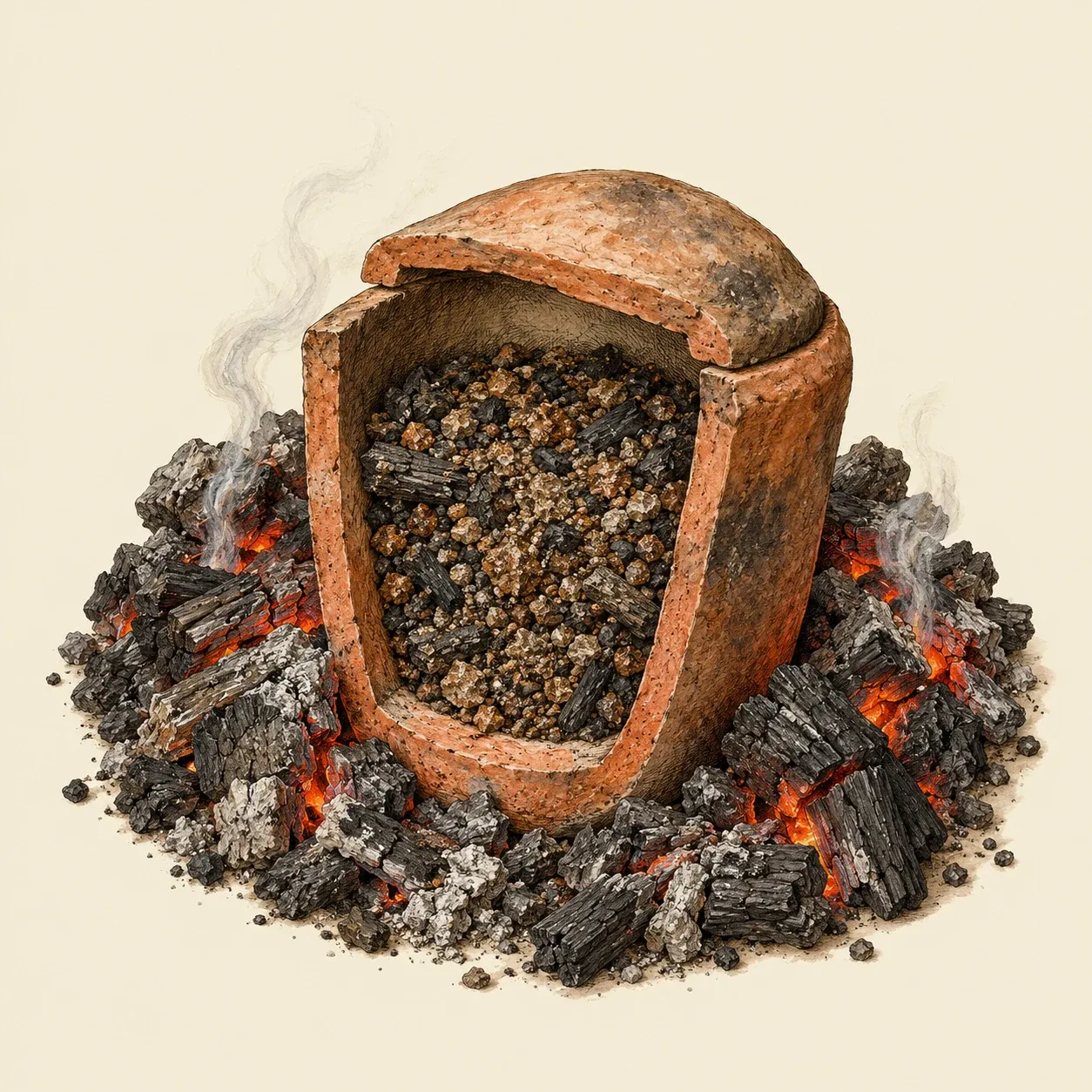 The crucible stays in the charcoal with its lid on, so little air reaches the charge.
Fill the crucible. Mix the dry concentrate with crushed charcoal, fill the crucible, cover it with more charcoal and close the lid. In an experiment at Butser, lidded crucibles set in an open bowl furnace gave no tin because the fire held too much air: keep the crucible buried in charcoal, out of the direct blast.
Heat it. Set the crucible deep in the forge, heap charcoal over it and blow hard enough to keep the fire above 1,000 °C for as long as the reaction takes. Add fuel as it burns down.
Recover the tin. Lift the crucible out with tongs and let it cool on a firebrick. Break the slag and pick out the bright beads of tin. Melted again in a small ladle at a few hundred degrees, they can be cast into a little ingot.
Safety. Keep every tool and mould bone dry: water under molten metal turns to steam and throws metal out. A charcoal fire gives off carbon monoxide; never smelt indoors. Tin ores often contain arsenic minerals, whose fumes are poisonous when heated: never heat ore without an analysis, and never roast it.
History and evolution
The oldest bronzes, such as a foil from Pločnik in Serbia of about 4650 BCE, were probably smelted from ores that held both copper and tin, without any tin metal. Smelting tin on its own came later. At Göltepe, in the central Taurus Mountains of Turkey, excavations in 1990 recovered some 250 fragments of bowl-shaped crucibles of the third millennium BCE with tin-rich residues, which the excavators read as the reduction of cassiterite to tin. Chemical analyses by Bryan Earl and Hadi Özbal, published in 1996, reached the same conclusion. Radiocarbon dates from the nearby Kestel mine begin around 3200 BCE. Other specialists, among them James Muhly, judged the tin in Kestel’s veins too poor and suggested the mine was worked for gold; a 2021 analysis of sediment left inside the mine found cassiterite and only a trace of gold. A piece of a tin ingot wrapped in cloth, from one of the Early Bronze Age royal tombs at Alacahöyük in central Anatolia, is considered by the archaeometallurgists who studied it the oldest tin ingot known.
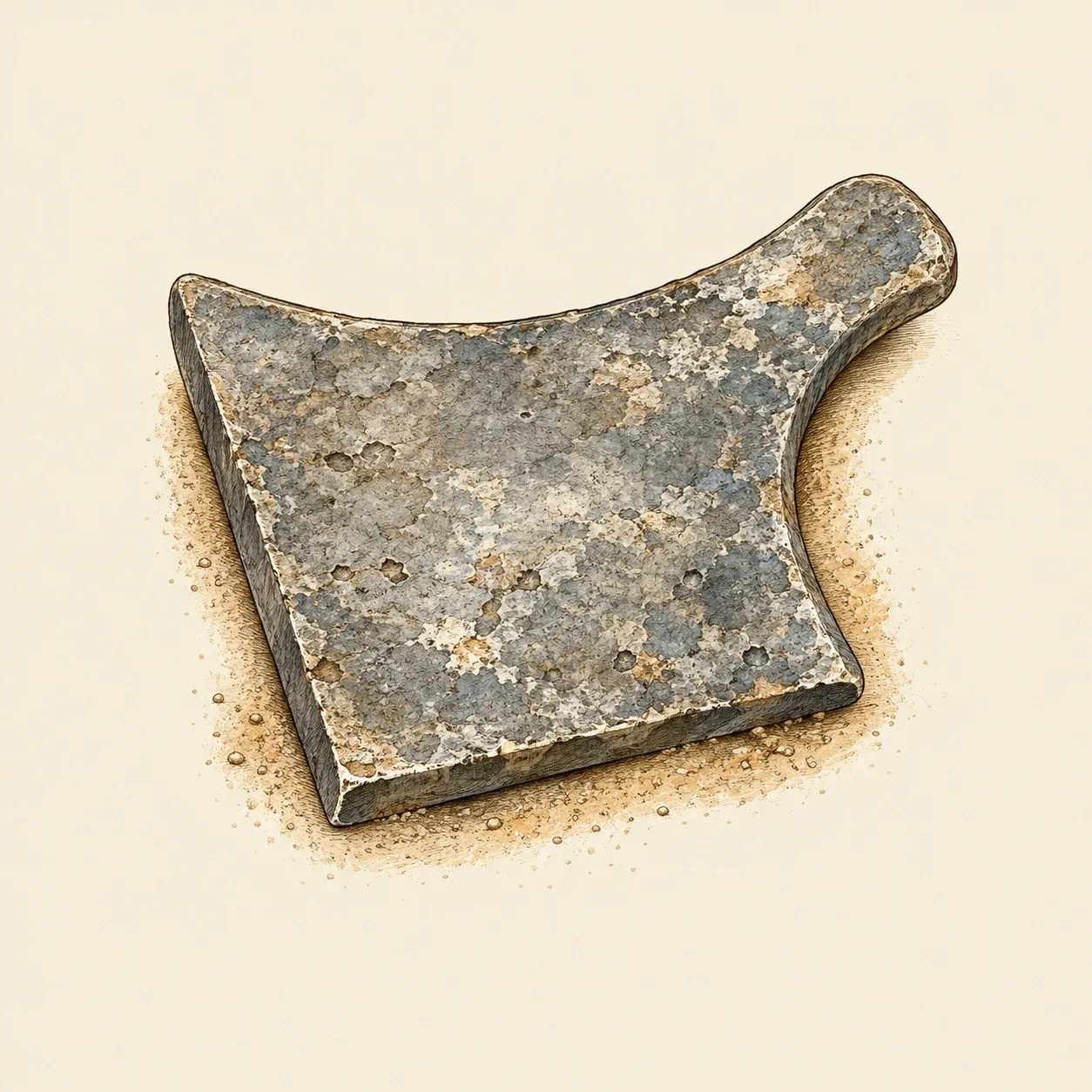 A quarter of an oxhide-shaped tin ingot, as many were cut before loading on the Uluburun ship.
By the Late Bronze Age tin was shipped in bulk. The Uluburun ship, wrecked off southern Turkey around 1300 BCE, carried about a tonne of tin, mostly as four-handled oxhide ingots, nearly all of them cut into quarters or halves before they were loaded. Tin ingots from three wrecks off Israel of about the same date were traced in 2025 to Cornwall and Devon. In the first century BCE the historian Diodorus of Sicily, drawing on older accounts, described the people of Belerion, in Cornwall, digging the ore, smelting and purifying the tin and working it into pieces the size of knucklebones, which they carried at low tide to the island of Ictis.
In the Middle Ages and later, tinners in Cornwall and on Dartmoor smelted in blowing houses, stone buildings where a water wheel drove the bellows. William Pryce described one in 1778: a furnace about six feet high, of granite and clay, filled with layers of black tin and charcoal; two bellows eight feet long blowing in through an iron block near the bottom; and a hole at the foot through which the tin ran into a stone trough, from which it was ladled into moulds. Such a furnace could smelt 8 to 12 hundredweight of tin in twelve hours.
Pryce noted that the purest tin, called grain tin, came from stream ore smelted with charcoal in blowing houses. Coal-fired reverberatory furnaces, in which the fire burns apart from the ore, spread from about 1700, the first in Cornwall at Newham near Truro, and had replaced the blowing houses by the 1850s. The last Cornish tin smelter, at Seleggan near Redruth, closed in 1931.