Pressure coffee maker
Coffee pushed up by steam
Contents
- 1Boiler filled with water
- 2Safety valve
- 3Funnel filter holding the ground coffee
- 4Filter plate and rubber gasket
- 5Central column
- 6Collecting chamber with lid and handle
A pressure coffee maker uses the pressure inside a closed, heated boiler to drive hot water through a bed of ground coffee into a separate chamber. In 1822 Louis Bernard Rabaut received an English patent for a pot in which steam pressure forced boiling water up through the coffee. The aluminium moka pot of the 1930s is its best-known form.
What it is
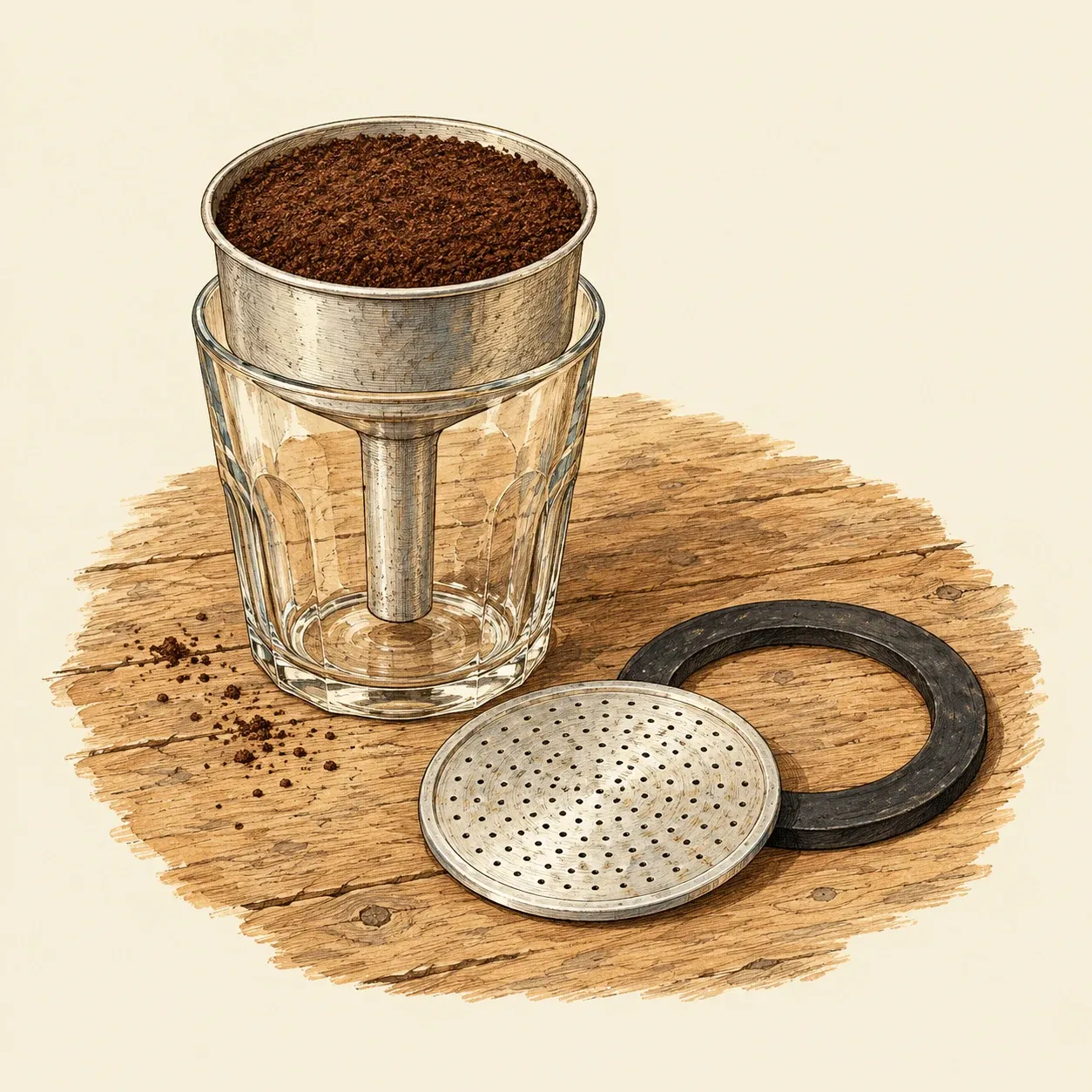 The funnel holds the coffee, and the plate and gasket close it from above.
A pressure coffee maker is a pot in three parts. The lower part is a boiler that holds the water. Above it sits a funnel-shaped basket for the ground coffee, and above that a chamber that collects the finished drink, with a lid, a spout and a handle. The coffee never stands in the water. Water reaches it only when the heated boiler pushes it up through the funnel, and it leaves as coffee at the top. The best-known model is the moka pot, made of cast aluminium and set directly on a stove.
The funnel has a perforated floor and a tube that reaches almost to the bottom of the boiler. A second perforated plate, held in place by a rubber gasket under the upper part, covers the coffee from above, and a hollow column rises from this plate into the collecting chamber. The upper part screws onto the boiler, so that the joint is tight. A small safety valve set in the wall of the boiler lets steam out if the pressure climbs too high, for instance when the coffee is ground too fine or pressed down too hard.
How it works
Heat from below warms the water and the air shut in above it. Both push on the surface of the water: the air because it expands as it warms, the vapour because its pressure rises steeply as the water heats. The only way out of the boiler is the tube of the funnel, which dips into the water, so the water is driven up the tube and into the coffee. Measurements by Luciano Navarini and his colleagues show that the flow begins well below the boiling point and that the trapped air plays a large part in starting it.
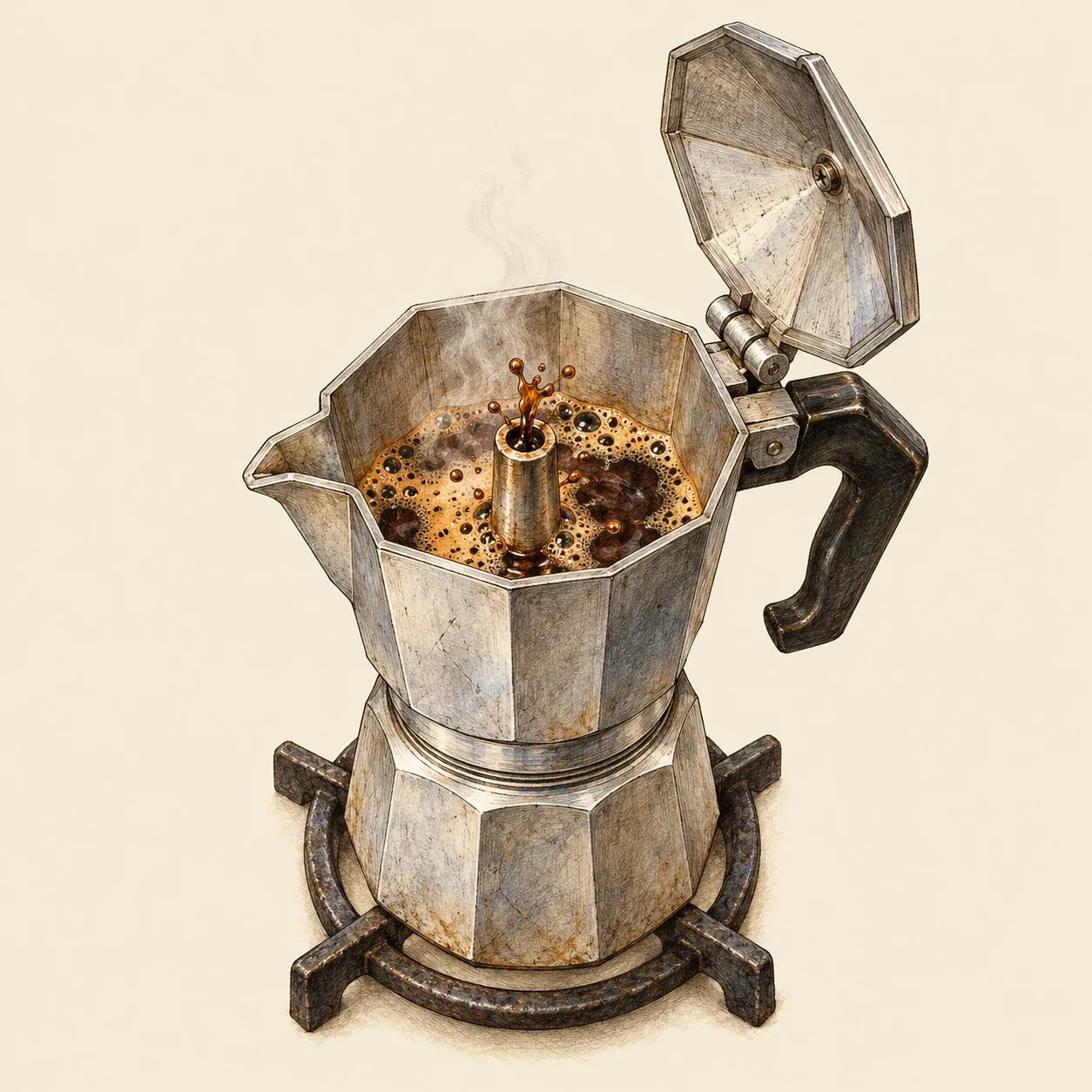 At the end of the brew, steam and water spurt from the column together.
The bed of ground coffee resists the flow, and nothing comes out until the pressure is high enough to force water through it. The hot water then soaks through the grounds, dissolves part of them and rises through the central column into the upper chamber. The finer and the more tightly packed the coffee, the higher the pressure needed. If the coffee or the filter blocks completely, the safety valve releases the steam. A boiler whose valve is blocked, or one improvised from other vessels, can burst. Use only a commercially made pot that meets the applicable safety standard, EN 13248 in Europe, and keep its valve clear.
The end of the brew is noisy. When the water level in the boiler falls to the bottom of the funnel tube, the steam finds a direct way out through the coffee, and the remaining water boils off fast with a sputtering sound. Navarini’s team calls this the strombolian phase, for its bursts like those of a small volcano. Very hot steam and water passing through the grounds at that stage carry out compounds that spoil the taste of the coffee.
History and evolution
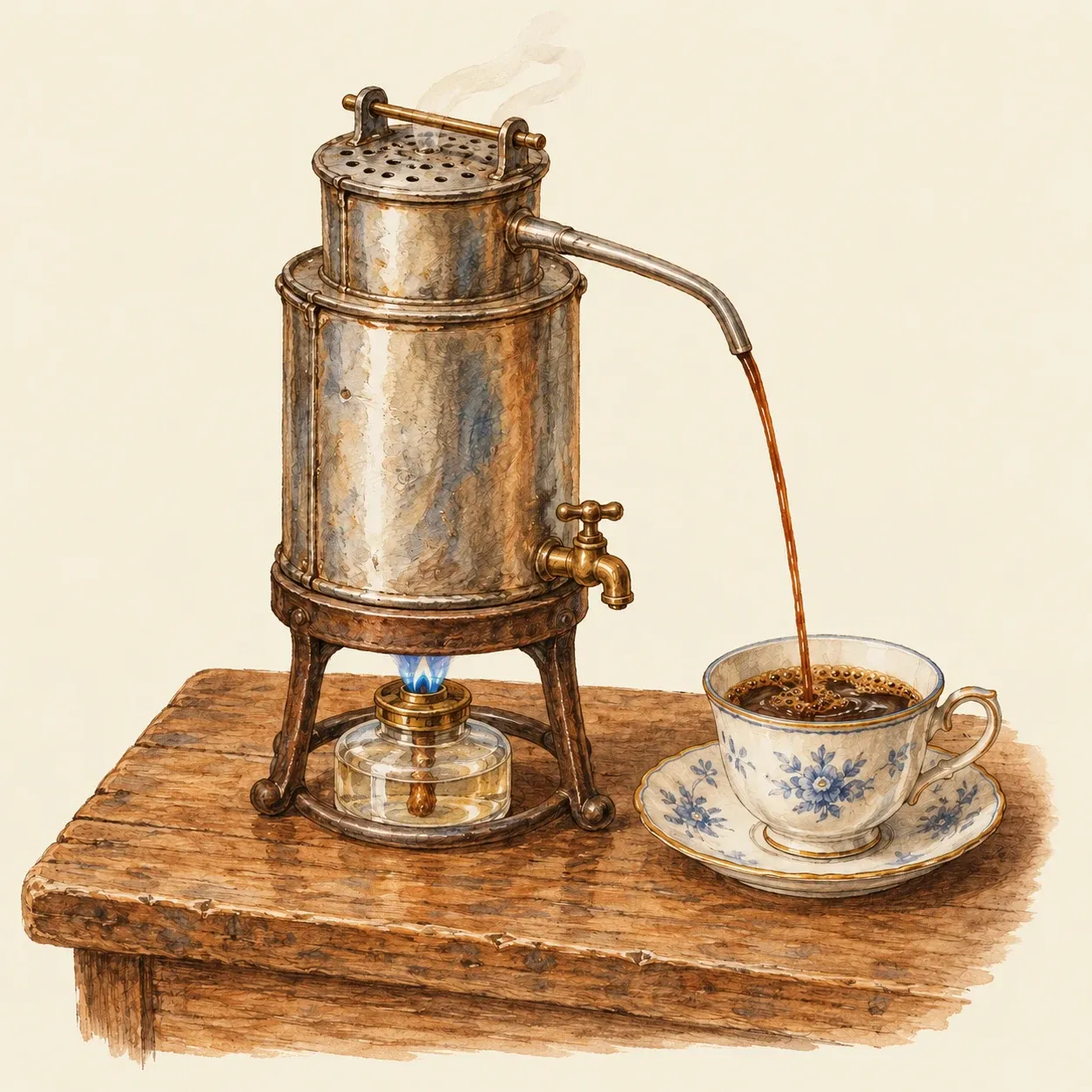 A small steam press for coffee of the 1820s, heated by a spirit lamp.
In 1821 the Polytechnisches Journal described the steam presses of Elard Römershausen of Aken on the Elbe, who held a Prussian patent for his extraction apparatus. In the large presses, steam from a closed copper vessel forced hot water upward through the material to be extracted, for dyers, tanners and brewers. The journal also mentioned small steam presses for coffee heated by a spirit lamp, and in the domestic model it described, the steam itself passed through the coffee. The writer warned that a closed boiler could burst. An article of 1847 in the same journal states that Römershausen first used steam pressure at the time of his 1818 patent for an air press, and complains of the many complicated imitations, some of them useless, that his coffee presses had inspired.
In 1822 Louis Bernard Rabaut received an English patent for an apparatus in which steam pressure forced boiling water up through the coffee, and in 1824 a Paris tinsmith named Casseneuve patented much the same idea in France. Through the nineteenth century these pressure pots were made alongside percolators, which poured boiling water over the grounds again and again, and vacuum pots, which drew the coffee down from an upper globe.
In Italy, the firm of Alfonso Bialetti at Crusinallo in Piedmont, an aluminium foundry, began to make the Moka Express, which the Museum of Modern Art in New York and the Treccani encyclopedia date to 1933. It is cast in aluminium, with eight flat sides, a funnel filter, a rubber gasket and a Bakelite handle, and it goes on the stove like a saucepan. It is still made in much the same form, and Navarini and his colleagues describe the moka pot as the most common way of making coffee at home in Italy. Like every other coffee maker, it needs beans that have already been through coffee processing: dried, roasted and ground.