Coffee processing and roasting
From red cherry to roasted bean
Contents
- 1Skin and pulp of the coffee cherry
- 2Mucilage, the sticky layer under the pulp
- 3Parchment around each seed
- 4Green bean with its silverskin
- 5Sheet-iron roasting cylinder turned by hand
- 6Charcoal embers in the brazier
Coffee processing turns the ripe fruit of the coffee shrub into a dry green bean, and roasting turns that bean brown, brittle and fragrant. The fruit is either dried whole or stripped of its pulp and sticky coating before drying, then hulled. Written accounts place the first coffee drinking among Sufis in Yemen in the fifteenth century.
What it is
The coffee shrub bears small fleshy fruits called cherries, red or yellow when ripe. Each usually holds two seeds lying flat face against flat face; about one cherry in twenty holds a single rounder seed, the peaberry. These seeds are the coffee beans. Around them lie several layers: a thin skin, a soft pulp, a slippery coat of mucilage, a papery husk called the parchment and, pressed against the seed, a very fine silverskin. Fresh from the tree, the fruit is about two thirds water.
Processing strips these layers away and dries the seed until it keeps. The result, called green coffee, is hard and pale and can be stored and shipped for months. Roasting comes last: it needs only fire and a vessel that keeps the beans moving, such as the hand-turned cylinder of sheet iron used in European homes from the seventeenth to the nineteenth century.
How it works
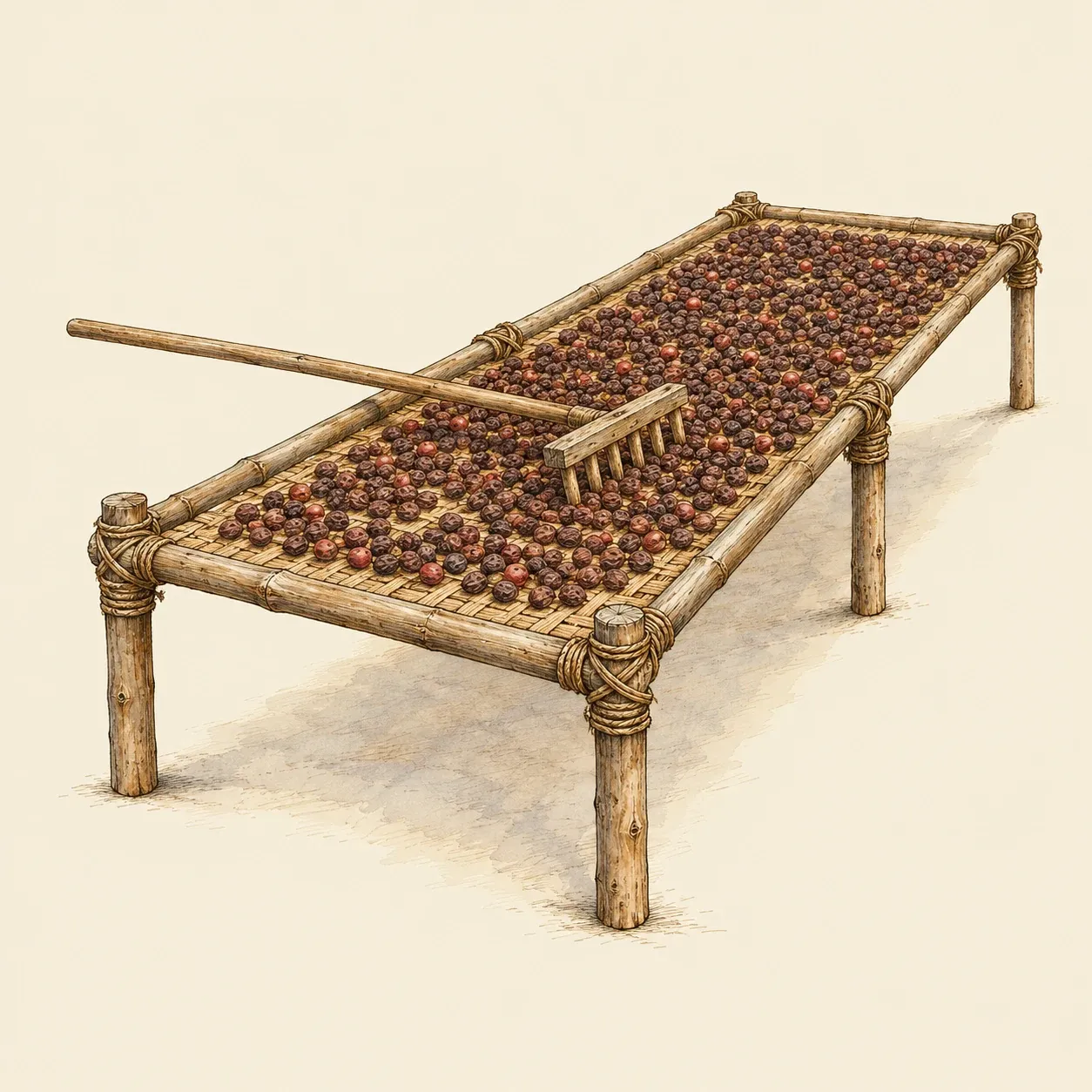 In the dry method, whole cherries dry in the sun and are turned several times a day.
The dry or natural method is the oldest. Whole cherries are spread thinly in the sun on a patio or a raised mat and raked several times a day so that every side dries. Depending on the weather, this takes from several days to about four weeks. Cherries left in heaps heat up and ferment, and mould can spoil them. Once the fruit has shrivelled into a hard husk, it is broken off the beans by pounding or in a hulling machine.
The wet method needs water and machinery. A pulper squeezes fresh cherries between a turning drum or disc and a slotted plate, so that the beans slip out of the skin and pulp. The mucilage still clings to the parchment. Left in tanks, it is broken down by microbes and the fruit’s own enzymes in roughly 12 hours to 3 days, then washed off. The beans dry in their parchment, which a huller removes afterwards. Other variants dry the pulped beans with their mucilage still on, or scrub it off by machine instead of fermenting it.
Either way, the bean is dried to about 12% moisture. Below about 12.5%, coffee is safe from the moulds that can produce the toxin ochratoxin A, which is why damp or re-wetted coffee is a risk. Beans dried much further turn brittle and break in the huller.
Green beans still hold about a tenth of their weight in water. In the roaster they first lose most of it, then turn yellow and brown as sugars and amino acids react together. From about 150 °C they give off steam, carbon dioxide and carbon monoxide and begin to swell, and somewhere between 180 and 200 °C they crack audibly. A roast lasts 7 to 20 minutes, with the heat raised from about 180 to 250 °C depending on the machine and on how dark the coffee should be. The beans lose 14 to 23% of their weight and their volume grows by a third or more, up to double.
A turning drum keeps every bean tumbling, so that none rests against the hot metal while others stay pale. At the end the beans must be cooled quickly with a stream of air or a spray of water; otherwise they keep darkening and lose aroma.
How to do it
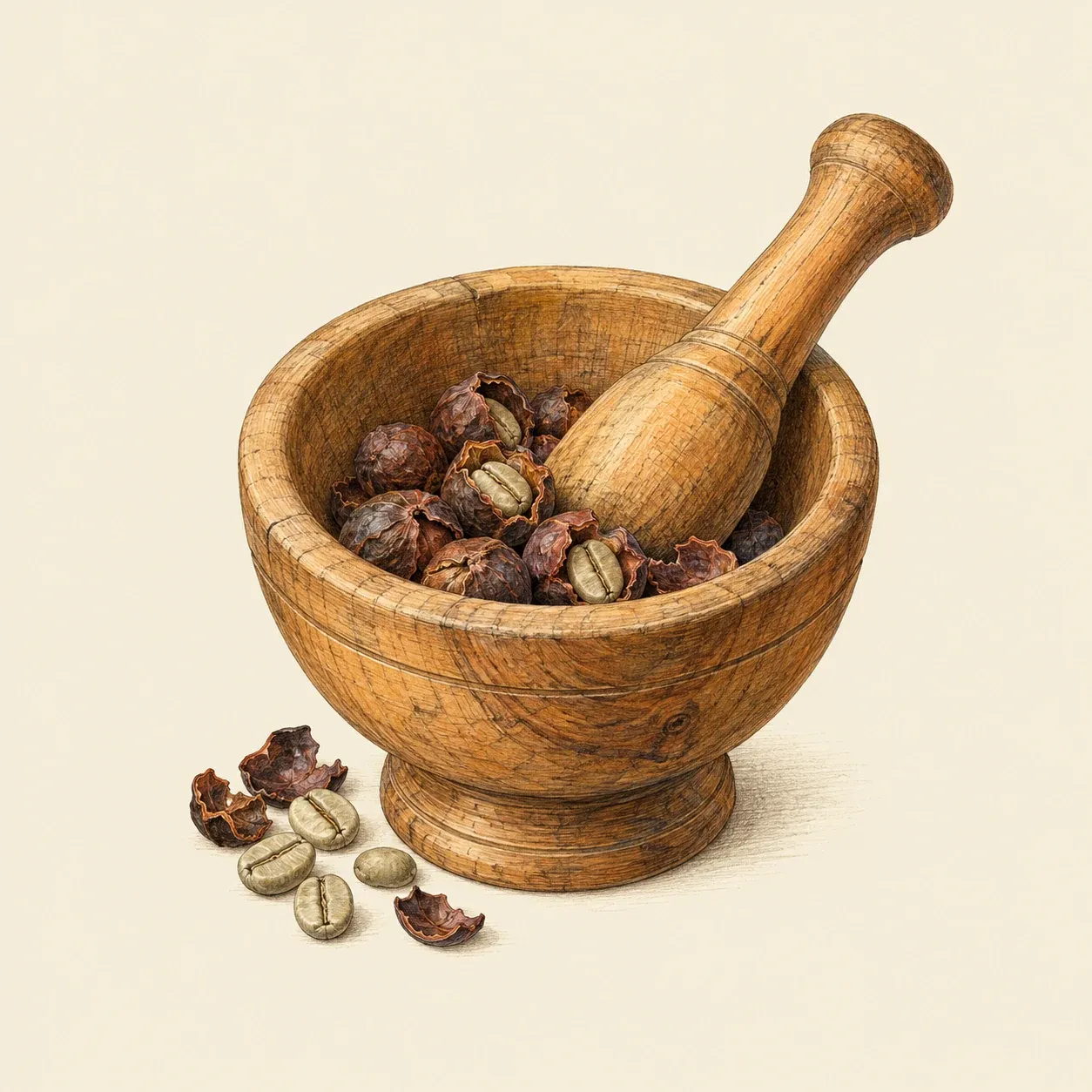 Light pounding in a wooden mortar cracks the dry husks.
If you can get fresh ripe cherries, a handful is enough to see the dry method. Spread them in a single layer on a fine mesh raised off the ground, in sun and moving air, and turn them several times a day. Cover them at night and whenever rain threatens, and throw out any that grow mould. After about three weeks the husks are hard and dark. Pound them lightly in a wooden mortar to crack the husks, then pour the mixture from one bowl to another in a breeze so that the husk fragments blow away.
Roasting is easier to try with green coffee bought from a supplier. Put a small batch, no more than a thin layer, in a hand-turned roasting cylinder over a gas ring, or in a heavy dry frying pan stirred with a wooden spoon, over medium heat. Keep the beans moving all the time. They turn yellow, then light brown, and after a few minutes more they start to crack. Stop when they reach the colour you want; darker roasts take longer.
Tip the beans at once into a metal colander and toss them in the open air, or in front of a fan, until they are cool enough to hold. Do this outdoors, as the silverskin flakes off as light chaff. Freshly roasted coffee keeps releasing gas for some time, so leave it to rest in a ventilated place before closing the jar.
Safety. Roasting gives off smoke and carbon monoxide, a poisonous gas with no smell, and freshly roasted beans go on releasing it: roast outdoors or under a strong extractor hood, and never store a large quantity of roasted coffee in a small closed room. Never leave beans over the heat, since they can scorch and catch fire.
History and evolution
The coffee shrub grows wild in the highlands of Ethiopia, but nobody knows when people first used it. The story of Kaldi, a goatherd whose animals grew lively after eating the berries, is a legend. The oldest written accounts point to Yemen. In the sixteenth century, ʿAbd al-Qadir al-Jaziri recorded that al-Dhabhani, a jurist of Aden who died in 1470, had come to know coffee in Africa and brought it to the Sufis, who drank it to stay awake during night prayers. In another passage he credits al-Shadhili, a Sufi master who died in 1418, with making it popular at Mocha. Encyclopaedia Iranica dates the arrival of coffee in Yemen to the fourteenth or fifteenth century, while Michel Tuchscherer argues that Yemen was producing coffee beans by the thirteenth century at the latest.
Early Yemeni drinks were brewed from the beans or from the dried husks, which are still infused in Yemen today as qishr. A husk drink reached Mecca towards the end of the fifteenth century, and Istanbul had its first coffeehouse in 1554. Until the end of the seventeenth century, nearly all the world’s coffee came from Yemen, where the cherries were dried whole. Cultivation then spread to Java and, in the eighteenth century, to the Americas.
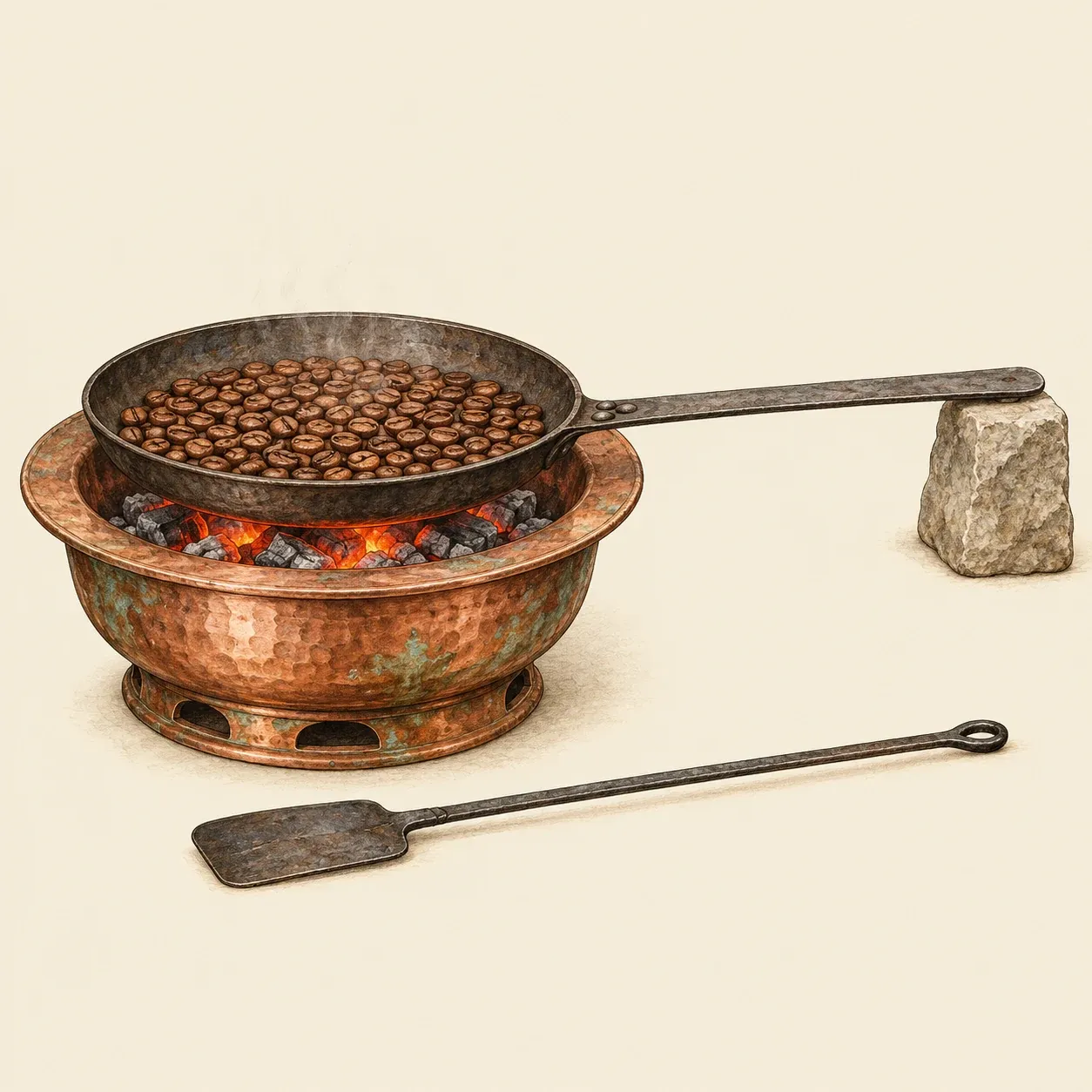 Before closed drums, beans were roasted in open pans and stirred by hand.
Seventeenth-century travellers described the roasting. In Turkey, Jean de Thévenot described beans roasted in a pan over the fire and pounded into a fine powder. In Persia, Engelbert Kaempfer watched a coffeehouse roast them in a flat vessel over charcoal, stirred until they were brownish black. In Europe, closed cylinders turned over the fire appeared around the middle of the century. A Dutch type, a sheet-iron drum on a long rod with a wooden handle, was used at the hearth from about 1670 into the nineteenth century. The Henry Ford museum in Michigan keeps a sheet-iron roaster of this kind, made between 1800 and 1850.
The wet method came later, on plantations with plenty of water; trade books of the early twentieth century call it the West Indian process. From the late eighteenth century, engineers in Britain and the United States patented pulpers, hullers and driers, and roasting moved into factories with large rotating drums heated by coal and later by gas. Many modern roasters blow hot air through the turning drum, and small-batch roasters have brought older types of drum back into use.