Coffee pulper
A rasping roller that strips the skin and pulp from fresh coffee cherries
Contents
- 1Hopper
- 2Roller covered with copper pierced as a rasp
- 3Upper chop, set with wedges, which bursts the cherries
- 4Lower chop, close to the rasp, which holds back the beans and lets the skins through
- 5Sloping shaken sieve where the beans fall
- 6Cranks on the axle
A coffee pulper strips the red skin and sweet pulp from freshly picked coffee cherries without harming the two beans inside. A turning roller with a rough copper surface drags each cherry against a fixed plate set just wider than a bean: the cherry bursts, the slippery beans are held back and the skin is carried through. A letter of 1765 from the lieutenant governor of Dominica, printed in London in 1774, already describes West Indian coffee passed through a mill before soaking, and Laborie published the oldest detailed description of such a mill in London in 1798.
What it is
A coffee cherry holds two beans, each wrapped in a thin parchment and coated with a slippery layer of mucilage, under a red skin and a soft, sweet pulp. In the wet method of coffee processing, that skin and pulp are removed while the fruit is still fresh, the beans are washed and then dried in their parchment. Removing the pulp by hand from thousands of cherries is slow, and a pulper does it by machine.
Every pulper has the same core: a turning surface that grips and drags the cherries, and a fixed edge set close to it. The cherry is squeezed in the narrowing gap until it bursts. The beans, smooth and hard, slip out and are held back; the skin and pulp, soft and torn, are carried on by the moving surface and leave by another way. A stream of water helps the cherries along and washes the pulp from the working parts.
The mill Laborie described in 1798 was a wooden roller covered with rough copper and turned by hand cranks. Later pulpers use a drum or vertical discs covered with knobbed copper or steel, worked by hand on small farms and by engines on large estates.
How it works
In the mill described by Laborie, cherries fall from a hopper onto a wooden roller. Its middle is covered with a sheet of copper pierced like a grater, each hole raising small sharp points on the outside. Two wooden blocks, the chops, are set in front of the roller, one above the other, each edged with a band of steel and moved closer or further with wedges.
The upper chop stands just far enough from the copper for a cherry to be crushed without harm to the parchment. The burst cherry’s beans pass between the points of the grater and meet the lower chop, set so close to the roller that they cannot pass. They slide down its sloping face onto a wire sieve. The flattened skin, caught on the sharp points, is drawn through between the roller and the lower chop and drops behind the mill. Pegs at the ends of the roller knock a hanging frame as it turns and keep the sieve shaking, so the beans fall through into a gutter leading to the soaking basin, while cherries that escaped crushing roll off the end to be fed in again.
Everything depends on the gaps. Laborie warns that if the upper chop is too close, the beans are bruised and turn black; too far, and cherries pass through whole. If a stone flattens some of the points, the cherries they should catch go out with the skins and are lost. A thread of water trickles onto the grater all the time to help the coffee through.
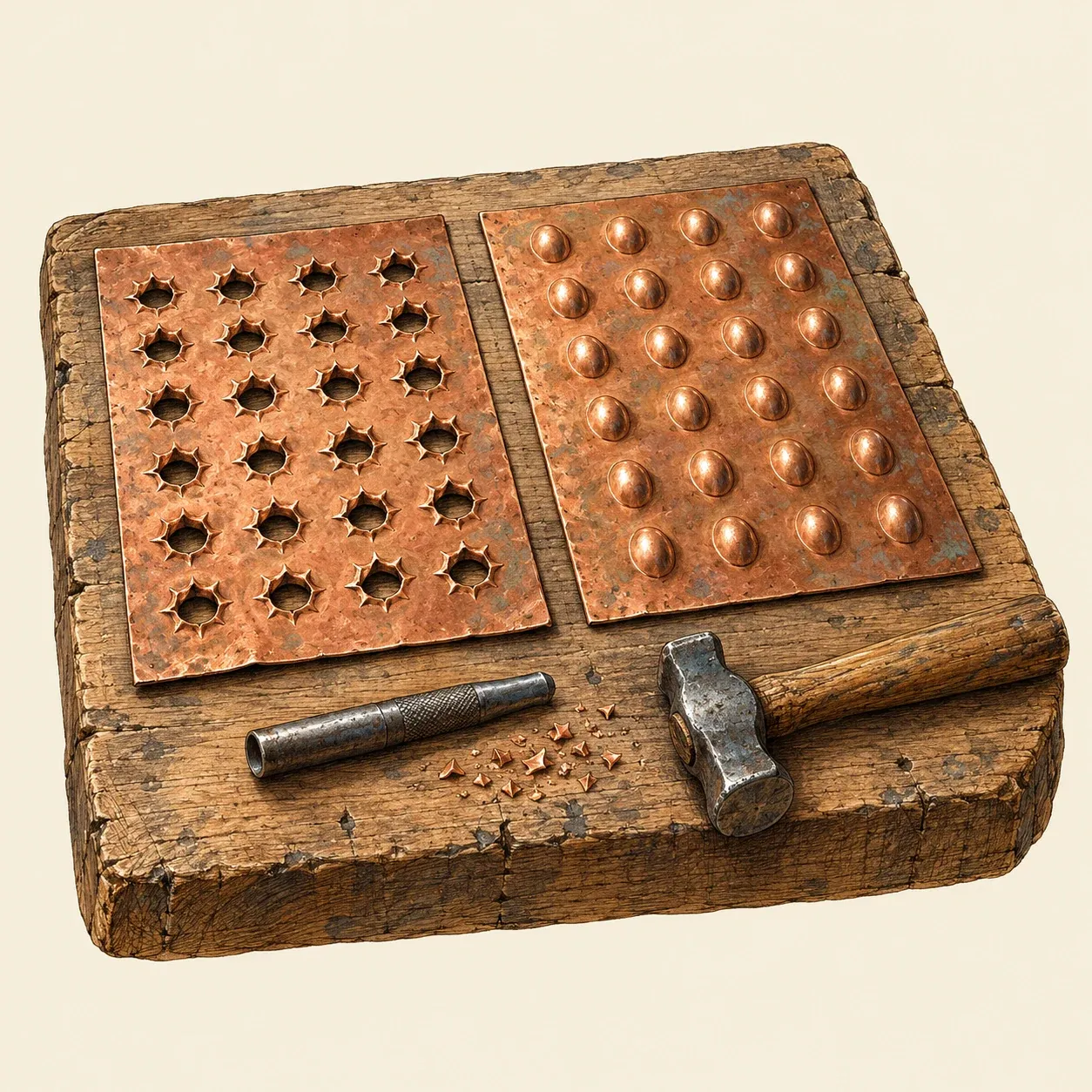 A pierced copper grater, as in Laborie’s mill, and the blind-punched knobs of later pulpers.
Later machines kept the principle and changed the surfaces. Sharp grater points could bruise the parchment, as Laborie had noted. By the mid-nineteenth century makers punched the copper so that it rose in half-moons or, with a blind punch, in rows of rounded knobs without holes or sharp edges. In a drum pulper, the knobbed drum turns against a breast, a plate with sloping ribs whose distance from the drum is adjusted to the size of the cherries; the pulp is carried round by the drum while the beans pass out through the breast. Disc pulpers do the same with vertical discs covered with knobbed copper turning between adjustable side bars. Sieves or rotating screens sort out the cherries that were not pulped and send them through again.
How to do it
A real pulper has a rasping roller turning against steel edges, which can trap fingers. The heart of the machine, a gap set to burst the fruit without crushing the seed, can be tried with sweet cherries and two strips of wood.
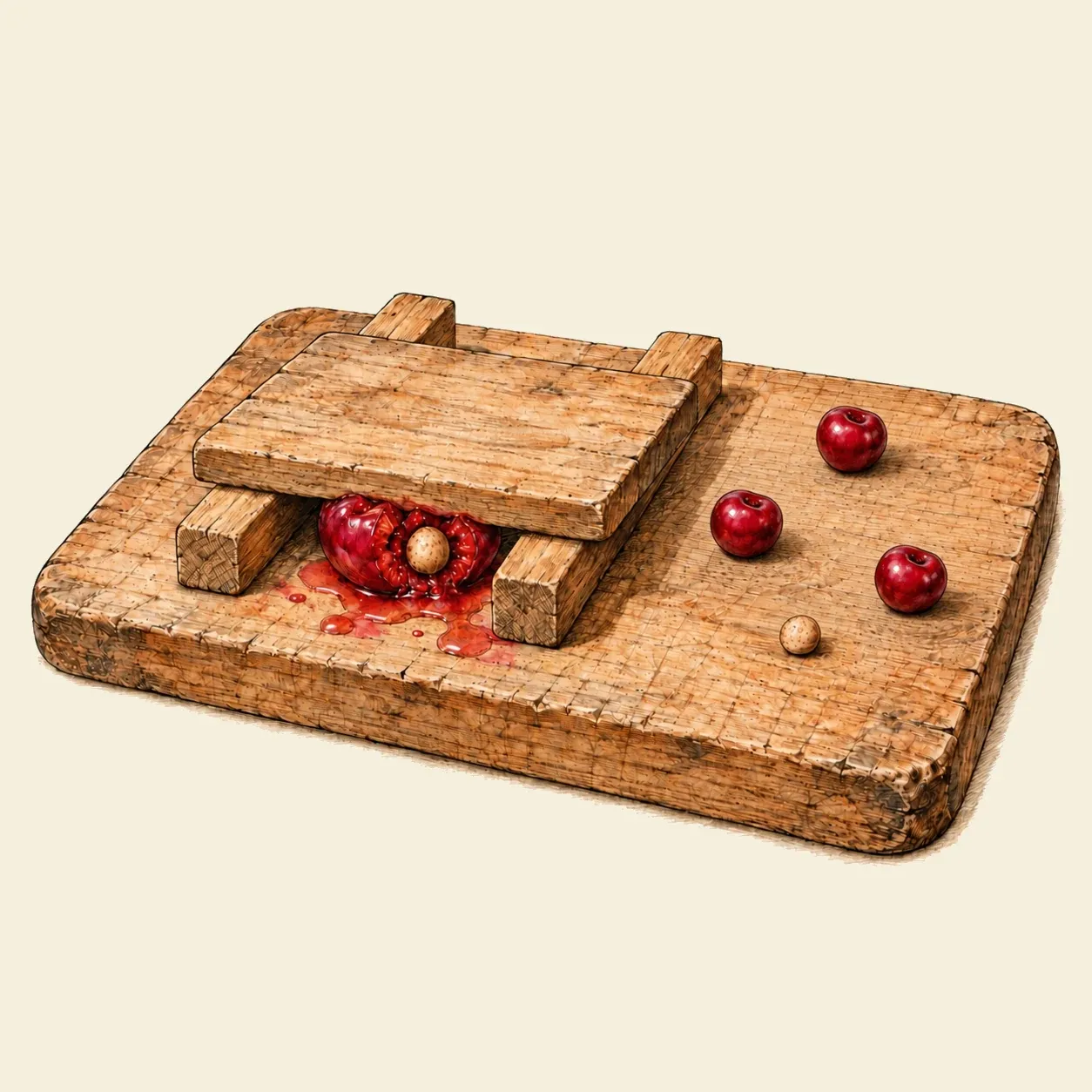 With spacers set a little thicker than the stone, the cherry bursts and the stone comes out whole.
Wash a few sweet cherries and pull off their stalks. Lay two strips of wood, a little thicker than a cherry stone, on a chopping board, a few centimetres apart. Put a cherry between them, lay a small flat board across the strips and press down firmly with the flat of your hand. The cherry bursts and the stone slips out of the flesh whole, because the gap is wider than the stone. Now replace the strips with thinner ones, thinner than the stone, and try again: the stone is caught and pressed, and the flesh tears around it. That is Laborie’s warning about a chop set too close. With strips much thicker than the cherry, nothing happens at all, like a chop set too far.
History and evolution
Coffee was first dried whole, in the cherry, and the dried husk was broken off later. A letter written in 1765 by George Scott, lieutenant governor of Dominica, and printed in London by John Ellis in 1774, gives the method then used through the West Indies: the ripe coffee is passed through a mill as soon as it is gathered, left under water in cisterns until the pulp comes loose, washed and dried in the sun, then pounded in troughs to beat off the parchment.
Laborie writes that drying in the cherry was the original method and that many planters still used it, while others had adopted the wet method of the Borgne district, which needed water, mills and basins but gave a finer coffee.
His book, The Coffee Planter of Saint Domingo, published in London in 1798, gives the oldest detailed description of a pulping machine, with engraved plates. Laborie had been a planter in the French colony of Saint-Domingue, today Haiti, and wrote his manual for plantations worked by enslaved people. He calls the machine a grater mill, from the Creole French grager, to grate. Its frame and chops were of mahogany, its roller turned by two cranks. Enslaved workers served each mill in the evening after field work, taking turns at the cranks while others fed the hopper, carried away the skins and brought back the unpulped cherries. Laborie also mentions larger mills turned by mules or water.
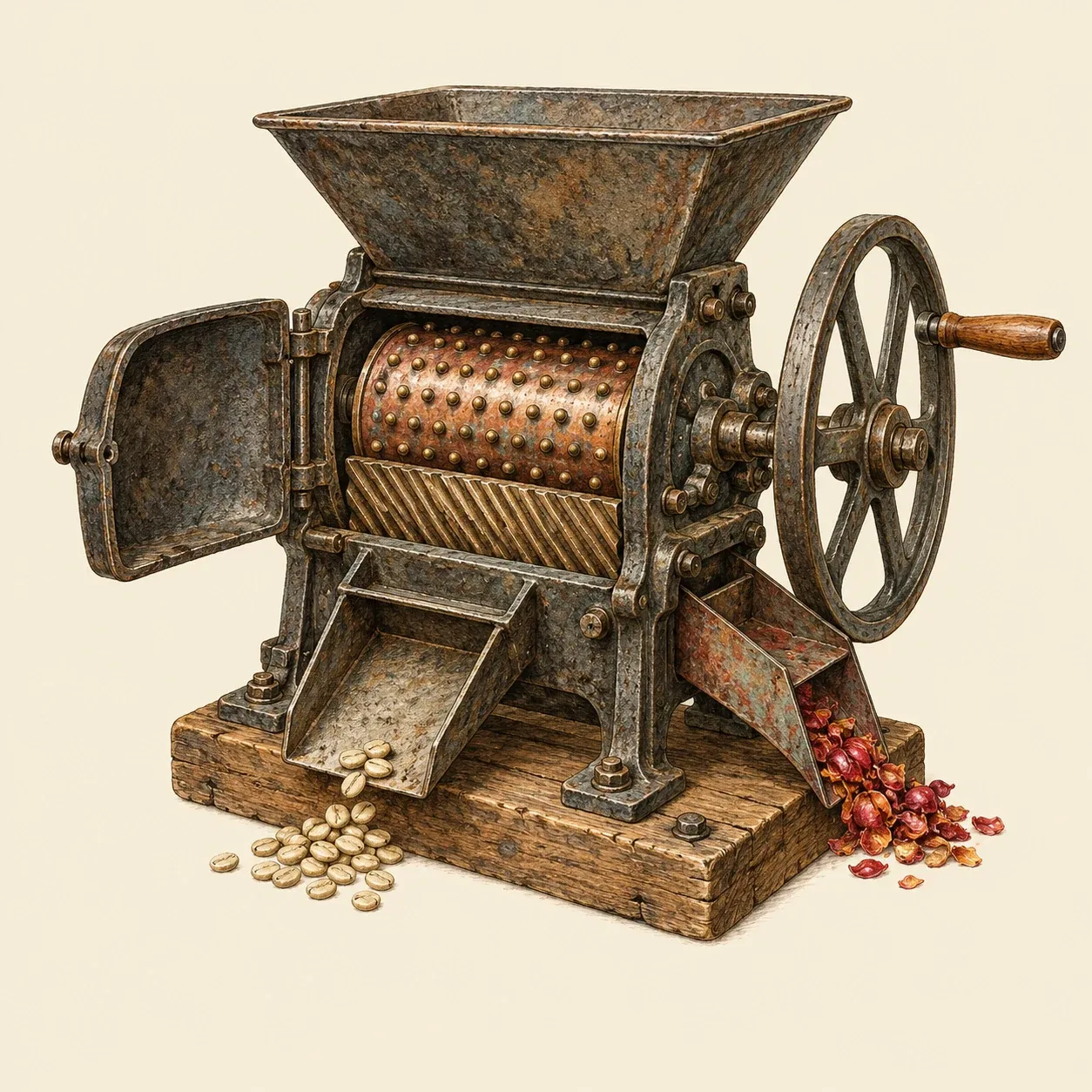 Nineteenth-century cylinder pulpers replaced the wooden roller with a knobbed copper drum in a cast-iron frame.
In the nineteenth century the pulper became an industrial product, made in Britain and the United States for estates in Jamaica, Ceylon, India and Central America. James Meacock of Kingston, Jamaica, patented in England in 1845 a machine for pulping, cleaning and sorting coffee. Around 1850 John Walker introduced in Ceylon a cylinder pulper covered with copper punched into raised half-moons, and in 1860 he patented a disc pulper whose copper was raised into oval knobs that left no sharp edges. John Gordon in London, Robert Bowman Tennent with a two-cylinder machine and Marcus Mason in Costa Rica followed with their own designs. Drum and disc pulpers built on these lines, adjusted to each variety of coffee, remain the common machines of wet processing.