Continuous track
A road that the vehicle lays down and picks up again
Contents
- 1Drive sprocket
- 2Front idler
- 3Track rollers
- 4Track frame
- 5Track shoe
A continuous track is an endless belt of hinged plates that runs around a vehicle's wheels, so that the vehicle lays down its own road in front and picks it up behind. Spreading the weight over a long strip of ground keeps heavy machines from sinking into mud, peat or snow. Richard Lovell Edgeworth patented in 1770 a carriage that laid down its own road of wooden planks, and John Barry in 1821 and George Cayley in 1825 patented endless railways. Steam log haulers in Maine put it to work in the early 1900s, and tractors, bulldozers and earth movers have used it ever since.
What it is
A continuous track, also called a crawler or caterpillar track, is a closed loop of hinged plates wrapped around a set of wheels on each side of a vehicle. The wheels never touch the ground. They roll along the lower part of the loop, which lies flat under them like a short stretch of railway, while the vehicle moves forward. At the front the loop lays a new plate on the ground and at the back it lifts the last one off and carries it forward over the top.
Tracks are used where wheels would sink or slip: on soft fields, snow, mud and building sites. Crawler tractors, bulldozers, earth movers and snow vehicles run on them, and so did the first military tanks.
How it works
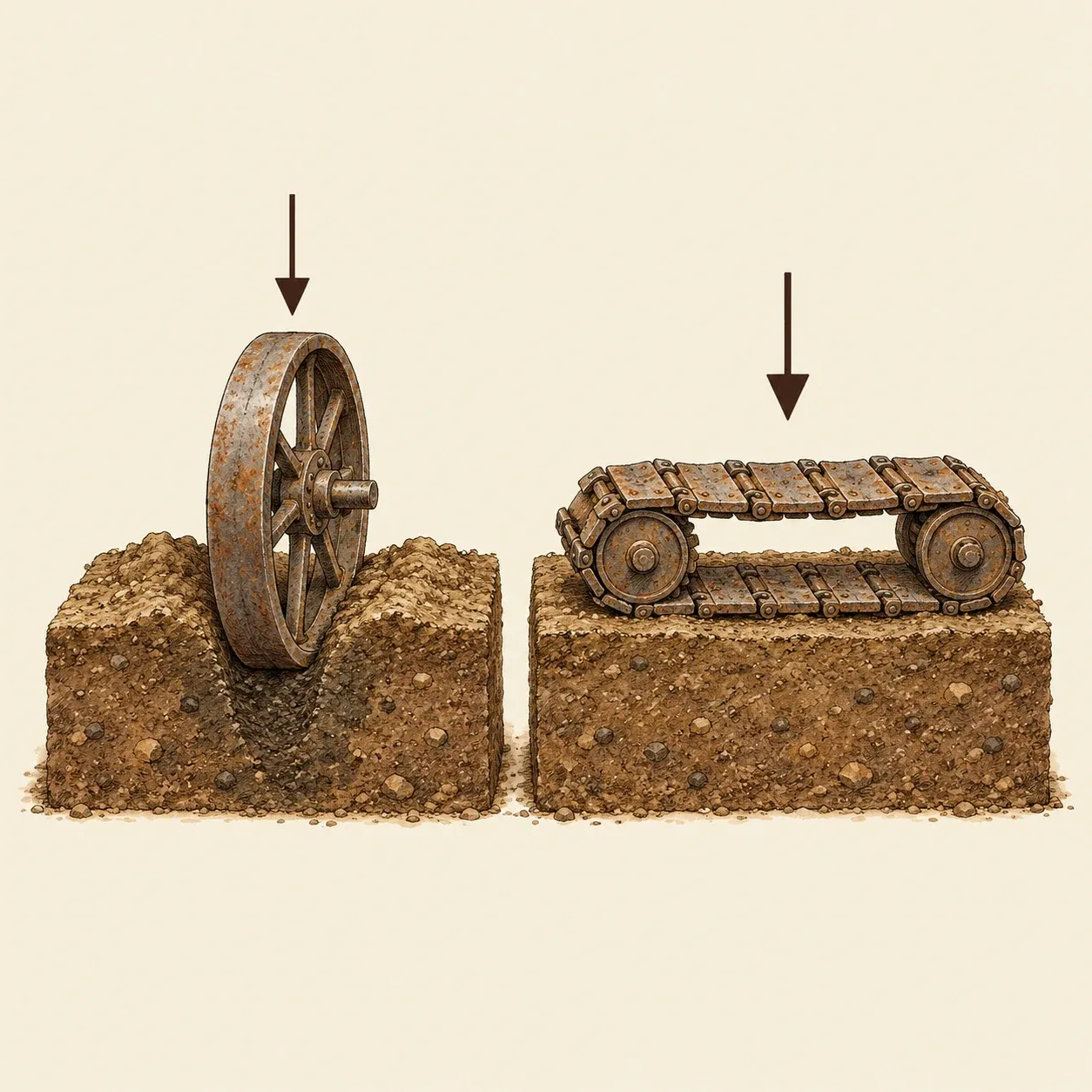 Under the same load, a wheel sinks where a track spreads the weight.
A wheel carries its whole load on a small patch of ground. On soft soil the patch sinks, the wheel digs a rut and then turns without moving. A track carries the same load on a strip as long as the distance between its end wheels, so each part of the ground bears much less weight. Benjamin Holt designed his track after finding that wheels were ineffective on the soft ground of California farms. The weight of the machine also holds the track plates firmly on the ground, so that the wheels always roll on a firm path.
On a modern crawler, each track runs around a frame that carries a toothed drive sprocket at one end, a plain idler wheel at the other and a row of track rollers underneath. The sprocket is a gear whose teeth fit between the hinges of the plates and pull the track around. The rollers carry the weight of the machine down onto the lower run of the track. The idler at the other end turns the track back on itself.
A tracked vehicle has no front wheels to turn. It changes direction by making one track run slower than the other. On older crawler tractors the driver pulls a lever that releases the clutch of one track, which then slows or stops, and can also brake it while the other track keeps driving. The vehicle pivots towards the slow side. This skid steering is simple, but the tracks scrape the ground as they turn, which wears the tracks, the sprockets and the ground.
How to do it
A cardboard model shows how a track lays down its own road in front and picks it up behind. You need a small cardboard box, two cardboard tubes as wide as the box, two wooden dowels longer than the box is wide, stiff card, glue, one long and wide rubber band, a folded towel, a pencil and a craft knife.
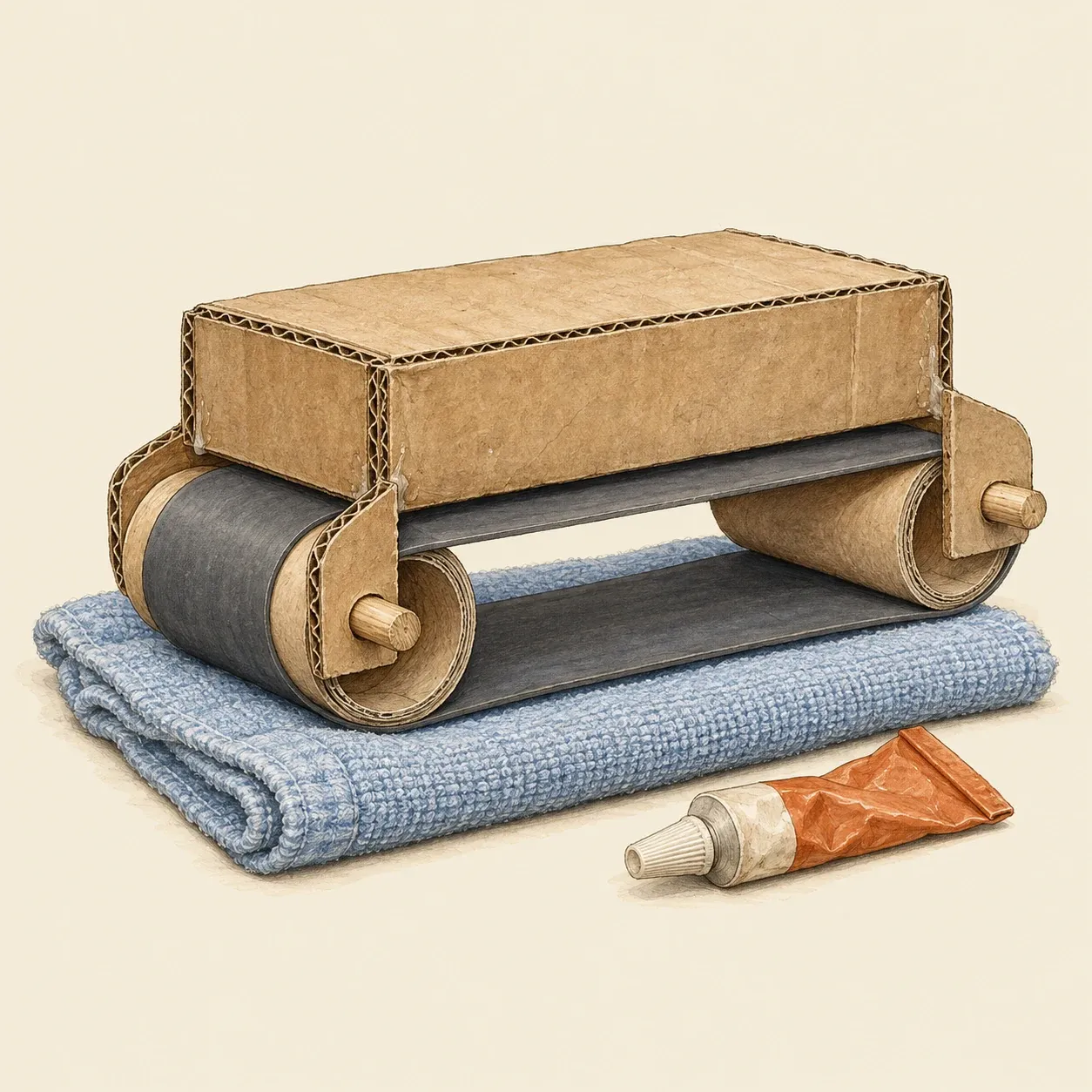 A rubber band around two tubes makes a track that lays itself down on the towel.
Cut two strips of stiff card as long as the box and glue one to each side of it, so that they hang below its base by a little more than the width of a tube. Near each end of the strips, below the box, pierce matching holes with the pencil and widen them until the dowels turn freely. Slide each dowel through one strip, through a tube and out through the other strip, so that the two tubes sit under the box, one at each end. Stretch the rubber band around both tubes so that it is tight. Set the model on the folded towel and push it gently. The band lays itself down on the towel in front, the tubes roll along it, and behind the box the band lifts off the towel and travels forward again over the top.
History and evolution
Ideas for vehicles that carry their own road go back to the 18th century. In 1770 Richard Lovell Edgeworth patented an ‘endless railway’. The engineer John Fowler, surveying the old patents in 1856, describes it as planks of wood set round the rims of cart wheels, so that each wheel laid one plank down in front while lifting another behind, and the Encyclopaedia Britannica of 1922 saw in it the principle of all later track-driven machines. In his memoirs, quoted by Grace’s Guide, Edgeworth says that the idea grew out of a machine with eight legs that took turns standing on the ground, and that over forty years he built more than a hundred models without reaching the result he wanted. In 1821 John Richard Barry patented ‘endless railways’: a heavy carriage rolled on wheels and axles held in two endless chains, one on each side, which carried the wheels round over pulleys, setting them down in front and taking them up behind. In 1825 the English engineer George Cayley patented a ‘universal railway’, which he also called a ‘revolving railway’, meant to carry a vehicle over bad roads, holes and trenches. Fowler judged it nearly the same in principle as Barry’s. Cayley published a description of it in the Mechanics’ Magazine in 1826. In 1859 Warren P. Miller of California patented an endless chain running over driving wheels, for ploughing soft and sandy soil.
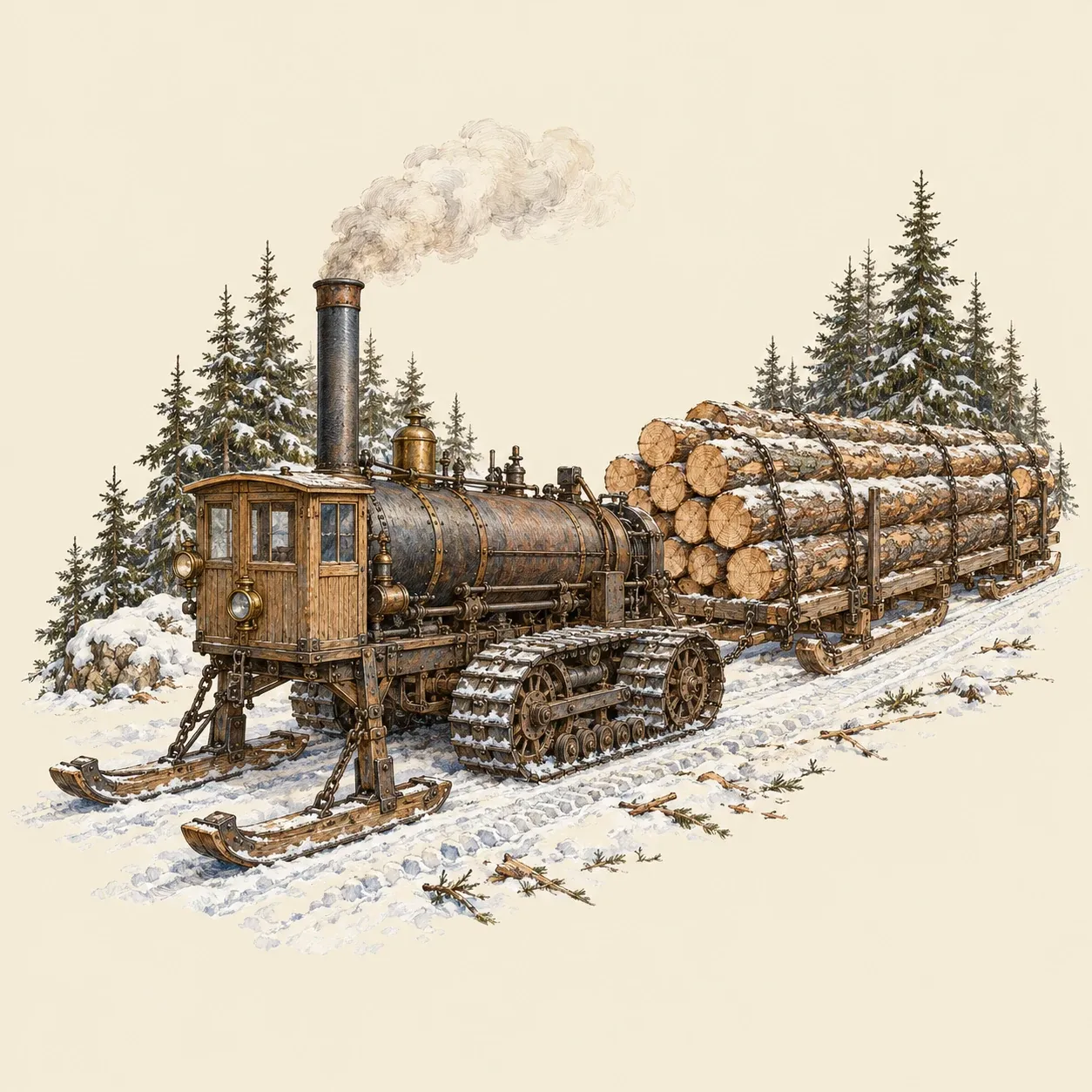 Lombard’s log haulers pulled strings of sleds along the frozen logging roads of Maine.
The first tracks to work for a living hauled timber. In Maine, logs had to come out of the woods on snow roads, where wheels slipped. Alvin Lombard filed his patent for a logging engine in November 1900 and it was granted on 21 May 1901. His machine was a steam engine on two tracks of plates linked to bend, geared to its wheels, with the front carried on a steered sled. The first plates were cast iron and broke on frozen ground, so Lombard changed to hard steel. A Maine lumber firm bought the first hauler in 1903, and others soon worked across Maine and New Hampshire.
In California, Benjamin Holt showed his first practical track-type tractor in a peat field on Roberts Island in 1904. His gasoline track-type tractors were patented and in production by December 1907, and were later sold under the name Caterpillar. During the First World War, Holt tractors hauled men and supplies for the American, French and British armies, and the track gave the first tanks their cross-country mobility. The same principle later carried bulldozers, earth movers and the many tracked machines of farms and building sites.