Music box
A pinned cylinder plucking a steel comb
Contents
- 1Pinned brass cylinder
- 2Steel comb
- 3Bass tooth with its lead weight
- 4Damper under the tip
- 5Spring barrel
- 6Governor fan on its endless screw
A music box plays a tune by itself: a brass cylinder set with fine steel pins turns slowly and plucks the tuned teeth of a steel comb, driven by a clock spring and held to an even speed by a small air brake. The positions of the pins encode the tune. The oldest dated example is a watch by Michel-Joseph Ransonnet of Nancy, its case dated 1772, in which a pinned barrel plucks six steel teeth through sprung levers. In 1796 the Geneva watchmaker Antoine Favre made a carillon whose pins caught steel blades, without bells or hammers.
What it is
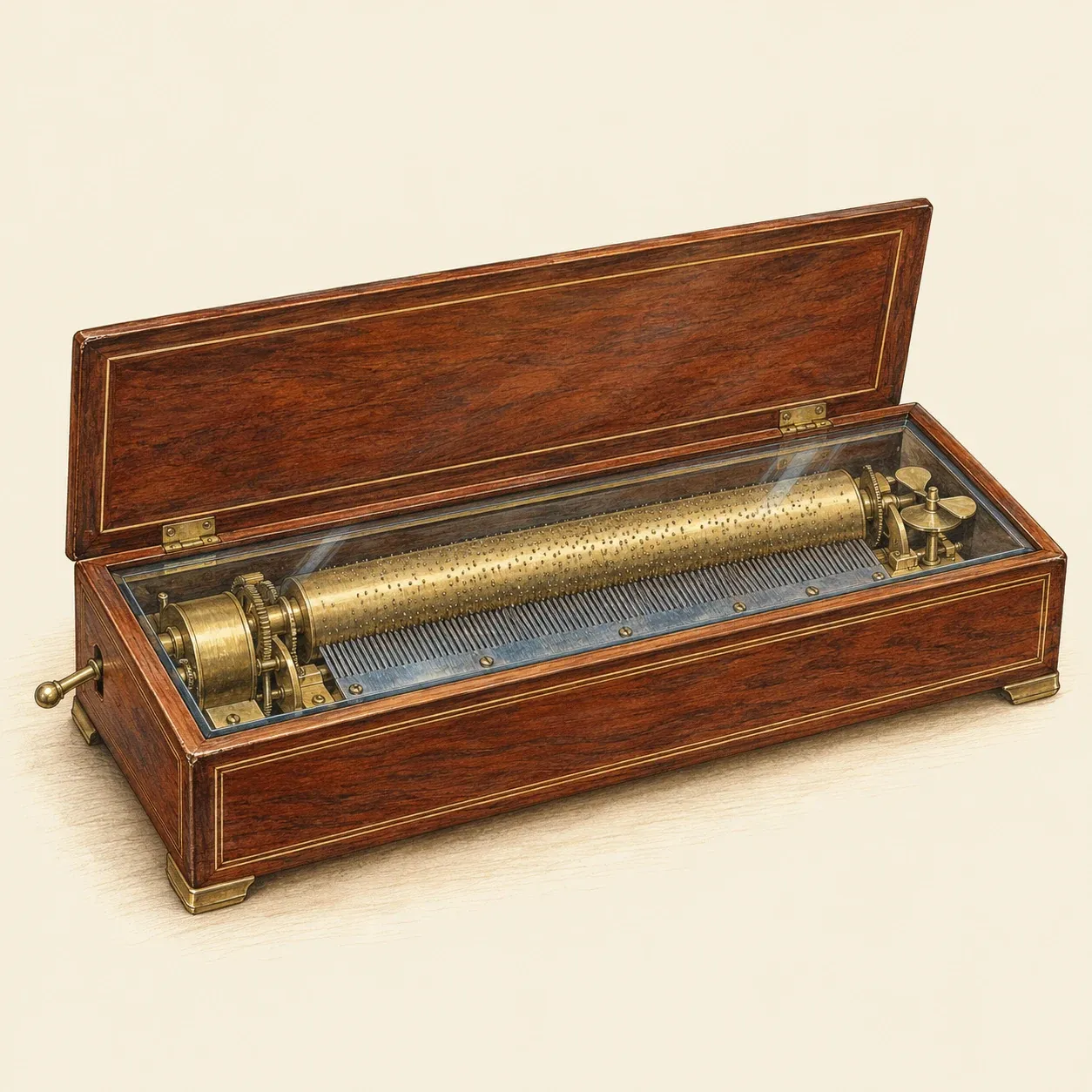 A cylinder music box in its case, the movement under a glass cover.
A cylinder music box is a small automatic instrument. Its working parts sit on a metal bedplate: a brass cylinder lying on its side, a steel comb screwed down in front of it, a spring motor at one end and a speed regulator at the other, both taken from the clock. The comb is a single plate of hardened steel cut into a row of teeth, each tuned to a note. The cylinder carries a great many fine steel pins, set so that as it turns they catch the teeth one after another and play a tune.
The first movements were tiny and were fitted into watches, clocks, snuffboxes and sewing boxes. From about 1815 the music box became an instrument in its own right, usually a wooden case holding the movement under a glass lid. One cylinder could carry several tunes: at the end of each tune, a cam called the snail shifts it slightly sideways, so that a different set of pins lines up with the teeth.
How it works
Each tooth is a small steel bar fixed at its root and free at its tip, like one prong of a tuning fork. A pin on the turning cylinder catches the tip, lifts it and then lets it slip off. The tooth springs back and vibrates at its own frequency. The note depends on the length and thickness of the tooth: a longer or thinner tooth vibrates more slowly and sounds lower. The deepest notes would need teeth too long for the comb, so small lead weights are attached under the bass teeth to slow them down.
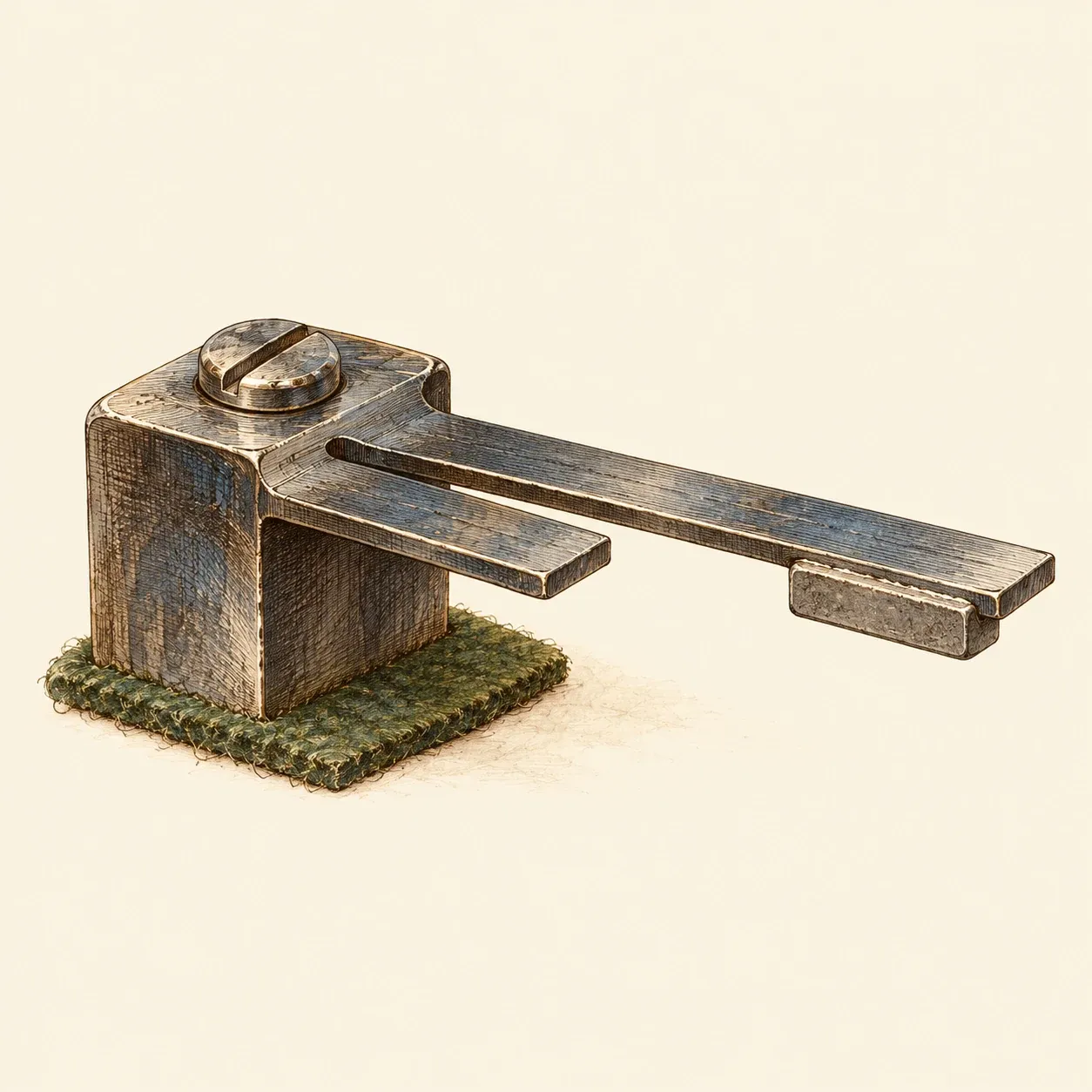 A short treble tooth and a long bass tooth weighted with lead.
The comb is screwed firmly to the bedplate, and the vibration passes through it to the case, which radiates the sound. A tooth that is still ringing when the next pin reaches it would buzz against the pin. A fine wire or a sliver of quill under the tip, the damper, stops the tooth before the pin plucks it again.
The cylinder is a thin brass tube, about 0.5 mm thick. Its tapered pins are driven tightly through the wall and held in place with cement. Their positions are the score: the place of a pin along the cylinder chooses the tooth, and its place around the cylinder chooses the moment. A coiled steel mainspring in a barrel drives the cylinder through a train of gears. The same train turns, much faster, a worm called the endless screw, which carries a small fan. The air resists the fan more and more as it speeds up, and this keeps the tune at a steady tempo.
How to do it
The principle can be heard with a few simple parts. Clamp three thin strips of spring steel, such as cheap flexible steel rulers, under a hardwood block screwed to a board, so that they stick out by different lengths, say 6, 8 and 10 cm. Pluck each tip: the shortest gives the highest note. Sliding a strip in or out tunes it.
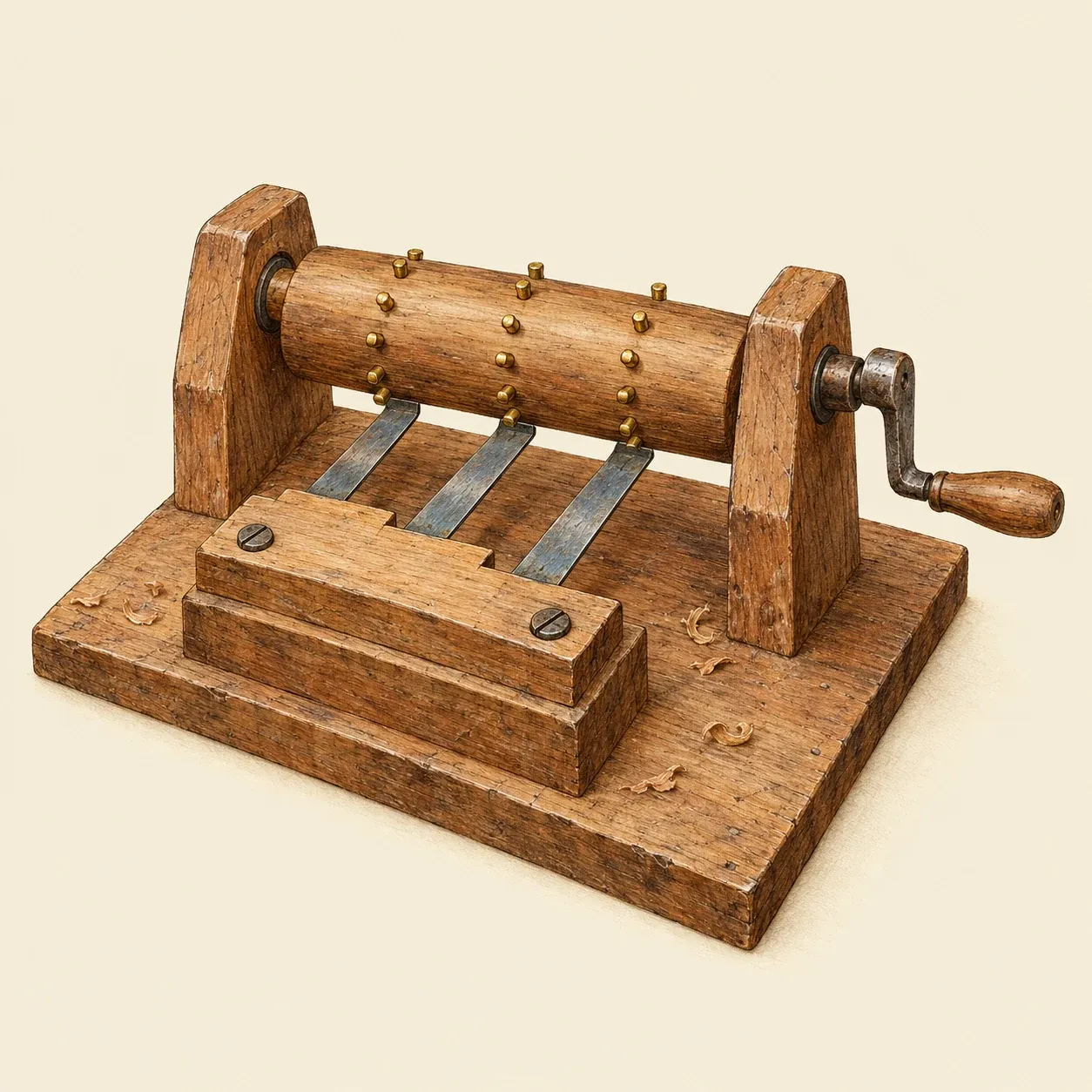 A hand-turned roller with pins plucks three clamped steel strips.
For the cylinder, take a hardwood dowel about 3 cm thick and as long as the row of strips is wide. Mark a line around the dowel opposite each strip, and drive short brass pins into these lines, leaving 2 or 3 mm standing; a pin for the first strip, then one for the second a little further round, and so on, makes a simple rising phrase. Mount the dowel in two holes in upright supports so that the pins just catch the tips of the strips, fit a crank to one end and turn it slowly. The pins pluck the strips in the order you set them, as the cylinder of a music box does.
Safety. Clamp the strips tightly: a strip that slips can spring out. Wear safety glasses while plucking and adjusting, and file or tape the corners of the strips. Wear gloves when driving the pins. Never open or adjust a real music box with the spring wound: if the governor slips, the spring unwinds in an instant, a “run” that spins the cylinder at great speed and breaks pins and teeth.
History and evolution
Pinned cylinders are much older than the music box. Since the late Middle Ages, automatic carillons in church towers had played tunes from large iron cylinders, later of brass, whose pins tripped levers connected to the hammers of the bells. In the Low Countries the pins could be moved to set new tunes, and almost every large church tower there still has one. The same pinned drum, on a smaller scale, drove the bells of chamber clocks.
Tuned steel teeth first replaced bells in France. In 1769, according to the auction house Antiquorum, Michel-Joseph Ransonnet, a watchmaker of Nancy, presented a mechanism in which a pinned cylinder set small blades vibrating in place of bells. The historian Arthur Ord-Hume examined one of his watches, now in the Patek Philippe Museum in Geneva, whose case is dated Paris 1772: its pinned barrel works sprung levers, and the levers pluck a comb of six steel teeth. In 1796 Antoine Favre, a watchmaker of Geneva, made a “carillon without hammers or bells”. In place of the bells he used five steel blades that sounded when the pins of a cylinder caught them. The sound was poor at first, and makers added more blades. Early combs were built up from separate sections of one to five teeth; later combs were cut from a single plate of steel.
Geneva made the boxes first; around 1815 the trade separated from watchmaking. The historian Daniel Troquet estimates that Geneva produced 13,000 boxes around 1860, with more than 1,000 people at work. After the watchmaking crisis of that year, the craftsmen of Sainte-Croix in the Jura turned to music boxes, and their first factories opened around 1875. Movements whose owner could change the cylinder date from the 1850s or 1860s: the collector John Clark dated the first, by Ducommun-Girod of Geneva, to 1854, while the Chimei Museum credits Paillard of Sainte-Croix with the interchangeable cylinder in 1862. Patents show that simple, reliable changing systems came into use only in the 1880s.
In the 1890s, boxes playing metal discs, made in Leipzig, took the market. A disc was cheaper and easier to change than a pinned cylinder, so the repertoire could grow. Their success ended around 1910 with the gramophone and the radio. After the Second World War, Japanese makers invested in mass production and prices fell. By the end of the twentieth century, Japan made 55 to 60 million movements a year and China about 30 million, while the luxury makers of Sainte-Croix and Yverdon made about 3 million.