Tuning fork
A pitch held in vibrating steel
Contents
- 1Vibrating steel prongs
- 2Curve joining the prongs
- 3Vibration-transmitting stem
- 4Wooden resonating box
A tuning fork provides a reference pitch through the vibration of two metal prongs. Musicians and acousticians compare its sound with a voice or an instrument; a resonating box makes it easier to hear.
What it is
A tuning fork is a metal resonator with two free prongs joined by a curved base that extends into a stem. A light tap sets it ringing at a pitch that can be used to tune an instrument or compare vibrations. The musician listens to this note, then adjusts a string or instrument to match it.
Rudolph Koenig, an instrument maker in Paris, made forks mounted on wooden resonating boxes. The Smithsonian holds a set of three steel forks with a small hammer, laboratory instruments it dates to about 1870 to 1900, and describes their boxes as spruce. At Kenyon College, a set of Koenig forks on resonators has boxes with spruce tops, like the top of a violin; Koenig’s 1889 catalogue priced the 128 Hz fork at 100 francs. At Dartmouth’s Hood Museum of Art, a Koenig box carrying a Max Kohl fork from about 1900 is made of pine.
How it works
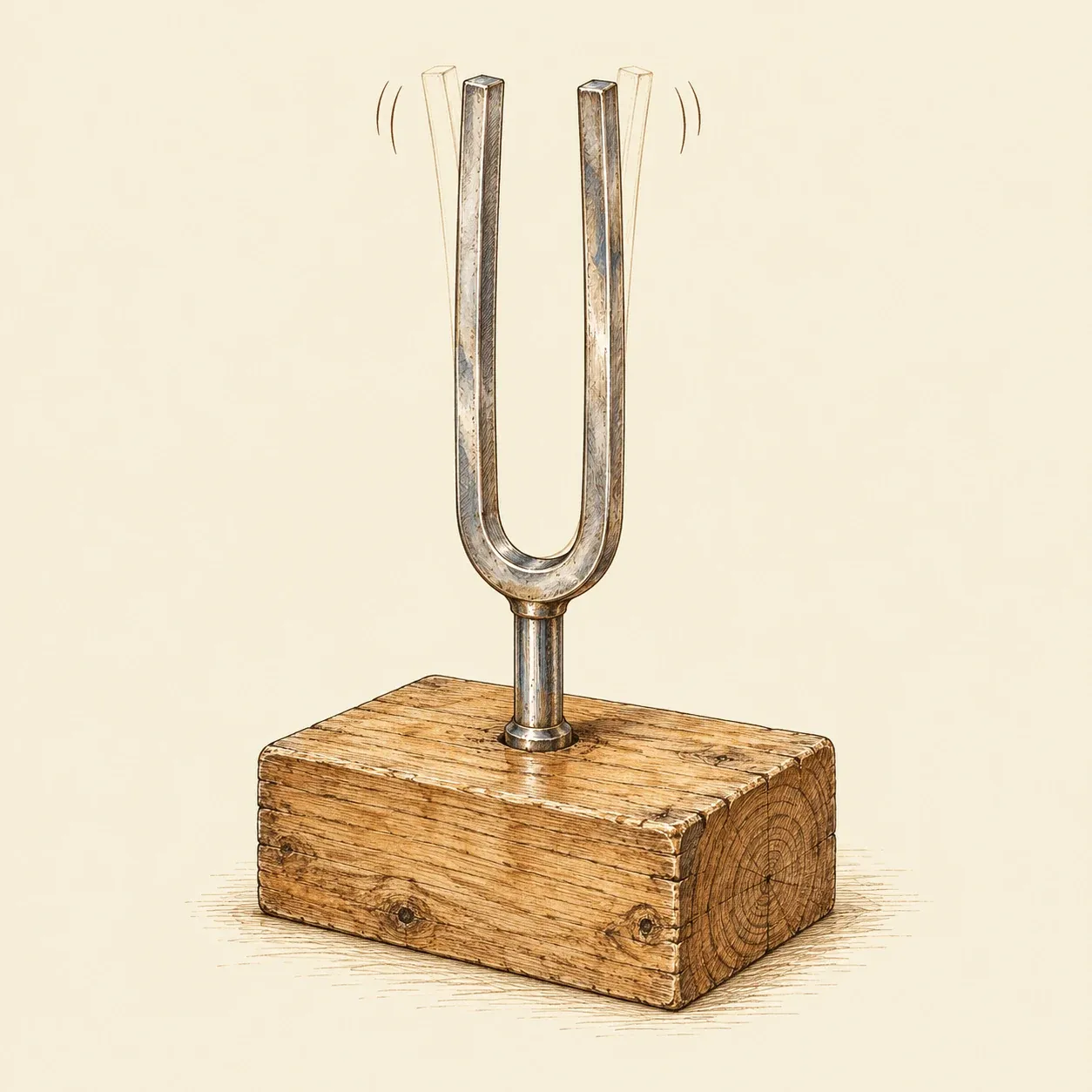 The prongs bend symmetrically about their resting position.
A tap bends the prongs slightly; their elasticity draws them back towards their original position. They keep moving past it, their tips approaching one another, moving apart and repeating the motion. Each prong bends like a small beam fixed at its base and free at its tip. In the mode normally used, the two movements are symmetrical, like mirror images.
Pitch depends on the frequency of this oscillation and therefore on the metal’s dimensions, stiffness and density. With otherwise comparable geometry, longer prongs vibrate more slowly and give a lower note. Shortening their tips raises the pitch. Changing the metal while keeping the same dimensions can also change the frequency, since materials differ in stiffness and density.
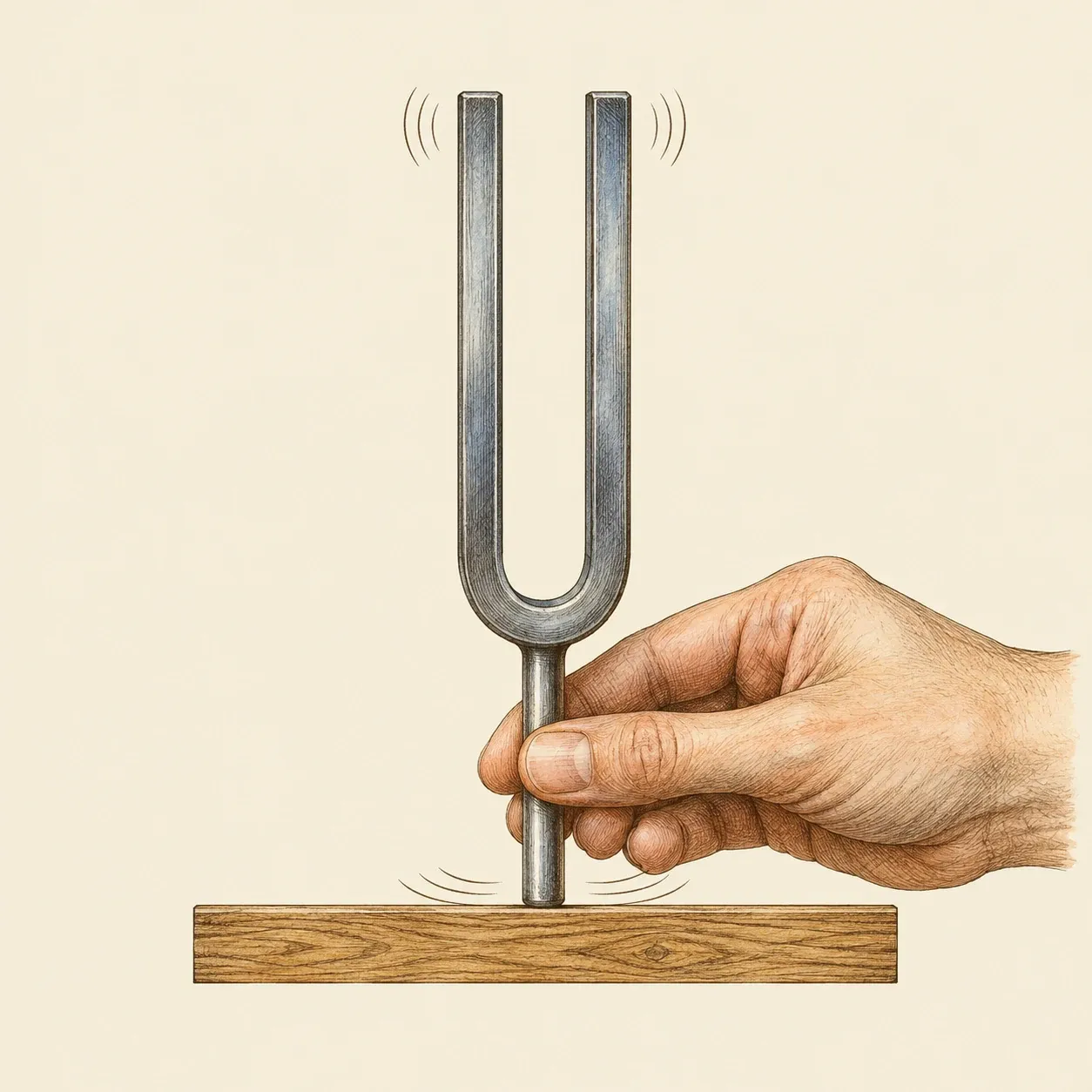 Touched to a table, the stem passes its vibration to a larger surface.
The oscillation moves the air, producing a sound whose loudness depends on the listening direction. A strike can excite several vibration modes. Hitting a hard object particularly encourages an additional high ringing sound. After the initial attack, the higher components fade and the main note dominates. The stem also moves, though only very slightly. Touching it to a table or soundboard transfers the vibration to a larger surface. Koenig’s instruments use this coupling to strengthen the sound through a resonating box.
Hold a free fork by its stem and leave its prongs clear so that they can keep moving. If another sound of nearly the same pitch is heard at the same time, the combined sound grows louder and softer at regular intervals. These beats result from the superposition of the two vibrations, and their rate allows the frequencies to be compared. Acousticians used this method to measure other sounds against known tuning forks.
How to do it
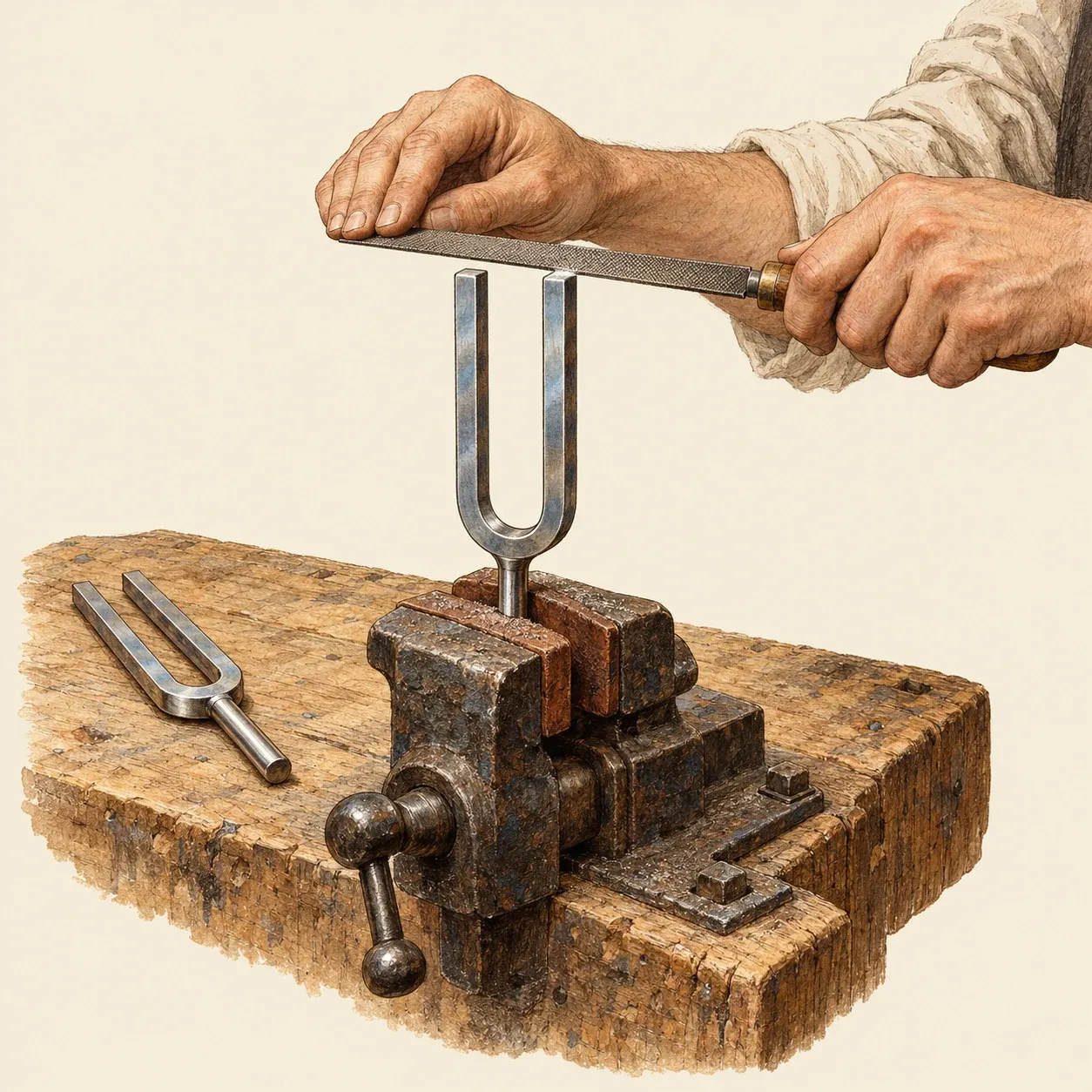 Filing the tips of the prongs shortens them and raises the pitch; the finished fork beside it serves as the reference.
A workshop method is to machine a fork from a single steel blank, as with the Koenig examples described by the Smithsonian. Leave two parallel prongs joined by a rounded base, with a stem extending from it. Material removal must preserve the prongs’ regular shape and symmetry while leaving their tips free. Shaping establishes their length and thickness, dimensions that determine how they vibrate. Keep the chosen steel throughout adjustment, since a change of metal changes the vibrating properties.
Compare the sound with a known reference, make a small correction, then listen again. Shortening the tips increases the frequency. Removing metal elsewhere cannot be treated as equivalent to shortening them: stiffness and mass distribution also affect the result. A wooden box can carry the fork, as on Koenig’s instruments, with a mechanical connection to transmit its vibration.
Secure the blank firmly, wear eye protection and use a file fitted with a handle. Keep fingers out of the tool’s path and remove burrs before handling. Any operation that heats the metal belongs in an equipped workshop; let the work cool before touching it. Begin sound tests gently, away from ears, and avoid forceful strikes against hard surfaces. A workshop-made fork intended for listening must not be used for medical diagnosis or presented as a calibrated medical instrument.
History and evolution
The Whipple Museum in Cambridge and the Smithsonian attribute the invention of the tuning fork to John Shore in 1711. Shore was a musician at the English court. His fork supplied a reference pitch for tuning instruments. Musicians had previously used wooden pitch pipes, among other aids; these were affected by temperature and humidity.
In the nineteenth century, improved manufacture made the fork an instrument for acoustic measurement. Johann Scheibler assembled series of forks to compare pitches through beats. Rudolph Koenig later developed large collections of frequencies and made apparatus for experiments with sound. The resonating boxes held by the Smithsonian belong to this laboratory practice.
Tuning forks also played a part in efforts to standardise musical pitch. The reference chosen depends on the convention and the instrument; historical forks do not all produce the same note. In the twentieth century, electronics replaced many of their scientific uses. Musical tuning and some medical examinations continue to use the vibrating fork.