Obstetric vacuum extractor
A suction cup that helps draw out a baby's head
Contents
- 1Soft bell-shaped cup
- 2Traction handle
- 3Vacuum tube
- 4Fluid trap
- 5Vacuum gauge
- 6Hand pump
An obstetric vacuum extractor is a cup that holds on to a baby's scalp by suction, with a handle to pull on, so that a doctor or midwife can help a stalled birth to finish. A naval surgeon tried a glass cupping cup on a baby's head around 1706, and the metal cups of Yves Couzigou and Tage Malmström made the method common after 1946.
What it is
A vacuum extractor, also called a ventouse, is used when a birth has stopped progressing and the baby’s head is already low in the mother’s pelvis. A cup is placed on the top of the baby’s head and a pump lowers the pressure inside it. The cup then holds on to the scalp, and the doctor or midwife pulls on its handle in time with the mother’s contractions to help the head down and out.
There are two families of cup. Rigid metal cups, the type introduced by Yves Couzigou and Tage Malmström, are shaped like a mushroom, 40 to 60 mm across, with a chain fixed at the centre that leads to a separate handle. Soft cups of silicone or plastic are bell- or funnel-shaped and carry their handle on a stem. Either kind is connected by a tube to a pump, worked by hand or by electricity, with a gauge that shows the vacuum and a small jar that catches any fluid drawn along the tube.
How it works
When air is pumped out of the cup, the pressure inside falls below that of the air around it. The outside air then presses the cup against the scalp with a force equal to that difference in pressure multiplied by the area of the cup. A wider cup, or a stronger vacuum, holds harder. If the pull on the handle grows larger than the force the vacuum provides, air rushes in under the rim and the cup comes off. A cup that comes off under full traction can itself injure the baby’s head, and guidelines advise abandoning the attempt after two or three detachments. Vacuum is applied only for short periods, because too strong or too long a suction can injure the scalp and cause bleeding under it.
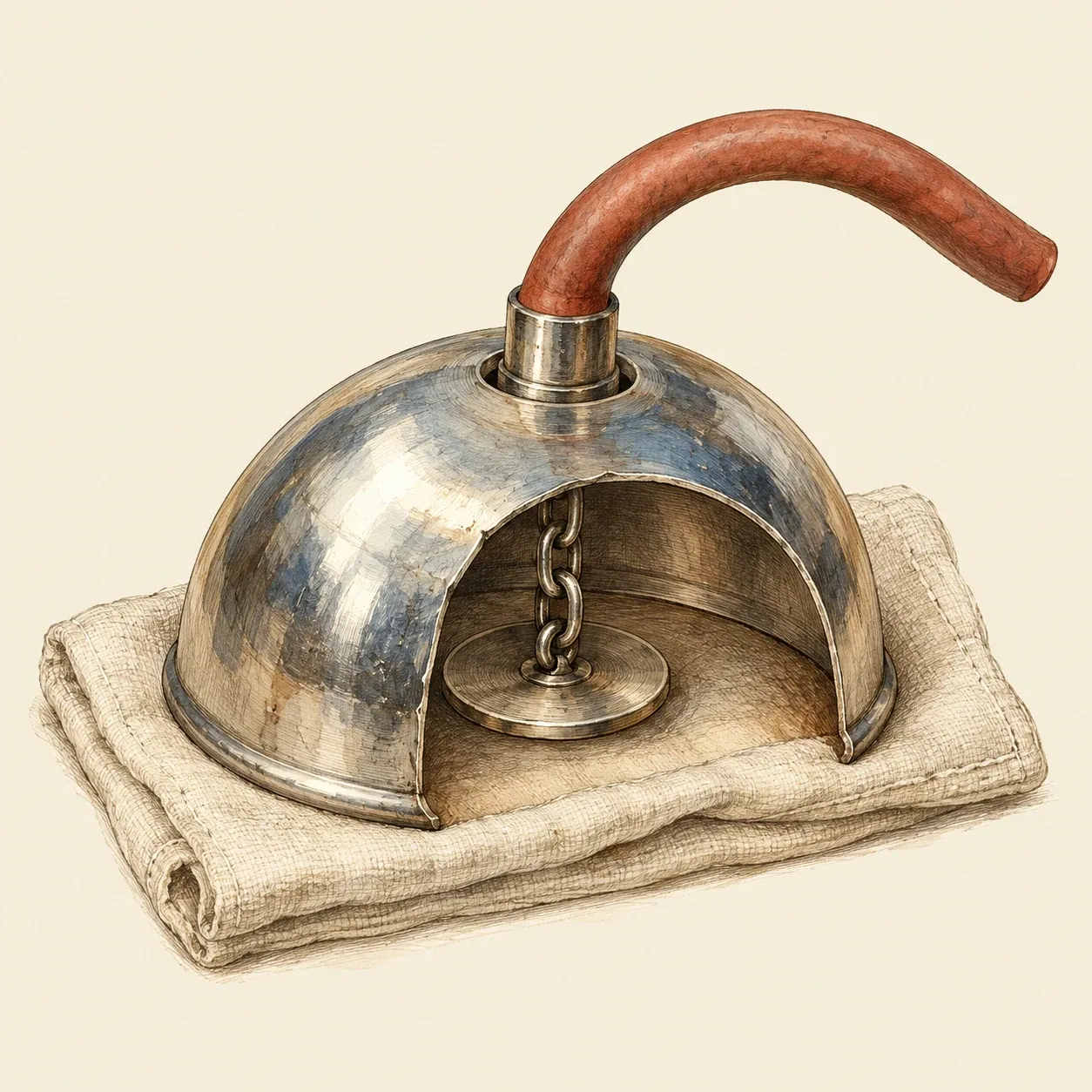 In the Malmström cup a chain runs from a plate inside the cup out through the centre of its floor.
The point where the pull is applied matters as much as the vacuum. On the original Malmström cup the chain is fixed high up, at the centre of the floor. A pull at an angle tilts the cup and lifts one edge, which lets air in. Later designs lowered the traction point. The Bird cup of 1969 did so first, and on the Kiwi OmniCup of 2001 the tube runs in a channel recessed into the cup, which brings the pull closer to the scalp. Soft cups mould themselves to the head and cause fewer injuries to the scalp than metal cups, but they come off more often.
Unlike forceps, whose two blades lie along the sides of the head, the cup sits on top of it and needs no room beside it. The pull is given only during the mother’s contractions. Each instrument suits some situations better than the other, and the choice depends on the case and on the experience of the person using it.
How to do it
A household suction hook shows the physics of the vacuum cup: the larger the cup, the more weight it holds, and it lets go all at once when the load is too great. The test is done on a tile or a sheet of glass. A vacuum extractor is used only by obstetricians and midwives trained in assisted birth, and never on anyone by anybody else.
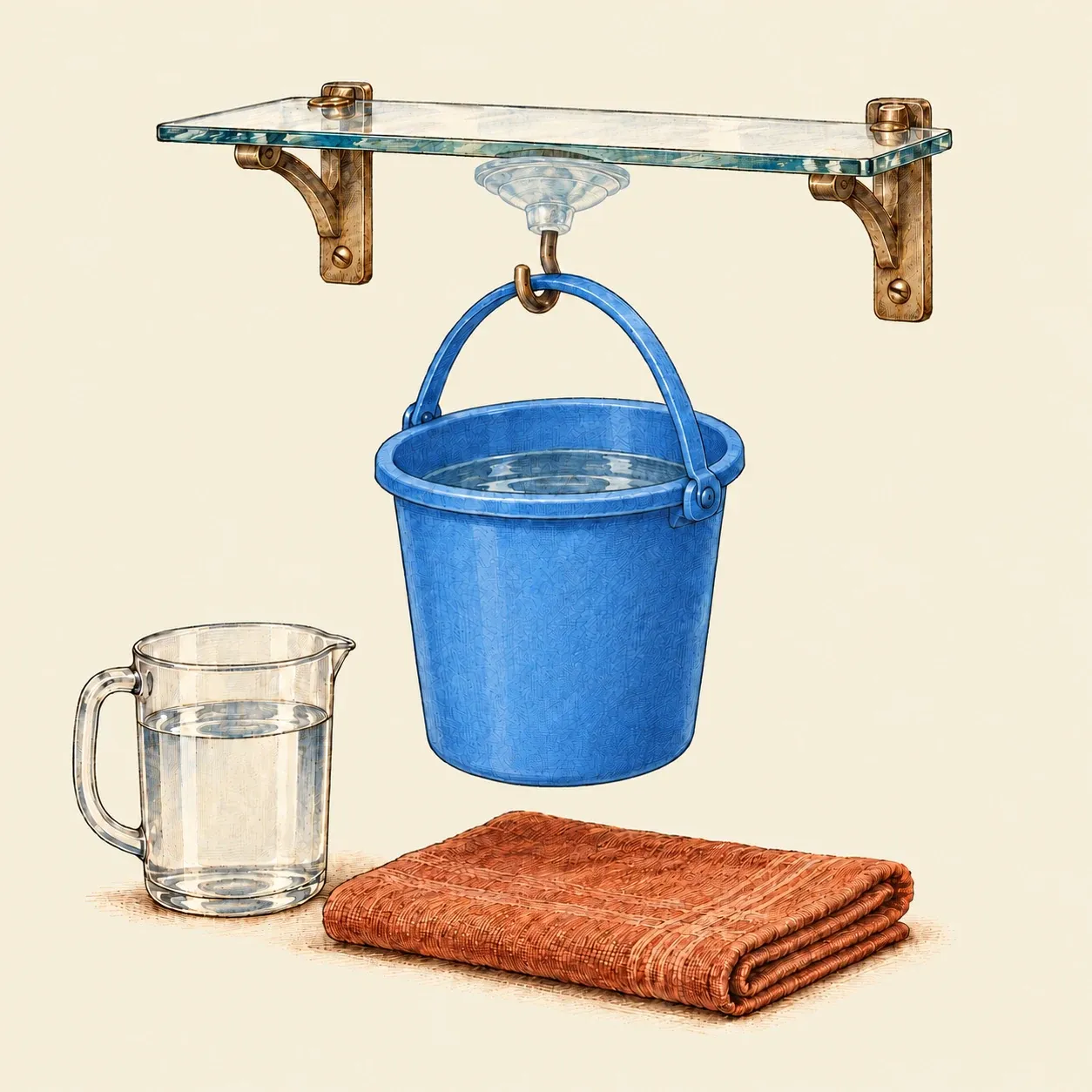 Water is added until the suction hook lets go: the larger the cup, the heavier the bucket it holds.
Clean a smooth, flat glazed tile or glass shelf and a rubber suction hook with soapy water, dry them and press the cup firmly onto the underside of the shelf so that the air is squeezed out. Hang an empty plastic bucket from the hook and put a folded towel or mat underneath. Pour water into the bucket from a measuring jug, a little at a time, and note how much is in it when the cup suddenly lets go. Repeat three times and take the middle result.
Measure the diameter of the cup and work out its area. Repeat the test with a cup of a different size: the load it holds goes up roughly with its area, because the air pushes on every square centimetre of the cup. Try the same cup on a rough surface such as unglazed wood, where air leaks in under the rim, and it holds far less. Pulling at an angle instead of straight down also makes it let go sooner, as with a cup whose handle is fixed high above its rim.
Safety. Never put a suction cup, or anything that makes a vacuum, on your skin or on anyone else, child or adult, or on an animal: suction bruises and can tear the skin.
History and evolution
Glass cupping cups, from which the air was removed by heat or by pumping, were long used in medicine for other purposes. The first known attempt to use one on a baby’s head is credited to James Yonge, a naval surgeon of Plymouth, in a report dated to 1706, though some accounts give 1705 or 1702. In 1848 the Edinburgh obstetrician James Young Simpson presented his air tractor to the Edinburgh Obstetric Society as an alternative to forceps in long labours. Its brass body held a small pump, and a cup edged with a leather skirt was held on the head by suction.
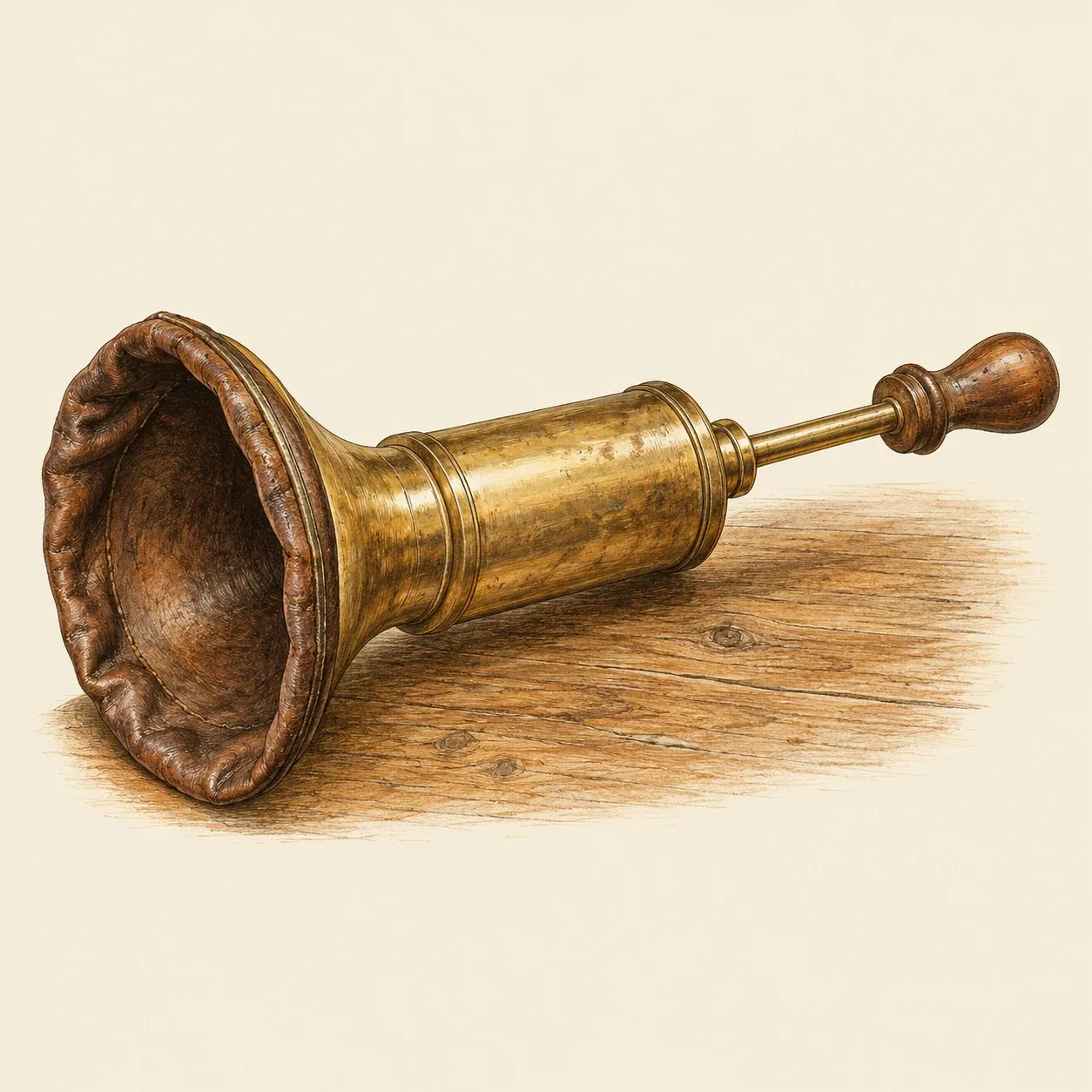 Simpson’s air tractor combined the pump and the cup in a single brass instrument.
Keeping the suction proved difficult, and Simpson soon dropped the air tractor in favour of his forceps, which are still in use. For another century no vacuum device lasted. In France, the obstetrician Yves Couzigou first used a metal suction cup of his own design in 1946 and patented it. In Sweden, Tage Malmström published his vacuum extractor in 1954, and it was his instrument that spread through Europe. He later wrote to Couzigou to acknowledge the earlier work.
By the 1970s the vacuum extractor had almost completely replaced forceps for assisted births in many European countries. Reports of scalp injuries led to changes in the cup: soft cups such as the Kobayashi silicone cup, then designs with a lower traction point. In the United States, deliveries by vacuum extractor outnumbered those by forceps by the end of the 1990s.