Washing machine
Washing, rinsing and spinning laundry in a drum
Contents
- 1Perforated stainless steel drum
- 2Lifter fixed inside the drum
- 3Outer tub that holds the water
- 4Spring hanging the tub from the cabinet
- 5Damper under the tub
- 6Door with its rubber seal
A washing machine moves laundry through water and detergent, rinses it and removes much of the water by wringing or spinning. In October 1677 Robert Hooke recorded and drew in his diary a device made by Sir John Hoskins for rinsing fine linen. In January 1752 the London monthly The Gentleman's Magazine printed an illustrated description of a machine for washing linen. In 1765 Gotthard Friedrich Stender, a pastor in Courland, described an English washing tub, and Jacob Christian Schäffer of Regensburg brought out an improved machine the next year. Hand-cranked tubs and drums led to electric machines in the early 20th century and to the automatic drum machine, sold by Bendix from 1937.
What it is
A washing machine does the work of the washtub, the washboard and the wringer. It soaks the laundry in water with detergent, keeps it moving so that the water passes through the cloth again and again, drains the dirty water, rinses with clean water and finally squeezes or spins out as much water as it can. In a modern automatic machine a controller opens the water valves, warms the water, runs the motor and the drain pump and times each stage without anyone standing by.
Washing machines come in two main forms. In a front-loader the laundry goes into a drum that turns about a horizontal axis behind a round door. In a top-loader the laundry goes in from above. Older machines were wooden or metal tubs in which a crank or a motor turned paddles, often with a pair of rollers on top to wring the washing.
How it works
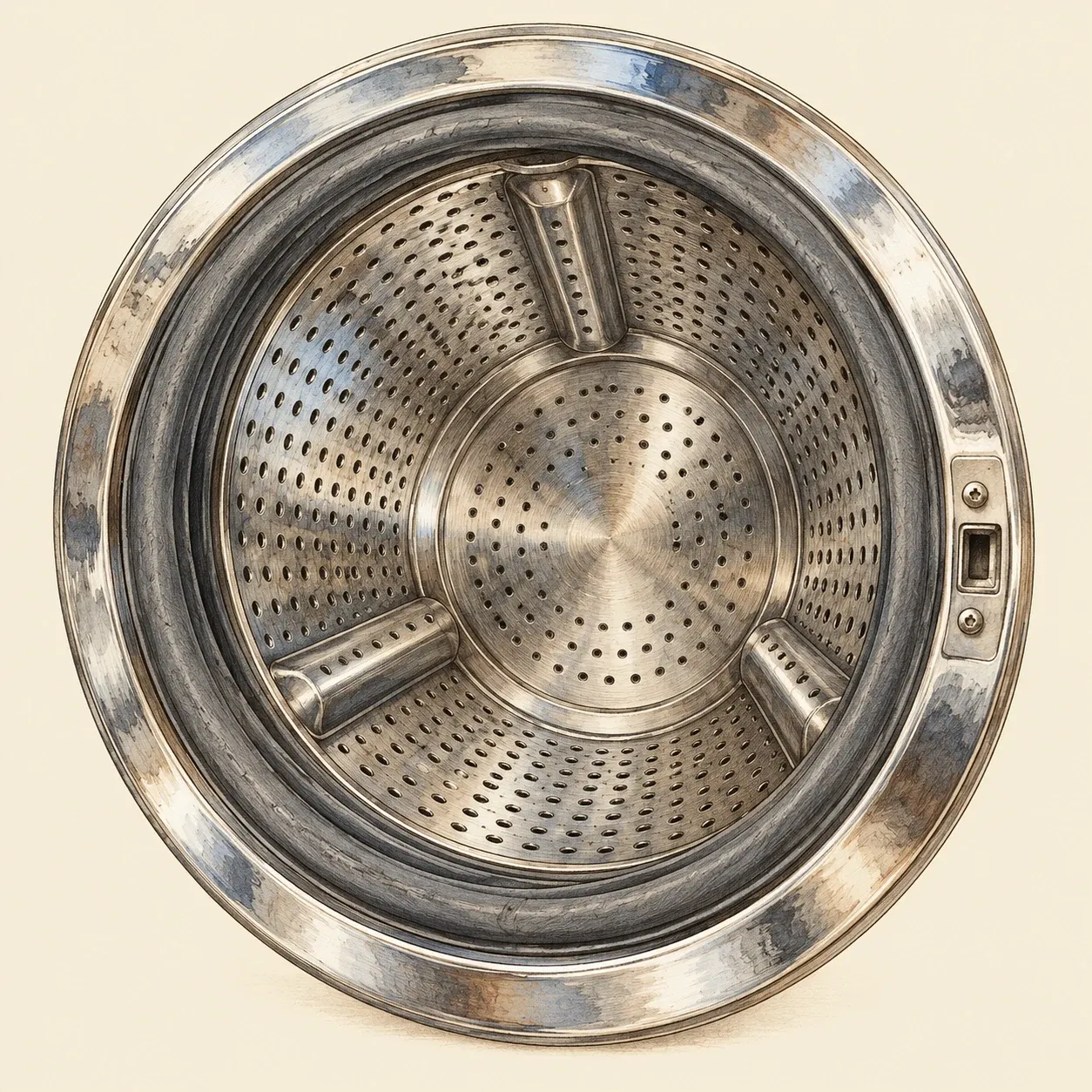 Inside the drum, three lifters carry the washing up and let it fall back into the water.
The drum of a front-loader is a cylinder of stainless steel pierced with small holes, set inside a closed tub that holds the water. Ribs called lifters, often three spaced evenly around the wall, carry the laundry up as the drum turns. Near the top it falls back through the water. Lifting, falling and rubbing against the rest of the load push the water through the fibres. The motor turns the drum one way, pauses and turns it the other way, so that the whole load keeps turning over.
The water alone removes little grease. Soap or a modern detergent surrounds the oily dirt so that the water can carry it off, and warm water helps. An electric heating element in the tub warms the water to the temperature chosen. After washing, a pump empties the tub, clean water rinses the load, and the cycle may repeat.
To finish, the drum turns fast in one direction. The laundry is pressed against the wall, and the water is flung out through the holes into the tub and pumped away. This spin is what leaves the washing damp instead of dripping. A heavy wet load that is not spread evenly makes the drum wobble, so the tub hangs from the cabinet on springs and rests on dampers that absorb the shaking. Heavy counterweights fixed to the tub steady it, and some machines add rings of balls that roll to the light side of the drum.
The machine combines mains electricity, water and a heavy drum turning at speed. Its door locks until the drum has stopped. Never force the door, bypass the lock or open the casing; repairs are work for a qualified technician. Keep young children away from the open door.
History and evolution
In October 1677 Robert Hooke recorded and drew in his diary a device made by Sir John Hoskins for rinsing fine linen. An English patent granted in 1691 to John Tyzacke covered an engine worked by one or more men, whose listed uses included raising water, washing clothes and pounding minerals and seeds; how it worked is not known. In January 1752 the London monthly The Gentleman’s Magazine printed a description and a picture of a machine for washing linen, which it called the Yorkshire Maiden. In 1765 Gotthard Friedrich Stender, a German pastor in Courland, published a description of an English washing machine in a Königsberg newspaper and in a booklet printed at Mitau, today Jelgava in Latvia. It was a closed wooden tub filled with hot soapy water in which the laundry was turned by hand. The Berlin magazine Berlinisches Magazin reprinted his account the following year.
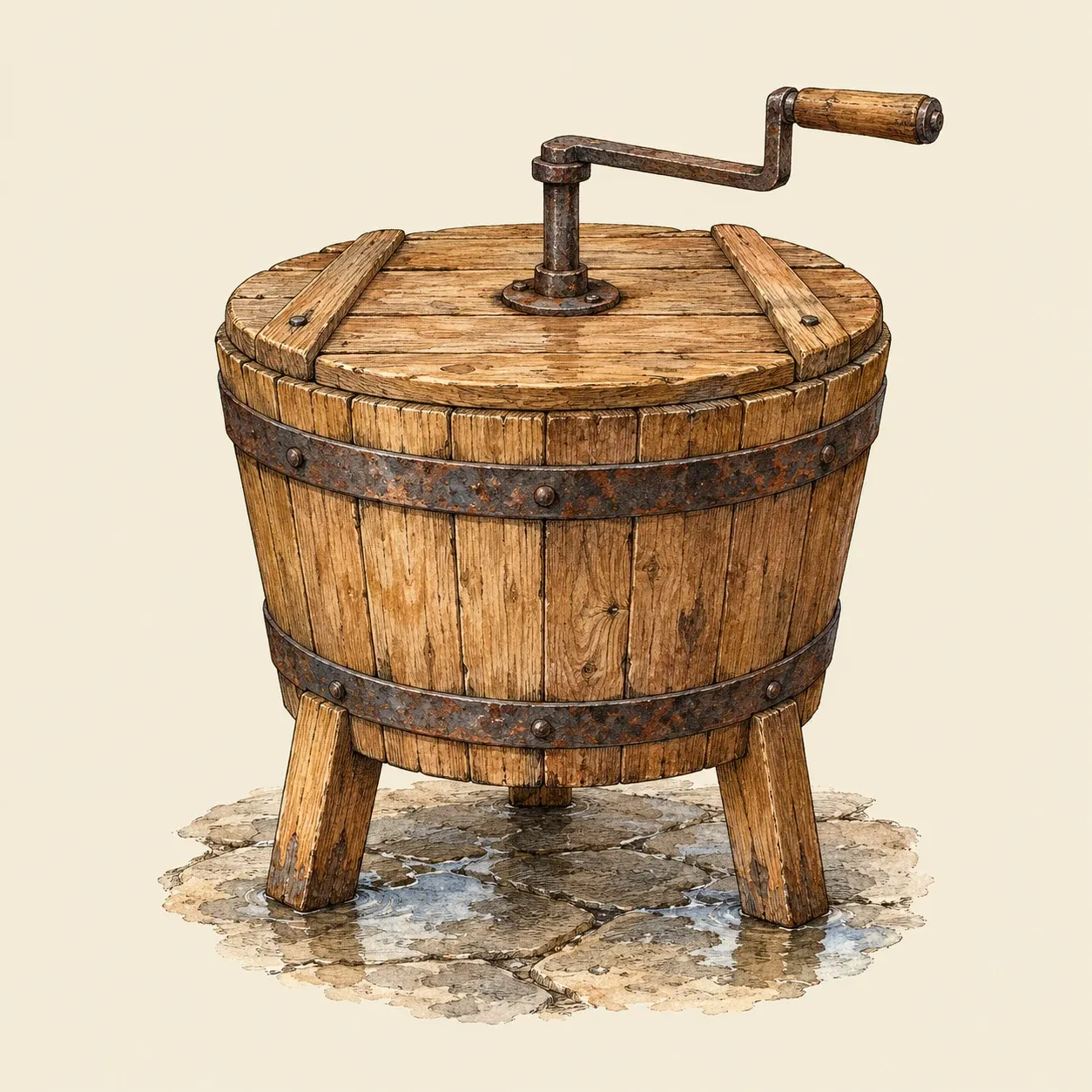 In the tub machines of the 18th and 19th centuries, a crank on the lid turned paddles in the hot soapy water.
Jacob Christian Schäffer, a Protestant pastor and naturalist in Regensburg, took up Stender’s idea and improved it. His booklet on a “convenient and most advantageous washing machine” was printed in 1766 and presented in February 1767. In his wooden tub a crank moved the laundry with paddles. Tub machines of this kind stayed on sale with little change until the middle of the 19th century. In London in the 1790s, Edward Beetham advertised a “royal patent washing mill” worked by a handle.
Hand-cranked machines were still common around 1900. The Museum of Ethnography in Budapest keeps one made by a Budapest ironmonger that a family used in its kitchen until the 1950s: water heated on the stove was poured over the linen, which was churned by turning the crank.
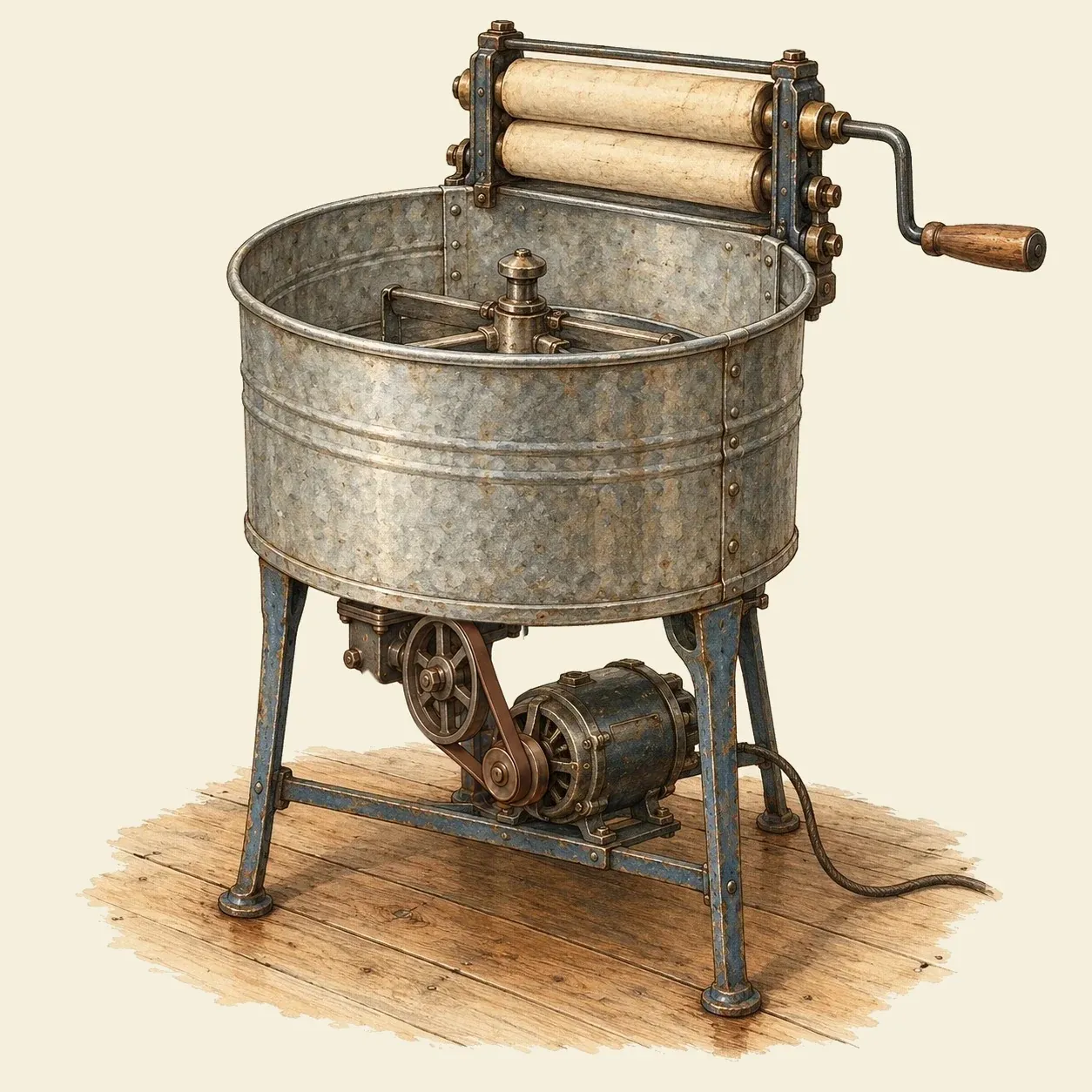 Many early electric washers kept a wringer: the washing was fed by hand between two rollers.
Electric washing machines were made in large numbers in the United States from the early 20th century. An “Electric Laundress” of about 1912, now in the Museum of Transport and Technology in Auckland, rocked its copper tub and turned its wringer by electricity. Many kept a wringer on top, through which the washing was fed by hand, like a Thor machine of about 1929 in the Science Museum in London. In 1937 Bendix Home Appliances of South Bend, Indiana, put on the market a domestic machine that washed, rinsed and spun the laundry by itself in a drum loaded from the front.