Electric heating element
Turning an electric current into useful heat
Contents
- 1Metal sheath
- 2Nickel-chromium resistance coil
- 3Compacted magnesium oxide powder
- 4Terminal pin
- 5End seal
An electric heating element is a conductor made to turn an electric current into heat, in a kettle, an oven, an iron or a water heater. The oldest patent for one was granted in the United States in 1859 to George B. Simpson, for a coil of platinum wire laid in the grooves of a soapstone slab and fed by batteries. Nickel-chromium wire, patented by Albert Marsh in 1906, and the sheathed element, a coil packed in magnesium oxide inside a metal tube, patented by Charles C. Abbott of General Electric in 1921, made heating elements durable.
What it is
An electric heating element is a conductor that is made to resist the current passing through it, so that it grows hot. Unlike a motor or a lamp, which also give some heat, it is built only for that purpose, and nearly all the electrical energy it receives comes out as heat. Elements warm the water in kettles, water heaters and washing machines, the air in ovens and heaters, and the soleplate of an iron.
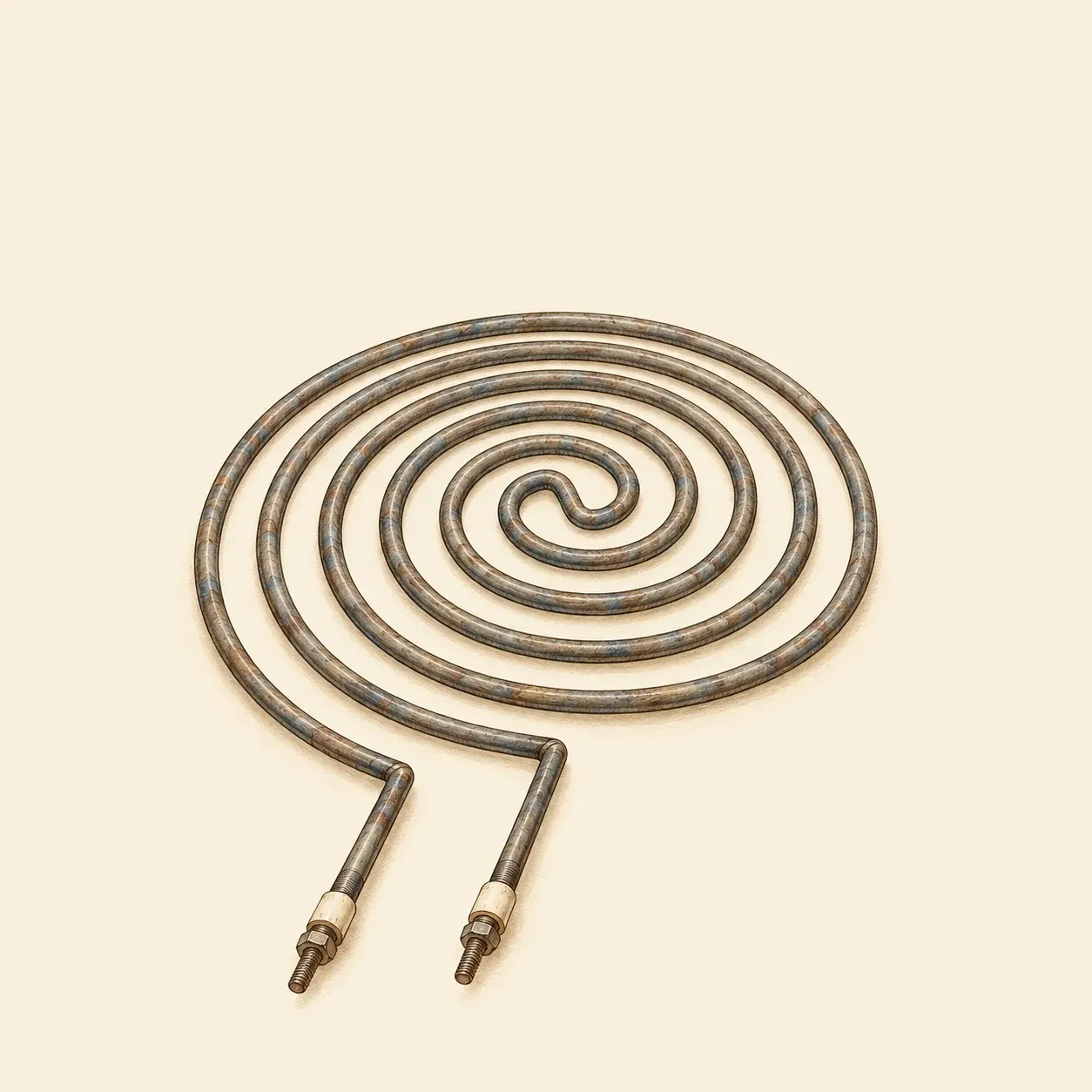 A sheathed element coiled into a flat spiral forms the hotplate of an electric cooker.
There are two main kinds. In an open element the bare resistance wire, usually wound into a coil or a flat ribbon, hangs in the air on supports of ceramic or mica. It heats up quickly and glows red, as in a toaster, a hair dryer or the bars of a radiant fire. In a sheathed element the coil runs down the middle of a metal tube packed with a white mineral powder that keeps the wire from touching the tube. The tube can be bent into rings and loops, set into a hotplate or dipped straight into water.
An element is part of a larger appliance. A thermostat or a regulator switches it on and off to hold the temperature chosen, and a cut-out breaks the circuit if it overheats. Heating elements run on mains voltage, reach several hundred degrees and can kill by electric shock. Use only certified appliances, never make, rewire or repair an element or its connections, and leave any work on them to a qualified electrician.
How it works
When a current flows through a wire, the moving charges collide with the atoms of the metal and give up energy as heat. In 1841 James Prescott Joule showed that the heat produced in a given time is proportional to the resistance of the wire multiplied by the square of the current. On a supply of fixed voltage, the designer therefore chooses the length and thickness of the wire so that the element draws exactly the power wanted: a shorter or thicker wire passes more current and gives more heat.
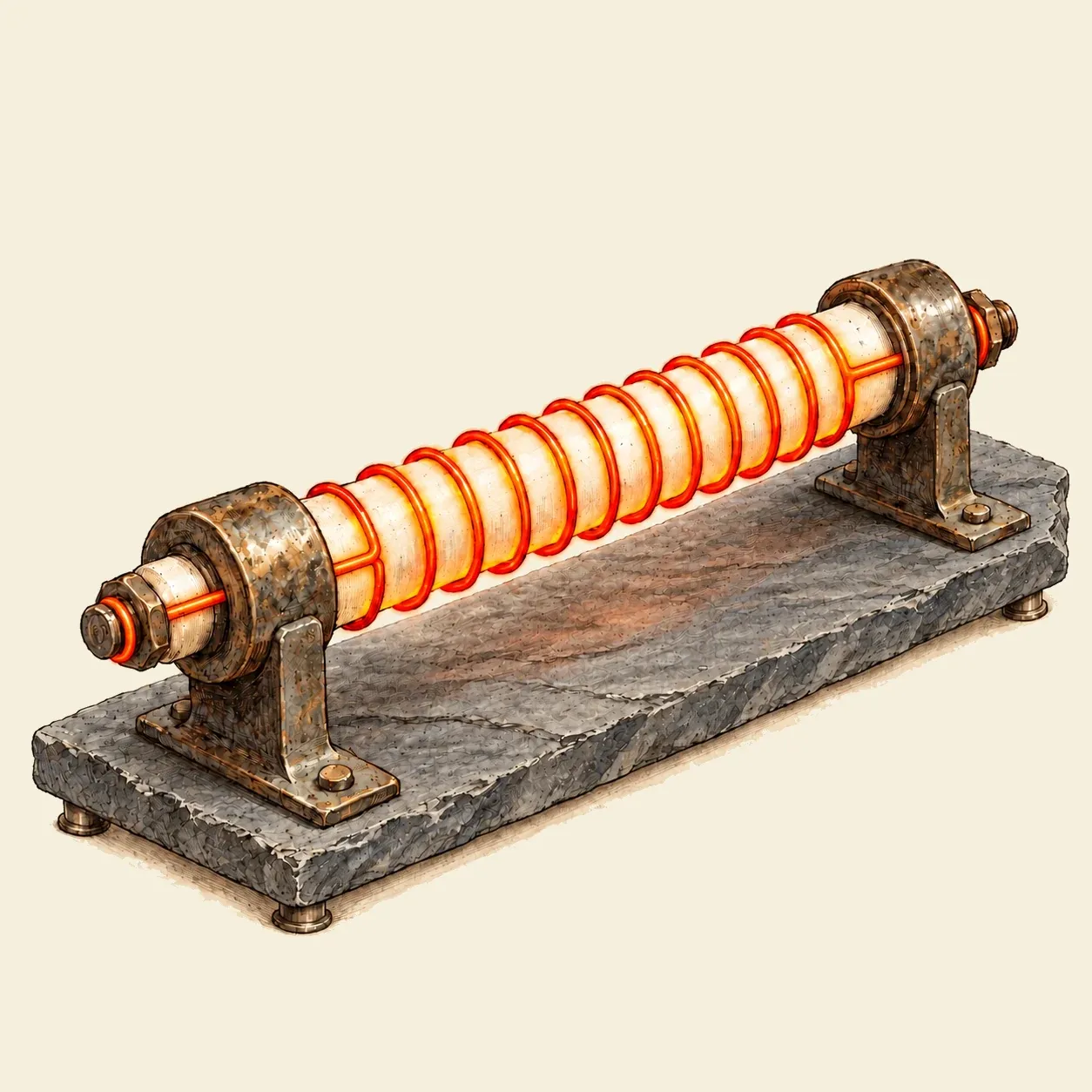 In a radiant heater the bare coil glows in the air, wound on a ceramic rod.
The wire must stand red heat in air for years. Most metals oxidise quickly when red-hot in air, and platinum, which Simpson used in 1859, resists but is rare and costly. Albert Marsh’s alloy of nickel with less than half chromium, patented in 1906, has a high electrical resistance and forms a thin, firmly attached layer of oxide on its surface that protects the metal beneath. The usual grade, 80 per cent nickel and 20 per cent chromium, is rated by makers for continuous use in air up to about 1,200 °C.
In a sheathed element the coil lies in the centre of a metal tube, held in a hard mass of magnesium oxide powder. Magnesium oxide insulates electrically but carries heat well, so the heat of the coil flows out to the sheath while the current stays inside. The powder soaks up moisture from the air, and damp powder lets current leak to the sheath, so the ends of the tube are sealed and the sheath is connected to earth.
History and evolution
Joule published his law of electrical heating in the Philosophical Magazine in 1841, in a paper on the heat given off by metal wires carrying a current and by the cells of a battery.
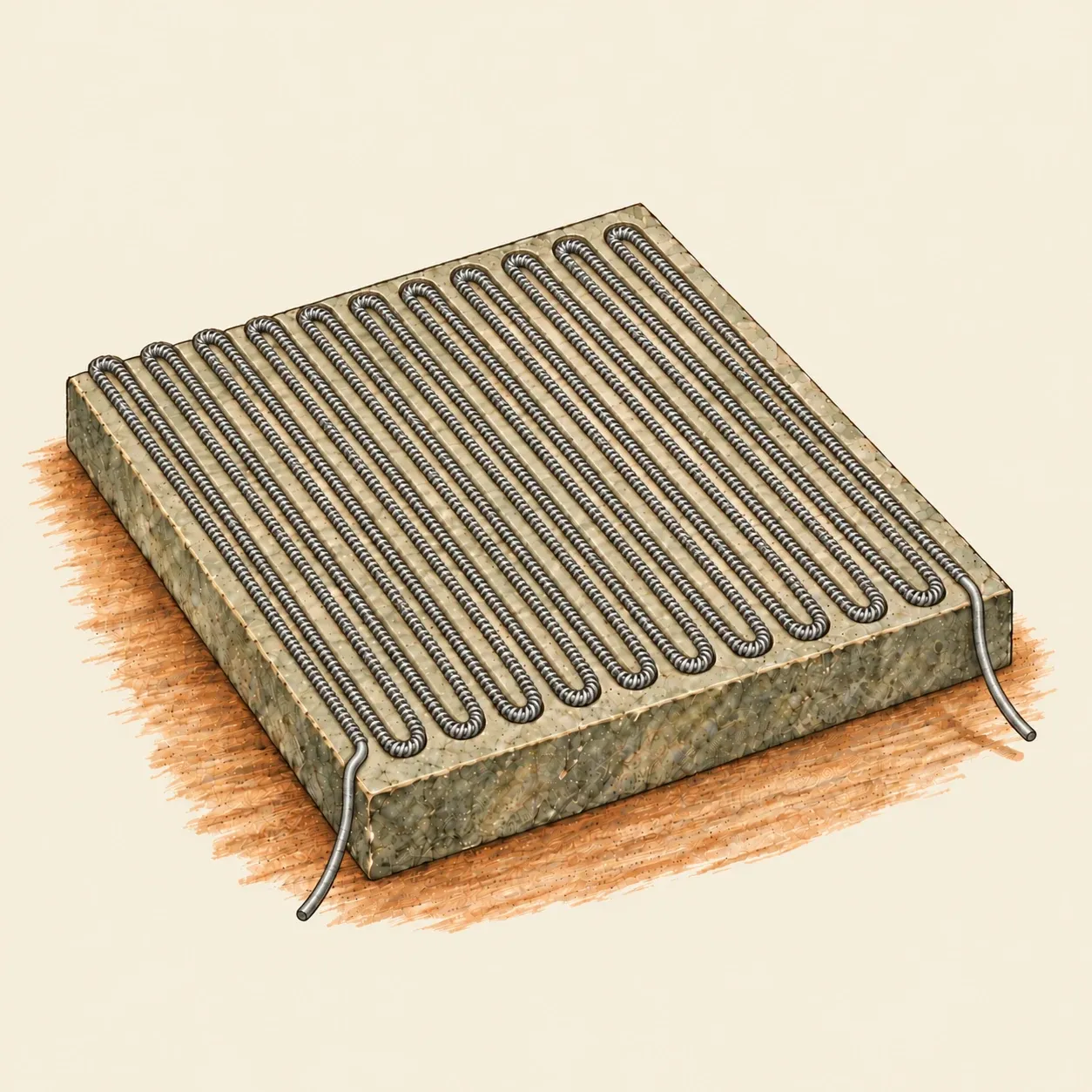 Simpson’s heater of 1859: a platinum coil laid back and forth in the grooves of a soapstone slab.
In a caveat filed on 16 December 1857, George B. Simpson of Washington described an electrical heating apparatus, and on 20 September 1859 he received a United States patent for it. He coiled platinum or another metal wire into twenty-one parallel grooves cut in a slab of soapstone about eight inches square, and fed it from galvanic batteries. He proposed it to “warm rooms, boil water, cook victuals”. The Hagley Museum and Library calls it the first patented electric range. In 1882 Henry W. Seely patented an electric clothes iron heated by a carbon resistance.
Within a few years of Marsh’s patent, several firms, General Electric among them, were making electric toasters with nickel-chromium wire. In 1918 Charles C. Abbott of General Electric, in Pittsfield, Massachusetts, applied for a patent on the sheathed element, a nickel-chromium coil insulated by powdered magnesia inside a metal tube. It was granted in 1921, and General Electric sold such elements under the name Calrod. Sheathed elements now heat water heaters, dishwashers, ovens and many other appliances.