Airship
A balloon with an engine and a rudder
Contents
- 1Spindle-shaped envelope
- 2Net and wooden spar
- 3Sail rudder
- 4Car with boiler and steam engine
- 5Chimney turned downward
- 6Three-bladed propeller
An airship is a gas balloon with engines, propellers and rudders, so that it can travel against or across the wind instead of drifting. Henri Giffard made the first powered flight in one on 24 September 1852, from Paris to Élancourt, with a steam engine hung under a long envelope. Rigid zeppelins later carried passengers across oceans, until the fire of the Hindenburg in 1937.
What it is
An airship, or dirigible, is an aircraft lighter than air that carries its own power and can be steered. A large envelope holds a gas lighter than air, which keeps the craft afloat. Engines turn propellers that push it through the air, and rudders and elevators at the tail point it where the crew wants to go. A free balloon can only rise, sink and drift with the wind.
Airships come in three kinds. A non-rigid airship, or blimp, keeps its shape only from the pressure of the gas inside it, and the cabin hangs below the envelope. A semi-rigid airship has the same pressurised envelope with a stiff keel along its underside that carries the cabin and engines. A rigid airship has a framework of girders covered with fabric, and its gas is held in separate cells inside the frame. Most rigid airships were built by the Zeppelin company, so they are often called zeppelins.
The first airship that flew under power was built by the French engineer Henri Giffard in 1852. Its envelope was 44 m long, pointed at both ends, and held about 2,500 m³ of gas, or 3,200 m³ in some accounts. A net over the envelope was gathered along a wooden spar 20 m long, and a triangular sail at the rear end of the spar served as the rudder. About 6 m below the spar hung the car, a wooden frame carrying a coke-fired boiler and a single-cylinder steam engine of 3 horsepower. The engine turned a three-bladed propeller about 3.4 m across at the back of the car.
Today an airship is certified like other aircraft before it may carry people, and its pilots hold a licence with an airship rating.
How it works
An airship floats for the same reason a balloon does: the gas in its envelope weighs less than the air it displaces. At sea level a cubic metre of hydrogen gives about 1.1 kg of lift, and helium, which is twice as heavy as hydrogen, gives about 7% less. That lift has to carry the envelope, the engines, the fuel, the crew and the load, so airships are very large for what they carry.
An elongated envelope slips through the air far more easily than a round balloon, and the propellers can then drive it forward. Its speed through the air adds to the wind. Accounts give Giffard’s airship an average of 6 to 10 km/h, and in the strong wind of its first flight it could turn and circle but not fly back against the wind to its starting point. Airships became useful only when engines were light for the power they gave and could push them faster than ordinary winds.
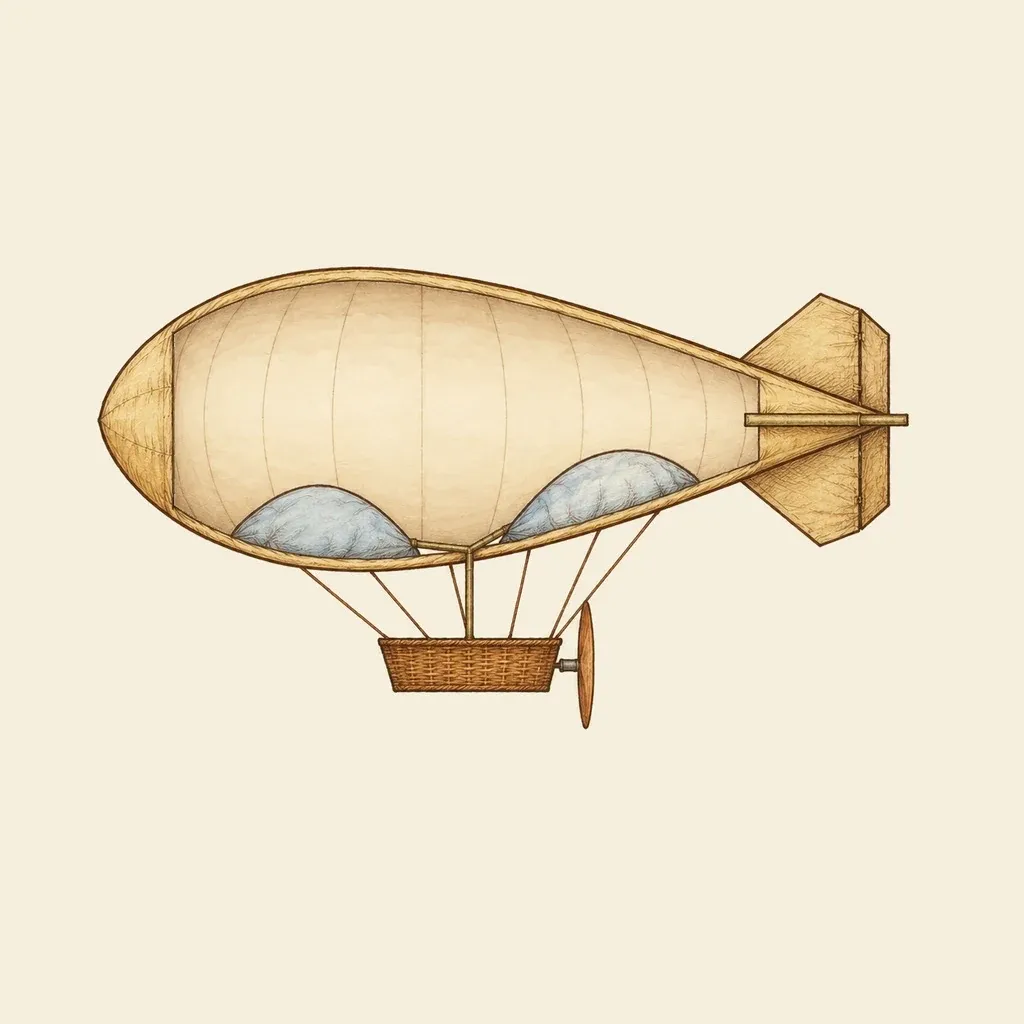 In a non-rigid airship, the ballonets empty as the gas expands and refill as it shrinks.
The rudder turns the airship, and the elevators tilt its nose up or down. Its lift changes with the load and the gas it carries: dropping ballast makes it lighter, and letting gas out through a valve reduces its lift. As the airship rises, the outside pressure falls and the gas expands. In a non-rigid airship, air bags inside the envelope, the ballonets, are emptied as the gas grows and refilled as it shrinks, so that the envelope keeps its shape. In a rigid airship the frame holds the shape, whatever the pressure in the cells.
Hydrogen and coal gas burn readily in air. Giffard’s boiler had an inverted firebox, and its smoke was led downward, away from the envelope. Dozens of hydrogen airships were later destroyed by fire, and modern airships use helium, which does not burn.
History and evolution
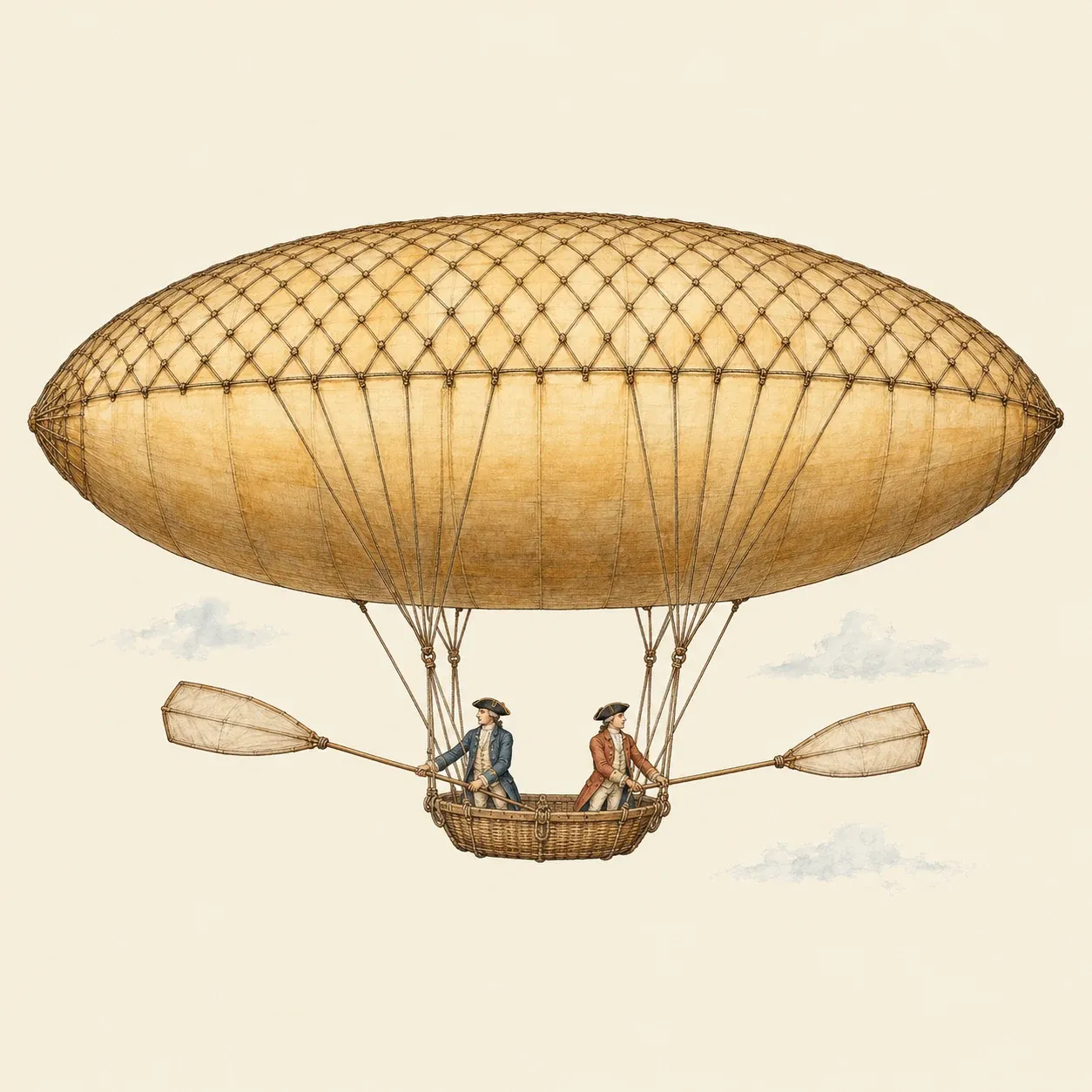 In 1784 the Robert brothers fitted their elongated hydrogen balloon with oars.
In December 1783, weeks after the first manned balloon flights, the French army engineer Jean-Baptiste Meusnier presented to the Academy of Sciences the first of two memoirs on steering balloons, with the design of an elongated balloon driven by propellers. His envelope, about 79 m long, had a second envelope inside it, and pumping air in or out of the space between the two would make it heavier or lighter. Three propellers were to be turned by eighty men. The craft was never built: money was lacking, and Meusnier died of his wounds at the siege of Mainz in 1793. In 1784 the Robert brothers, who had made the first hydrogen balloons, flew an elongated one fitted with oars, and on 19 September they covered about 186 km from Paris to Beuvry, near Béthune.
Henri Giffard, a young engineer, took out a patent for the use of steam in air navigation in 1851. On 24 September 1852 he took off alone from the Hippodrome in Paris. He wrote that the wind was strong and that he made no attempt to fight it, but that the rudder answered at once and that he turned and veered at will, rising as high as 1,800 m. He landed at dusk at Élancourt, near Trappes, about 27 km away. The detailed account of Jean Molveau says the envelope held coal gas, and that the Passy gas company would not supply more for later flights; many shorter accounts say hydrogen.
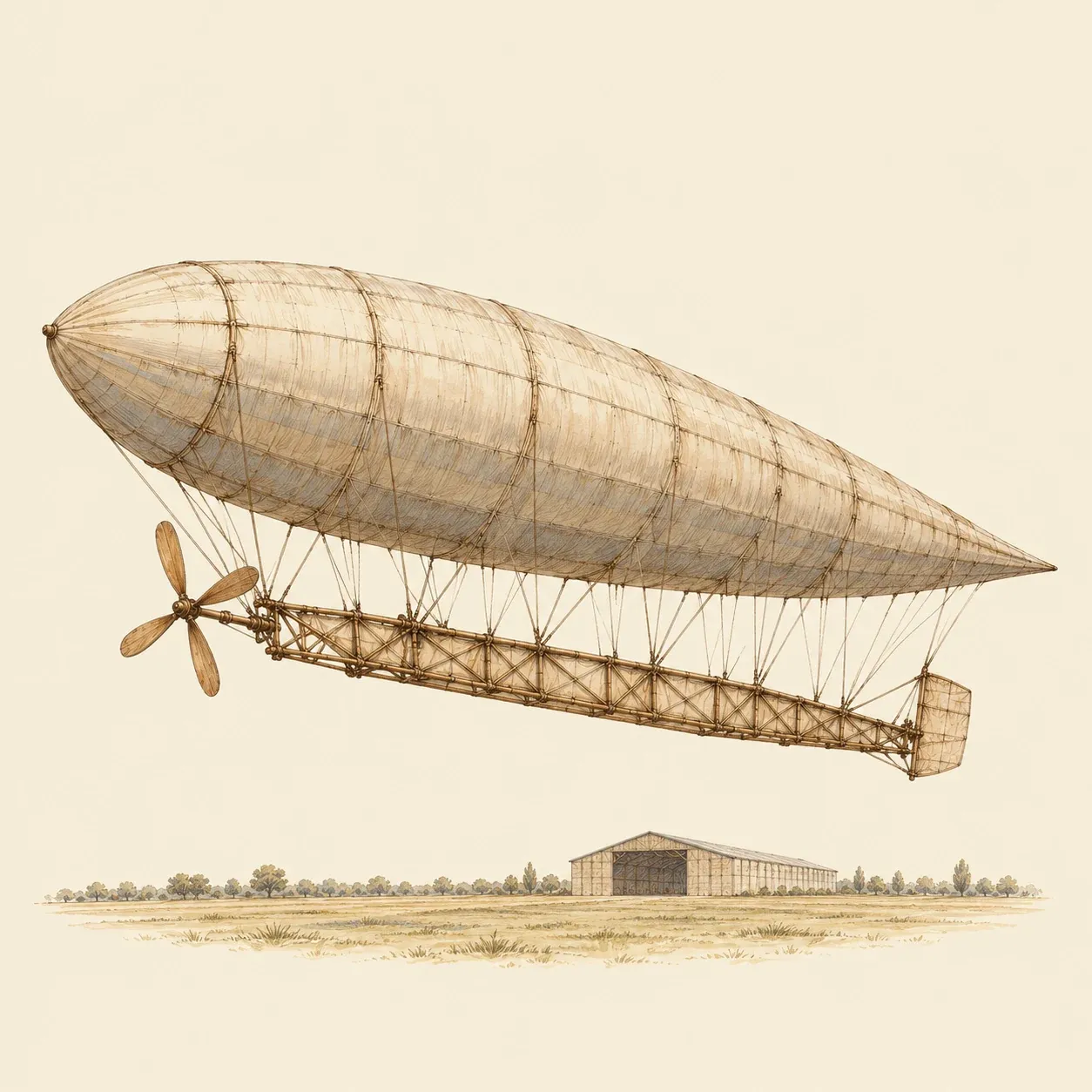 In 1884 La France flew a closed circuit under an electric motor and landed where it had started.
Steam was too heavy, so other inventors tried electricity. In 1884 Charles Renard and Arthur Krebs, officers of the French army, flew the airship La France, driven by a battery and an electric motor, on a circuit of about 8 km from Chalais-Meudon and back to the ground they had left. Light petrol engines came next. In Germany Ferdinand von Zeppelin flew his first rigid airship, LZ 1, over Lake Constance on 2 July 1900. In 1901 Alberto Santos-Dumont flew his airship No. 6 from Saint-Cloud around the Eiffel Tower and back in under half an hour and won the Deutsch prize. In 1926 the Italian semi-rigid Norge, piloted by its designer Umberto Nobile, carried Roald Amundsen’s expedition over the North Pole from Svalbard to Alaska.
The rigid airship reached its peak with the Graf Zeppelin, which between 1928 and 1937 made 590 flights, flew around the world in 1929 and carried passengers and mail to South America. On 6 May 1937 the hydrogen of the Hindenburg caught fire as it came in to land at Lakehurst, New Jersey, and 36 people died. The disaster ended scheduled transatlantic passenger service by airship. Most airships flying today are small non-rigid blimps filled with helium.