Frame beehive
Movable frames spaced to the bees' own measure
Contents
- 1Roof
- 2Honey super
- 3Queen excluder
- 4Brood box
- 5Frame holding its comb
- 6Bee space
A frame beehive holds each honeycomb in a wooden frame that hangs in a box without touching the walls, the floor or the next comb. The gap left around every frame, the bee space, is too narrow for the bees to fill with comb and too wide for them to seal shut, so any comb can be lifted out, inspected and put back. Lorenzo Langstroth built his top-opening frame hive in 1851 and patented it in 1852.
What it is
A wild honeybee colony builds its nest in a cavity such as a hollow tree, as a row of parallel wax combs hanging from the roof. Each comb is a sheet of six-sided cells on both faces, where the bees raise their young, the brood, and store honey and pollen. For thousands of years people kept bees in hollow logs, clay pipes or straw baskets, and the bees fixed their combs to the walls. To take honey the keeper cut combs out, and nobody could look at the brood without breaking up the nest.
The frame hive is a wooden box in which each comb is built inside a removable rectangular frame. The frames hang side by side from ledges at the top of the box, like files in a drawer, and a small gap separates them from each other and from every wall. The keeper can lift out any comb, look at both faces and put it back, give it to another colony, or empty it of honey and return it whole. The tools and habits of modern beekeeping grew up around this box: the smoker and the veil, the boxes stacked on top for honey, and the extractor that spins honey out of the comb.
How it works
The design depends on one measurement. Bees fill a gap narrower than about 6 mm with propolis, a sticky resin they collect from plants, and build comb in a gap wider than about 9.5 mm. A gap in between, which beekeepers call the bee space, they leave open as a passage, wide enough for two bees to work back to back. The University of Arkansas Extension gives combs in a natural nest as centred about 38 mm apart. Langstroth’s patent of 1852 left about three eighths of an inch, 9.5 mm, between the frames and the sides and floor of the box, so that the bees would not fasten them there.
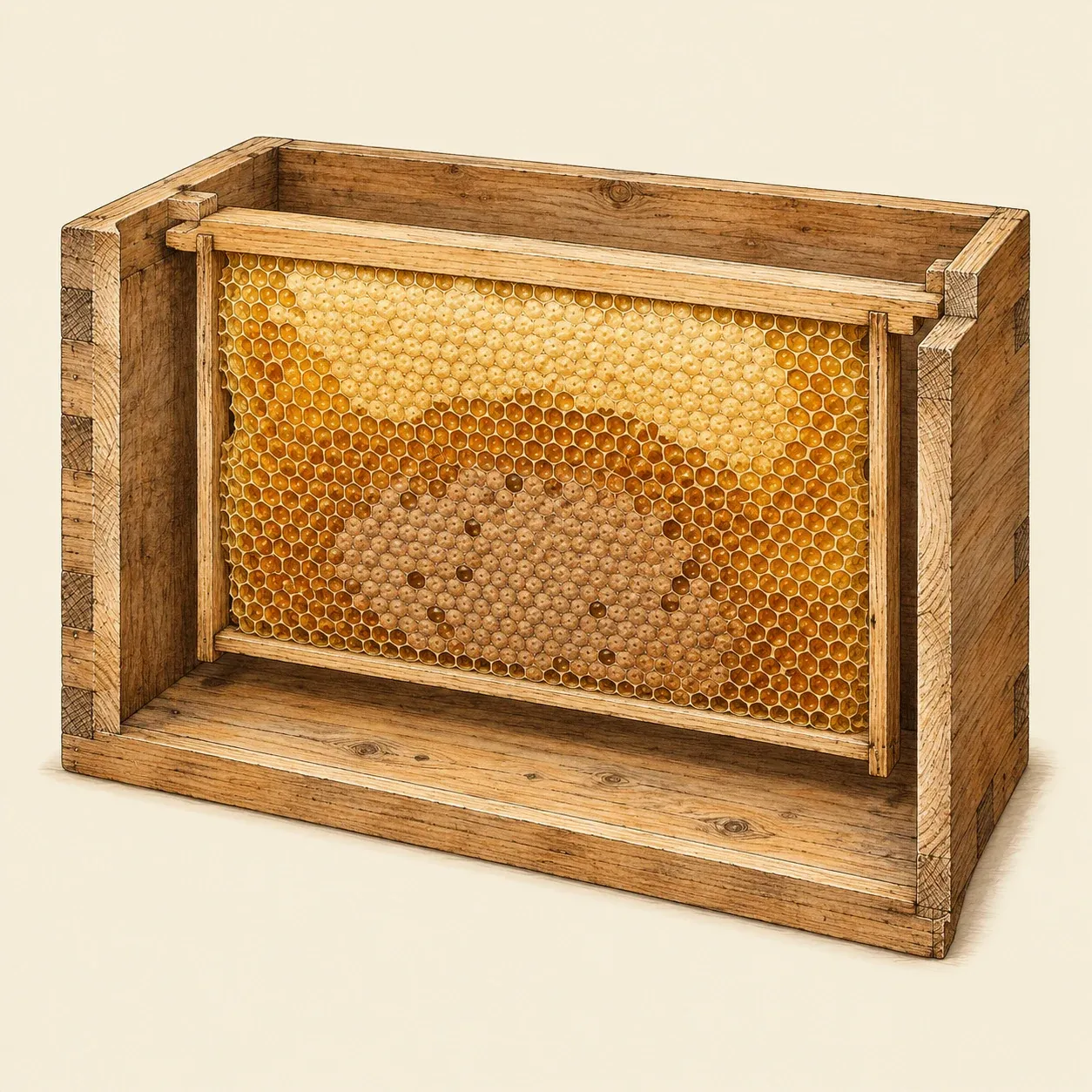 The frame hangs by the ends of its top bar and touches nothing else.
A frame is a top bar, two side bars and a bottom bar. The ends of the top bar stick out as lugs and rest in a rebate cut along the top of the front and back walls, so the frame hangs there and touches the box nowhere else. In modern frames the side bars are wider than the top bar, and frames pushed together space themselves. A standard box takes ten frames, a lighter version eight. The bees start their comb from a line of wax or a sheet of wax foundation fixed under the top bar and build it downwards, parallel to the combs on either side.
The colony lives in the lowest box, the brood box, where the queen lays her eggs. The Arkansas Extension counts 3,360 cells on each face of a standard deep frame and 20,000 to 60,000 bees in a hive. Bees store honey above their brood, so the keeper adds shallower boxes called supers on top as the season goes on. Between the brood box and the first super lies a queen excluder, a grid whose holes let workers through and stop the larger queen, so that she lays no eggs in the honey combs. An inner cover and a roof close the top, and the entrance is a slot just above the floor board.
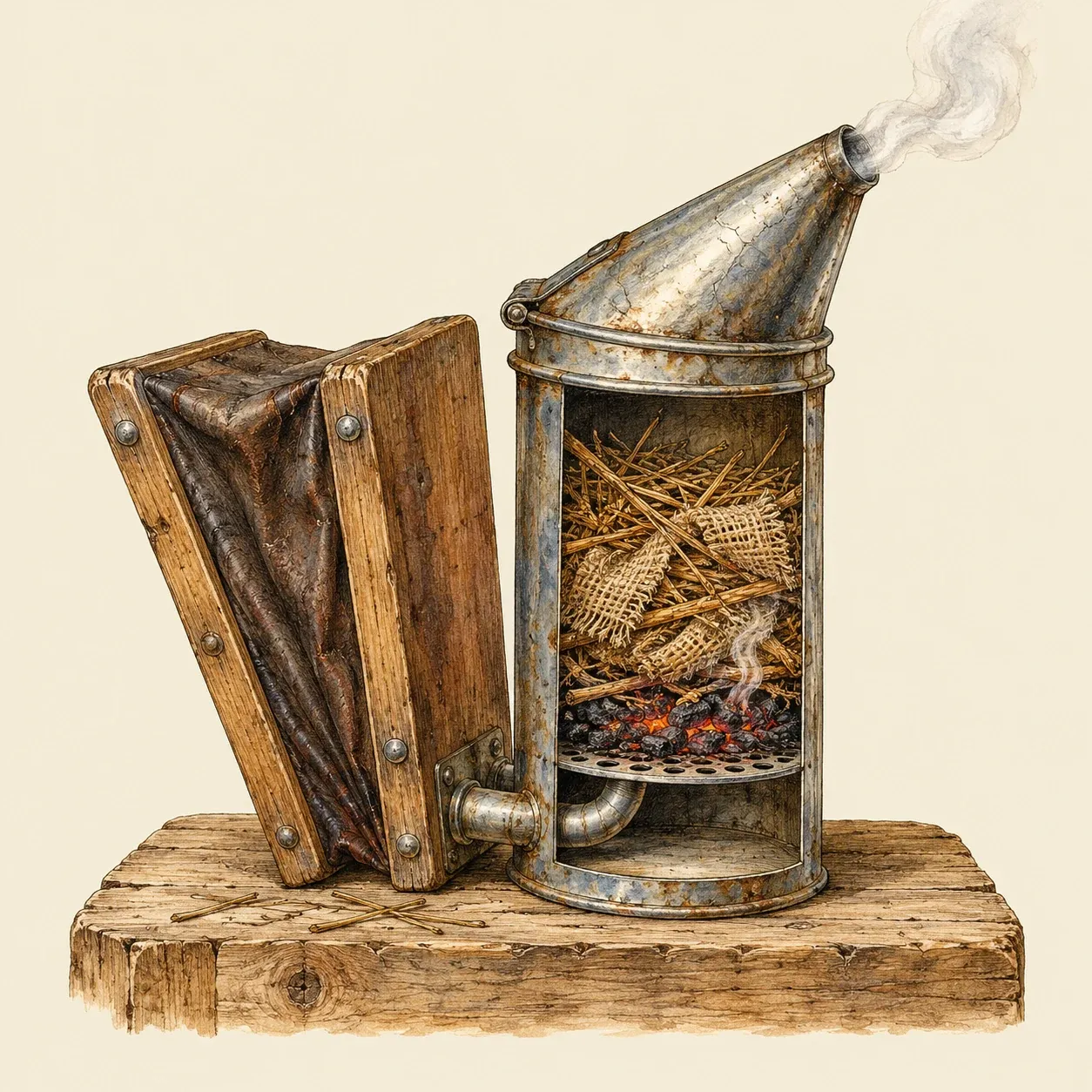 Air from the bellows enters under the grate and drives cool smoke out of the spout.
Opening a hive alarms the guard bees. A bee that senses danger or stings gives off an alarm pheromone, an odour whose main component is isopentyl acetate, and other bees join the defence. Smoke masks that odour. The smoker is a metal can with a grate, a cone lid and a small bellows. Fuel such as pine needles, burlap or dried dung smoulders on the grate, more fuel packed on top cools the smoke and catches sparks, and each squeeze of the bellows sends out a puff. The FAO advises a little smoke at the entrance before the hive is opened, then gentle handling.
Movable frames let the keeper read the colony. An inspection checks that the queen is laying and that the bees have enough stores, and looks for disease and for the large queen cells that come before swarming. Frames of brood or honey can be moved from a strong colony to a weak one, and one colony can be split into two. A swarm is a queen leaving with part of the colony, leaving about half of it behind, and it can be caught in an empty hive rubbed inside with beeswax. At harvest the keeper takes out frames whose honey the bees have sealed with wax, slices off these cappings with a knife and spins the frames in an extractor. The honey flies out against the drum, and the empty combs go back into the hive. The FAO puts the yield at about 75 kg of honey for every kilo of wax in frame hives, against about 10 to 1 where combs are cut out and pressed.
How to do it
Every part of a hive has to match to within a few millimetres, so a beginner should buy or borrow a standard hive and join a local beekeepers’ group. A spare frame for a box you already have is a good first piece of work.
Measure the inside of the box from the front wall to the back wall, and the depth from the bottom of the rebate to the floor. Cut a top bar long enough to rest about a centimetre into each rebate, then two side bars and a bottom bar so that the finished frame clears each end wall and the floor by 6 to 9.5 mm. Copy the width of the side bars from a frame already in the box, so that the new frame keeps the same spacing as its neighbours. Use plain softwood: the Arkansas Extension warns that treated timber usually contains insecticide. Glue and nail the joints with small nails and check that the frame is square.
Melt a little clean beeswax in a container standing in hot water and run a thin line of it along the middle of the underside of the top bar, or fix a strip of old comb there. Langstroth’s manual already used such a line or strip as a guide, and the bees build their comb down from it. Hang the frame in the box with the others and check after a week or two that the new comb is straight.
Safety. Beeswax melts at 62 to 64 °C and is highly flammable: heat it only in a container standing in water, never over a direct flame, and never leave it unattended. In some people a sting causes anaphylaxis, with faintness, confusion and loss of consciousness, which is a medical emergency treated with adrenaline: call for help at once. Never open a hive without a veil, gloves and light-coloured clothing, and do it the first times with an experienced beekeeper.
History and evolution
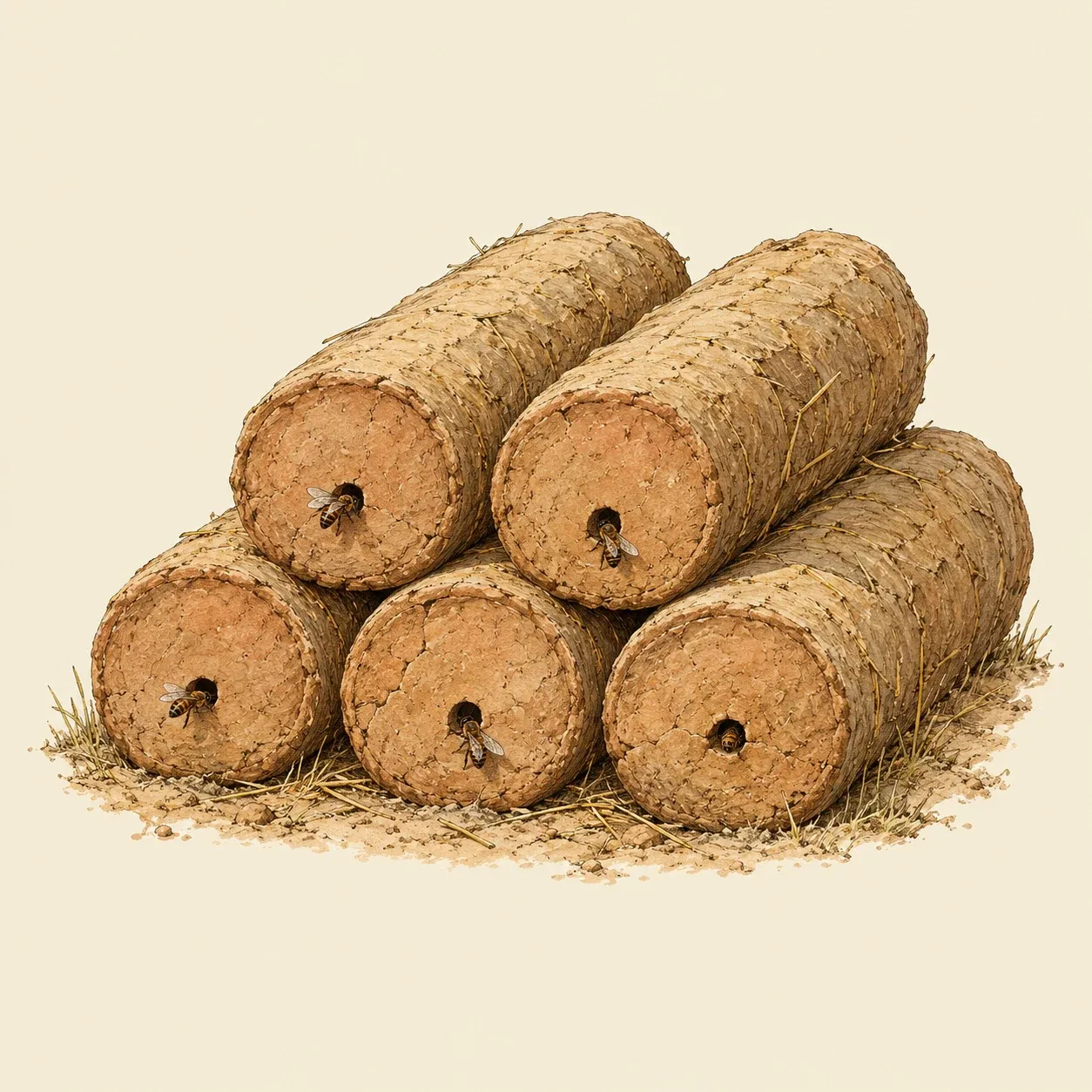 In clay cylinder hives the bees fixed their combs to the walls, and the combs had to be cut out.
The oldest known picture of beekeeping is a relief from the sun temple of King Niuserre at Abu Ghorab in Egypt, about 2400 BCE. Eva Crane and A. J. Graham describe a kneeling man blowing smoke through a vessel towards a stack of horizontal hives, and Gene Kritsky notes other men pouring honey into jars. A painting in the tomb of Rekhmire, about 1450 BCE, again shows honeycombs taken from hives with the help of smoke. The oldest hives yet found come from Tel Rehov in the Jordan valley: Guy Bloch and his colleagues published cylinders of unfired clay from the 10th to early 9th century BCE, with the remains of workers, drones, pupae and larvae inside. In such hives, as in logs and straw baskets, the combs were fixed and had to be cut out.
Bars that the bees could build on were older than frames. Langstroth thought them probably at least a hundred years old, and he had used bar hives himself, but the bees still fastened the combs to the sides of the box. In 1789 François Huber of Geneva, whose poor sight made him work through an assistant, François Burnens, described his leaf hive. It was twelve fir frames a foot square, each holding one comb and hinged to the next, so that the hive opened like a book and both faces of every comb could be watched. In 1814 Petro Prokopovych in Ukraine built one of the first hives with frames, opened from the side. The clergyman Johann Dzierzon, in Prussia, is said to have identified the bee space in 1835, and his hive with bars, opened from one end, spread across Germany.
Lorenzo Langstroth, an American clergyman who kept bees near Philadelphia, first laid bars on rebates in the front and back walls of his box. To stop cutting combs free, he then hung each comb in a frame that touched neither the top, the floor nor the sides, in a box that opened from the top so that any comb came out without disturbing the rest. In 1851 he showed this hive to a Philadelphia pastor, Dr Berg, who told him of Dzierzon, and each man had worked without knowing of the other. In Dzierzon’s hive, Langstroth wrote, nine combs had to be cut out to reach the tenth from the end. His patent is dated 5 October 1852, and his manual appeared in 1853.
The Arkansas Extension describes the Langstroth hive, or designs close to it, as the world standard for practical beekeeping and commercial honey production. Langstroth’s patent already listed what it made possible: examining every comb, strengthening weak colonies, raising queens and making new colonies without waiting for swarms. In the 1960s a top-bar hive with steeply sloping sides was developed in Kenya. It keeps movable combs without frames, and since its combs are cut out at harvest it yields far more wax for each kilo of honey.