Bellows
Moving air with a flexible chamber
Contents
- 1Wooden boards and handles
- 2Hinge at the nose
- 3Leather sides
- 4Inlet hole with a flap opening inwards
- 5Nozzle
Loading the figure…
Bellows are an air pump built around a flexible chamber. Opening it draws air in through a valve, and closing it drives the air out through a nozzle as a jet that makes a fire burn hotter. The oldest that survive are clay pot bellows from a copper smelting workshop in eastern Crete, of the late third millennium BCE.
What it is
Bellows are a pump for air. A flexible chamber is opened to fill it and squeezed to empty it, and since the only open way out is a narrow nozzle, the air leaves as a jet. Aimed at burning charcoal, that jet feeds the fuel more oxygen than a natural draught and raises the heat enough to melt copper and cast bronze, or to smelt iron.
The fireside hand bellows has two wooden boards with handles, hinged together at the nose. A band of leather nailed round the edges of both boards closes the sides and folds up as the boards come together. The lower board has a hole covered on the inside by a leather flap, and a metal nozzle is set into a block at the nose. Older bellows used the same parts in other shapes: a clay or stone pot covered with a skin, or a leather bag, worked by hand or by foot.
How it works
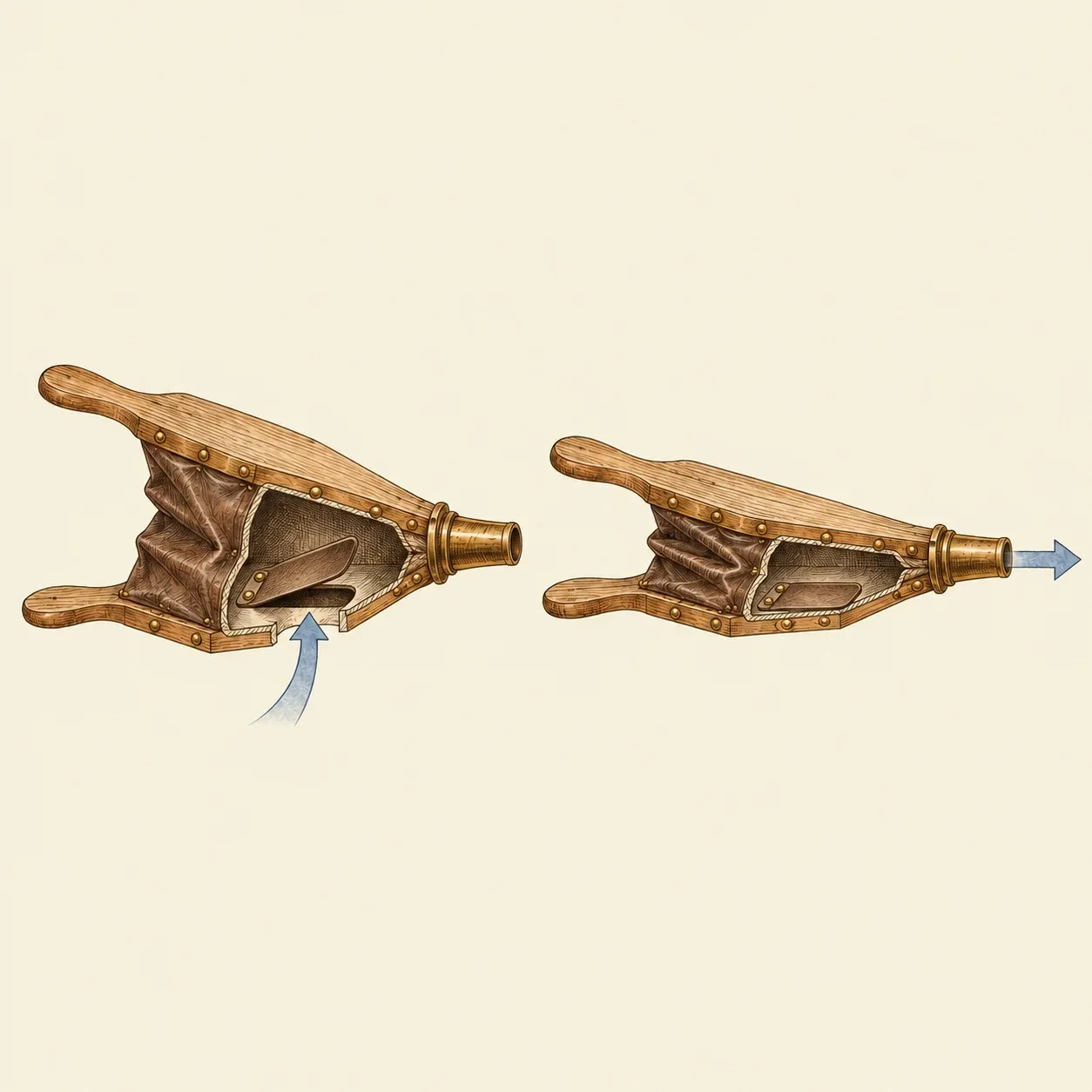 Opening the boards lifts the flap and fills the chamber; closing them shuts the flap and sends the air out of the nozzle.
When the handles are pulled apart, the space inside grows and the pressure drops slightly below that of the air outside. The outside air pushes the flap up and flows in through the hole. A little also comes back through the nozzle, which is never closed, but the hole is much wider and offers the easier path.
When the handles are pushed together, the pressure inside rises, presses the flap down on the board and closes the hole. The air can then only leave through the nozzle. A quick stroke gives a strong jet, a slow one a gentle stream. A single chamber blows in puffs, with a pause at each refill, so metalworkers who needed a steady blast worked two bellows in turn, filling one while emptying the other.
The nozzle of a furnace bellows did not go into the fire. In ancient workshops the air pipe ended in a clay nozzle, the tuyère, which was set into the furnace wall and could stand the heat. A hand bellows used on a hearth is held back from the embers for the same reason.
How to do it
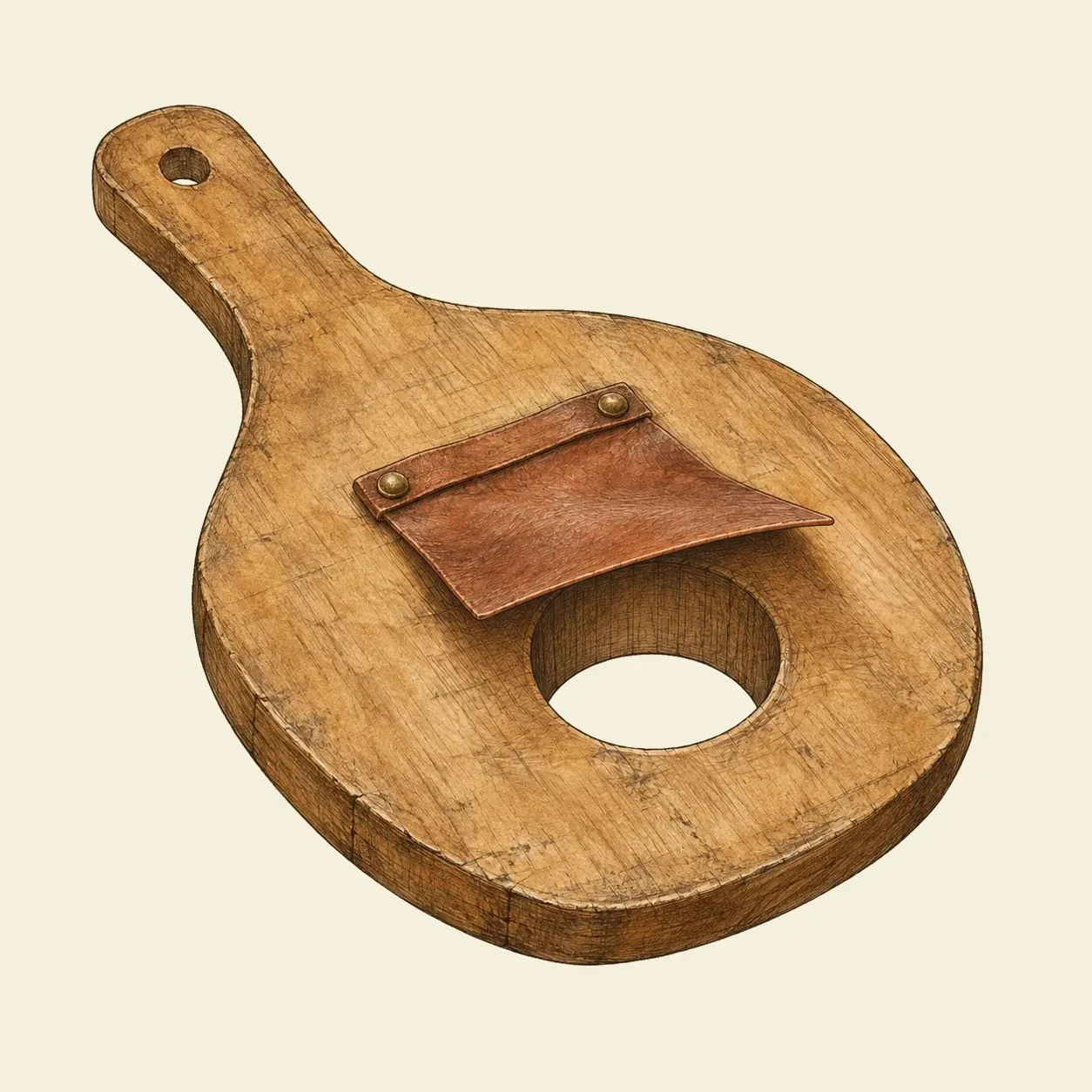 The flap is nailed along one edge on the inside of the board, so the air can push it open only inwards.
Cut two boards of the same pear shape from dry hardwood, each with a handle at the wide end. Leave the lower board thicker at the narrow end, or glue a block there, and bore a channel through it lengthwise for the nozzle. Bore a round hole near the middle of the lower board. On its inner face, nail a piece of soft leather a little larger than the hole along one edge only, so that it lifts freely and falls back flat. Check it at once: blow gently through the hole from the outer face and the flap should lift, then fall back flat over the hole and stay shut when you suck.
Join the two boards at the nose with a strip of leather nailed across both, so that they open like a book. Cut the side leather long enough to go all round and deep enough to let the boards open fully. Lay it along the edge of each board, cover it with a thin strip of leather or wood and drive the nails through the strip and the leather into the wood. The strip clamps the leather against the edge, spreads the pressure of the nail heads and stops leaks between them. Carry the leather over the hinge so the nose is airtight. Fit a tube of brass, copper or iron into the channel and seal it in with glue or wax. A wooden nozzle would char at the fire.
Test the bellows cold once it is closed. The flap is now out of sight, so check the inlet from outside: hold a thread or a feather just under the hole and open the boards slowly, and it should be drawn towards the hole. Close them and the thread should hang still while the air comes from the nozzle alone. A strip of paper held in front of the nozzle shows the jet. If it is weak, run a wet finger along the seams to find the leaks and add nails or glue there.
Bellows feed a fire, and the fire flares as they work. Use them only on a fire in a hearth, stove or outdoor fire pit, with nothing that can burn close by and water or sand within reach. Keep the nozzle and the leather out of the embers and away from flames, and stand to the side, as sparks and ash can fly up. Never burn charcoal indoors, as it gives off carbon monoxide, a gas with no smell that can kill; light a charcoal fire only in the open air.
History and evolution
Early metalworkers blew air into the fire through tubes. Tomb scenes of the Old Kingdom in Egypt show two or three men blowing through pipes at the open side of a crucible, and a painted limestone figure of the Fifth or Sixth Dynasty from Giza shows a kneeling man doing the same. An earlier use of bellows has been proposed. At Abu Matar, a copper workshop of the Ghassulian period (4500–3800 BCE) in the northern Negev, Thomas Rose and his colleagues re-examined the metallurgical finds. In their reading, several fragments that had never been published point to bellows and to furnaces covered with large potsherds, which would make them probably the oldest evidence of bellows.
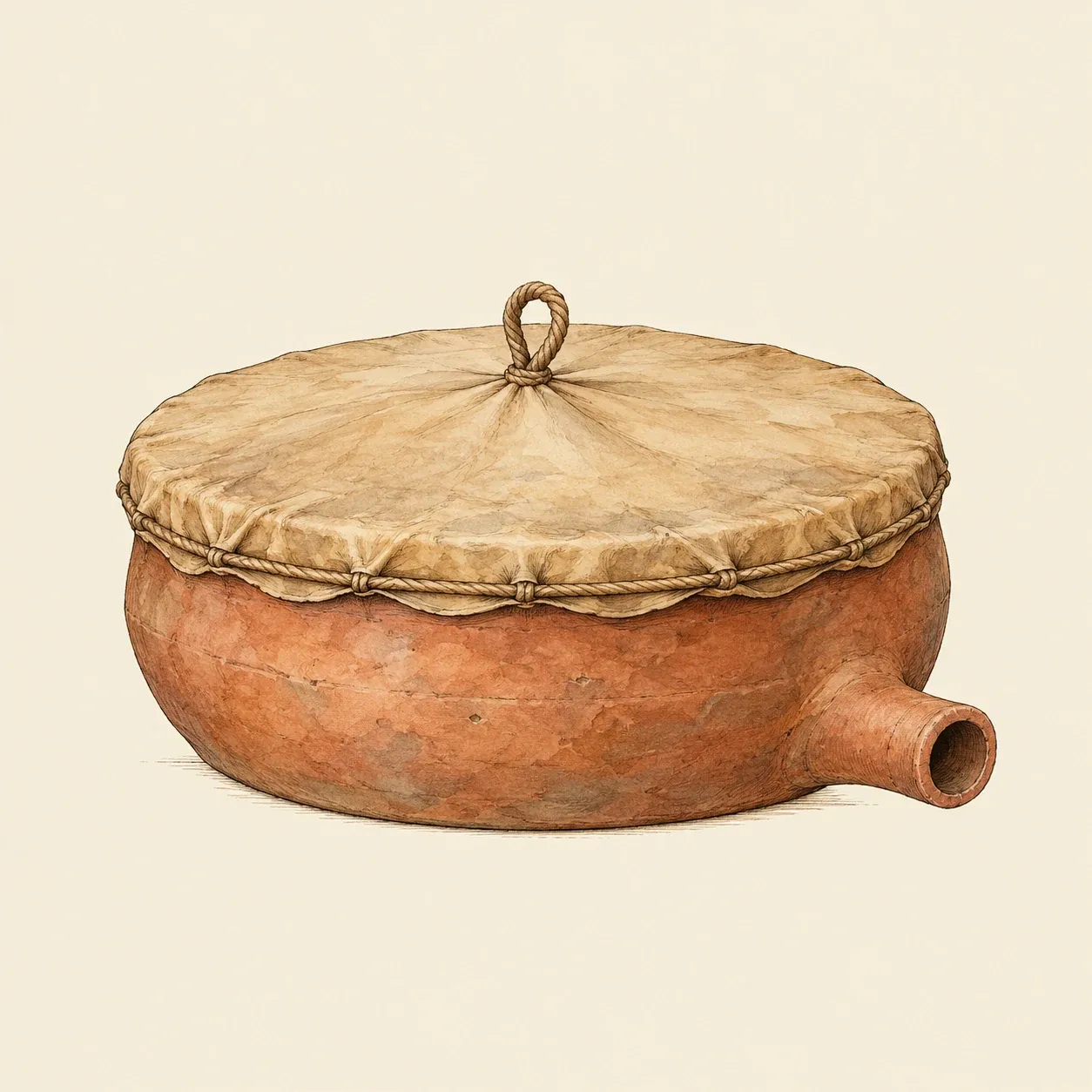 A pot bellows: a squat clay vessel with a nozzle near its base, closed by a skin that was pulled up and pressed down.
The oldest objects recognised as bellows are pot bellows: a squat vessel of clay or stone with a nozzle near its base, closed at the top by a skin that the operator pulled up and pressed down. The oldest that survive come from Chrysokamino, a copper smelting site in eastern Crete. Philip Betancourt’s team found fragments of at least ten in levels of Early Minoan III, at the end of the third millennium BCE. They are drums of local clay, 28 to 48 cm across. Roger Doonan and Yvette Marks accept them as pot bellows, but question whether they were used to smelt the ore in the site’s furnaces. In the Near East, Christopher Davey, who catalogued pot bellows in 1979, placed the earliest in central Anatolia and Babylonia in the early second millennium BCE. They were in use in northern Syria and southern Palestine by the middle of that millennium, and later in Egypt and Cyprus. In the Levant stone pot bellows of the Middle Bronze Age gave way to ceramic ones. On Cyprus, Vasiliki Kassianidou identifies the oldest probable pot bellows, which arrived with clay tuyères, in a copper smelting workshop of 1650–1500 BCE.
Egyptian tomb paintings of the 15th century BCE show bellows worked by foot. In the tomb of the vizier Rekhmire at Thebes, a worker stands on two leather bags and shifts his weight from one to the other. As he steps off a bag, he pulls its top up with a cord so it fills again, and a reed pipe ending in a clay nozzle carries the air into the fire. Norman de Garis Davies, who copied the scene, saw no valve and suggested that the air came in through a hole closed by the worker’s heel.
Hand bellows with hinged boards survive from early modern Europe. The Metropolitan Museum holds an oak and leather example decorated with the Flight into Egypt, made in the Netherlands in the first half of the sixteenth century or later, and bellows of about 1675 in wood, leather, iron and silver that belong to a set.