Pipe organ
Steady wind, keys and tuned pipes
Contents
- 1Pump lever
- 2Pump cylinder with its piston
- 3Inverted funnel standing in the water tank
- 4Wind chest
- 5Key and perforated slider
- 6Pipes
A pipe organ is a wind instrument played from a keyboard. Air kept at a steady pressure fills a wind chest, and each key opens a valve that lets it into pipes tuned to one note each. Ancient writers credit the first, the hydraulis or water organ, to Ctesibius, an engineer in Alexandria in the third century BCE.
What it is
A pipe organ gives each note its own pipe. A pipe sounds a single pitch, so an organ needs at least one pipe per key, and most have several sets of them, called ranks or stops, each with its own tone colour. The instrument has four working parts: a wind supply that keeps air at a steady pressure, a wind chest that holds this air under the feet of the pipes, the keys and the valves they open, and the pipes themselves.
The oldest form is the hydraulis, the water organ of the Greek and Roman world. Two hand pumps forced air into a funnel standing upside down in a tank of water, and the water held the pressure steady. Above the tank stood the wind chest and a row of pipes, played from a row of keys. Later organs replaced the pumps and the water with weighted bellows and added many more pipes, but kept the same four parts.
How it works
In the hydraulis, each pump is a cylinder with a piston worked by a long lever, like the force pump of the same engineer. Valves let the air go one way only, from the cylinders into the top of the inverted funnel. The funnel rests on small blocks, so its open mouth stands a little above the bottom of the tank. Air pumped in drives the water out of the funnel and up into the tank around it, and the weight of that raised water presses back on the air. Between two strokes the water flows back into the funnel and keeps pushing air towards the pipes, so the pressure hardly drops. If too much air is pumped in, it escapes in bubbles under the rim of the funnel.
A pipe leads from the top of the funnel up to the wind chest. In the top of the chest, under the foot of each pipe, a thin slider with a hole runs in a groove. Pressing a key pushes its slider until the hole lines up with the pipe and the wind rushes in. When the key is released, a spring pushes the slider back and the pipe falls silent. Vitruvius describes chests with four, six or eight channels, one per row of pipes, each opened or closed by a stop.
Later organs supply the wind from bellows loaded with weights, which press them down slowly and keep the pressure set by the weights. In the usual slider chest, each key pulls down a valve called a pallet, through a linkage of thin wooden strips, and lets wind into a channel that runs under all the pipes of that note. Each rank has its own perforated slider, moved by a stop knob. A pipe speaks only when the pallet of its note is open and the slider of its rank is drawn. A spring closes the pallet when the key comes up.
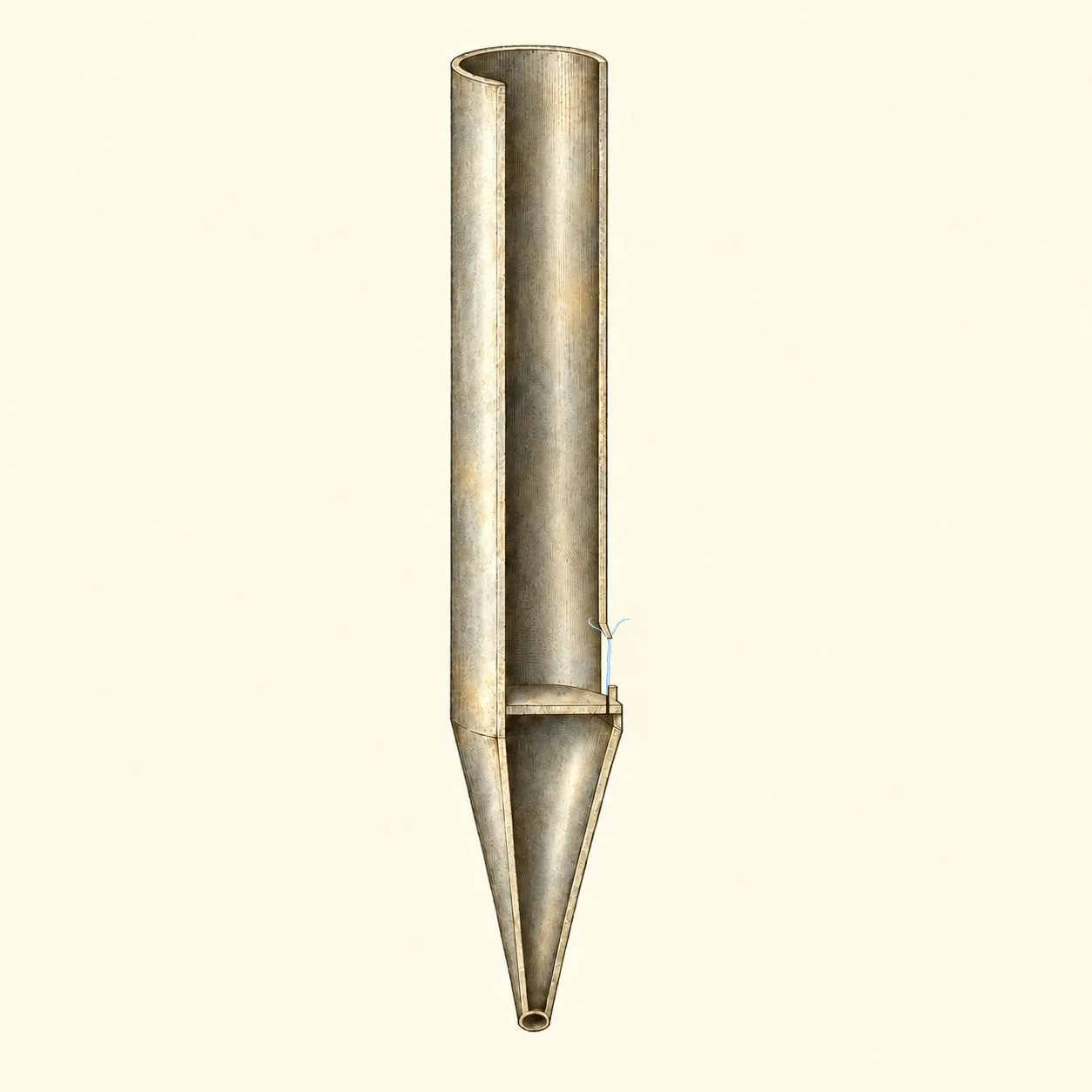 The sheet of air leaving the slit strikes the upper lip and flips in and out of the pipe.
Flue pipes work like a recorder and have no moving part. Wind enters the foot and leaves through a narrow slit between a flat plate, the languid, and the lower lip. The thin sheet of air crosses the mouth and strikes the sharp upper lip. It flips in and out of the pipe at each cycle, steered by the pressure waves in the air column above, and the column sets the pitch. An open pipe is about half a wavelength long. A stopped pipe, closed at the top, is a quarter wavelength long and sounds about an octave lower than an open pipe of the same length. An open pipe about 2.4 m long, eight feet in organ builders’ terms, sounds the C two octaves below middle C, at about 65 Hz. Reed pipes make their sound differently, with a vibrating brass tongue.
Metal pipes are usually cast from alloys of tin and lead. More tin brightens the tone, more lead darkens it. Wooden pipes are square in section and built from boards.
How to do it
A whole organ takes years of work by trained builders. A small demonstration shows the main parts: a wooden wind box, three stopped wooden pipes and a hand bellows. Each pipe sounds when a slider is pushed, as on the hydraulis.
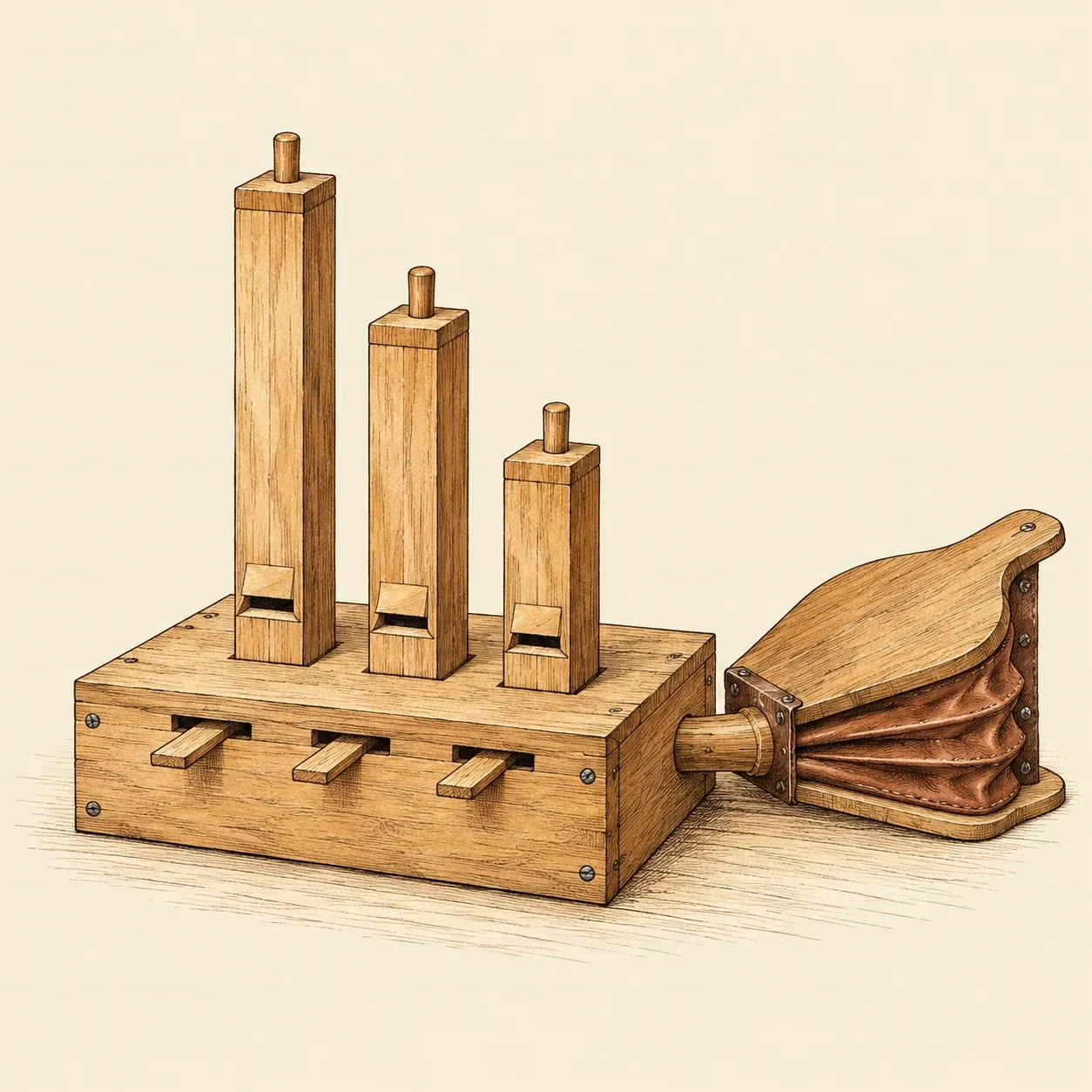 Three stopped pipes on a wind box: each slider opens one pipe, and the bellows feeds the box from the side.
Build the box from planed boards glued and screwed together, about the size of a shoebox, and seal every joint with glue so it holds air. Bore a hole in one side for the nozzle of a hand bellows whose inlet flap works. In the top board, bore three holes for the pipe feet. Under each hole, cut a groove across the board and fit a thin wooden slider with one hole in it, so that pushing the slider in lines its hole up with the pipe and pulling it out closes the pipe. Rub the sliders with soap or graphite so they run easily without leaking much.
Make each pipe from four strips of straight-grained softwood glued into a square tube. Glue a block into the lower end, plane a very shallow flat across its front face to form the slit, and cut the mouth in the front wall just above the block, with the upper edge bevelled to a sharp lip. Close the top with a wooden stopper wrapped in leather or felt, with a handle so it can slide in and out. To choose the length, divide the speed of sound, about 343 m/s at 20 °C, by four times the frequency: for the A at 440 Hz this gives about 19.5 cm of air column. A real pipe sounds lower than this figure, because some air just outside the mouth vibrates with the column, so the column between mouth and stopper must end up shorter; for a stopped pipe the organ builder Cavaillé-Coll subtracted about one pipe width. Make the tube a few centimetres longer than the calculation all the same, to leave room for the stopper and for tuning, and tune it by moving the stopper: pushing it in shortens the column and raises the note.
Pump the bellows gently and steadily, then push one slider. If the pipe only hisses, the slit is too wide or the lip is not in line with it: adjust them with thin card shims and fine paring. If it jumps to a much higher note, the wind is too strong; pump more gently. The note wavers with each stroke of the bellows, which is why real organs take their wind from bellows held down by weights.
Safety. Clamp the wood when sawing, chiselling or paring, and cut away from your hands. Glue and fine dust from sanding can irritate the lungs: work in a ventilated room and wear a dust mask. Never cut, sand or solder old metal organ pipes, which usually contain lead; lead dust and fumes are poisonous. Use the bellows rather than your mouth, especially if pipes are shared.
History and evolution
Ancient writers credit the water organ to Ctesibius, an engineer in Alexandria. None of his own writings survive. Modern historians place him around 250 BCE, during the reigns of the early Ptolemies, but the Greek writer Athenaeus put him under a later king, Ptolemy VIII Euergetes II, in the second century BCE. In the early first century BCE, Delphi honoured Antipatros of Eleutherna, a hydraulis player who performed there for two days, with a bronze statue; editions of the decree date it to 94/93 or to 86 BCE. Vitruvius, writing in the late first century BCE, and Hero of Alexandria describe the instrument’s pumps, water tank, wind chest and sliders.
The oldest remains of an organ come from Dion in northern Greece. In 1992 excavators led by Dimitrios Pandermalis found the upper part of an instrument there: a set of bronze pipes and a metal plate that carried them. The European Cultural Centre of Delphi, which had a replica built between 1995 and 1999, dates the find to the first century BCE. Stefan Hagel, who leads a research project on it, dates it to about the first century CE and expects that it was blown by bellows rather than regulated by water.
At Aquincum, the Roman town on the site of Budapest, a bronze tablet records that in 228 CE Gaius Julius Viatorinus gave an organ to the guild of textile dealers, which also served as the town’s fire brigade. Its remains were found in 1931 in the cellar below the guild’s hall, where they had fallen when a fire destroyed the building. The small, portable instrument had 52 pipes in four rows of thirteen. The Aquincum Museum notes that scholars still disagree on whether water or air steadied its wind; the organologist Jeremy Montagu thinks it had bellows held down by a weight.
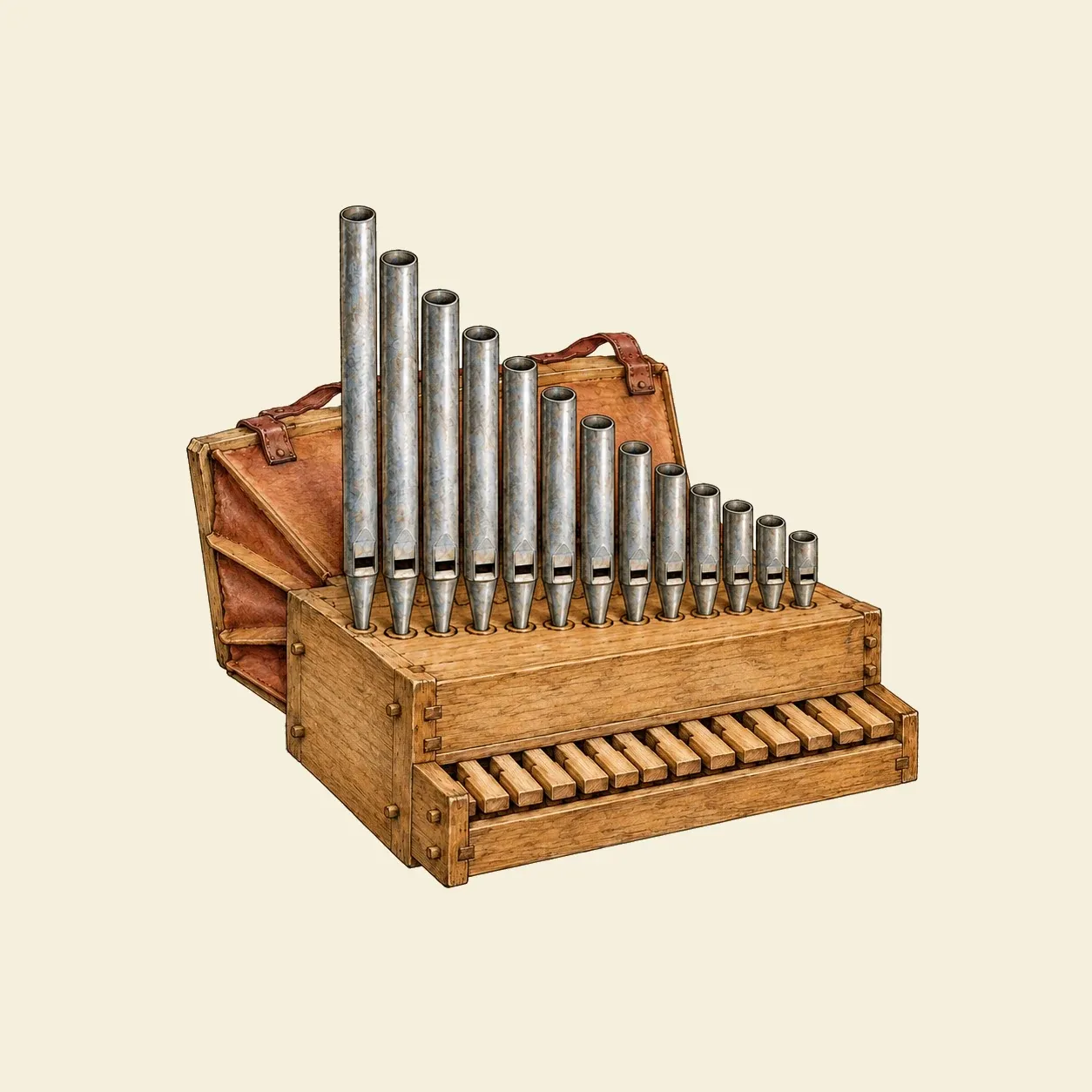 By the thirteenth century small portable organs appear: one hand plays while the other pumps the bellows.
Bellows replaced the water regulator over the following centuries. The Royal Frankish Annals record that in 757 the Byzantine emperor Constantine V sent an organ to the Frankish king Pepin among other gifts. In 1906 Franciscans digging at their monastery beside the Church of the Nativity in Bethlehem found 221 pipes of an organ of the twelfth century, with bells and other church furnishings. According to Montagu, the stops and keyboard of Aquincum had been forgotten by the ninth or tenth century, when each note was played by pulling out and pushing back a handle. By the thirteenth century small portable organs appear, played with one hand while the other pumped a pair of bellows. He dates the first reed ranks to the late fifteenth century.