Flutes
Finger holes and separate pipes
Contents
- 1Bone body of the Nishapur flute
- 2Visible holes in the tube
- 3Upper openings of the putu pipes
- 4Bindings holding the pipes together
A flute makes sound when a jet of breath strikes an edge and sets the air in a tube vibrating. On a flute with finger holes, the player changes the pitch by opening and closing holes. On panpipes, the lips move from pipe to pipe, and each pipe gives its own note.
What it is
A flute is a wind instrument in which an air jet meets an edge and sustains vibrations in the air inside a cavity. The player’s breath supplies the energy. Resonances in the tube favour particular frequencies, which we hear as musical pitches. This mechanism has no vibrating reed.
Finger-hole flutes and panpipes offer different ways of playing several notes. Fingers uncover or seal holes along a single tube, whereas a panpipe player moves the lips from one pipe to another. A transverse flute receives the jet through a side opening; a recorder guides it through a windway; an end-blown flute receives it at the end. In all three, the sound starts with a jet striking an edge.
How it works
The jet does not simply flow into the tube. It swings from one side of the edge to the other, steered by the pressure changes in the air column. With a suitable breath, the jet adds energy at every cycle to make up for losses, and the note holds. On a flute without a windway, the lips set the direction and speed of the jet. A recorder’s windway fixes part of that geometry.
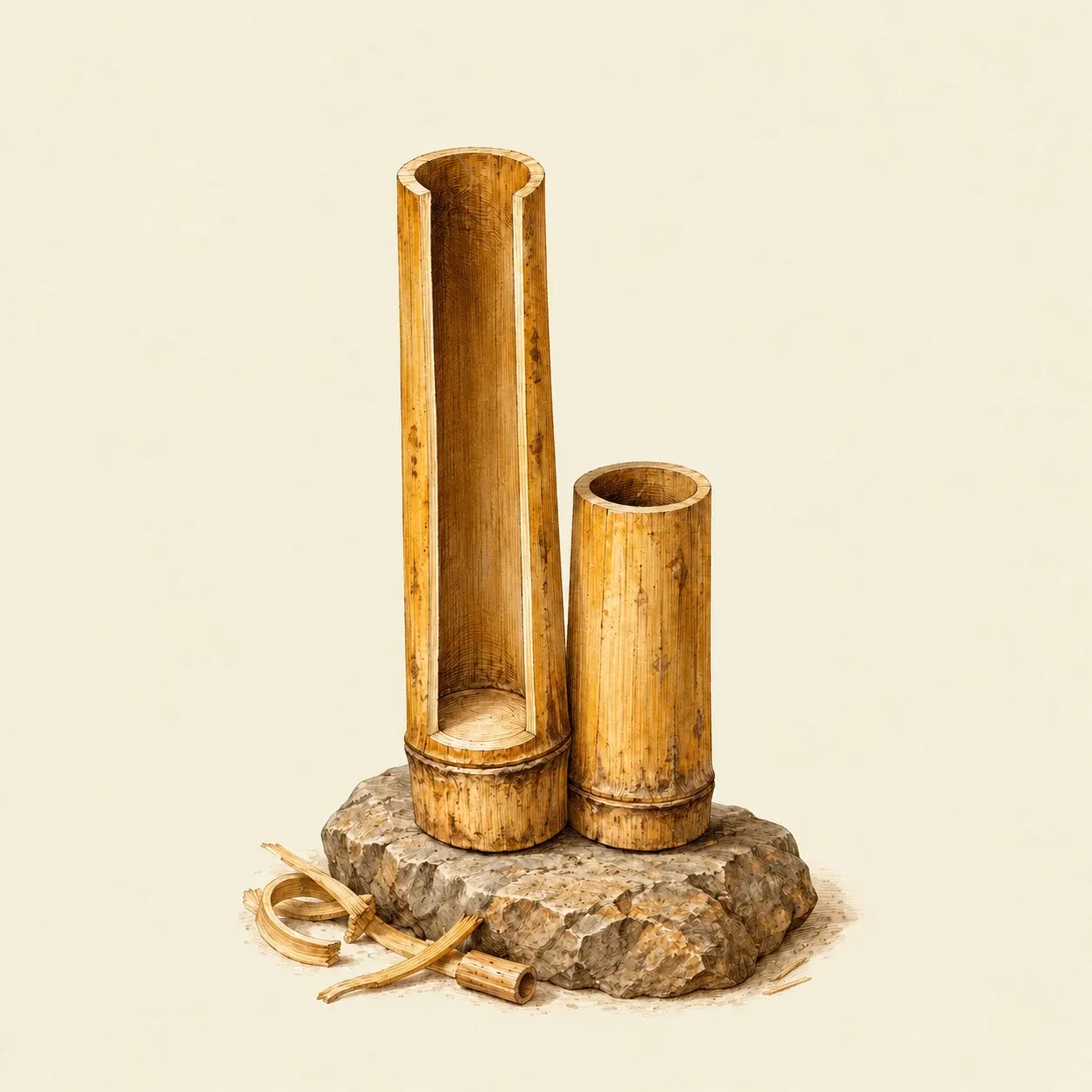 Each air column has its own resonating length.
An open finger hole connects the bore to the outside air. The vibrating air column then ends near that hole, so it is shorter and the note is higher. Closing the hole lets a longer column vibrate and lowers the note. Blowing faster, with a small change in lip position, makes the same column sound its second harmonic, an octave above the fundamental. The breath therefore changes the pitch as well as the loudness.
In panpipes with closed bottoms, the player blows across the open top of a pipe whose far end is sealed. Each pipe holds its own air column, and a longer column gives a lower note. The sealed end changes the resonance. In a pipe closed at one end, the longest wave that fits is about four times the length of the pipe; in a pipe open at both ends, it is about twice the length. A closed pipe therefore sounds roughly an octave below an open flute of the same length. The pipes are bound together in rows or bundles, depending on the tradition, so the lips can move easily from one to the next.
How to do it
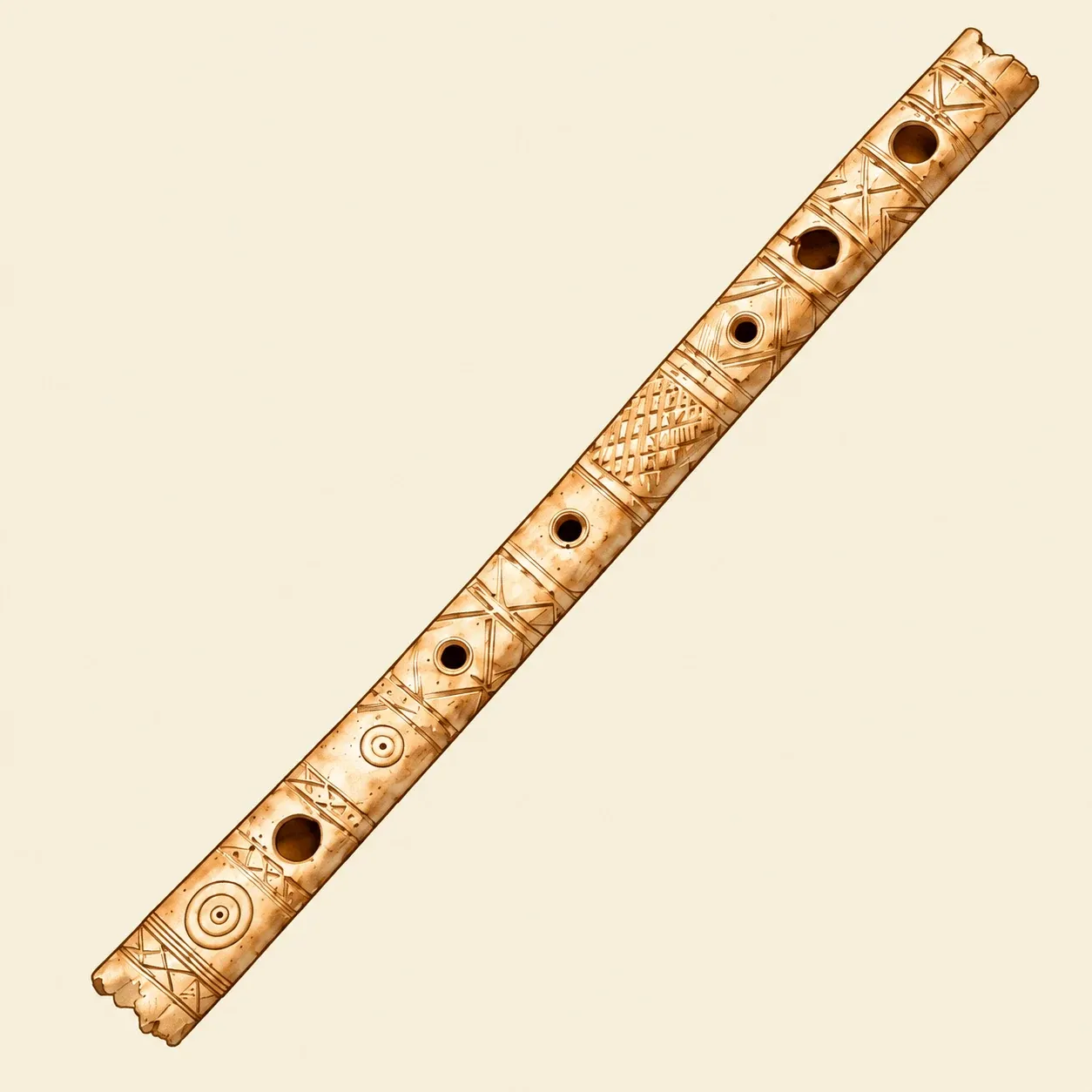 The holes connect the inside of the tube to the surrounding air.
To explore both principles, use commercially made beginner instruments or clean tubes prepared by an instrument maker. In a professional workshop, the maker selects the material and bore, prepares the openings, then adjusts the tuning by testing fingerings and breath. Flute holes cannot simply be spaced evenly. For panpipes, resonating length and bottom closure must be tuned together before assembly.
A teaching set can use commercial tubes already cut and deburred, with securely attached bottoms and flexible bindings. The supplier should confirm that the materials are suitable for contact with the lips. Compare the sound of the separate pipes, then how easily they can be reached when bound together: tuning and binding are different jobs.
Safety and hygiene. Leave cutting, drilling and finishing to an equipped professional. Do not sand or drill bone, bamboo or plastic in an improvised workshop. Do not collect wild animal bones to clean or turn into a mouthpiece. Reject split tubes, sharp edges and small parts that could come loose. Do not use a flame to pierce or seal a tube. Keep an instrument for individual use, follow the manufacturer’s cleaning instructions and let it dry before storage. Stop if playing causes discomfort or dizziness.
History and evolution
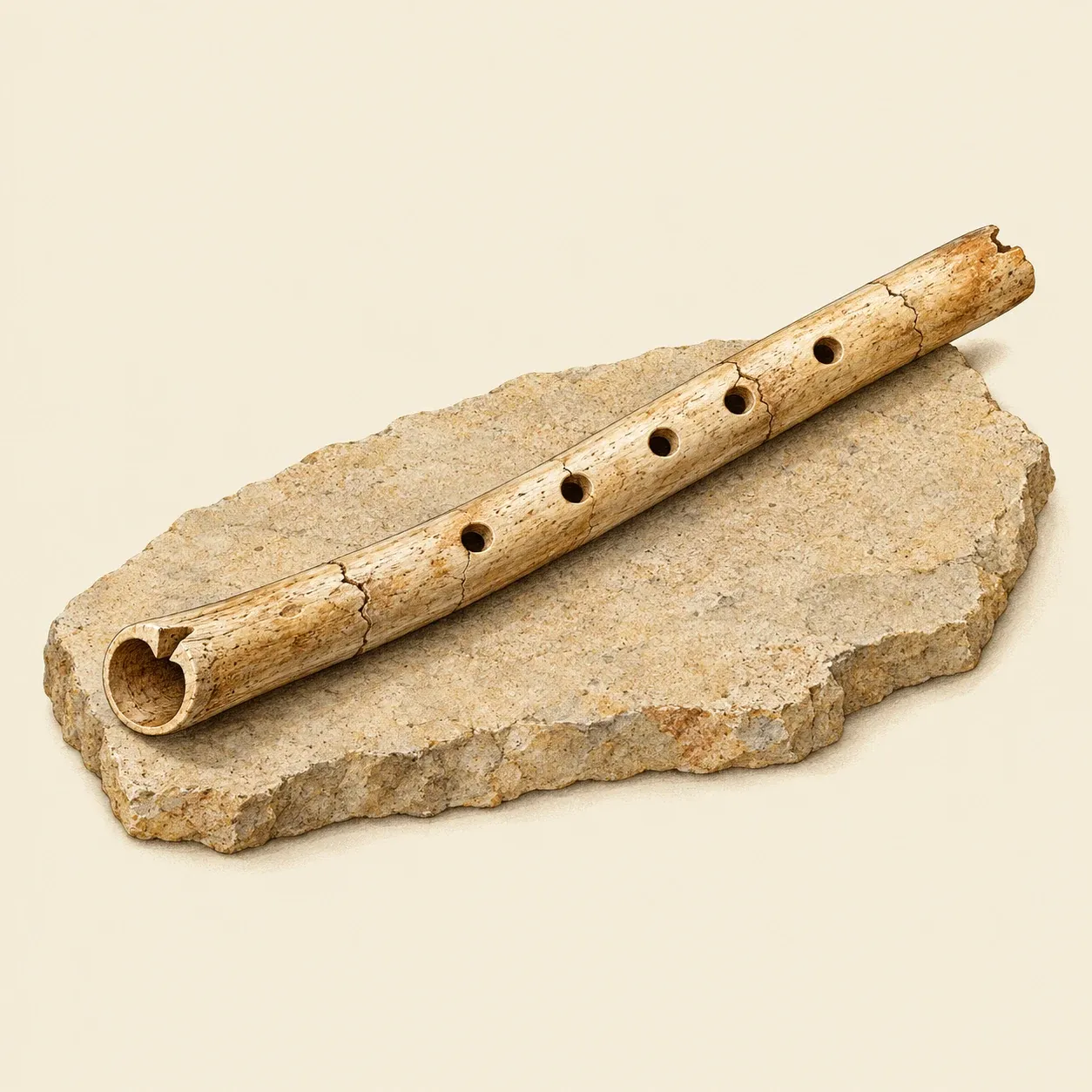 A flute of vulture wing bone that keeps its blowing end and five finger holes.
Aurignacian layers at Geißenklösterle in the Swabian Jura have yielded musical instruments, including flutes of bone and ivory. A study published in 2012 dates the start of the Aurignacian at the site to between 42,000 and 43,000 years ago, and places this group of innovations in the region by about 40,000 years ago. At Hohle Fels, a flute made from a vulture wing bone keeps its blowing end and five finger holes. The surviving part is 21.8 cm long. Its fragments were excavated in 2008.
A possibly older find is disputed: the perforated bone of a cave bear cub from Divje Babe in Slovenia. The National Museum of Slovenia presents it as a 60,000-year-old Neanderthal flute and cites, among other evidence, music played on reconstructions. In a 2015 study, the palaeontologist Cajus Diedrich attributes the holes to hyenas.
A ninth-century bone flute from Nishapur, Iran, is incised with geometric patterns and has holes of different sizes. The Metropolitan Museum of Art holds it under accession number 38.40.239. The same museum holds a putu from the Nggela Islands in the Solomon Islands, made in the late nineteenth century from bamboo pipes bound in a bundle (89.4.802). Today the flute family includes recorders, end-blown flutes and transverse flutes with keys.