Seed Drill
Sowing seed in rows at an even depth
Contents
- 1Shafts for one ox
- 2Seed hopper
- 3Hole leading from the hopper into each leg
- 4Hollow legs
- 5Iron shares that open the furrows
- 6Handles held by the sower
A seed drill opens a narrow furrow, lets seed run into it at a steady rate and leaves it covered, so the crop comes up in straight rows at an even depth. The oldest known is the Mesopotamian seeder plough, a plough fitted with a seed funnel, shown on seals of the third millennium BCE and described in a Sumerian manual copied around 1700 BCE. Chinese farmers pulled a three-legged drill by the first century BCE, and wheel-driven drills appeared in Europe in the seventeenth century.
What it is
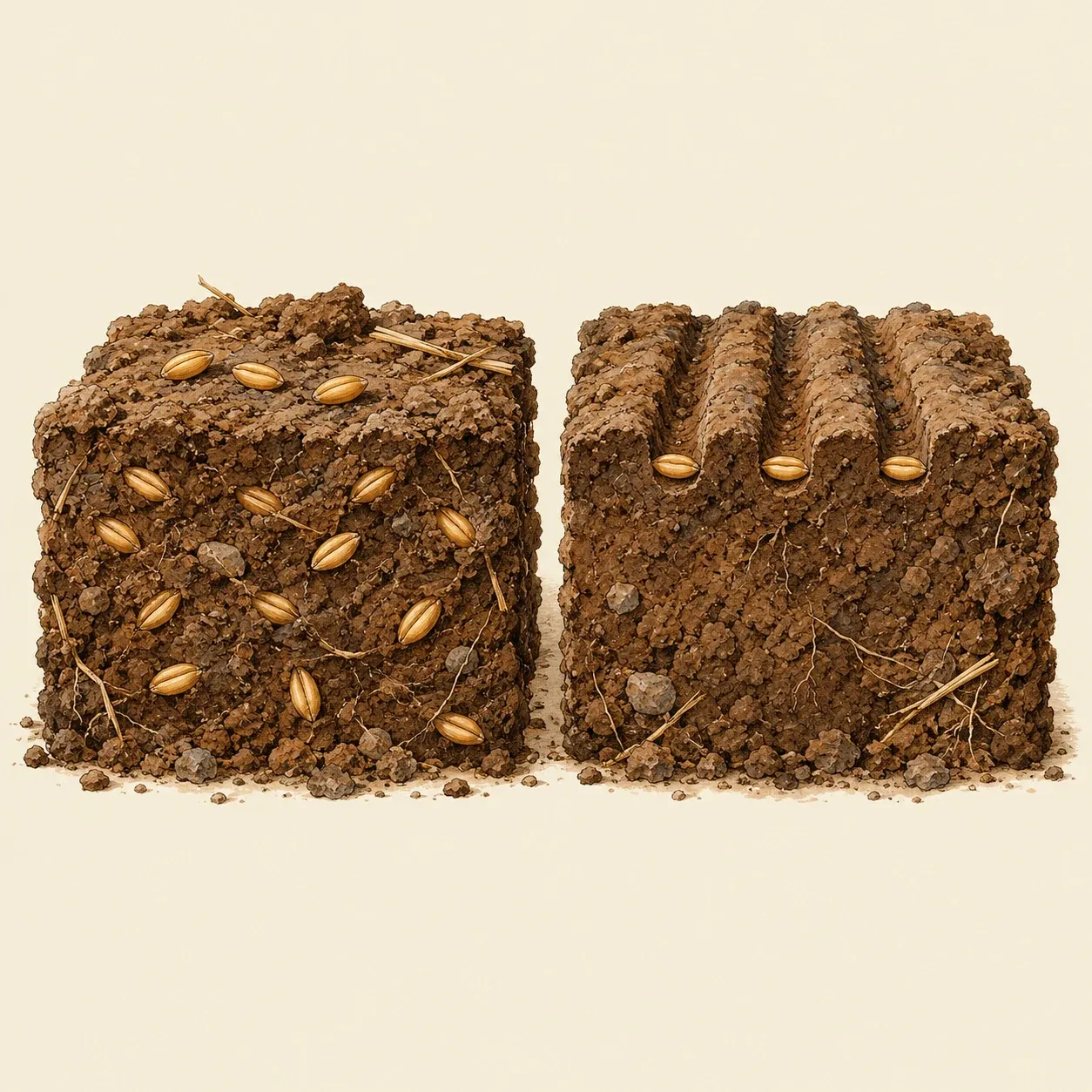 Thrown by hand, seed lands at every depth; drilled, it lies in rows at the same depth.
Sowing by hand means throwing handfuls of seed across the ground. It is quick, but it takes long practice to spread the seed evenly, and the grains end up scattered at every depth: some lie on the surface for the birds, others are buried too deep to come up. A seed drill puts each seed where it should go. It cuts a narrow groove in the soil, the drill, lets seed fall into it at a steady rate and leaves it covered, so the crop rises in straight, parallel rows at the same depth. Rows also leave room to weed between the plants.
The idea has taken three main forms. The Mesopotamian seeder plough was an ordinary plough with a funnel and a tube fixed to it, into which a man dropped the grain by hand. The Chinese drill, called lou, is a wooden frame pulled by one ox, with a seed box in the middle and hollow legs that end in small iron shares. In the European drills of the seventeenth century and after, a wheel rolling on the ground turns a part that measures out the seed.
How it works
Every drill does three things. A share or a small blade opens a groove at a set depth. The seed tube ends just behind it, so the grain drops to the bottom of the groove before the loose soil falls back. Then the groove is closed: by the soil itself, by a light harrow dragged behind, or, in China, by a bundle of brushwood weighted with earth or a pair of stone rollers that press the soil onto the seed. In Mesopotamia the seed was covered by ploughing a second time across the furrows.
The hard part is the flow of seed. On the seeder plough it depended on the man pouring grain into the funnel, and the Sumerian manual tells the farmer to keep an eye on him. The Chinese drill relies on gravity: the grain runs from the seed box through a hole into each hollow leg, and the man holding the handles shakes the drill as he walks to keep it flowing, as Wang Zhen describes in 1313.
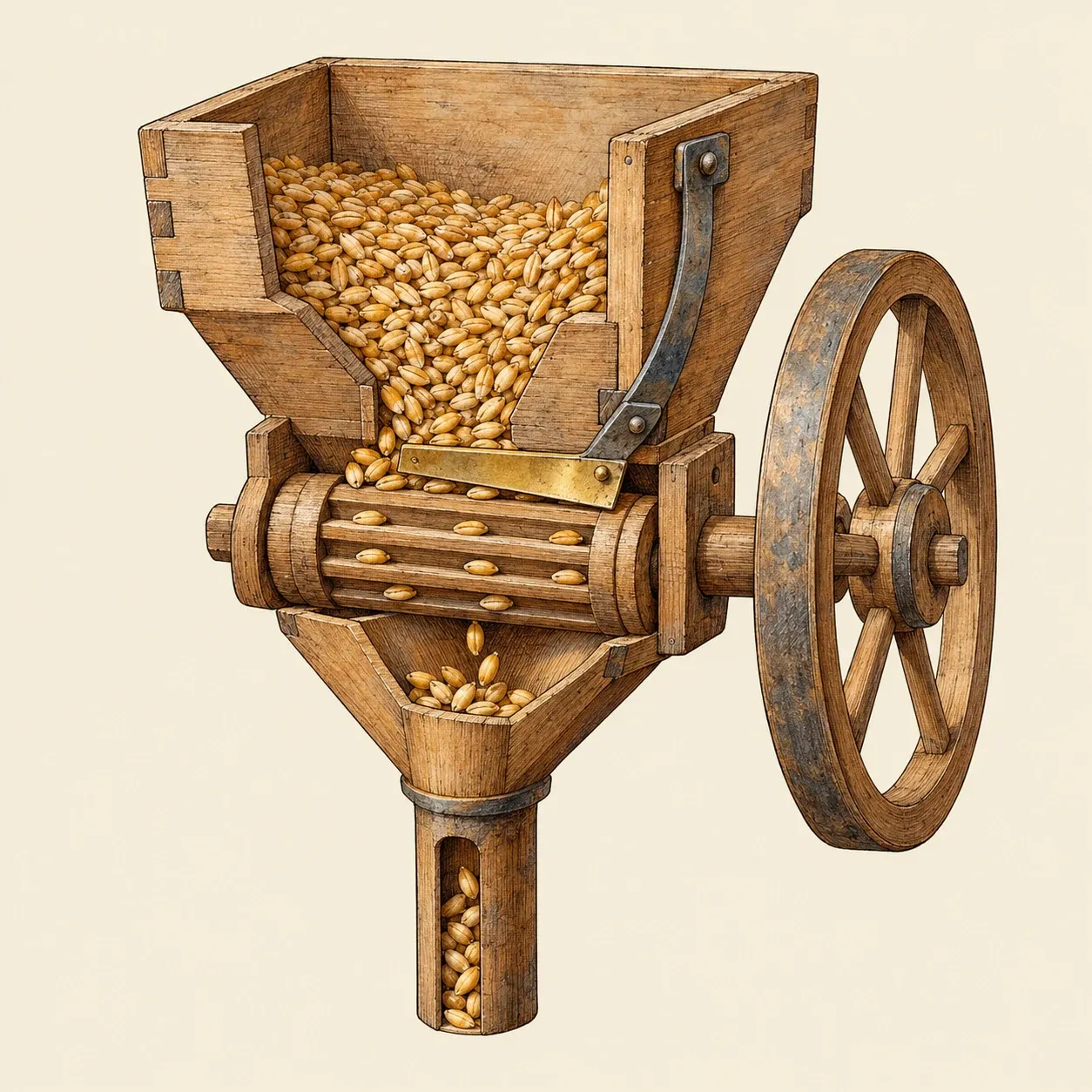 A grooved roller feed: each groove carries the same small load of seed from the box to the funnel as the wheel turns.
European drills measure the seed mechanically. A shaft turned by the ground wheels runs under the seed box and carries something that picks up a fixed amount of seed at each turn: small spoons in Joseph Locatelli’s drill of the 1660s, grooves cut along the axle in Jethro Tull’s drill of 1701, disks rimmed with little cups in the nineteenth-century cup-feed drill. Tull took the idea of a groove with a tongue pressed on it by a spring from the soundboard of an organ. The tongue wipes off the extra seed, so each groove delivers the same load. Since the feed turns with the wheels, the drill puts down the same amount of seed for each metre travelled, whether the horse walks fast or slowly.
How to do it
A tabletop model shows how a roller feed measures seed. Make a small open box of thin plywood with a sloping floor that leads to a slot. Below the slot, run a hardwood dowel across the box through two holes in its sides, so that it turns freely and closes the slot from underneath. Cut four or five shallow grooves along the dowel where it passes under the slot, each wide enough to hold two or three peas. Fix a strip of felt or soft leather to the box so that it rests on the dowel along the outer edge of the slot: it plays the part of Tull’s tongue and wipes off the extra seed. Glue a wooden wheel to one end of the dowel, and under the dowel fit a funnel made from card that leads into a short tube.
Fill the box with dried peas or beans and roll the model slowly along a table, the wheel turning the dowel. Each groove fills under the box, carries its seeds round and drops them into the funnel, and a strip of paper laid under the tube shows them falling in a row. Count the seeds for ten turns of the wheel, then roll faster and count again: the number per turn stays the same. Deeper or wider grooves sow more thickly.
Safety. Clamp the work before sawing, drilling or cutting the grooves, cut away from your hand with the knife or chisel, and supervise children. Seed sold for farming or gardening is often coated with a fungicide or an insecticide, usually coloured: use plain dried peas or beans from the kitchen for the model, and if you handle coated seed, wear gloves, keep it away from children and animals and never eat it.
History and evolution
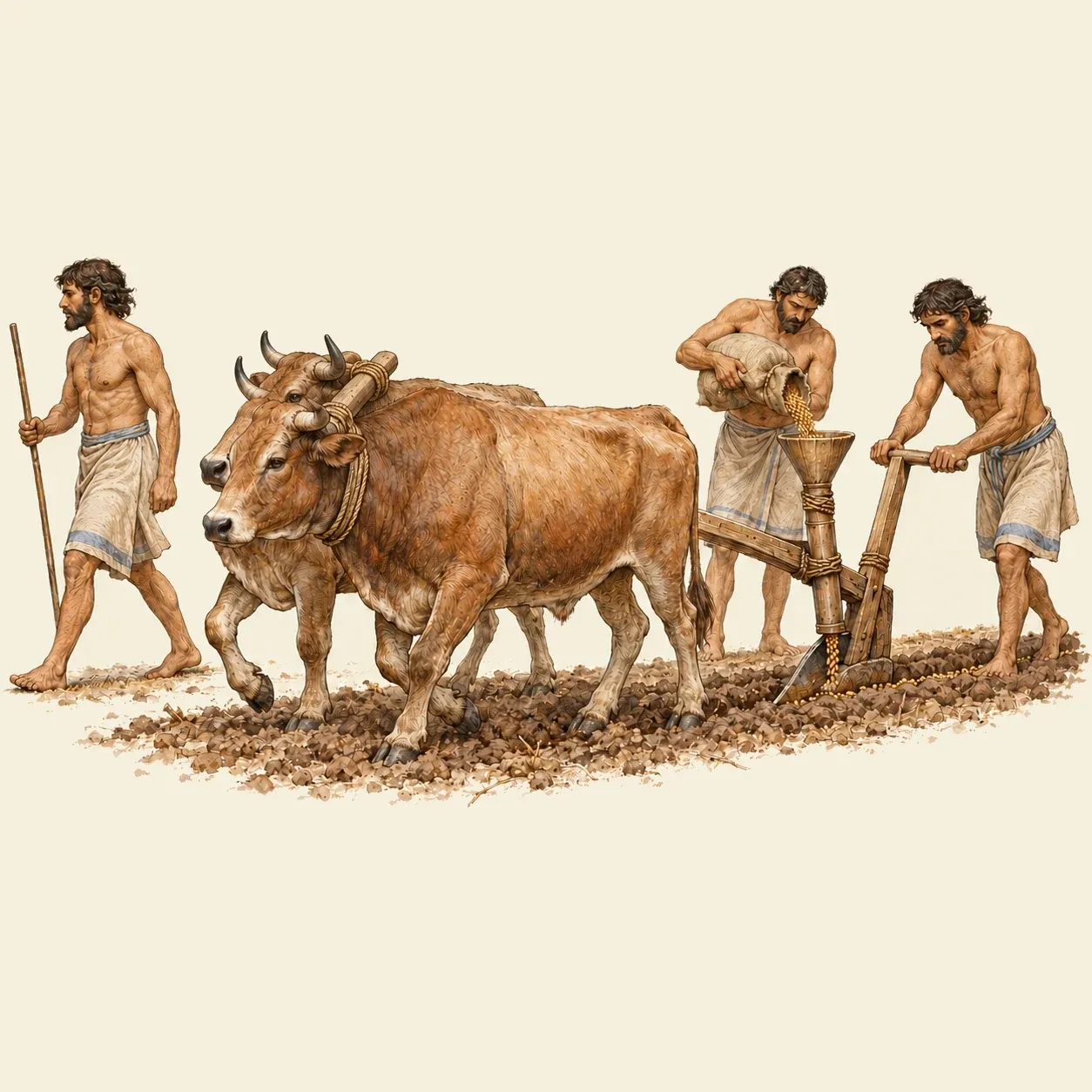 A Mesopotamian seeder plough: the grain poured into the funnel runs down the tube into the furrow behind the share.
The oldest evidence comes from Mesopotamian seals. Daniel Potts cites several seals of the Early Dynastic period, which ended around 2350 BCE, carved with a seeder plough, and the British Museum lists a seed plough among the figures on an Akkadian seal dated 2400 to 2200 BCE. Working such a plough took two or three men: one to drive the oxen, one to drop the seed and one to turn the team. The fullest early description is Sumerian. The Farmer’s Instructions, a manual known from tablets of the Old Babylonian period found at Nippur and Ur, about 1900 to 1600 BCE, tells the farmer to keep the seeder plough properly adjusted and to watch the man who drops the seed: the grain must fall two fingers deep, with eight furrows to every ninda of width, about six metres. Seal impressions on tablets from Nippur of the fifteenth and fourteenth centuries BCE show the same implement at work: a plough drawn by oxen, with a seed funnel fixed to it.
In China, the Han history records that late in the reign of Emperor Wu, who died in 87 BCE, the official Zhao Guo was put in charge of grain and taught a new way of farming with ingenious implements for ploughing, weeding and sowing. Cui Shi, writing in the second century CE, explains that with Zhao Guo’s method one ox pulled three shares while a single man guided it and sowed at the same time, and that it sowed a hundred mu in a day, where farmers in Liaodong needed two oxen and six men to sow twenty-five. In the sixth century Jia Sixie identified those three shares with the three-legged drill of his own day, and mentioned one- and two-legged drills too. Wang Zhen’s treatise of 1313 describes the drill in detail: two shafts for one ox, a seed box in the middle of the frame feeding a hole in each hollow leg, one man leading the ox and another holding the drill. He also mentions four-legged drills, and a newer model that dropped fine manure with the seed.
In Europe, Joseph Locatelli built a sowing plough in the Austrian lands in the 1660s; the Neue Deutsche Biographie gives 1663, the 1911 Encyclopaedia Britannica 1662. A wooden seed box hung from the handles behind the share, and an axle fitted with small spoons, turned by a wheel at the side, dropped the seed through rows of holes. After trials on the imperial estate of Laxenburg, Emperor Leopold I granted him a monopoly. The machine went on to Spain as the Sembrador, and an English translation of its description reached the Royal Society in London in 1670.
Jethro Tull designed his drill in England in 1701. Pulled by a horse, it sowed three rows of wheat: a share at the front of each row opened a channel, the grooved axle under each hopper let the seed through at even intervals, and a harrow at the back covered it. Tull sowed in rows so that a horse-drawn hoe could weed between them, and he set out his method in The New Horse-Houghing Husbandry in 1731, then in Horse-Hoeing Husbandry in 1733. According to the Neue Deutsche Biographie, one of Locatelli’s machines reached England, and the historian G. Fischer held that it inspired Tull.
Nineteenth-century drills were long boxes on wheels with a row of tubes, fed by cups or by fluted wheels turning in the bottom of the hopper. Firms such as James Smyth and Sons, founded in 1801 at Peasenhall in Suffolk, built horse drills whose furrow openers could be set at different spacings. The Food Museum in Stowmarket keeps one of their drills made around 1911.